Analysis of Pre-Death Relationship Closure Decisions under Parental Economic and Emotional Dependence Reversal
把这篇文章落到自己身上验证:先看结构,再进入个人分析,不做泛泛阅读。
Why This Decision Is Especially Difficult in This Scenario
The reversal relationship where parents depend economically and emotionally on their children often leads to severely blurred family boundaries. Children not only bear the pressure of financial support but also face excessive emotional dependence from their parents. This dynamic easily triggers disagreements between spouses because the needs of the partner's family often conflict with the expectations of the original family, creating a squeeze on the children's own family and even the risk of long-term depletion.
From a psychological perspective, the dependent and dependent-on relationship easily forms emotional blackmail and guilt, making it difficult for children to find a balance between filial affection and self-needs. Under cultural expectations, traditional values of respecting elders and loving the young further reinforce this continuous economic and emotional supply, increasing psychological resistance to cutting or adjusting the relationship.
From a BaZi perspective, the structure of the Four Pillars reflects the distribution of individual power and coping strategies in family relationships through the strength of the Day Master, the positioning of the Yong Shen (favorable element), and Ji Shen (unfavorable element). For example, the Yin stars (印星, Zheng Yin/Pian Yin) represent parental support, Guan Sha (官杀, Zheng Guan/Qi Sha) imply authority pressure, Bi Jian/Jie Cai (比肩/劫财) symbolize peers or competition, and Cai stars (财星, Pian Cai/Zheng Cai) relate to material resources. The current Da Yun (decade luck cycle) and Liu Nian (annual fortune) interactions reveal the rhythm and energy flow of individual pressure endurance and relationship adjustment.
Therefore, in scenarios where parents depend on children economically and emotionally in a reversed manner, pre-death relationship closure decisions involve multiple emotional and economic negotiations and are influenced by BaZi rhythms. Correctly identifying the windows and potential costs of reconciliation, farewell, and forgiveness is an important premise for rational action and psychological healing.
Three Core Dimensions of BaZi Judgment
The strength of the Day Master is the foundation for determining an individual's energy resources and resistance. A relatively strong Day Master usually has strong self-direction but may also show stubbornness or resistance to change. A relatively weak Day Master may be passive in family relationships, easily influenced by emotional or economic pressures, and requires the Yong Shen to balance.
The configuration of Yong Shen (favorable element) and Ji Shen (unfavorable element) reveals the key forces of harmony or conflict. Yin stars typically represent parental support and influence; if Yin stars are strong, parental dependence may be more obvious. Bi Jian/Jie Cai stars reflect peer or competitive relationships, possibly intensifying internal family conflicts or resource struggles. Guan Sha stars symbolize authority and pressure, reminding children to be aware of authority dynamics and potential emotional blackmail when handling parental relationships.
Da Yun and Liu Nian represent dynamic time rhythms, reflecting the ups and downs and adjustment windows of BaZi energy. A stable and auspicious Da Yun often corresponds to relationship maintenance and easing, while Liu Nian may bring sudden changes or opportunities. In the relationship closure of parental dependence on children, recognizing the interaction of Da Yun and Liu Nian helps judge when it is suitable to promote reconciliation, farewell, or forgiveness, and when to wait or adjust strategies.
Three Real Natal Chart Cases
Case 1: Female, 40-45 years old, Day Master Geng Metal (庚, Geng) relatively strong, Yang Ren (羊刃) pattern, Yong Shen Metal, Ji Shen Earth, currently in Wu Shen (戊申) Da Yun, Bing Wu (丙午) Liu Nian. This chart shows a strong Day Master with Yang Ren pattern, indicating a strong will but possible emotional volatility. Metal as Yong Shen strengthens self-protection. The Wu Shen Da Yun is stable, suitable for maintaining status quo, while the Bing Wu Liu Nian requires adaptability. In family struggles with parental economic and emotional dependence reversal, this structure tends to increase the individual's responsibility pressure, while Ji Shen Earth warns against excessive boundary invasion within the family. In pre-death relationship closure decisions, the impact of the Yang Ren pattern may amplify conflicts, but the stability of Wu Shen Da Yun offers an easing opportunity. It is recommended to prioritize assessing personal boundary feelings, combine with professional psychological counseling, and steadily advance reasonable emotional and economic boundary setting to avoid irreversible emotional outbursts.
Case 2: Male, 25-30 years old, Day Master Geng Metal relatively weak, Qi Sha (七杀) pattern, Yong Shen Fire, Ji Shen Water and Wood, currently in Ji Wei (己未) Da Yun, Bing Wu (丙午) Liu Nian. The Qi Sha pattern represents strong external pressure and challenges; a weak Day Master reflects a passive position in the family. Yong Shen Fire helps stimulate internal motivation to resist pressure, but Ji Shen Water and Wood warn against emotional and environmental interference. In parental economic and emotional dependence reversal, the Qi Sha pattern may cause the individual to feel dual oppression from authority and responsibility, especially during pre-death relationship closure, where pressure can catalyze action or trigger conflict. The stability of Ji Wei Da Yun and the adaptability of Bing Wu Liu Nian suggest careful timing in action to avoid emotional impulsiveness damaging relationships. It is advised to first manage emotions and analyze family dynamics, combined with family therapy, to gradually explore paths of reconciliation or farewell, reducing long-term psychological trauma.
Case 3: Female, 30-35 years old, Day Master Wu Earth (戊, Wu) relatively weak, Zheng Cai (正财) pattern, Yong Shen Fire, Ji Shen Metal and Water, currently in Ding Mao (丁卯) Da Yun, Bing Wu (丙午) Liu Nian. The Zheng Cai pattern indicates the individual undertakes considerable material and emotional support responsibilities in the family; the weak Day Master requires Yong Shen Fire to balance energy. Ji Shen Metal and Water warn of potential emotional and material losses. The Ding Mao Da Yun is auspicious, with smooth career and financial progress, and the Liu Nian aligns with this trend, favorable for relationship adjustment and closure. Under parental economic and emotional dependence reversal, this chart reflects a heavy burden but potential to resolve difficulties through adjustment and self-growth. Pre-death relationship closure decisions can leverage the favorable Ding Mao Da Yun period, combined with psychological counseling and family therapy, to actively promote emotional forgiveness and farewell, reduce costs, and improve relationship quality and self-healing capacity.
Common Misjudgments and Blind Spots in This Scenario
Firstly, a common misjudgment is treating BaZi results as fate determinism, ignoring that BaZi is only an auxiliary tool for rhythm judgment and cannot replace psychological counseling or family therapy. The economic and emotional dependence of parents on children is essentially a complex psychological and social issue that BaZi alone cannot fully resolve.
Secondly, emotional blackmail and long-term depletion are often misunderstood as inevitable expressions of filial affection, causing children to struggle to set reasonable boundaries and neglect their own and their partner’s needs and feelings. This blind spot easily worsens relationships and intensifies original family trauma.
Thirdly, rushing reconciliation or farewell decisions without considering the influence of Da Yun and Liu Nian rhythms may lead to emotional outbursts or relationship breakdowns at inopportune times. Correct identification and use of BaZi rhythms help adjust at suitable moments, avoiding excessive costs.
Finally, ignoring partner opinions and the reality of one’s own family being squeezed leads to isolation and underestimation of family dynamics complexity, resulting in imbalanced subsequent decisions.
Practical Judgment Sequence
Step one: Conduct a comprehensive investigation of family boundaries and the current state of emotional and economic supply, identifying partner opinions, the bearing capacity of one’s own family, and specific manifestations of parental dependence. Combine this with the Day Master’s strength, Yong Shen and Ji Shen, and Da Yun/Liu Nian rhythms to evaluate current pressure points and adjustment windows in the relationship.
Step two: Under professional psychological counseling and family therapy support, gradually explore possible paths of reconciliation, farewell, and forgiveness. Pay attention to the interaction of Da Yun and Liu Nian indicated by BaZi; avoid rushing actions during periods of excessive Ji Shen or unfavorable Da Yun, and choose times when emotions are relatively stable and resources are sufficient to advance.
Step three: Timely adjust the boundaries of economic and emotional supply, strengthen self-protection, and respect the needs of the partner and one’s own family. Utilize stable or auspicious Da Yun and Liu Nian periods in BaZi to implement relationship closure, preventing long-term depletion and ongoing trauma and negative cycles.
FAQ
Question 1: Can BaZi determine the specific degree of parental dependence on children? Answer: BaZi reflects an individual’s energy relationships and support structures in the family through the combination of the Day Master with Yin stars (印星), Bi Jian/Jie Cai, and Cai stars (财星), but the specific degree requires integration with real family conditions and psychological assessments. BaZi provides only a rhythm reference.
Question 2: What BaZi warning signs indicate emotional blackmail caused by parental dependence? Answer: Pressure from Guan Sha stars, the manifestation of Ji Shen, and clash combinations in Da Yun and Liu Nian may signal risks of authority pressure and emotional blackmail. When encountering such signals, professional psychological intervention should be combined, avoiding major decisions based solely on BaZi.
Question 3: How to combine BaZi and psychological counseling in pre-death relationship closure? Answer: BaZi helps identify suitable timing and potential risks for adjustment, while psychological counseling assists in handling emotions and boundary issues. Together, they enable rational planning of reconciliation, farewell, and forgiveness processes, reducing the risk of relationship breakdown and psychological trauma.
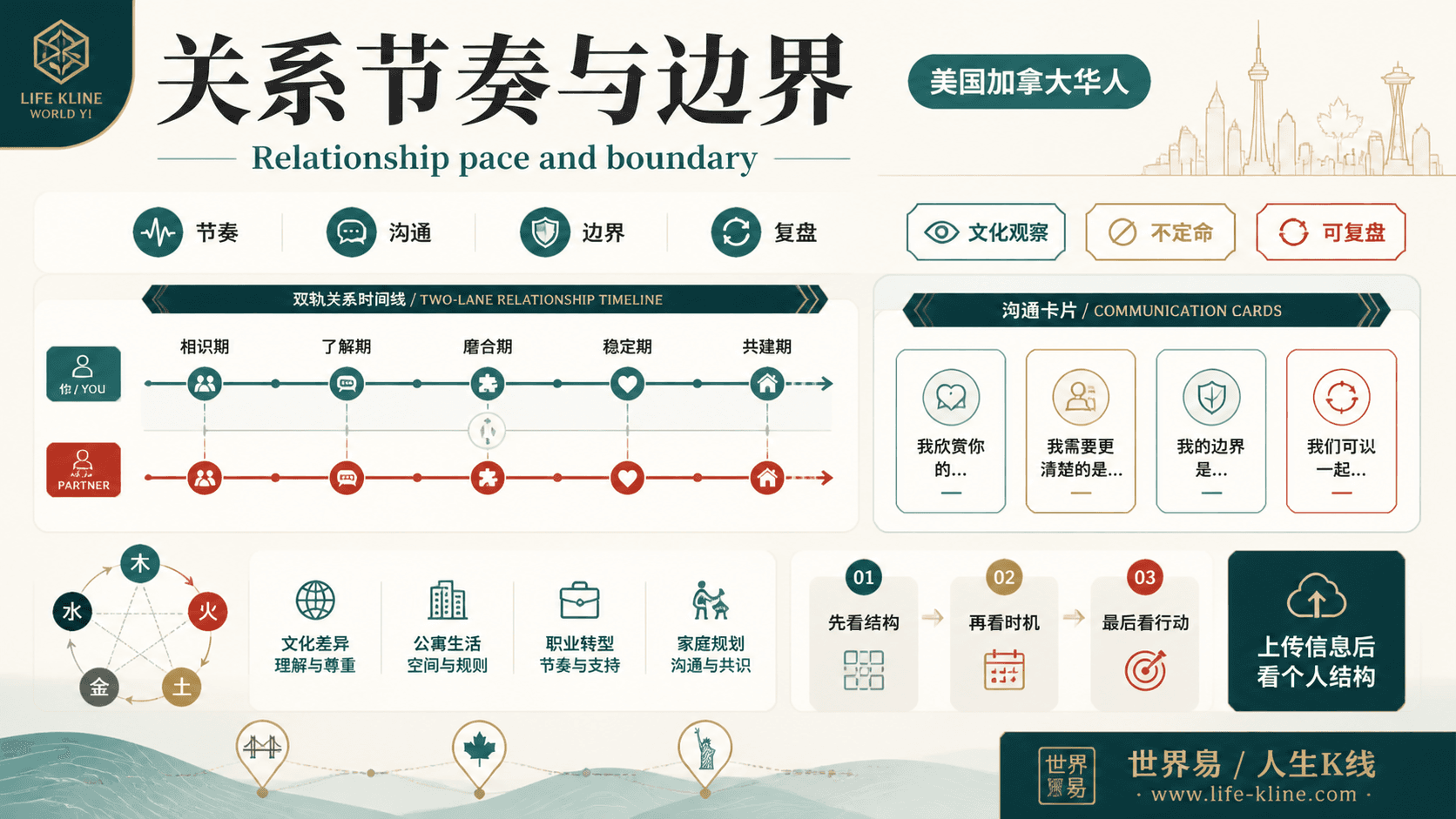
关系节奏与边界|美国加拿大华人
这张图把《Analysis of Pre-Death Relationship Closure Decisions under Parental Economic and Emotional Dependence Reversal》里的命理概念转成关系、边界和应用场景,适合先看图建立结构,再回到知识文章正文理解细节。
关系节奏与边界不应被写成固定结论。更适合美国加拿大华人的读法,是把传统术语翻译成结构、时机、环境、行动和复盘。
查看图片解读