Metaphysical Decision Reference for Optimal Start and Expansion Rhythm in Catering Entrepreneurship
把这篇文章落到自己身上验证:先看结构,再进入个人分析,不做泛泛阅读。
Why This Decision Is Especially Difficult in This Industry
The catering industry, especially the model combining dine-in and delivery, faces high operating costs mainly reflected in rent, labor, and food wastage, all of which are fixed expenses that cannot be easily reduced. High rent requires site selection to balance foot traffic and cost, while customer repurchase models are influenced by brand recognition and service experience. The relatively weak brand moat leads to extremely fierce market competition.
When deciding on the optimal start and expansion rhythm, entrepreneurs often fall into impulsiveness and anxiety, eager to scale quickly or raise funds rapidly, neglecting the capacity of the cash flow and the market feedback cycle. This psychological bias easily leads to blind expansion, increasing operational risks.
From a metaphysical perspective, catering entrepreneurship is particularly sensitive to the combinations of Cai Xing (Wealth Stars), Bi Jian (Peer Stars), Guan Sha (Officer and Seven Killings), and Yin Xing (Resource Stars). Cai Xing relates to capital inflow and customer resources; Bi Jian reflects partnership and team support; Guan Sha indicates external pressure and policy environment; Yin Xing is associated with resource integration and learning ability. When Da Yun and Liu Nian harmonize with the Yong Shen (favorable element), they bring opportunities for smooth expansion; otherwise, it is advisable to maintain and observe cautiously.
Therefore, decisions on starting and expanding in catering entrepreneurship must find a dynamic balance among operating structure, psychological rhythm, and metaphysical cycles, avoiding misjudgment from a single dimension and improving financing and store opening success rates.
Three Core Dimensions of Metaphysical Judgment
First, the relationship between the Day Master and Cai Xing (Wealth Stars) is key. The Day Master represents the entrepreneur’s own energy and resource-bearing capacity, while Cai Xing corresponds to capital and customer resources. For the catering industry, a strong Cai Xing that is mutually supportive with the Day Master indicates relatively smooth financing and customer accumulation. Conversely, if Cai Xing is restricted or insufficient, careful evaluation of cash flow stability is needed.
Second, Bi Jian (Peer Stars) and partnership relations affect team collaboration and resource sharing. A flourishing Bi Jian can help the team work together to overcome challenges, but if overly strong, it may cause internal conflicts. In partnership entrepreneurship, balancing Bi Jian and Yin Xing (Resource Stars) is particularly important; Yin Xing represents learning and organizational resources, which can alleviate conflicts caused by excessive Bi Jian, forming a stable operational foundation.
Finally, Guan Sha (Officer and Seven Killings) and pressure regulate the entrepreneurial rhythm. Guan Sha represents external pressure, policies, regulations, and market competition. If the Guan Sha pattern is reasonable, it indicates the entrepreneur can effectively respond to external challenges and seize policy dividends. The conflict and harmony states of Guan Sha in Liu Nian and Da Yun directly affect the choice of expansion rhythm, serving as a key reference for whether to be aggressive or conservative.
Integrating Da Yun and Liu Nian interactions, if the Yong Shen (Water) is supported and Da Yun and Liu Nian are harmonious, it represents smooth capital and resource circulation, suitable for active store opening and financing expansion; otherwise, steady progress with strengthened internal management and brand building is advisable.
Three Real BaZi Chart Cases
Case 1: This chart has a slightly weak Jia (甲, Jia) Wood Day Master, with a Qi Sha (Seven Killings) pattern. The Yong Shen is Water, and the Ji Shen (unfavorable elements) are Fire and Earth. Currently in the Yi Mao (乙卯, Yi Mao) Da Yun (ages 44-53), a stable period suitable for maintaining achievements, with Liu Nian Bing Wu (丙午). The slightly weak Jia Wood Day Master implies limited resource-bearing capacity; the Qi Sha pattern indicates significant pressure and challenges. Water as the Yong Shen helps regulate the negative influence of Fire and Earth Ji Shen. In catering entrepreneurship, facing pressures from high rent and labor costs, the entrepreneur should start cautiously and avoid blind expansion. The Yi Mao Da Yun brings a stable environment, favoring maintenance rather than aggressive expansion. Although the Bing Wu Liu Nian brings some variability, the stable Da Yun suggests adjusting strategies based on market feedback rather than large-scale financing. Recommended judgment sequence: first assess cash flow stability and labor cost control to ensure steady operation of existing stores, then decide whether to moderately open new stores based on Liu Nian resource conditions, combining financial due diligence and market validation for gradual advancement.
Case 2: This chart has a slightly weak Yi (乙, Yi) Wood Day Master, with a Zheng Cai (Proper Wealth) pattern. The Yong Shen is Water, and Ji Shen are Fire and Earth. Currently in the Xin Chou (辛丑, Xin Chou) Da Yun (ages 26-35), a stable period suitable for maintaining achievements, with Liu Nian Bing Wu (丙午). The slightly weak Yi Wood and Zheng Cai pattern emphasize the importance of capital flow; Water as Yong Shen mitigates the adverse effects of Fire and Earth Ji Shen. During the Xin Chou Da Yun, the overall situation is stable. The entrepreneur faces dual pressures of high rent and a weak brand moat; success in financing depends on customer repurchase rates and brand reputation accumulation. The Bing Wu Liu Nian offers opportunities for adaptive responses but overall requires steady development. Expansion rhythm should focus on consolidating the existing customer base, avoiding overly rapid new store openings that cause cash flow strain. Recommended judgment sequence: focus on examining customer repurchase models and cash flow status, combined with financial and market research; leverage Liu Nian opportunities to optimize menu and service experience, steadily enhancing brand influence; consider expansion only after cash flow stabilizes.
Case 3: This chart has a balanced Jia (甲, Jia) Wood Day Master, with a Zheng Yin (Proper Resource) pattern. The Yong Shen is Water, and Ji Shen is Metal. Currently in the Ji Si (己巳, Ji Si) Da Yun (ages 34-43), a stable period suitable for maintaining achievements, with Liu Nian Bing Wu (丙午). The balanced Jia Wood Day Master has good resource-bearing capacity; the Zheng Yin pattern benefits learning and resource integration, with Water Yong Shen helping harmonize the adverse effects of Metal Ji Shen. The entrepreneur in the catering industry, facing challenges of location traffic and a weak brand moat, can leverage Yin Xing advantages to optimize internal management and team building. The Ji Si Da Yun is stable, conducive to maintenance and steady expansion. The Bing Wu Liu Nian brings some market fluctuations, suitable for cautiously managing the store opening rhythm. Recommended judgment sequence: prioritize evaluating team collaboration and supply chain stability; combine market research to identify potential store locations; reasonably arrange expansion rhythm to avoid cash flow disruption; coordinate financial due diligence to ensure safe expansion funding sources.
These three cases all reflect the commonality of stable Da Yun favoring maintenance. Although the Bing Wu Liu Nian introduces variability, flexible responses should be based on the relationships between Yong Shen and Ji Shen. The optimal expansion rhythm in catering entrepreneurship should prioritize steadiness, using metaphysical cycles to assist in seizing market opportunities.
Common Misjudgments and Blind Spots in This Industry
A common misjudgment among catering entrepreneurs is over-reliance on short-term market feedback and capital input, neglecting the long-term pressures of high rent and labor costs, leading to cash flow tightness. When Cai Xing is weak or Yong Shen insufficient in the metaphysical chart, blind expansion amplifies risks and accelerates capital depletion.
Another blind spot is ignoring the importance of internal team collaboration and resource integration. Excessive Bi Jian or insufficient Yin Xing causes internal conflicts or irrational resource allocation, affecting operational efficiency. The balance of Yin Xing in the metaphysical structure directly impacts the enterprise’s ability to cope with pressure and innovate.
Additionally, entrepreneurs often overlook external environmental pressures represented by Guan Sha, such as policy changes and intense market competition. Failure to fully consider the conflict and harmony states of Guan Sha in Liu Nian can cause expansion rhythms to clash with the environment, increasing operational uncertainty.
In summary, catering entrepreneurship requires attention not only to capital and market but also to the rhythms of Yong Shen and Ji Shen in metaphysics, warning against blind expansion and neglect of team and external pressure misjudgments.
Practical Judgment Sequence
Step one: Examine financial status and Yong Shen condition. Combining the strength of Cai Xing and Yong Shen (Water) in metaphysics, evaluate cash flow stability and financing potential. If Yong Shen is strong and Cai Xing supportive, capital circulation is smooth, suitable for active expansion; otherwise, strengthen financial management and risk control.
Step two: Analyze team cooperation and resource integration. Through the combination of Bi Jian and Yin Xing, judge internal conflicts and support levels. Reasonable Bi Jian and strong Yin Xing indicate smooth team collaboration, beneficial for controlling expansion rhythm. If Bi Jian is excessive or Yin Xing insufficient, optimize internal management and consolidate the team first.
Step three: Focus on the interaction of Guan Sha with Liu Nian and Da Yun to assess external environmental pressure. Reasonable Guan Sha supported by Liu Nian and Da Yun indicates favorable policies and market environment for expansion. If Guan Sha is conflicted or Da Yun unfavorable, maintain caution, avoid blind financing and rapid store openings, and wait for the right timing.
Overall, the optimal expansion rhythm in catering entrepreneurship should integrate metaphysical cycles with commercial due diligence and financial analysis, dynamically adjusting strategies to avoid being overly conservative or rash.
FAQ
Question 1: When is it suitable to rapidly expand in catering entrepreneurship? Answer: According to metaphysical judgment, when the Yong Shen (Water) is supported in Da Yun and Liu Nian, Cai Xing is strong, and Bi Jian and Yin Xing are balanced, with moderate external Guan Sha pressure, capital circulation is smooth and team support is good, suitable for active expansion. However, decisions should still be made cautiously with financial due diligence and market feedback.
Question 2: How to manage entrepreneurial risks if the chart has many Ji Shen? Answer: When there are many Ji Shen (such as Fire, Earth, or Metal), indicating a challenging operating environment or internal and external pressures, the focus should be on maintenance, strengthening internal management, optimizing cost structure, and consolidating the customer base. Avoid aggressive financing and rapid expansion. Meanwhile, use the Yong Shen to harmonize Ji Shen and seek suitable market entry points.
Question 3: What is the impact of the Bing Wu (丙午) Liu Nian on catering entrepreneurship? Answer: The Bing Wu Liu Nian brings certain market fluctuations and opportunities for adaptive responses. For charts with stable Da Yun, it is a good time to adjust and optimize operations but not to advance blindly. Entrepreneurs should flexibly adjust the start and expansion rhythm based on financial status and market changes to avoid cash flow disruptions caused by Liu Nian volatility.
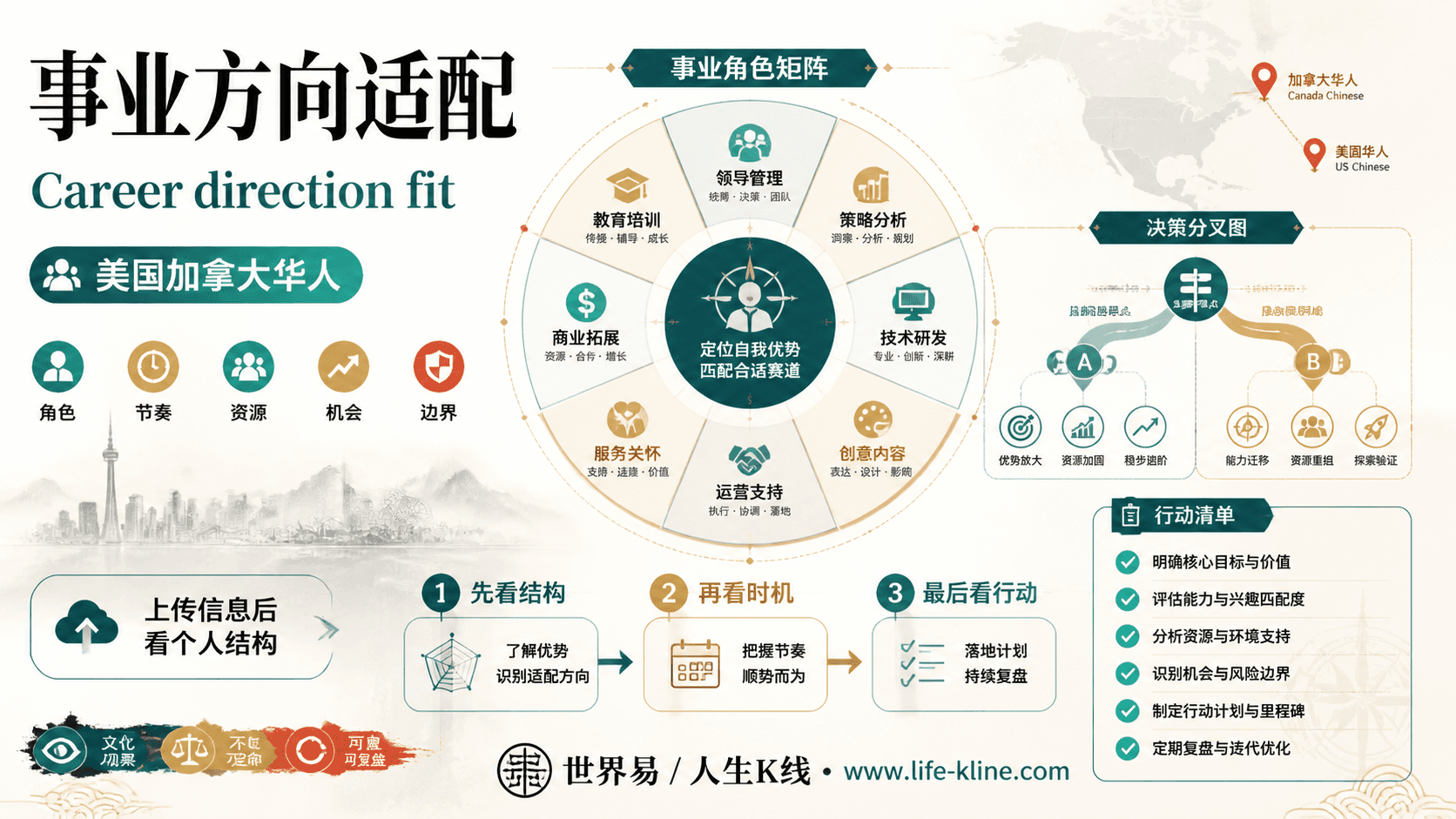
事业方向适配|美国加拿大华人
这张图把《Metaphysical Decision Reference for Optimal Start and Expansion Rhythm in Catering Entrepreneurship》里的命理概念转成关系、边界和应用场景,适合先看图建立结构,再回到知识文章正文理解细节。
事业方向适配不应被写成固定结论。更适合美国加拿大华人的读法,是把传统术语翻译成结构、时机、环境、行动和复盘。
查看图片解读