Metaphysical Assistance in Risk Control and Stop-Loss for REITs and Real Estate Funds
把这篇文章落到自己身上验证:先看结构,再进入个人分析,不做泛泛阅读。
Why This Decision Is Especially Difficult in This Category
REITs and real estate funds, as asset classes based on real estate, have investment characteristics mainly reflected in stable cash flow dividends and sensitivity to interest rates. Market interest rate fluctuations, policy regulations, and differences between overseas and domestic markets bring significant uncertainty to investors, increasing the complexity of risk control and stop-loss.
Firstly, the underlying assets of REITs are mostly commercial properties, which are significantly affected by economic cycles and the leasing market. Cash flow volatility directly relates to dividend stability. Secondly, rising interest rates often lead to increased financing costs and asset valuation declines, causing investors to face strong financial pressure and market sentiment fluctuations.
Additionally, investor psychological biases such as overconfidence and loss aversion often delay stop-loss decisions, resulting in risk accumulation. In this decision-making process, BaZi structures can reveal an individual's risk tolerance and adaptability through the strength of the Day Master, the combination of wealth stars (Cai Xing) and Bi Jian/Jie Cai stars, assisting in judging when to decisively reduce positions or exit.
Therefore, risk control and stop-loss are not only about capturing market signals but also about the coordinated response of internal and external rhythms. Metaphysical assistance can effectively reduce the probability of blind operations and enhance the scientific nature of investment decisions.
Three Core Dimensions of Metaphysical Judgment
First, the strength of the Day Master determines the investor's basic energy state. A strong Day Master possesses strong self-drive and resource integration ability, suitable for seeking opportunities amid volatility; a weak Day Master suggests caution and avoidance of blind expansion, especially in interest rate-sensitive assets like REITs, where strict risk control is necessary.
Second, the performance of the wealth star (Cai Xing) is particularly critical. In REITs investment, the wealth star represents the inflow of wealth. When the wealth star is strong and interacts well with the Day Master, the investor has good wealth management ability and risk diversification awareness. Bi Jian and Jie Cai stars reflect resource sharing and competition; a reasonable configuration of these stars can provide support during market fluctuations and prevent risk concentration.
Third, the interaction between Da Yun (decade luck cycle) and Liu Nian (annual fortune) reflects the cyclical rhythm. Da Yun represents mid-to-long-term trends, while Liu Nian reflects the current market environment. Stable Da Yun combined with favorable Liu Nian supports maintaining positions and steady operations; if Liu Nian clashes with Da Yun, especially when Ji Shen (unfavorable elements) are prominent, one must be alert to sudden market risks and adjust positions timely.
By integrating these three dimensions, investors should combine metaphysical rhythms with market signals to dynamically adjust risk exposure, avoiding both blind panic and blind optimism, thereby achieving rational stop-loss and risk control.
Three Real BaZi Chart Cases
Case 1: The Day Master is 戊 (Wu, Earth), with a Qi Sha (Seven Killings) pattern. The Yong Shen (favorable element) is Fire, and the Ji Shen (unfavorable element) is Wood. Currently in the Da Yun of 庚午 (Geng Wu), with the Liu Nian of 丙午 (Bing Wu). The Day Master is balanced; the wealth star is not prominent but the Fire Yong Shen supports the Day Master. The Geng Wu Da Yun is stable for maintaining gains, while the Bing Wu Liu Nian brings some changes. In REITs investment, Wu Earth represents steadiness and bearing capacity; Fire as Yong Shen corresponds to market capital flow and activity; Wood as Ji Shen warns of negative external factors with rapid changes, such as quick interest rate hikes.
In risk control, this BaZi chart suggests reducing positions when the market shows rapid interest rate increases or policy tightening that cause obvious cash flow pressure. Although Fire Yong Shen assists the Day Master, Wood Ji Shen may bring hidden risks, reflecting gradually exposed market risk exposure. The recommended judgment sequence is to first observe market interest rate and policy signals, then combine personal Da Yun and Liu Nian rhythms. If Liu Nian clashes are significant, decisive stop-loss is advised to avoid prolonged holding that enlarges losses.
Case 2: The Day Master is 乙 (Yi, Wood), relatively weak, with a Pian Cai (Indirect Wealth) pattern. Yong Shen is Water, Ji Shen are Fire and Earth. Currently in the Da Yun of 壬子 (Ren Zi) and the Liu Nian of 丙午 (Bing Wu). Yi Wood represents growth and development; the Pian Cai pattern indicates multiple and diverse wealth sources; Yong Shen Water benefits the Day Master, favoring capital liquidity. The Ren Zi Da Yun is auspicious, overall following the trend. In REITs investment, the weak Yi Wood Day Master and Ji Shen Fire and Earth remind investors to be cautious when facing rising interest rates (Fire and Earth旺), preventing asset value shrinkage due to worsening external interest rate environments.
For risk control, the chart indicates that during a favorable Da Yun but Liu Nian with Fire, close attention should be paid to interest rate and liquidity changes. If the market experiences funding tightness or increased dividend pressure, reducing positions is prioritized to prevent the weak Day Master from being suppressed by Ji Shen Fire and Earth, which would cause losses. The judgment sequence suggests first assessing cash flow stability and interest rate trends, then leveraging the liquidity advantage of Yong Shen Water to adjust positions timely and avoid blind holding.
Case 3: The Day Master is 庚 (Geng, Metal), relatively weak, with a Jie Cai (Rob Wealth) pattern. Yong Shen is Earth, Ji Shen are Water and Wood. Currently in the Da Yun of 戊申 (Wu Shen) and the Liu Nian of 丙午 (Bing Wu). The weak Geng Metal Day Master indicates insufficient core energy; the Jie Cai pattern reflects competition and resource contention; Yong Shen Earth helps stabilize the foundation. The Wu Shen Da Yun is auspicious, with overall progress in wealth and career. In REITs investment, Geng Metal symbolizes asset value stability; Earth Yong Shen corresponds to asset bearing and risk mitigation; Ji Shen Water and Wood warn of market liquidity risks and external shocks.
In risk control and stop-loss decisions, when the market shows liquidity tightening (Ji Shen Water) or unfavorable policy environment (Ji Shen Wood), the chart reminds investors to be alert to potential risk accumulation. The recommended judgment sequence is to first observe market liquidity indicators and policy trends, combined with Da Yun support. If Liu Nian shows clash signals, timely reduction or exit is advised to avoid worsening losses.
These three cases jointly highlight that combining BaZi with market signals can help investors rationally identify risks and avoid losses caused by emotions or blind following.
Common Misjudgments and Blind Spots in This Category
One of the biggest misjudgments in REITs and real estate fund investments is ignoring the direct impact of interest rate fluctuations on cash flow and valuation. Investors often become overly optimistic due to stable dividends, neglecting the financing pressure and asset value decline risks caused by rising market interest rates, leading to delayed stop-loss decisions.
Secondly, investors easily fall into the illusion of stable underlying assets, lacking sufficient understanding of regulatory differences between overseas REITs and domestic markets, and ignoring cross-market risk transmission mechanisms, which makes timely stop-loss difficult when risks concentrate.
In metaphysical analysis, a common blind spot is over-reliance on the strength of the Day Master while neglecting the dynamic relationship between wealth stars (Cai Xing) and Bi Jian/Jie Cai stars. Although the wealth star represents wealth inflow, excessive Bi Jian/Jie Cai stars may trigger resource competition and increase risk exposure. Investors failing to consider this comprehensively may experience ineffective risk control.
Additionally, the clash and combination relationship between Liu Nian and Da Yun is often overlooked. Especially when Liu Nian clashes with Da Yun, market environment changes drastically; if positions are not adjusted timely, significant losses may occur. Investors should beware of single-dimensional judgments and adopt multi-dimensional metaphysical and market signal integrated analysis.
Practical Judgment Sequence
Step one: Investors should first assess the current market environment, focusing on interest rate trends and their impact on REITs cash flow and valuation. Rapid interest rate increases or policy tightening are risk signals requiring heightened vigilance.
Step two: Combine personal BaZi structure by observing the strength of the Day Master and the relationship between Yong Shen (favorable elements) and Ji Shen (unfavorable elements) to judge personal risk tolerance and response rhythm. Pay special attention to the states of wealth stars and Bi Jian/Jie Cai stars to evaluate capital inflow or risk sharing capability.
Step three: Analyze the current interaction between Da Yun and Liu Nian. If Liu Nian clashes with Da Yun or Ji Shen are prominent in Liu Nian causing intensified market volatility, priority should be given to reducing positions or stop-loss to prevent loss expansion. If Da Yun and Liu Nian are mutually supportive, moderate holding aligned with the trend is advisable.
The overall recommendation is to dynamically adjust positions by combining market signals with metaphysical rhythms, avoiding blind panic or stubbornness, and achieving scientific risk management through multi-dimensional judgment.
FAQ
Question 1: Can metaphysics replace professional financial advice for stop-loss decisions? Answer: Metaphysics is only an auxiliary tool that helps investors grasp personal rhythms and market timing; it cannot replace professional financial advice. All investment decisions should be based on comprehensive market analysis and professional consultation.
Question 2: Does a weak Day Master mean one cannot invest in REITs? Answer: A weak Day Master suggests cautious risk management, suitable for adopting more conservative positions and stop-loss strategies, but does not mean one cannot invest at all. By reasonably combining Yong Shen and Da Yun/Liu Nian, investors can still find an investment rhythm suitable for themselves.
Question 3: During market interest rate sensitive periods, how to use metaphysics to judge whether to reduce positions? Answer: When interest rate pressure is obvious and Liu Nian Ji Shen clashes with Da Yun, metaphysical indications of increased risk suggest prioritizing reduction and stop-loss; conversely, if Liu Nian and Da Yun are mutually supportive and Yong Shen is strong, moderate holding is possible while monitoring subsequent market changes.
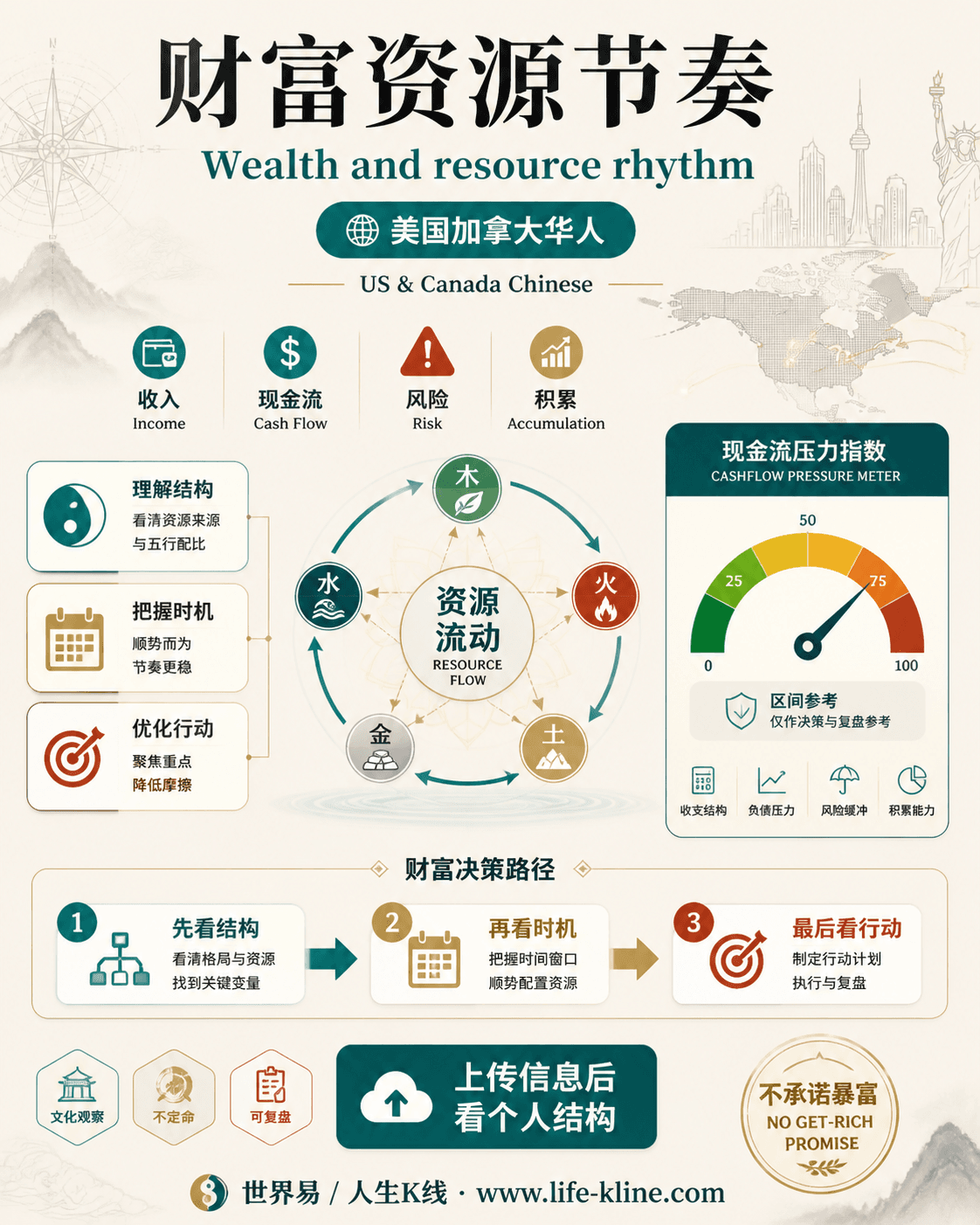
财富资源节奏|美国加拿大华人
这张图把《Metaphysical Assistance in Risk Control and Stop-Loss for REITs and Real Estate Funds》里的命理概念转成关系、边界和应用场景,适合先看图建立结构,再回到知识文章正文理解细节。
财富资源节奏不应被写成固定结论。更适合美国加拿大华人的读法,是把传统术语翻译成结构、时机、环境、行动和复盘。
查看图片解读