Metaphysical Analysis of Independent Operation versus Advisor Guidance in REITs Investment
把这篇文章落到自己身上验证:先看结构,再进入个人分析,不做泛泛阅读。
Why This Decision Is Especially Difficult in This Category
REITs and real estate funds, as investment categories heavily reliant on cash flow dividends and sensitive to interest rates, have a complex market structure. Their liquidity is more limited compared to traditional stocks, and the underlying assets are mostly physical properties whose valuation is significantly influenced by macroeconomic conditions and policies, resulting in considerable uncertainty for investors. Differences in tax and regulatory environments between domestic and international REITs further increase decision-making difficulty.
Psychologically, investors often tend toward overconfidence or blind reliance on advisors when faced with complex market information. The stable dividends and price volatility characteristics of REITs cause risk perception biases during decision-making, especially in interest rate fluctuation cycles, where investors are prone to chasing highs and selling lows.
From a metaphysical perspective, the strength of the Day Master, the attribute of the BaZi structure, and the combination of Yong Shen and Ji Shen influence how investors process information and tolerate risk. For example, those with prominent Pian Cai (wealth stars) tend to actively seek investment opportunities; those with strong Bi Jian (peer stars) may prefer independent operation but are prone to impulsiveness; those with strong Yin stars (Pian Yin or Zheng Yin) are more suited to rely on professional support to avoid blind decisions.
Therefore, the choice between independent operation and following advisors in REITs investment is a complex issue involving multidimensional intersections of market, psychology, and metaphysics. A comprehensive consideration of the investor’s own BaZi characteristics and the market environment is necessary to make relatively reasonable judgments.
Three Core Dimensions of Metaphysical Judgment
Firstly, the relationship between the Day Master and the Pian Cai (wealth star) is key to judging the investor’s ability to absorb and utilize wealth-related information. Investors with a strong and balanced Day Master and effective Pian Cai are more confident in independently researching underlying assets and cash flow conditions in REITs investments, making them suitable for proactive operation. Conversely, a weak Day Master or inconspicuous Pian Cai indicates a greater need to rely on professional advisor analysis.
Secondly, the role of Bi Jian (peer stars) manifests in risk tolerance and resource sharing. Those with abundant Bi Jian tend to be confident and independent, willing to research the market on their own but prone to impulsive decision-making errors. Those with weaker Bi Jian show more caution and are better suited to follow advisor recommendations, forming a beneficial complement.
Thirdly, the interaction between Da Yun (decade luck cycle) and Liu Nian (annual fortune) reflects the rhythm of the investor’s current fortune. When the Da Yun is auspicious and harmonizes with the Liu Nian, symbolizing smooth career and wealth luck, the investor is suitable to make proactive decisions based on their metaphysical advantages combined with the market environment. If the Da Yun is stable or unfavorable and the Liu Nian presents clashes, caution is advised, and reliance on advisors is preferable to avoid potential risks.
In summary, Pian Cai represents wealth acquisition ability, Bi Jian influences the tendency for autonomous action, and Yin stars relate to reliance and stability. Together with the conditions of Da Yun and Liu Nian, these form a metaphysical framework for evaluating REITs investment decision-making patterns.
Three Real BaZi Chart Case Studies
Case 1: The investor’s Day Master is Ji (己, Earth), with a Cong Cai (following wealth) structure. The Yong Shen are Water and Metal, and the Ji Shen are Fire and Earth. Currently in the Geng Xu (庚戌) Da Yun, with Liu Nian Bing Wu (丙午). The chart shows a strong Pian Cai and a prominent wealth structure, indicating a strong ability to absorb wealth. The Geng Xu Da Yun is stable and suitable for maintaining gains, while the Bing Wu Liu Nian calls for flexible adaptation, suggesting a moderately flexible operational rhythm. In REITs investment, this chart suits independent, in-depth research of underlying assets and cash flow, leveraging keen sensitivity to financial information for proactive positioning. However, caution is advised regarding market volatility risks brought by the Ji Shen Fire and Earth; setting stop-loss points is recommended to avoid blind expansion. The judgment sequence should first confirm current market interest rates and dividend stability, then combine with personal liquidity to flexibly adjust positions.
Case 2: The investor’s Day Master is Geng (庚, Metal), with a Pian Yin (partial resource) structure. The Yong Shen is Fire, and the Ji Shen is Earth. Currently in the Jia Wu (甲午) Da Yun, with Liu Nian Bing Wu (丙午). The Pian Yin structure reflects a preference for relying on professional knowledge and guidance. Fire as Yong Shen increases motivation and enthusiasm, but Ji Shen Earth suggests caution regarding risks in underlying market assets. The Jia Wu Da Yun is auspicious, with smooth career and wealth progress. The Liu Nian supports following the trend, making it suitable to operate REITs investments steadily under advisor guidance. Considering REITs’ sensitivity to interest rate fluctuations and regulatory policies, independent operation carries higher risk. It is recommended that this chart holder prioritize listening to professional advisors’ asset allocation advice, focusing on dividend stability and fee impact, and make appropriate adjustments based on risk assessments provided by the advisor. The judgment sequence should first verify the advisor’s professional qualifications and market judgment, then rely on their strategy execution.
Case 3: The investor’s Day Master is Ren (壬, Water), relatively weak, with a Pian Yin structure. The Yong Shen is Metal, and the Ji Shen are Wood and Fire. Currently in the Gui Chou (癸丑) Da Yun, with Liu Nian Bing Wu (丙午). The Pian Yin structure and Yong Shen Metal indicate a reliance on professional knowledge, but the weak Day Master shows limited self-drive and susceptibility to market volatility. The Gui Chou Da Yun is stable and suitable for maintaining gains, while the Liu Nian calls for flexible adaptation, reflecting a period suitable for cautious asset holding and avoiding aggressive operations. In REITs investment, this chart is better suited to rely on advisors for asset screening and risk control, especially paying attention to tax and regulatory differences between overseas and domestic REIT products. It is advised to first assess personal risk tolerance, then combine with advisor suggestions for diversified allocation to avoid concentrated exposure to interest rate-sensitive single assets.
Common Misjudgments and Blind Spots in This Category
Investors often overlook the interest rate sensitivity of REITs, especially during rate hike cycles when valuation pressure increases. They tend to be overly optimistic about dividend stability, thereby underestimating market adjustment risks. Even if the Pian Cai is strong in the BaZi, failure to consider Da Yun and Liu Nian can lead to overconfidence and misjudgment of market trends.
Another blind spot is misunderstanding the advisor’s role. Some investors with charts showing strong Bi Jian prefer independent operation but neglect the complexity of REITs’ underlying assets and regulatory differences, resulting in significant losses due to lack of professional support. The BaZi structure indicates a strong independent will but may not be suitable for all investment stages and market environments.
Some investors also tend to ignore the stabilizing role of Yin stars and underestimate the importance of relying on professional advisors, especially during unfavorable Liu Nian or stable Da Yun periods. Blindly aggressive operations overlook potential risks from market volatility. Both dividend and price fluctuations in the REITs market require cautious evaluation; blindly following the crowd or overconfidence are unwise choices.
In summary, understanding the match between metaphysics and market structure can effectively avoid common decision-making errors and improve risk management and return stability in REITs investment.
Practical Judgment Sequence
First, investors should combine their own BaZi structure to assess the strength of the Day Master and the combination of Pian Cai, Bi Jian, and Yin stars, judging their capacity to process market information and risk tolerance. Those with strong Day Master and prominent Pian Cai are suited for proactive research, while those with strong Pian Yin and weak Day Master are better suited to rely on advisors.
Second, analyze the relationship between the current Da Yun and Liu Nian to judge the auspiciousness of the period and whether to follow the trend. During auspicious luck, proactive positioning is advisable; during stable or challenging luck, caution and prioritizing professional guidance help reduce decision errors.
Finally, combined with REITs market characteristics, focus on interest rate trends, cash flow stability, fee costs, and tax/regulatory differences. Use metaphysical rhythm judgments to reasonably arrange investment timing. It is recommended that investors set clear take-profit and stop-loss strategies to avoid emotional operations and ensure steady wealth growth.
Throughout the judgment process, the principle that investment carries risks must be upheld. Metaphysics serves only as auxiliary reference and should never replace professional financial advice.
FAQ
Question 1: Does a strong Pian Cai in my BaZi mean I can completely operate REITs investments independently? Answer: A strong Pian Cai indicates strong wealth absorption and information processing abilities, but the REITs market is influenced by multiple factors. It is still necessary to consider Da Yun, Liu Nian, and market environment. Independent operation should be cautious and not completely exclude advisor recommendations.
Question 2: If my BaZi has a Pian Yin structure, must I always follow advisors? Answer: Pian Yin represents a greater reliance on professional knowledge, so following advisors is generally the better choice. However, you should also combine your own risk preference and actual market conditions to participate reasonably in decision-making and avoid blind dependence.
Question 3: How do I use metaphysics to judge when to adjust my REITs holdings? Answer: Combine the auspiciousness or inauspiciousness of Da Yun and Liu Nian and changes in Yong Shen and Ji Shen. Pay special attention to whether the Liu Nian clashes or harmonizes with Pian Cai or Yin stars. Together with market interest rate and dividend changes, judge whether it is appropriate to adjust holdings, achieving flexible adaptation.
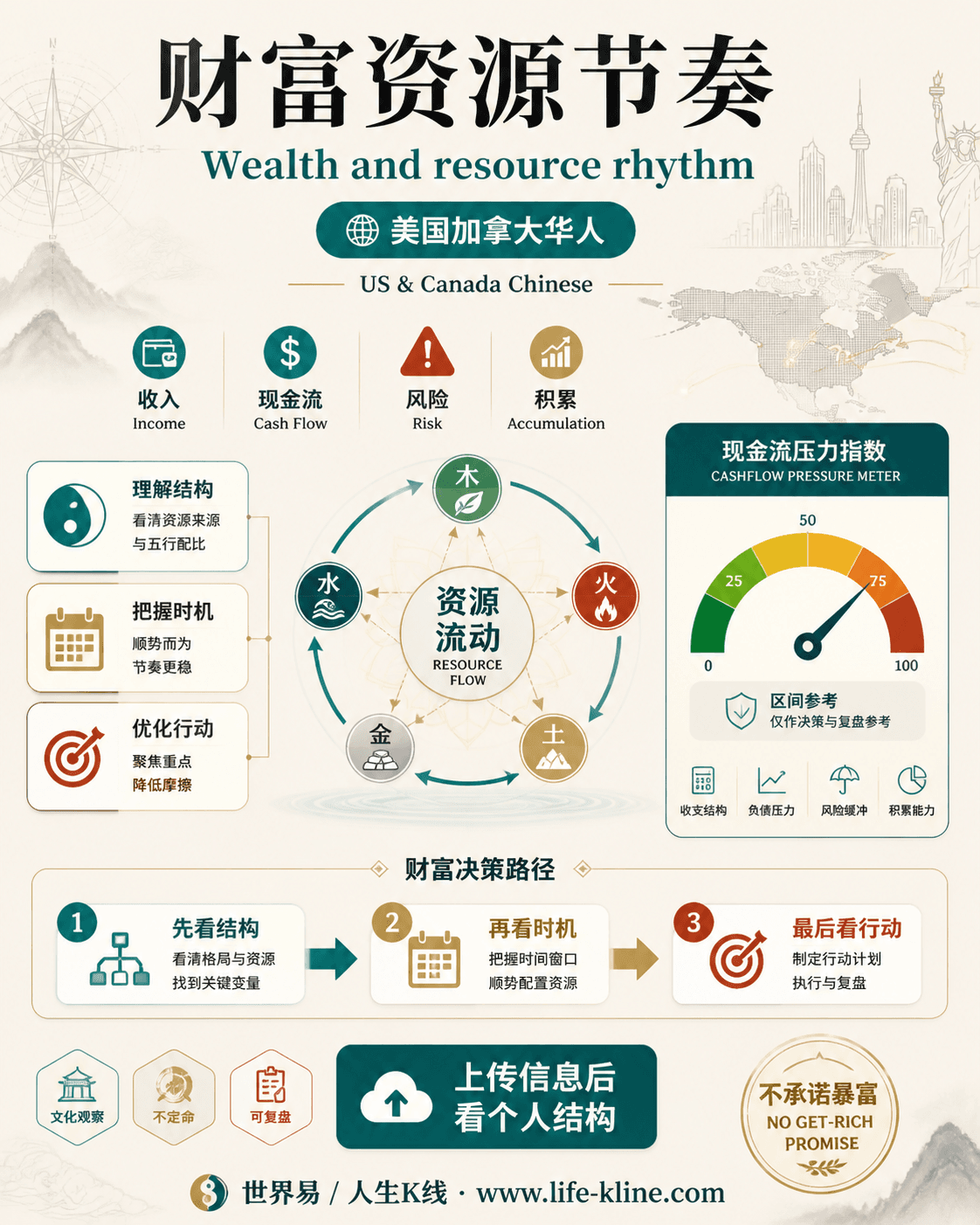
财富资源节奏|美国加拿大华人
这张图把《Metaphysical Analysis of Independent Operation versus Advisor Guidance in REITs Investment》里的命理概念转成关系、边界和应用场景,适合先看图建立结构,再回到知识文章正文理解细节。
财富资源节奏不应被写成固定结论。更适合美国加拿大华人的读法,是把传统术语翻译成结构、时机、环境、行动和复盘。
查看图片解读