Metaphysical Rhythm Analysis of Entry and Observation in REITs Investment
把这篇文章落到自己身上验证:先看结构,再进入个人分析,不做泛泛阅读。
Why This Decision Is Especially Difficult in This Category
Investment decisions in REITs and real estate funds, especially the choice between entry and observation, face multiple challenges. Firstly, the cash flow dividend characteristic of REITs makes income stability a core consideration, while interest rate fluctuations significantly impact their valuation. The current global interest rate environment is complex and volatile, increasing prediction difficulty.
Secondly, the quality, geographic location, and management efficiency of underlying assets directly determine the fund's long-term performance. However, this information is often difficult to fully grasp, causing investors to rely on market sentiment and macro indicators for decision-making, which easily leads to herd behavior or panic selling.
Additionally, overseas REITs and domestic REITs differ significantly in tax policies, regulatory environments, and liquidity, requiring investment strategies to be localized and strengthening understanding of market structure.
From a metaphysical perspective, the investor’s Day Master strength, pattern, and Yong Shen configuration reflect their personal energy rhythm and risk tolerance. Especially the interaction between wealth stars and Bi Jian (competing elements) affects their capacity to endure market volatility and decisiveness, making metaphysical assistance a valuable tool to identify entry and observation timing.
Three Core Dimensions of Metaphysical Judgment
The first core dimension is the relationship between the Day Master and the wealth star. REITs investment centers on cash flow and returns; the wealth star symbolizes wealth and income, while the Day Master’s strength determines its capacity to bear the wealth star. A relatively strong Day Master combined with a Zheng Yin (Proper Seal) pattern indicates strong personal ability and good resource support, suitable for proactively seizing investment opportunities.
The second core dimension is the role of Bi Jian (Peer) and shared burden. Bi Jian represents competition and sharing, reflecting risk sharing and market competition in investment. Excessive Bi Jian may lead to over-aggressiveness, while moderate Bi Jian helps risk diversification and team cooperation.
The third dimension is the interaction between Da Yun (decade luck cycle) and Liu Nian (annual fortune). Da Yun represents long-term trends, while Liu Nian reflects the current environment. A favorable Da Yun combined with a supportive Liu Nian often implies a dual advantage in investment environment and personal fortune, suitable for active position building; otherwise, caution or position adjustment is advised.
Special attention should be paid to the balance between Yong Shen and Ji Shen (unfavorable element). In metaphysics, Yong Shen is the key element harmonizing the Day Master and wealth star. A reasonable Yong Shen presence helps counteract market interest rate fluctuations and policy risks, enhancing risk resistance.
Three Real BaZi Chart Cases
Case 1: Female, 35-40 years old, Xin (辛, Metal) Day Master relatively strong, Zheng Yin pattern, Metal as Yong Shen, Earth as Ji Shen. Currently in the 7th year of Yi You (乙酉) Da Yun, a favorable luck cycle, with Bing Wu (丙午) Liu Nian supporting the trend. This chart shows a relatively strong Day Master with Metal as Yong Shen; the Zheng Yin pattern brings resource support and stability, suitable for focusing on cash flow stability and interest rate-sensitive sectors in the REITs market. The Yi You Da Yun and Bing Wu Liu Nian form a favorable combination, indicating alignment between the current market environment and personal fortune, suitable for considering position building. However, avoid the Ji Shen Earth influence by being cautious of over-reliance on high leverage or Earth-heavy real estate projects in asset allocation. The recommended judgment sequence is to first confirm market interest rate trends and dividend stability, and if no major policy risks exist, gradually build positions.
Case 2: Male, 30-35 years old, Ren (壬, Water) Day Master relatively strong, Pian Yin (偏印) pattern, Fire as Yong Shen, Metal as Ji Shen. Currently in the 6th year of Gui Mao (癸卯) Da Yun, a stable luck cycle, with Bing Wu (丙午) Liu Nian requiring flexible adaptation. This chart’s Pian Yin pattern tends to rely on external support and information. The Day Master Water and Yong Shen Fire have some mutual restriction, and the presence of Ji Shen Metal warns to be cautious of market interest rate rise pressures. REITs, as interest rate-sensitive assets, under the current Liu Nian’s volatile environment, suggest observation, especially when overseas REITs and domestic interest rate policies differ significantly. The judgment sequence recommends first observing interest rate and policy signals, waiting for a clearer favorable Liu Nian before considering entry, avoiding blind following.
Case 3: Male, 40-45 years old, Gui (癸, Water) Day Master relatively strong, Jie Cai (劫财) pattern, both Yong Shen and Ji Shen are Metal. Currently in the 6th year of Bing Zi (丙子) Da Yun, a stable luck cycle, with Bing Wu (丙午) Liu Nian requiring flexible adaptation. The Jie Cai pattern shows strong personal competitiveness and good risk resistance, but having both Yong Shen and Ji Shen as Metal causes some internal conflict. REITs investment is highly sensitive to interest rates, and the strong Metal element emphasizes overall interest rate fluctuation risks. The current Da Yun and Liu Nian suggest maintaining existing positions, keeping liquidity during market volatility, and avoiding heavy positions. The judgment sequence advises prioritizing evaluation of underlying asset quality and cash flow stability, and participating moderately only when no major interest rate hikes or policy adjustments pressure exist, focusing on risk diversification and liquidity management.
Common Misjudgments and Blind Spots in This Category
A common misjudgment in REITs investment is over-reliance on short-term interest rate trends or market sentiment, neglecting cash flow stability and the long-term value of underlying assets, resulting in frequent in-and-out trading that increases costs and reduces returns. Additionally, ignoring tax and regulatory differences between overseas and domestic REITs increases cross-border allocation risks.
From the metaphysical perspective, a blind spot is failing to integrate the dynamics of Da Yun and Liu Nian, focusing only on the Day Master or Yong Shen, and neglecting the interaction between market environment and personal fortune, leading to misjudgments. For example, forcing entry during an unfavorable Liu Nian can amplify market risks.
Some investors treat metaphysics as an absolute signal, ignoring the inherent complexity and variability of investment markets. Metaphysics should only serve as a rhythm-assisting tool and cannot replace comprehensive market analysis and professional financial advice.
Overall, avoiding blind spots requires synchronizing investment strategy adjustments with market structure and personal metaphysical rhythm, flexibly responding to interest rate fluctuations and policy changes, while emphasizing risk management.
Practical Judgment Sequence
Step one: Evaluate whether the current Da Yun and Liu Nian present favorable or stable conditions. Combine this with Day Master strength and Yong Shen configuration to judge if personal fortune supports active investment. When favorable and the Day Master is relatively strong with reasonable Yong Shen, entry can be considered.
Step two: Integrate REITs market structure, focusing on interest rate trends, cash flow stability, and underlying asset quality. Confirm no major policy or tax risks. If the market environment tends to be favorable and personal metaphysical rhythm aligns, gradual position building is appropriate.
Step three: If metaphysics indicates Liu Nian requires flexible adaptation or Da Yun is stable but market interest rates are uncertain, observation and flexible position adjustment are advised to avoid heavy risk exposure. Continuously monitor the synchronization of metaphysical rhythm and market changes to act rationally and follow trends.
FAQ
Question 1: Does a relatively strong Day Master in metaphysics necessarily mean suitability for REITs position building? Answer: A relatively strong Day Master indicates strong personal energy and risk tolerance, but whether to build positions also depends on Yong Shen, Ji Shen, and Da Yun/Liu Nian conditions, as well as market interest rate and cash flow status. Metaphysics is only an auxiliary judgment tool.
Question 2: How do Yong Shen and Ji Shen in metaphysics affect interest rate-sensitive REITs investment? Answer: Yong Shen represents harmonizing and supportive forces that enhance risk resistance, while Ji Shen indicates potential risk points. In interest rate-sensitive REITs investment, if Ji Shen overlaps with interest rate-related elements, extra caution is needed to avoid amplified risks from interest rate volatility.
Question 3: What are the differences in metaphysical judgment between overseas REITs and domestic REITs? Answer: Overseas REITs involve more tax and regulatory differences. Metaphysical judgment should consider the individual’s pattern dependence on external support (such as Pian Yin pattern) and the volatility of Liu Nian and Da Yun, enhancing recognition of cross-border investment risks. It is inappropriate to simply apply domestic environment judgments.
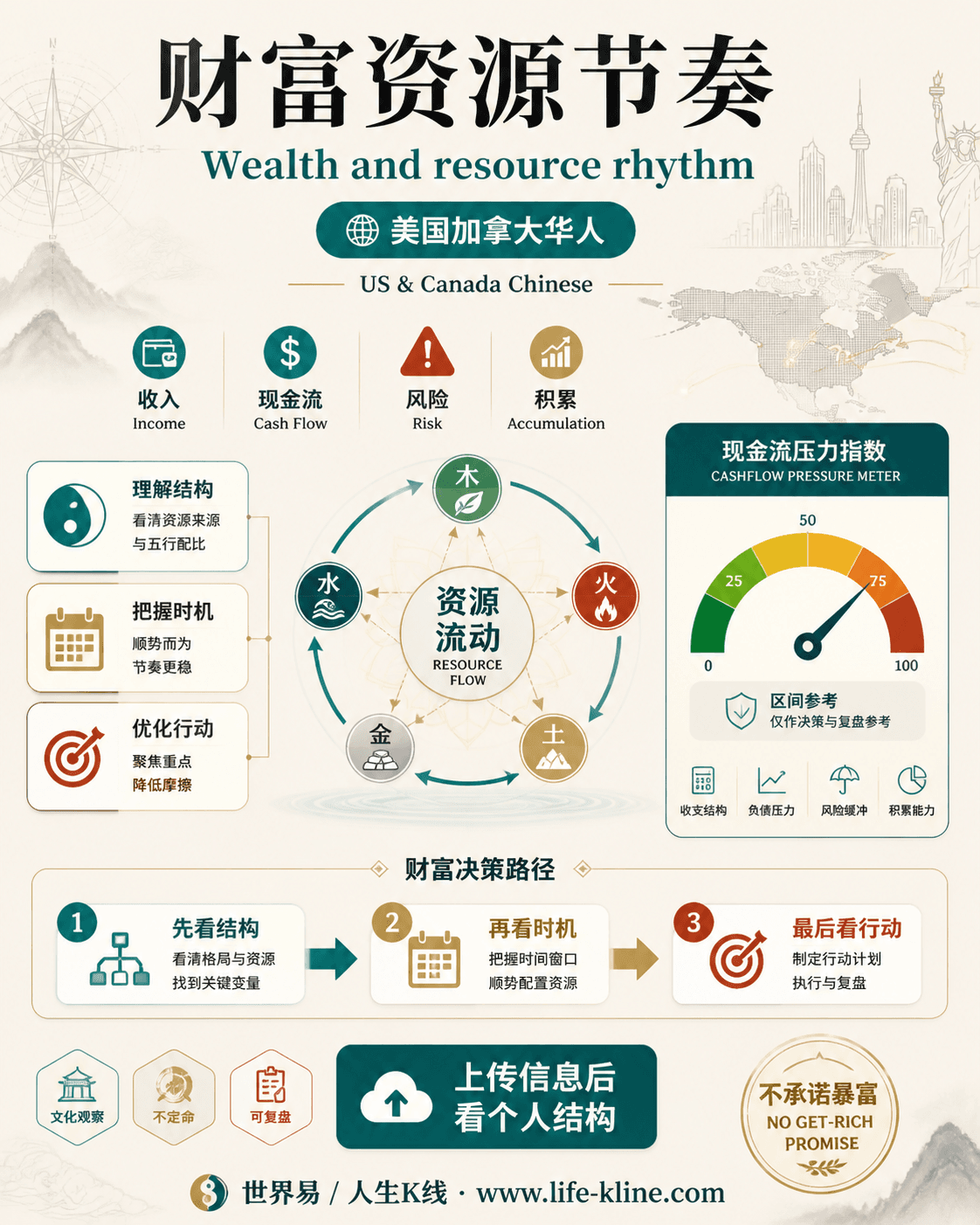
财富资源节奏|美国加拿大华人
这张图把《Metaphysical Rhythm Analysis of Entry and Observation in REITs Investment》里的命理概念转成关系、边界和应用场景,适合先看图建立结构,再回到知识文章正文理解细节。
财富资源节奏不应被写成固定结论。更适合美国加拿大华人的读法,是把传统术语翻译成结构、时机、环境、行动和复盘。
查看图片解读