Analysis of Risk Tolerance in Home Buying: The Impact of Wealth Stars and Bi Jian-Yin Star Structures on Decision-Making
把这篇文章落到自己身上验证:先看结构,再进入个人分析,不做泛泛阅读。
你现在搜索的,
其实是一个要落到自己身上的判断。
当前页面主要回答「Home Buying Decision」这类搜索问题;真正有价值的下一步是把这套结构带进自己的报告、工具与案例验证。
Why This Decision Is Especially Difficult in This Financial Context
Home buying, as one of the most important financial decisions in life, involves key variables such as the source of the down payment, loan terms, and city selection. In reality, constrained by high housing prices, interest rate fluctuations, and inflation pressures, risk tolerance becomes the core of decision-making. Especially in contemporary China, young families generally rely on loans and borrowing from relatives and friends; their risk tolerance often deviates from actual financial flexibility, easily leading to short-term financial stress or long-term debt burdens.
On the psychological level, home buying decisions often suffer from biases due to emotional factors, future expectations, and social comparison psychology, manifesting as over-optimism or conservatism. The combinations of Wealth Stars (Cai Xing), Bi Jian (Peer Stars), and Yin Stars in BaZi can reveal the individual's true psychological endurance and coping strategies under financial pressure from a subconscious level, more accurately reflecting risk appetite rather than relying solely on superficial statements.
In BaZi analysis, the Wealth Star represents wealth opportunities and income ability; Bi Jian symbolizes competition and resource sharing; Yin Star relates to support and protection. The interplay of these three reflects the liquidity of home-buying funds, cooperation relationships, and risk buffering capacity. This structure overlaps with the real-world challenges of down payment collection, loan negotiation, and family financial support, making the judgment of risk tolerance more complex and nuanced.
Therefore, the difficulty in assessing home buying risk tolerance lies in accurately judging the true risk boundaries of an individual or family by combining current financial pressures with BaZi structures, avoiding decision errors caused by subjective biases or single financial indicators. The metaphysical perspective supplements the understanding of implicit psychology and latent resources, enhancing the scientific nature of decision-making.
Three Core Dimensions of Metaphysical Judgment
First, the relationship between the Day Master and the Wealth Star is central. The Day Master represents personal energy and willpower, while the Wealth Star reflects wealth inflow and external resources. When the Wealth Star is strong and supported by the Yong Shen (favorable element), it usually indicates good wealth support and fund mobilization ability; if the Wealth Star is constrained or suppressed by the Ji Shen (unfavorable element), fund pressure and potential risks need to be carefully assessed.
Second, the presence of Bi Jian reflects competition or cooperation among similar resources. In home buying, this corresponds to financial collaboration and borrowing relationships among family members or friends. When Bi Jian is strong, resource sharing and mutual assistance are robust, but it may also cause resource dispersion and internal friction, requiring careful management of cooperation boundaries and risk sharing.
Third, the interaction of Liu Nian (annual fortune) and Da Yun (decade luck cycle) affects the timing of current decisions. Da Yun represents long-term trends, while Liu Nian reflects annual environmental fluctuations. A stable Da Yun suggests maintaining the status quo; when risk tolerance is low, aggressive moves are not advisable. When Da Yun is auspicious and Liu Nian aligns, it is suitable to act with the trend, enhancing risk tolerance. The appearance of Ji Shen signals potential risk escalation, requiring attention to prevention.
In summary, the combination of Wealth Star, Bi Jian, and Yin Star forms the metaphysical foundation of the home-buying capital chain. The strength of the Day Master determines personal initiative and risk resistance, while the coordination of Da Yun and Liu Nian provides timing references. Through these three dimensions, one can more accurately grasp home buying risk tolerance.
Three Real BaZi Chart Cases
Case 1: The female’s BaZi chart has a relatively weak Day Master Yi Wood (乙, Yi), belonging to the Shi Shen (Eating God) pattern. The Yong Shen is Water, and the Ji Shen are Fire and Earth. She is currently in the 8th year of the Xin Chou (辛丑, Xin Chou) Da Yun, which is stable and suggests maintaining the status quo. The Liu Nian is Bing Wu (丙午, Bing Wu), requiring flexible adaptation. The Wealth Star is constrained, and the Yong Shen Water is the key regulator, indicating her fund liquidity depends on external support. There is considerable pressure in raising the down payment, and loan duration should not be too long to avoid aggravating risks from the Ji Shen Fire and Earth. In joint spousal finances, it is recommended to strengthen cash flow management and avoid excessive leverage. The risk tolerance is relatively low, favoring cautious operation, prioritizing low-risk properties and stable cities to reduce economic volatility impact. The suggested judgment sequence is: first evaluate whether liquidity is sufficient to ensure effective regulation by the Yong Shen Water, then carefully select loan schemes to avoid triggering Ji Shen Fire and Earth that increase financial pressure.
Case 2: The male’s BaZi chart has a relatively strong Day Master Ding Fire (丁, Ding), belonging to the Bi Jian (Peer) pattern. The Yong Shen are Water and Metal, and the Ji Shen is Wood. He is currently in the 3rd year of the Gui Hai (癸亥, Gui Hai) Da Yun, which is very auspicious. The Liu Nian is Bing Wu (丙午, Bing Wu), favoring acting with the trend. The Wealth Star is strong, and Bi Jian is favorable, indicating strong fund sources and cooperative relationships with relatives and friends, resulting in higher risk tolerance. Raising the down payment is relatively easy, and loan duration can be moderately extended to optimize cash flow. City choice can consider areas with high development potential but greater volatility. Spousal financial cooperation is smooth, facilitating risk sharing. Attention should be paid to the Ji Shen Wood’s subtle influence on financial planning to avoid overexpansion. The suggested judgment sequence is: prioritize leveraging the auspicious Da Yun period to expand funding channels, plan loans and repayment reasonably, monitor potential fund dispersion risks caused by Ji Shen Wood, and establish risk buffers.
Case 3: The male’s BaZi chart has a relatively strong Day Master Xin Metal (辛, Xin), belonging to the Yang Ren (Sheep Blade) pattern. The Yong Shen are Fire and Wood; the Ji Shen is Earth. He is currently in the 9th year of the Bing Zi (丙子, Bing Zi) Da Yun, which is auspicious. The Liu Nian is Bing Wu (丙午, Bing Wu), favoring acting with the trend. The Wealth Star is prominent and supported by Yong Shen Fire and Wood, indicating strong capital strength and good risk adjustment ability. In home buying decisions, risk tolerance can be moderately increased, selecting higher-quality or high-potential properties. Loan duration and down payment ratio can be flexibly adjusted, suitable for an aggressive strategy. In joint spousal finances, Yin Star support is obvious, beneficial for fund protection and risk sharing. The Ji Shen Earth warns to pay attention to land policies and market environment changes. The suggested judgment sequence is: first confirm the sustainability of favorable Da Yun and Liu Nian, evaluate market and policy dynamics, actively seek loan discounts and quality properties, and establish risk contingency plans to address market fluctuations caused by Ji Shen Earth.
Common Misjudgments and Blind Spots in This Scenario
Risk tolerance in home buying is often misjudged by solely relying on income or savings size, neglecting the profound impact of the Wealth Star, Bi Jian, and Yin Star structures on fund liquidity and cooperative relationships in BaZi. This leads some people who appear financially abundant to easily fall into financial difficulties, or conversely, miss good opportunities.
Another blind spot is ignoring the regulatory role of Da Yun and Liu Nian on risk tolerance. Home buying decisions focus only on current financial status without considering long-term trends and annual environmental changes, making it easy to blindly expand during unfavorable Da Yun or Liu Nian shocks, increasing risk exposure.
Additionally, when couples buy homes together, the cooperative and competitive relationships represented by Bi Jian are often overlooked. The stability of both parties’ financial collaboration and potential conflicts are insufficiently assessed, resulting in uneven loan pressure and repayment responsibilities, concentrating risk.
Finally, Ji Shen in BaZi is often viewed negatively and avoided. In fact, Ji Shen also indicates risk points and prevention priorities. Properly identifying and addressing challenges brought by Ji Shen is an important way to improve risk tolerance.
Practical Judgment Sequence
Step one: Clarify the strength of the Day Master and the status of the Wealth Star in the BaZi chart to judge personal fund initiative and external wealth support. When the Wealth Star is strong and the Yong Shen effective, funding sources are relatively stable and risk tolerance is higher; otherwise, prioritize stable financing and control leverage ratio.
Step two: Analyze the combination of Bi Jian and Yin Star to assess the family or partner’s fund collaboration ability and risk-sharing mechanisms. When Bi Jian is strong and relationships harmonious, it facilitates cooperative financing and pressure sharing; if conflicts or resource dispersion exist, establish clear fund management plans to avoid hidden risks.
Step three: Combine the current Da Yun and Liu Nian to judge the timing of the home buying decision. When Da Yun is auspicious and Liu Nian aligns, risk tolerance can be moderately increased to seize market opportunities; if Da Yun is stable or unfavorable, maintaining the status quo is advised to avoid rash moves. When Ji Shen appears, focus on related risk points and prepare countermeasures in advance.
In summary, judging home buying risk tolerance should start from metaphysical structures, combined with real financial conditions and market environment, proceeding step-by-step to avoid single-point decisions and enhance overall risk management.
FAQ
Question 1: How does the strength or weakness of the Wealth Star specifically affect home loan choices? Answer: A strong Wealth Star means better wealth inflow and fund support, allowing flexible adjustment of loan amounts and terms to optimize cash flow and interest costs. When the Wealth Star is constrained, it is recommended to choose short-term loans or lower leverage to avoid excessive financial pressure affecting repayment ability.
Question 2: Does a strong Bi Jian always mean smooth cooperation in home buying? Answer: Bi Jian represents resource sharing and competition. A strong Bi Jian indicates great cooperation potential but may also cause resource dispersion and internal friction. Whether cooperation is smooth depends on the stability of the relationship and fund management ability of both parties, requiring reasonable planning of cooperation boundaries and responsibility sharing.
Question 3: How to control home buying risks when Da Yun and Liu Nian are unfavorable? Answer: When Da Yun and Liu Nian are unfavorable, risk tolerance is relatively low. Conservative strategies should be adopted, such as postponing home purchase plans, increasing down payment ratios, choosing lower-risk properties or cities, and enhancing cash reserves to avoid fund chain breaks.
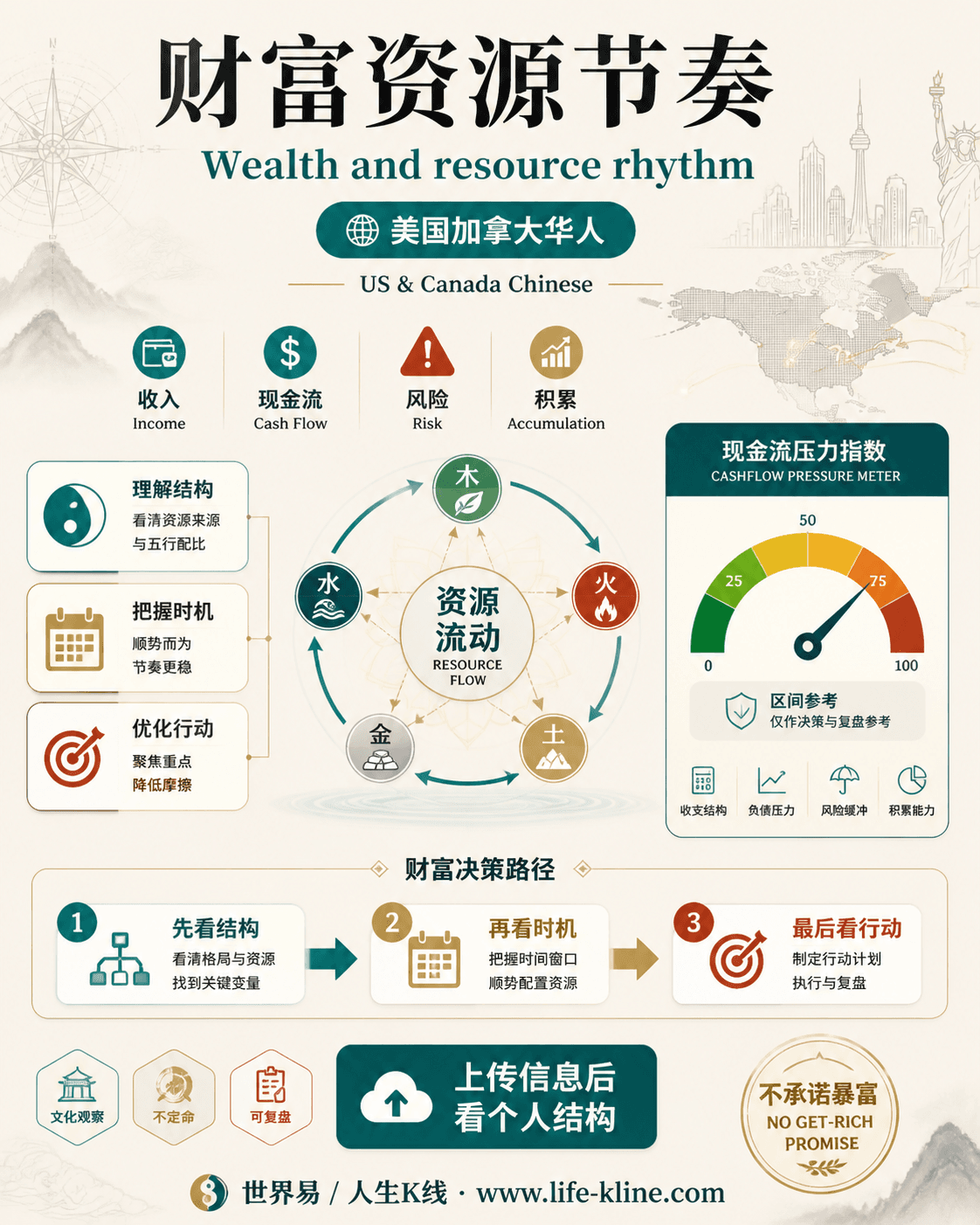
财富资源节奏|美国加拿大华人
这张图把《Analysis of Risk Tolerance in Home Buying: The Impact of Wealth Stars and Bi Jian-Yin Star Structures on Decision-Making》里的命理概念转成关系、边界和应用场景,适合先看图建立结构,再回到知识文章正文理解细节。
财富资源节奏不应被写成固定结论。更适合美国加拿大华人的读法,是把传统术语翻译成结构、时机、环境、行动和复盘。
查看图片解读