Review and Restart After Property Loss: Risk and Opportunity Assessment from a Metaphysical Perspective
把这篇文章落到自己身上验证:先看结构,再进入个人分析,不做泛泛阅读。
Why This Decision Is Especially Difficult in This Financial Context
The core difficulty in reviewing and restarting after a property loss lies in balancing psychological pressure with real financial constraints. In reality, limited sources for the down payment, coupled with fluctuations in city housing prices and interest rates, force decision-makers to weigh tight funds against market uncertainty. Borrowing from relatives and friends, family savings, and choices regarding loan terms further increase decision complexity.
On the psychological level, cognitive biases often arise after losses—either panic-induced loss acceptance or blind doubling down due to unwillingness to admit defeat. At this time, the combinations of wealth stars, Bi Jian (Peer) and Yin stars in the metaphysical structure can provide auxiliary judgments on risk tolerance and resource allocation, helping to grasp the appropriate timing for review and restart.
Moreover, buying a house as a major family asset allocation decision affects not only individual finances but also the integration and collaboration of resources between spouses. The cooperation and clashes among Bi Jian in BaZi reflect the strength of real-world cooperative relationships and risk-sharing capacity, serving as an important reference for whether to continue investing.
Therefore, only by integrating real financial pressure, psychological state, and metaphysical structure can one make more scientific and rational judgments in the review and restart after property loss, thereby reducing subsequent risk of loss.
Three Core Dimensions of Metaphysical Judgment
First, the relationship between the Day Master and wealth stars is the core dimension. The Day Master represents the individual's core energy and risk resistance, while wealth stars reflect sources and flow of wealth. For example, when the Day Master is weak and the wealth star is overly strong, it tends to create financial pressure, indicating that during review one must cautiously assess the stability of the cash flow.
Second, Bi Jian (Peer) and cooperative relationships greatly influence decisions. Bi Jian represents competition and resource sharing; a well-coordinated Bi Jian combination may help share risks jointly, which is especially important when spouses buy property together. However, if Bi Jian is too strong, it may cause internal resource conflicts, increasing decision difficulty.
Finally, the interaction of the current Da Yun (decade luck cycle) and Liu Nian (annual fortune) with the natal chart determines short-term fortune fluctuations. Da Yun represents the basic trend of a period, while Liu Nian reflects the specific situation of the year. When both are stable, it is suitable for maintaining and steady operations; when Liu Nian shows clashes or combinations, it signals changes in risk or opportunity, requiring flexible adjustment of property purchase strategies.
Overall, the strength of the Day Master, wealth star combinations, cooperation among Bi Jian and Yin stars, and the interaction of Da Yun and Liu Nian form the metaphysical foundation for reviewing and restarting decisions after property loss, directly impacting risk assessment and timing of actions.
Three Real BaZi Chart Cases
Case 1: This chart has a Jia (甲, Jia) Wood Day Master that is relatively weak, with a Bi Jian pattern. The Yong Shen (favorable element) is Water, and the Ji Shen (unfavorable elements) are Fire and Earth. The current Da Yun is Geng Chen (庚辰) during the 31-40 age stage, representing a stable maintenance period. The Liu Nian is Bing Wu (丙午), bringing adaptive energy. In reality, the weak Jia Wood Day Master and Bi Jian pattern indicate limited personal competitiveness and insufficient self-regulation of funds. Water as Yong Shen suggests the importance of liquid funds or loan capital. After the property loss, down payment and loan repayment pressures are significant. Under the current Da Yun and Liu Nian combination, it is advised to prioritize liquidity protection and avoid blind leverage. During review, focus should be on cash flow stability and check whether an overly strong Bi Jian causes resource dispersion. The judgment sequence should first verify sufficient liquid funds, then assess loan interest rates and repayment terms, and finally consider whether to hold or transfer assets in the current city.
Case 2: This female chart has a Jia (甲, Jia) Wood Day Master that is relatively weak, with a Pian Yin (偏印) pattern. The Yong Shen is Water, and Ji Shen are Fire and Earth. She is currently at the end of the Ji Mao (己卯) Da Yun, with the Liu Nian being Bing Wu (丙午). Both Da Yun and Liu Nian are stable but require adaptability. The Pian Yin pattern indicates she has certain external resource assistance and informational advantages, but the weak Day Master limits her ability to proactively control financial risks. After the property loss, city choice and loan term become critical, as the Pian Yin pattern implies reliance on external help. During review, focus should be on the stability of borrowing from relatives and friends and the sustainability of cooperative relationships. Leveraging metaphysical insights, it is recommended to adjust loan structures after confirming stable external support, avoiding increased risk from Ji Shen Fire and Earth elements causing financial tightness. The judgment sequence should first examine the credit and support strength of partners, then adjust loan plans according to funding status, and finally evaluate whether to change cities or properties to reduce risk.
Case 3: This chart has a Geng (庚, Geng) Metal Day Master that is relatively strong, with a Jie Cai (劫财) pattern. The Yong Shen is Water, and Ji Shen is Earth. The chart is in the 3rd year of Bing Xu (丙戌) Da Yun, with Liu Nian being Bing Wu (丙午). Both Da Yun and Liu Nian are relatively stable. The Jie Cai pattern indicates strong financial competition and cooperative relationships. The strong Day Master shows high personal financial risk resistance. After the property loss, despite market fluctuations, the individual has strong fund integration and risk-sharing capabilities. Water as Yong Shen emphasizes the importance of liquid and flexible fund management, while Ji Shen Earth warns of burdens from capital stagnation. During review and restart, focus should be on optimizing cash flow and risk diversification, prioritizing the use of Bi Jian cooperative relationships to relieve financial pressure. The recommended judgment sequence is first to assess the liquidity of existing assets, then adjust loan structures to avoid suppression by Earth energy, and finally consider risk sharing through cooperation to smoothly transition through property investment fluctuations.
Common Misjudgments and Blind Spots in This Scenario
A common misjudgment during the review process after property loss is overreliance on short-term market rebound expectations, neglecting the financial endurance reflected in the metaphysical structure. This leads to blind doubling down or extending loan terms, increasing long-term burdens. Especially for charts with a weak Day Master and overly strong wealth stars, failure to fully assess cash flow can easily cause a broken capital chain risk.
Another blind spot is ignoring the real-world reflection of Bi Jian and cooperative relationships. In spousal or close friend cooperation, an excessively strong Bi Jian often signals intense internal resource competition. Failure to timely identify potential cooperation risks results in uneven fund allocation or tense relationships, affecting smooth execution of review decisions.
Additionally, many overlook the timing significance of Da Yun and Liu Nian interactions, blindly making major moves during Liu Nian clash or combination periods, failing to follow the steady principle of Da Yun maintenance phases, which exacerbates losses. Correct understanding of the stability or volatility characteristics of Da Yun and Liu Nian combinations is key to avoiding rash actions.
In summary, the integration of metaphysics and real financial conditions provides multi-dimensional risk warnings. Neglecting any dimension may cause review judgment errors and increase subsequent loss risks.
Practical Judgment Sequence
First, check whether the Yong Shen (Water) in the chart is strong, especially focusing on whether liquid funds and loan structures are reasonable. A strong Water Yong Shen indicates good fund circulation, suitable for steady adjustment of loan terms and repayment plans; if Water Yong Shen is restrained or weak, leverage should be used cautiously, prioritizing cash flow safety.
Second, assess risk tolerance based on the Day Master strength and wealth star status. A weak Day Master combined with overly strong wealth stars indicates significant financial pressure, suggesting consideration of loss acceptance and exit or adjusting holdings. Conversely, a strong Day Master with good Bi Jian cooperation may consider continuing remediation within a steady range, leveraging cooperative relationships to spread risk.
Finally, combine current Da Yun and Liu Nian to judge timing. When Da Yun is in a maintenance phase and Liu Nian shows no obvious clashes or combinations, steady review and adjustment are suitable; if Liu Nian presents clashes or unfavorable changes, it is recommended to maintain a wait-and-see approach, avoid major moves, and wait for more favorable timing before decision-making.
In summary, practical operation should first ensure fund liquidity, then evaluate personal risk resistance, and finally combine fortune timing to make review and restart action choices, reducing further loss caused by blind operations.
FAQ
Question 1: After a property loss, how to determine whether to accept the loss and exit? Answer: Focus on the relationship between the Day Master and wealth stars in the chart. If the Day Master is weak and wealth stars are strong, and there is no significant support from Liu Nian or Da Yun, it indicates high financial pressure and risk, recommending considering loss acceptance to stop further loss; otherwise, remediation may be evaluated.
Question 2: When spouses buy property together, how does metaphysics help assess cooperation risk? Answer: Bi Jian represents cooperation and competition relationships. Well-coordinated Bi Jian indicates strong resource sharing and risk-sharing ability between parties; overly strong or conflicting Bi Jian suggests potential internal resource conflicts, requiring cautious decisions to ensure a stable cooperation foundation.
Question 3: What impact do Liu Nian clashes or combinations have on property review? Answer: Liu Nian clashes or combinations often bring market or personal fortune fluctuations. When such clashes occur, avoid major moves, prioritize stabilizing existing assets, and wait for fortune improvement before considering adjustments, thereby reducing review risks.
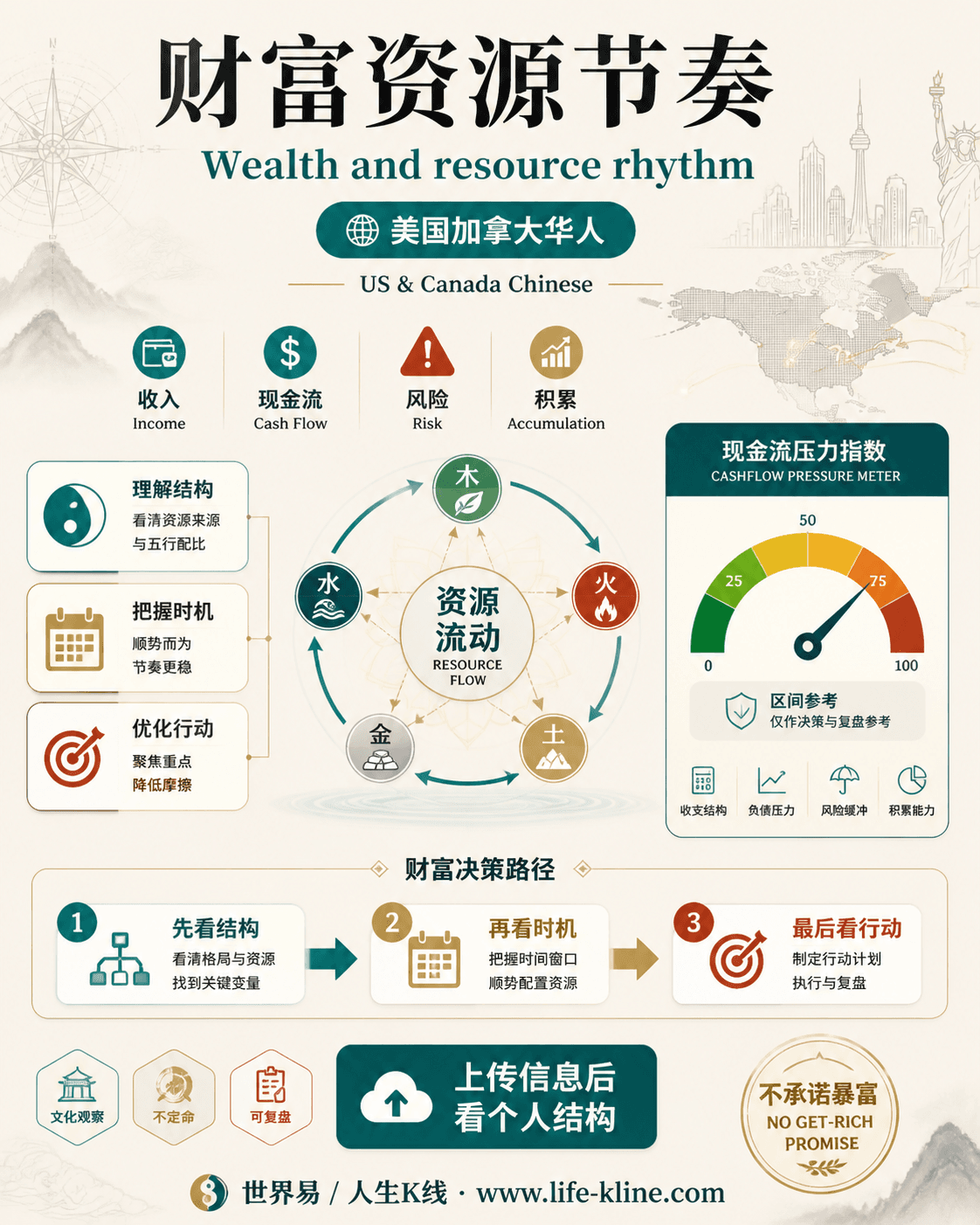
财富资源节奏|美国加拿大华人
这张图把《Review and Restart After Property Loss: Risk and Opportunity Assessment from a Metaphysical Perspective》里的命理概念转成关系、边界和应用场景,适合先看图建立结构,再回到知识文章正文理解细节。
财富资源节奏不应被写成固定结论。更适合美国加拿大华人的读法,是把传统术语翻译成结构、时机、环境、行动和复盘。
查看图片解读