BaZi Reference and Decision Analysis for Advancing or Waiting in Primary to Secondary School Transition
把这篇文章落到自己身上验证:先看结构,再进入个人分析,不做泛泛阅读。
Why This Decision Is Especially Difficult at This Educational Stage
The primary to secondary school transition is a critical juncture in Chinese family education. Parents must navigate public school district restrictions while weighing the high costs and potential high returns of private and international schools. Especially under the "Double Reduction" policy, extracurricular tutoring resources are limited, making school choice a vital guarantee for children's academic and interest development. Meanwhile, interview processes and peer group influences add complexity to decision-making, significantly increasing parental anxiety.
From a BaZi perspective, children at this stage are in a key period for expressive ability and learning motivation. The Shi Shen (Eating God) and Yin Star (Seal Star) in the chart significantly affect learning and expression, while Guan Sha (Officer and Killing) relate to discipline and pressure endurance, intertwining these three factors. Different rhythms of Da Yun and Liu Nian can either strengthen or suppress the child's initiative and adaptability, directly influencing the pace at which parents should advance school choices.
With reality and metaphysics intertwined, parents must carefully weigh advancing versus waiting. Advancing too early when the chart structure indicates the child is not ready may cause rebellion or psychological pressure; waiting might miss out on quality school placements or interview opportunities. Therefore, combining BaZi signals with educational realities is key to rational decision-making.
Additionally, when the chart shows combinations unfavorable to psychological endurance, parents should be alert to the child's emotional fluctuations and stress responses, seeking professional psychological assistance promptly. BaZi should serve only as a rhythm reference to avoid misjudgments that could exacerbate parent-child tensions.
Three Core Dimensions of BaZi Judgment
First is the attribute and strength of the Day Master. Children with a relatively weak Day Master often lack expression and self-driven motivation. When advancing school choice, it is necessary to ensure a strong supportive environment and avoid entering high-pressure or highly competitive settings too early. Conversely, a strong Day Master displays greater initiative and adaptability, suitable for actively seizing opportunities to advance.
Second is the pattern’s Shi Shen (Eating God) and Yin Star (Seal Star). Shi Shen represents learning and expressive ability, while Yin Star symbolizes support and protection. When Shi Shen is strong, the child has a strong desire to express and learn, making it appropriate to advance during turning points. A strong Yin Star indicates good internal support; combined with favorable Da Yun and Liu Nian, advancing carries lower risk.
Third is the interaction of the current Da Yun and Liu Nian. A stable Da Yun suggests maintaining the status quo, with both environment and personal state stable, suitable for steady advancement. If the Liu Nian activates Ji Shen (unfavorable elements), caution and waiting are advised to avoid amplified risks. Parents should use BaZi rhythms as a timing reference and flexibly adjust advancement or waiting strategies according to educational realities.
Three Real BaZi Chart Cases
Case 1: The female chart has a relatively weak Day Master Yi Wood (乙, Yi), with a Shang Guan (Hurting Officer) pattern, indicating strong Shi Shen but weak Day Master. This shows the child has a strong desire to express but insufficient internal energy, requiring Water as Yong Shen to nurture, with Fire and Earth as Ji Shen. Currently in the Geng Chen (庚辰, Geng Chen) Da Yun, representing a stable maintenance phase. Regarding the primary to secondary school transition, the child’s expressive potential is high but internal support is lacking. Advancement is suitable when preparation is sufficient and the environment is supportive, avoiding excessive pressure that may cause rebellion. Focus during advancement should be on interview preparation and peer group matching; when waiting, emphasize enhancing psychological endurance and learning initiative. The specific recommendation is to first assess the child’s verbal expression and interview adaptability; if insufficient, delay one year for expression and psychological coaching before advancing.
Case 2: The male chart has a relatively strong Day Master Gui Water (癸, Gui), with a Zhuan Wang (Specially Strong) pattern, Metal as Yong Shen, and Fire as Ji Shen. Currently in the Bing Chen (丙辰, Bing Chen) Da Yun, steady but with potential challenges from the Ji Shen Fire. A strong Day Master indicates the child’s initiative and adaptability are strong; the Zhuan Wang pattern shows concentrated focus and resources, suitable for seizing opportunities to advance. In the primary to secondary transition, this child is likely to perform well in interviews and school competition, fitting for immediate advancement. However, attention should be paid to emotional management and learning state to avoid pressure from the Ji Shen Fire. Parents should monitor the child’s emotional regulation; if no significant Da Yun or Liu Nian conflicts appear, timely advancement is advantageous for securing quality resources; otherwise, adjust the pace accordingly.
Case 3: The male chart has a relatively weak Day Master Bing Fire (丙, Bing), with a Shi Shen (Eating God) pattern, Wood as Yong Shen, and Earth and Metal as Ji Shen. Currently in the Gui Wei (癸未, Gui Wei) Da Yun, a stable maintenance phase. The Shi Shen pattern indicates strong expressive ability, but the weak Day Master shows insufficient internal drive. The Wood Yong Shen helps stimulate vitality. During the primary to secondary transition, the child shows strong learning interest but may be affected by environmental constraints or psychological pressure, leading to unstable performance. When advancing school choice, attention should be given to the child’s emotional state and adaptability. If the current Liu Nian does not aggravate Ji Shen, steady advancement is suitable; if pressure signals exist, a one-year wait is recommended to strengthen psychological resilience and learning foundation. The judgment sequence should prioritize assessing the child’s adaptability and environmental capacity before deciding the advancement pace.
Common Misjudgments and Blind Spots at This Stage
First, parents often base advancement or waiting solely on the child’s temporary performance, ignoring the BaZi rhythms of Da Yun and Liu Nian, resulting in advancing too early or waiting too long and missing the optimal educational window. BaZi rhythms should be combined with actual performance and environmental factors for comprehensive judgment.
Second, overreliance on a single BaZi element such as Shi Shen or Yin Star while neglecting Ji Shen and the interaction of Da Yun and Liu Nian can underestimate risks from psychological pressure or environmental changes. Especially facing interview stress and peer group shifts, psychological support should not be overlooked.
Third, ignoring the balance between the child’s internal drive (Day Master strength) and external support (Yong Shen). Even with a superior external environment, a weak Day Master child lacking internal motivation may struggle to perform effectively. Blind advancement may exacerbate rebellion and learning fatigue.
Fourth, neglecting psychological crisis risks. Some parents treat BaZi as the sole decision basis, overlooking the child’s emotional issues and missing windows for professional psychological intervention. BaZi should be combined with professional psychological counseling to ensure the child’s mental and physical health.
Practical Judgment Sequence
Step one: Confirm the child’s Day Master strength and Yong Shen status. A strong Day Master with Yong Shen well established indicates good psychological and learning condition, with lower risk in advancing school choice. A weak Day Master with constrained Yong Shen calls for caution and consideration of waiting to enhance internal motivation.
Step two: Combine the current Da Yun and Liu Nian to observe whether Ji Shen is active. If Ji Shen is controlled or the Liu Nian is stable, advancement is suitable; if Ji Shen is strong and Da Yun and Liu Nian conflict, buffering and waiting are advised to avoid performance decline caused by environmental or psychological pressure.
Step three: Assess the child’s interview readiness and social adaptability in the real educational environment. Pay particular attention to the roles of Shi Shen and Yin Star in expression and learning, determining whether the child has sufficient expressive and psychological endurance to support school choice advancement.
Step four: Parents should closely observe the child’s psychological state. If significant stress or emotional fluctuations occur, professional psychological assistance should be sought promptly. BaZi serves only as a rhythm reference and cannot replace professional intervention. After comprehensive judgment, flexibly adjust the decision rhythm between advancing or waiting.
FAQ
Question 1: If the Day Master is relatively weak in the chart, must the child wait before transitioning to secondary school? Answer: A weak Day Master indicates insufficient internal energy. Whether to advance depends on whether the Yong Shen is effective and the Da Yun and Liu Nian are stable. If Yong Shen is well established and the environment is supportive, advancement can be attempted; otherwise, it is advisable to first strengthen the child’s expression and psychological foundation and wait appropriately.
Question 2: If Da Yun and Liu Nian are stable but the child’s performance is average, is advancement suitable? Answer: Stable Da Yun and Liu Nian provide a stable foundation, but average performance requires detailed analysis of Shi Shen and Yin Star status. If expression and learning motivation are insufficient, advancement may have limited effect. It is recommended to combine tutoring to improve before advancing.
Question 3: If BaZi shows strong Ji Shen, how should parents respond in decision-making? Answer: Strong Ji Shen often corresponds to psychological pressure or external obstacles. Parents are advised to be cautious and avoid forcing advancement. Focus should be on the child’s emotional and adaptability status, seeking professional psychological help if necessary, and adjusting the school choice rhythm accordingly.
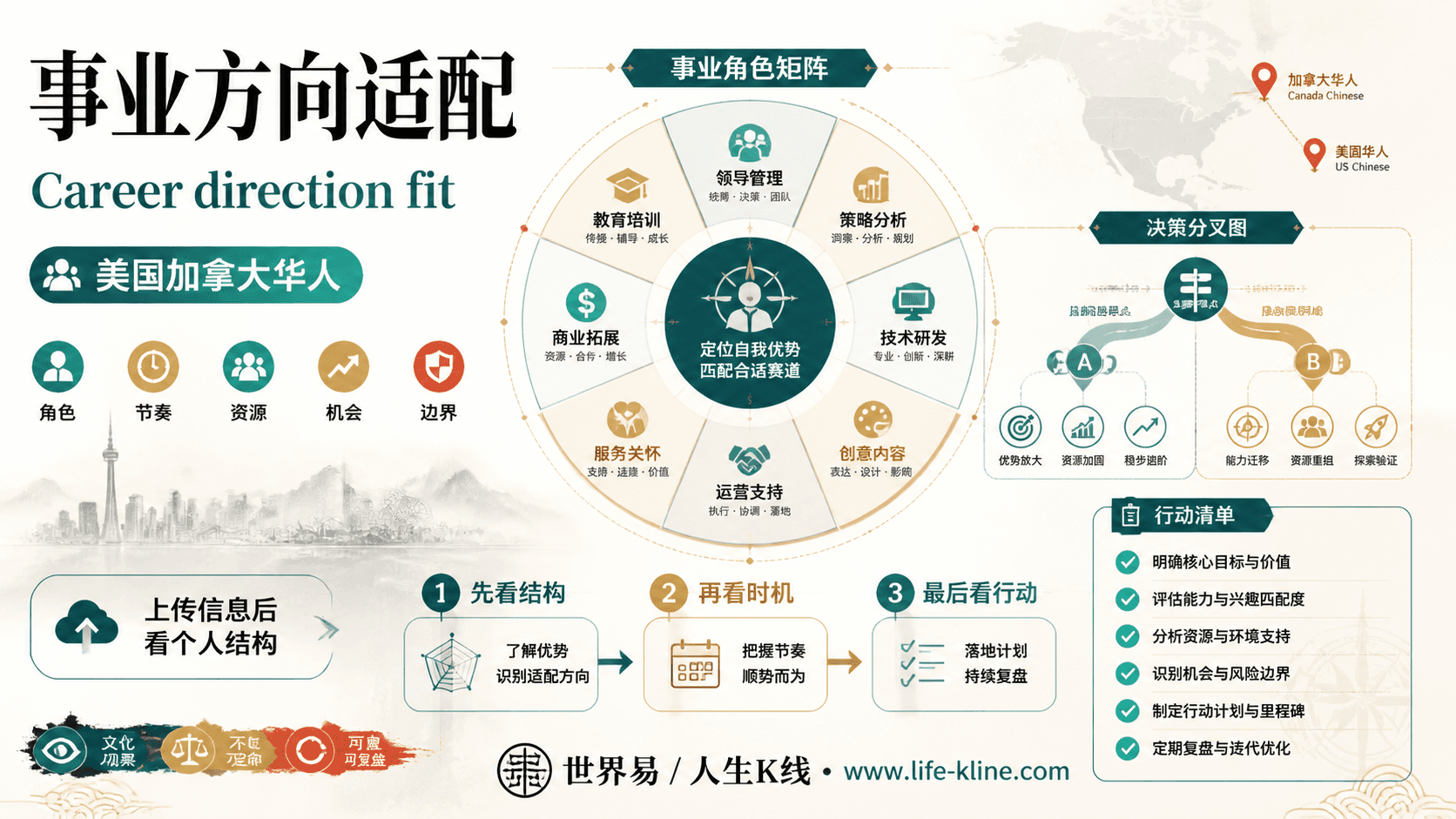
事业方向适配|美国加拿大华人
这张图把《BaZi Reference and Decision Analysis for Advancing or Waiting in Primary to Secondary School Transition》里的命理概念转成关系、边界和应用场景,适合先看图建立结构,再回到知识文章正文理解细节。
事业方向适配不应被写成固定结论。更适合美国加拿大华人的读法,是把传统术语翻译成结构、时机、环境、行动和复盘。
查看图片解读