Timing for Health Checkups and Long-Term Maintenance Strategies: Adjusting Health Rhythms from a Metaphysical Perspective
把这篇文章落到自己身上验证:先看结构,再进入个人分析,不做泛泛阅读。
你现在搜索的,
其实是一个要落到自己身上的判断。
当前页面主要回答「health checkup timing」这类搜索问题;真正有价值的下一步是把这套结构带进自己的报告、工具与案例验证。
Why This Decision Is Especially Difficult in This Health Scenario
The core difficulty in timing decisions for health checkups and early screenings lies in how to precisely integrate an individual's intrinsic life rhythms with external environmental changes to identify sensitive periods of health risk. In reality, annual checkups and tumor screenings are often complicated by lifestyle rhythms, work stress, and family history, making it challenging to determine the optimal timing, which can lead to overlooked potential health hazards or missed early intervention windows.
Furthermore, fluctuations in imaging projects and laboratory indicators are significantly influenced by the body's Five Elements rhythms. Different metaphysical patterns with Five Elements imbalances correspond to varying strengths and weaknesses of organ functions. Ignoring these differences may result in biased interpretation of checkup results, thereby affecting the scientific formulation of long-term maintenance strategies.
The overlay of metaphysical structure with actual symptoms makes judging health rhythms more complex. For example, some charts with strong Five Elements but Yong Shen being overcome may experience bodily function fluctuations during changes in Liu Nian and Da Yun, increasing the probability of abnormal checkup results. How to reasonably schedule checkups and maintenance by combining the dynamic changes in metaphysics becomes a key difficulty in decision-making.
Therefore, understanding the strength of the Day Master, the roles of Yong Shen and Ji Shen (unfavorable element), combined with the current Da Yun and Liu Nian, can not only assist in judging health rhythms but also provide a scientific basis for annual checkups and early screenings, reducing risks of blind spots or delays.
Correspondence Between Metaphysics and Five Elements Organs
In metaphysics, the Day Master's Five Elements attribute directly relates to the main organ functions of the body. Excessive or deficient tendencies reflect the strengths and weaknesses of certain systems. For example, Wood Day Masters often correspond to the liver and gallbladder system; Fire Day Masters relate to the heart and small intestine; Earth Day Masters govern the spleen and stomach; Metal Day Masters influence the lungs; Water Day Masters associate with the kidneys. The strength or weakness of the Day Master reflects the physiological state of these organs, affecting overall health rhythms.
The choice of Yong Shen and Ji Shen plays a key role in regulating the Five Elements balance. Yong Shen supplements the deficient elements, aiding organ function recovery; Ji Shen may aggravate organ burdens or induce functional imbalances. In long-term maintenance strategies, properly leveraging Yong Shen for regulation while avoiding excessive Ji Shen can stabilize bodily rhythms and reduce the risk of abnormal checkup results.
The current Da Yun and Liu Nian are important dynamic adjustment factors in metaphysics. Da Yun reflects the overall trend over a 10-year cycle, while Liu Nian indicates the body's fluctuations in a given year. Their interaction influences the rise and fall of Five Elements energy. Timing health checkups in accordance with the Five Elements strengths and weaknesses in Da Yun and Liu Nian, as well as organ conditions, can more precisely capture potential internal issues and optimize health management.
Additionally, the Five Elements seasonal qi is closely related to organ functions. For instance, Wood is strong in spring, suitable for liver and gallbladder care; Fire peaks in summer, requiring attention to heart load; Metal is strong in autumn, making lungs vulnerable; Water dominates in winter, critical for kidney function. Adjusting maintenance plans by combining metaphysics and seasonal qi can make long-term health care more targeted.
Three Real BaZi Chart Cases
Case 1 (based on Fact Package 1): This male's BaZi chart has a Day Master of Yi Wood (乙, Yi), which is relatively strong, with a Shi Shen (Eating God) pattern. The Yong Shen is Fire, and the Ji Shen is Water. Currently, he is in the Gui Mao (癸卯, Gui Mao) Da Yun, which is weak in strength, and the Liu Nian is Bing Wu (丙午, Bing Wu) with strong Fire supporting. The relatively strong Yi Wood corresponds to an active liver and gallbladder system, but the Gui Water Da Yun as Ji Shen may increase pressure on the liver and gallbladder or cause kidney function fluctuations. During health checkups and early screenings, focus should be on liver, gallbladder, and kidney-related indicators, especially liver and kidney structures in imaging examinations. Long-term maintenance strategies should strengthen the Fire Yong Shen to assist liver and gallbladder circulation and metabolism, avoiding excessive Water Ji Shen that may cause organ imbalance. The recommended assessment sequence is to first evaluate liver, gallbladder, and kidney function indicators, combined with lifestyle adjustments to enhance Fire element care, strictly preventing liver and kidney overload, and cooperating with medical monitoring if necessary.
Case 2 (based on Fact Package 2): This female's Day Master is Ji Earth (己, Ji), with balanced strength, a Zheng Guan (Direct Officer) pattern, Fire as Yong Shen, and Wood as Ji Shen. She is in the Ji Mao (己卯, Ji Mao) Da Yun and Bing Wu (丙午, Bing Wu) Liu Nian, with stable luck suitable for maintenance. Ji Earth represents spleen and stomach function; the balanced Earth Day Master corresponds to a relatively stable digestive system, but the Wood Ji Shen may consume the spleen and stomach to some extent. Health checkups should focus on digestive tract and immune indicators, especially spleen and stomach digestive absorption capacity and related tumor screenings. Long-term maintenance emphasizes Fire Yong Shen supplementation to promote spleen and stomach qi and blood metabolism, while avoiding excessive Wood Ji Shen causing internal damp-heat or digestive burden. The assessment sequence suggests starting with spleen and stomach function tests, combined with dietary habit adjustments, strengthening Fire element care, reducing Wood's negative impact, and maintaining internal yin-yang balance.
Case 3 (based on Fact Package 3): This female's Day Master is Bing Fire (丙, Bing), relatively strong, with a Yang Ren (Yang Blade) pattern. Water and Metal are Yong Shen, Wood is Ji Shen. Currently in Yi Chou (乙丑, Yi Chou) Da Yun which is stable, and Bing Wu (丙午, Bing Wu) Liu Nian with strong Fire. The strong Bing Fire Day Master corresponds to vigorous heart and small intestine functions, but excessive Fire and Wood Ji Shen may cause emotional fluctuations and nervous system strain. Yong Shen Water and Metal help balance the excessive Fire and protect kidney and lung functions. Health checkups and early screenings should focus on heart and lung function and neurological and psychological indicators, especially cardiovascular imaging examinations. Long-term maintenance should strengthen Water and Metal Yong Shen regulation to alleviate overwork and anxiety caused by Fire excess, avoiding Wood Ji Shen exacerbation. The assessment sequence recommends first monitoring heart and lung functions and emotional states, combined with metaphysical Yong Shen-guided lifestyle adjustments, reasonable rest scheduling, and emotional control.
Common Misjudgments and Blind Spots in This Scenario
A common misjudgment in timing decisions for health checkups and early screenings is over-reliance on metaphysical inference while neglecting clinical medical diagnosis, leading to delayed treatment or ignoring serious symptoms. Metaphysics should only serve as an auxiliary reference; any abnormal checkup results or red alert indicators must be professionally diagnosed by doctors, and self-diagnosis or medication adjustments are strictly prohibited.
Another blind spot is ignoring the impact of Liu Nian and Da Yun changes on bodily rhythms, relying solely on static BaZi charts to formulate maintenance strategies, which may fail to address annual fluctuations in bodily functions, resulting in ineffective health management. Long-term maintenance should combine dynamic metaphysical changes and actual symptoms to flexibly adjust lifestyle rhythms and examination plans.
Some people mistakenly equate Yong Shen directly with a specific organ's substitute indicator, ignoring Yong Shen's overall role in Five Elements regulation, leading to misjudgments focused on a single organ. A comprehensive analysis of the Day Master, Yong Shen, Ji Shen, and Da Yun and Liu Nian influences is necessary to scientifically determine checkup items and maintenance priorities.
Finally, neglecting the integrated evaluation of family history with metaphysics is also a common blind spot. The risk from family medical history combined with Five Elements weaknesses in certain organs requires precise timing and focus in checkups and early screenings to avoid missing important health risks.
Practical Judgment Sequence
First, combine the individual's BaZi chart Day Master Five Elements and Yong Shen and Ji Shen to preliminarily assess the strengths and weaknesses of organ functions, then integrate the current Da Yun and Liu Nian dynamics to predict the trends of health rhythms. This stage focuses on the potential burdens of overly strong organs and vulnerabilities of weak organs to assist in selecting key checkup items.
Second, combine actual symptoms and family history to observe whether there are obvious red flags such as persistent pain, abnormal imaging, severe insomnia, or fatigue. If present, immediate medical consultation is required without delay. Metaphysics can only assist in rhythm judgment and cannot replace medical diagnosis and treatment.
Finally, based on the metaphysical guidance on Yong Shen regulation, combined with seasonal changes, reasonably arrange diet, rest, emotional management, and checkup timing to formulate personalized long-term maintenance strategies. Regularly review changes in Da Yun, Liu Nian, and health status to dynamically adjust plans, ensuring stability and continuous optimization of health rhythms.
FAQ
Question 1: How do Yong Shen and Ji Shen specifically guide early screening and health checkups? Answer: Yong Shen represents the element that supplements deficient Five Elements, indicating organ functions requiring focused maintenance. Early screenings should focus on the corresponding systems. Ji Shen indicates potentially damaged or burdened organs; checkups should pay attention to risk indicators related to Ji Shen organs to detect hidden hazards early.
Question 2: What impact do Liu Nian and Da Yun changes have on timing health checkups? Answer: Liu Nian and Da Yun reflect annual and periodic fluctuations in body energy. During peak periods, organ functions are relatively active, suitable for comprehensive examinations. During weak periods, more caution is needed to avoid excessive burden. Checkup frequency and items should be adjusted according to these rhythms.
Question 3: Can metaphysics replace medical diagnosis? Answer: Absolutely not. Metaphysics serves only as an auxiliary tool for rhythm reference. Any abnormal symptoms or checkup indicators must be promptly evaluated by medical professionals for diagnosis and treatment. Metaphysics helps optimize maintenance rhythms but does not possess diagnostic or therapeutic functions.
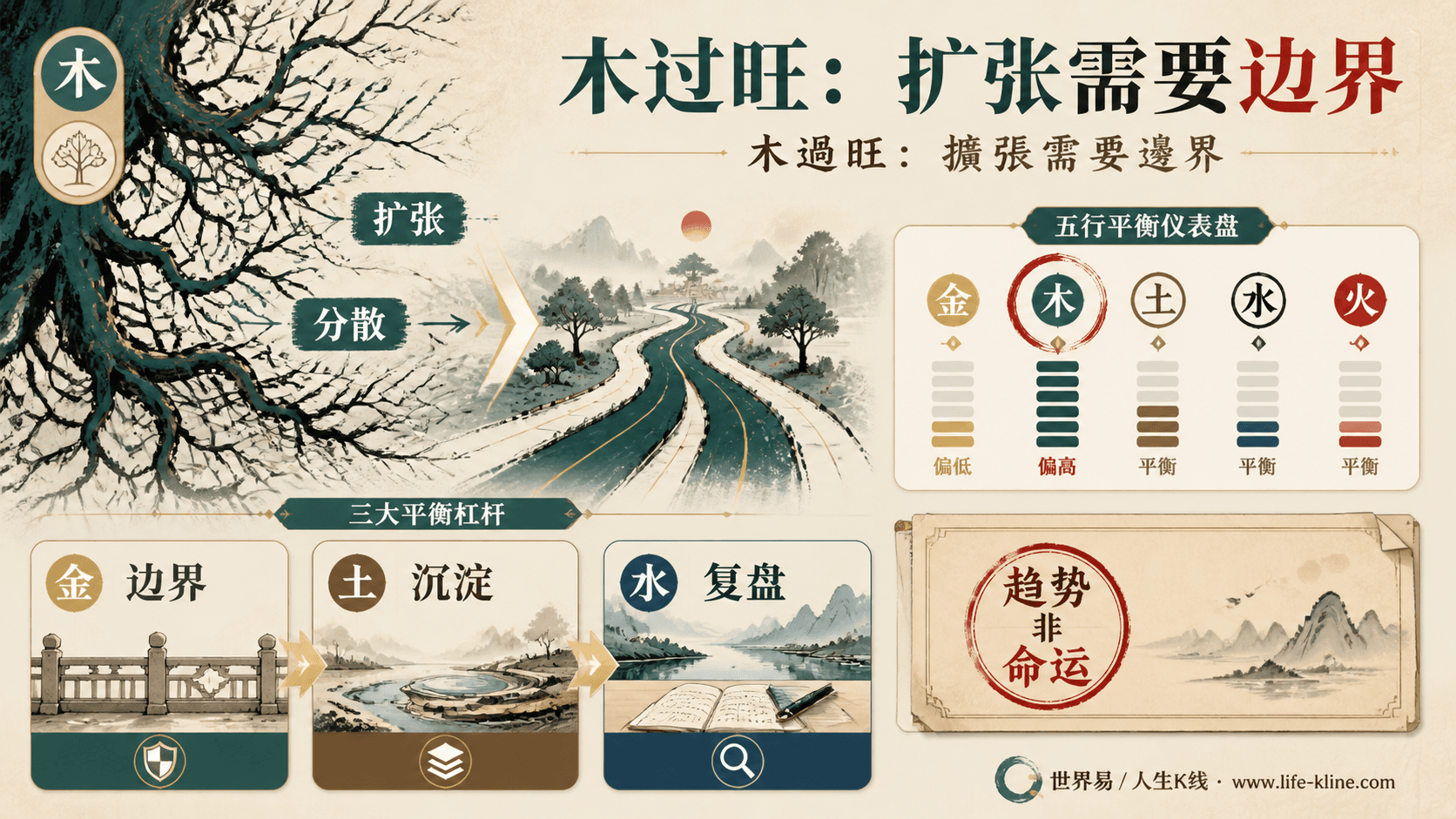
木过旺与再平衡
这张图把《Timing for Health Checkups and Long-Term Maintenance Strategies: Adjusting Health Rhythms from a Metaphysical Perspective》里的命理概念转成关系、边界和应用场景,适合先看图建立结构,再回到知识文章正文理解细节。
木过旺常表现为扩张过快、计划繁多、方向分散。在人生K线系统中,这是一种时位特征,而非固定标签。通过引入边界、沉淀与复盘,可实现自然再平衡,导向更可持续的结构。
查看图片解读