Jie Cai Pattern: Composition and Application Analysis of One Yang Ren Pattern in Destiny Studies
把这篇文章落到自己身上验证:先看结构,再进入个人分析,不做泛泛阅读。
Concept Definition
The Jie Cai pattern is a special configuration within the Yang Ren (Yang Blade) pattern system in destiny studies. Its fundamental composition involves the Month Branch or revealed stems sharing the same Five Element as the Day Master but with opposite Yin-Yang polarity. Specifically, if the Day Master is a Yang element, then the Month Branch or revealed stem must be the Yin form of the same element, and vice versa. This composition creates a presence of the same element’s force in the chart but with differing Yin-Yang qualities, forming a unique dynamic relationship.
In practical destiny analysis, the Jie Cai pattern is regarded as a powerful configuration that can enhance the Day Master’s energy under certain conditions but also carries potential risks of financial loss. Therefore, understanding the composition and function of the Jie Cai pattern is crucial for accurate chart interpretation.
The formation of the Jie Cai pattern relies on a detailed differentiation of the Five Elements and Yin-Yang, reflecting the profound insights of traditional Chinese metaphysics into the relationships between nature and human destiny. It is not only a theoretical classification but also an important guide for career choices and life directions in practical applications.
Destiny Characteristics and Symbolic Meaning
The main characteristic of the Jie Cai pattern is that the Five Element of the Month Branch or revealed stems is the same as the Day Master but with opposite Yin-Yang polarity. This structure brings a complex relationship that both supports and restrains, highlighting the importance of Yin-Yang balance in destiny. For a weak Day Master, encountering Jie Cai can act as a supportive force, helping to strengthen the Day Master’s vigor and vitality.
However, if the Day Master is strong, caution is needed because the Jie Cai force may be excessively strong, easily causing financial loss or adverse clashes and combinations with Yang Ren. This pattern symbolizes competition and conflict of forces, requiring proper adjustment and coordination to maintain balance and prevent losses caused by excessive strength.
Symbolically, the Jie Cai pattern represents challenge and aggressive energy. It is a vibrant but risky life pattern that emphasizes courage in life and career to take initiative and breakthrough. At the same time, it reminds one to maintain self-control and environmental harmony to avoid negative consequences from excessive impulsiveness.
Practical Configuration and Interpretation
In actual destiny interpretation, the Jie Cai pattern commonly appears when the Month Branch or revealed stems share the same Five Element as the Day Master but have opposite Yin-Yang polarity. For example, if the Day Master is Yang Wood (甲 Jia or 丙 Bing), then the Month Branch or revealed stem being Yin Wood (乙 Yi or 丁 Ding) forms the Jie Cai pattern. When the Day Master is relatively weak, Jie Cai can significantly enhance its strength, acting as a supportive force beneficial for personal growth and development.
The principle of favorability for the Jie Cai pattern is that it supports a weak Day Master and is suitable for careers requiring aggressive energy and competitiveness, such as competitive sports and sales. These fields demand strong initiative and stress resilience, which align well with the characteristics of the Jie Cai pattern.
Conversely, if the Day Master is strong, encountering Jie Cai is unfavorable because the excessive Jie Cai force may lead to financial loss or interpersonal conflicts due to clashes and combinations with Yang Ren. Such charts require careful control of impulsiveness in career and life to avoid adverse outcomes caused by over-competition.
Common Misconceptions
Many people mistakenly believe that Jie Cai in the Jie Cai pattern is always a negative force. In reality, when the Day Master is weak, Jie Cai has a positive role in supporting the Day Master and enhancing vitality. Ignoring this can lead to a one-sided understanding of the chart and missing out on the beneficial support that Jie Cai provides.
Another misconception is equating the Jie Cai pattern simply with impulsiveness and financial loss, neglecting the distinction between strong and weak Day Masters. Correct interpretation should consider the Day Master’s strength and differentiate the favorability of Jie Cai, enabling a comprehensive and accurate analysis that better guides practical life and career planning.
FAQ
Question: Why is the Jie Cai pattern classified as one of the Yang Ren patterns? Answer: Because the Jie Cai pattern’s composition involves the Month Branch or revealed stems sharing the same Five Element as the Day Master but with opposite Yin-Yang polarity, generating a similar aggressive force and energy as Yang Ren, it is considered a special manifestation within the Yang Ren pattern system.
Question: How should a weak Day Master utilize the Jie Cai pattern? Answer: A weak Day Master should use Jie Cai to support the self, leveraging the same-element force of Jie Cai to enhance personal vigor, which helps strengthen vitality and career development.
Question: Why does a strong Day Master encountering Jie Cai often suffer financial loss? Answer: When the Day Master is strong, the Jie Cai force may be too powerful, easily triggering conflicts and unfavorable situations that lead to financial loss or other damage. Therefore, encountering Jie Cai is unfavorable for a strong Day Master due to potential financial loss and clashes with Yang Ren.
Question: Which professions suit the Jie Cai pattern? Answer: The Jie Cai pattern suits competitive industries, sales, and other careers requiring aggressive energy and competitiveness. These fields can fully utilize the positive aggressive energy and vitality that Jie Cai brings.
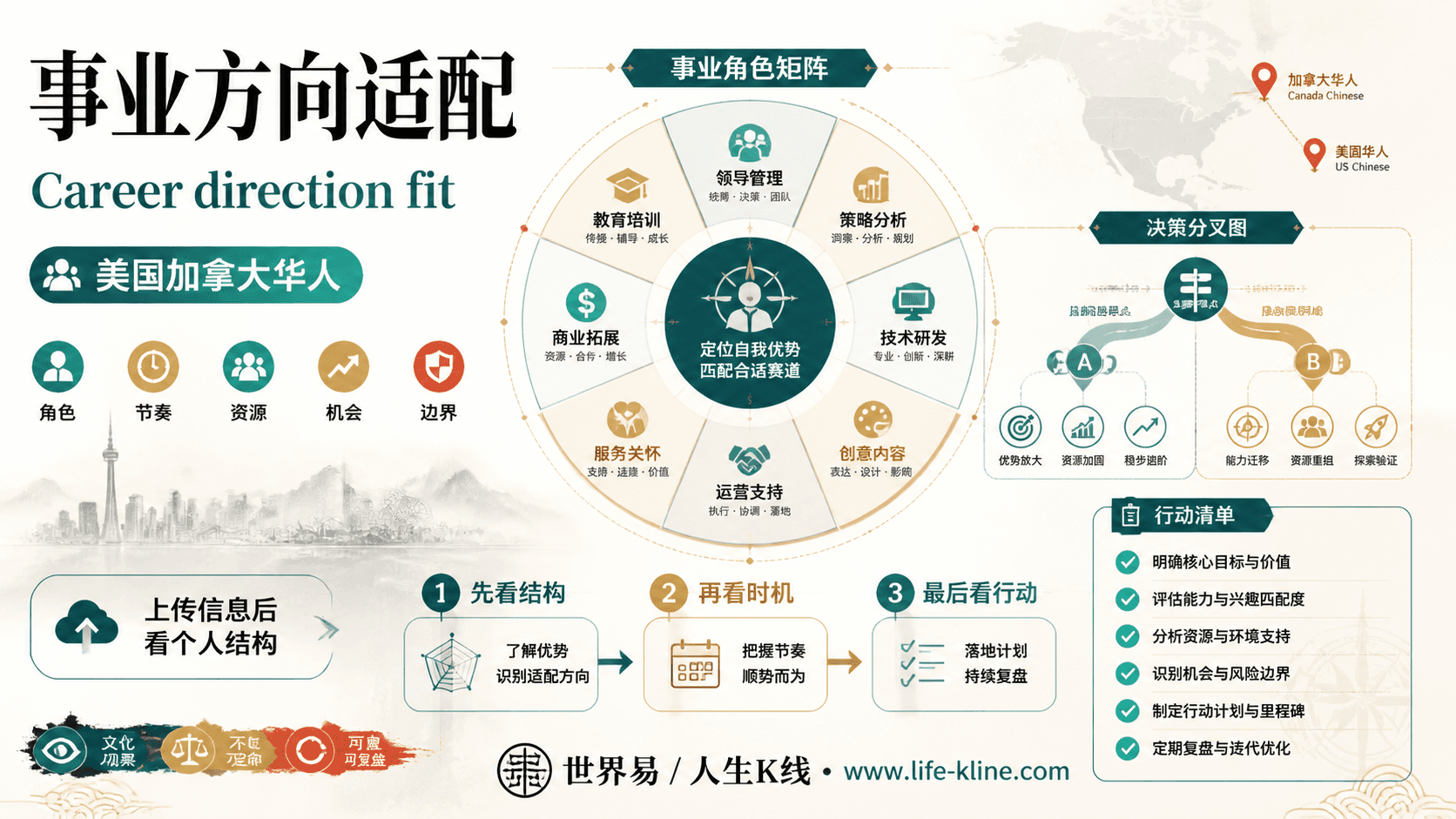
事业方向适配|美国加拿大华人
这张图把《Jie Cai Pattern: Composition and Application Analysis of One Yang Ren Pattern in Destiny Studies》里的命理概念转成关系、边界和应用场景,适合先看图建立结构,再回到知识文章正文理解细节。
事业方向适配不应被写成固定结论。更适合美国加拿大华人的读法,是把传统术语翻译成结构、时机、环境、行动和复盘。
查看图片解读