Identifying Danger Signals and Metaphysical Analysis in Partnership Equity Decisions
把这篇文章落到自己身上验证:先看结构,再进入个人分析,不做泛泛阅读。
Why This Decision Is Especially Difficult in This Wealth Scenario
Partnership and equity decisions inherently involve coordinating multiple interests. The complexity of equity ratio allocation, timing of joining, and exit settlements often traps decision-makers in a dilemma. Currently, with high housing prices, interest rate fluctuations, and inflation pressure in China, capital liquidity is particularly tight. The partners’ sense of financial security and trust directly affect the stability of cooperation.
Psychologically, partnership decisions are prone to cognitive biases, including overconfidence and blind trust in relatives and friends. In BaZi, this often manifests as intense resource competition when Bi Jian (Peer Stars) are strong and lack of support when Yin Stars are insufficient. Financial uncertainties exacerbate anxiety during decision-making, especially when Da Yun (decade luck cycles) and Liu Nian (annual fortunes) fluctuate, amplifying risks.
From a metaphysical perspective, the strength of the Day Master, and the interaction between Yong Shen (favorable elements) and Ji Shen (unfavorable elements), directly influence an individual’s capacity to bear financial risks and sensitivity in decision-making. Particularly, the combination of wealth stars, Bi Jian, and Yin stars determines the gain or loss of wealth and the stability of cooperation in partnerships. Understanding how these combinations resonate with real-world signals is key to accurately identifying danger signals.
Three Core Dimensions of Metaphysical Judgment
Firstly, the relationship between the Day Master and wealth stars determines a person’s initiative and attractiveness in wealth cooperation. A relatively weak Day Master, such as 乙 (Yi) Wood, tends to lose ground in cooperation when wealth stars are constrained and relies on strong Yong Shen like Water to regulate; whereas a relatively strong or balanced Day Master holds more initiative in resource competition but may face internal competition due to strong Bi Jian stars.
Secondly, Bi Jian stars reflect competition and support relationships among partners. The Bi Jian pattern often represents intense peer resource competition, which can easily cause trust breakdowns; the Shang Guan (Hurting Officer) pattern brings innovation but may cause tension if Ji Shen Water appears; in a specialized strong pattern, when the Day Master is 庚 (Geng) Metal and strong, Earth is the Yong Shen, and if Wood is the Ji Shen in the environment, external interference risks in cooperation should not be ignored.
Lastly, the interaction between Da Yun and Liu Nian reflects cyclical risk fluctuations. Stable Da Yun such as 辛卯 (Xin Mao), 癸巳 (Gui Si), and 庚子 (Geng Zi) provide good opportunities for consolidation, but if the Liu Nian has strong fire like 丙午 (Bing Wu) and fire is the Ji Shen, caution is needed in handling potential sudden conflicts and financial pressures in cooperation. By comprehensively analyzing these three dimensions, one can precisely identify potential danger signals in partnership decisions.
Three Real BaZi Chart Cases
Case 1: This lady’s Day Master is relatively weak 乙 (Yi) Wood, belonging to the Bi Jian pattern. Her Yong Shen is Water, and Ji Shen are Fire and Earth. She is currently in the 辛卯 (Xin Mao) Da Yun, with the 丙午 (Bing Wu) Liu Nian. The weak 乙 (Yi) Wood Day Master depends on Yong Shen Water for regulation. The 辛卯 (Xin Mao) Da Yun is stable and suitable for consolidation, but the 丙午 (Bing Wu) Liu Nian’s strong fire is a Ji Shen, possibly intensifying internal resource competition and trust risks. In partnerships, if equity ratios are uneven or joining occurs during tight capital flow, beware of conflicts triggered by Bi Jian stars. It is recommended to thoroughly check the trust foundation among partners and suspend major strategic decisions when Fire and Earth Ji Shen are prominent, waiting for a more stable environment before proceeding.
Case 2: This lady’s Day Master 丁 (Ding) Fire is balanced, with a Shang Guan (Hurting Officer) pattern. Her Yong Shen is Wood, and Ji Shen is Water. She is currently in the 癸巳 (Gui Si) Da Yun, with the 丙午 (Bing Wu) Liu Nian. 丁 (Ding) Fire Day Master expresses strongly; the Shang Guan pattern brings creativity but also internal friction risks. The Yong Shen Wood supports growth, while Ji Shen Water may cause emotional fluctuations and capital flow disruptions. The 癸巳 (Gui Si) Da Yun combined with the 丙午 (Bing Wu) Liu Nian’s strong fire confirms an active fire-wealth star state, but the appearance of Ji Shen Water increases the risk of cooperation breakdown. It is advised to thoroughly verify partners’ financial backgrounds and communication mechanisms before joining. When Water Ji Shen signals are evident, avoid blind expansion to prevent trust collapse and capital chain breaks.
Case 3: This lady’s Day Master is relatively strong 庚 (Geng) Metal, with a specialized strong pattern. Her Yong Shen is Earth, and Ji Shen is Wood. She is in the 庚子 (Geng Zi) Da Yun, with the 丙午 (Bing Wu) Liu Nian. The strong 庚 (Geng) Metal Day Master and specialized strong pattern highlight personal leadership. Earth as Yong Shen helps stabilize, while Wood as Ji Shen represents external interference. The current Da Yun is stable, but the Liu Nian’s strong fire combined with significant Wood Ji Shen indicates potential external competitive pressure and cooperation risks. In equity partnerships, be cautious of external interest interference and complex relationships brought by family members joining. The recommended judgment sequence is to first assess the impact of external environment and family relations. When Wood Ji Shen signals are strong, suspend key decisions and stabilize internal structure before development.
Common Misjudgments and Blind Spots in This Scenario
A common misjudgment in partnership equity decisions is overreliance on intuition and emotional trust, neglecting the potential resource competition and emotional conflict risks when Bi Jian stars are strong in BaZi. This blind spot is especially fatal when equity ratios are uneven or the timing of joining is inappropriate, often leading to trust collapse and financial disputes.
Another blind spot is ignoring the cyclical impact of Da Yun and Liu Nian on the cooperative environment, assuming a stable Da Yun allows one to proceed confidently, while overlooking sudden risks from Ji Shen in Liu Nian, resulting in capital chain breaks or partner intention changes at critical moments.
Additionally, insufficient understanding of Yong Shen and Ji Shen, without integrating real financial factors such as interest rate changes, inflation pressure, and stock market volatility, causes misinterpretation or exaggeration of metaphysical signals, leading to frequent decision errors.
Practical Judgment Sequence
First, verify the current strength of the Day Master and the status of Yong Shen and Ji Shen in the BaZi chart, with special attention to the combination of wealth stars and Bi Jian stars to determine the individual’s active or passive position in the partnership. Next, combine the current Da Yun and Liu Nian to analyze cyclical risks, focusing on whether Ji Shen is prominent and its resonance with the real financial environment.
Then, examine the real-world equity structure and capital liquidity to assess whether equity imbalance or tight capital flow exacerbates the risk of Bi Jian star conflicts in BaZi. If Ji Shen signals are obvious and real signals such as stock price fluctuations or disputes over loans among relatives appear simultaneously, immediately suspend partnership decisions and prioritize stabilizing the cooperative relationship.
Finally, establish a dynamic monitoring mechanism to regularly review changes in metaphysical and real-world signals. Combine Yong Shen adjustment strategies to timely adjust cooperation tactics, avoiding blind expansion and trust collapse, ensuring the healthy and stable development of the partnership enterprise.
FAQ
Question 1: If the Day Master is weak but the Yong Shen is strong, does that mean partnership risk is low? Answer: When the Day Master is weak, relying on Yong Shen support can indeed mitigate some risks, but one must still beware of internal competition caused by strong Bi Jian stars. Especially when the trust foundation among partners is weak, risks remain and decisions should not be based solely on Yong Shen strength.
Question 2: When the current Da Yun is stable but Ji Shen appears in Liu Nian, how should partnership decisions be handled? Answer: A stable Da Yun offers a good opportunity for consolidation, but prominent Ji Shen in Liu Nian indicates short-term sudden risks. At this time, major strategic decisions should be suspended first. Wait until Liu Nian risks subside before considering joining or expanding equity to avoid capital chain breaks and trust crises.
Question 3: For family members joining as partners, how to assess trust risks using BaZi? Answer: Family partnerships often involve deep emotions but tend to overlook conflicts from strong Bi Jian stars and Ji Shen influences in BaZi. Special attention should be paid to whether Bi Jian stars are strong and Ji Shen intensifies conflicts. If clear conflict signals exist, it is recommended to first establish clear financial and responsibility boundaries to prevent emotional factors from exacerbating partnership risks.
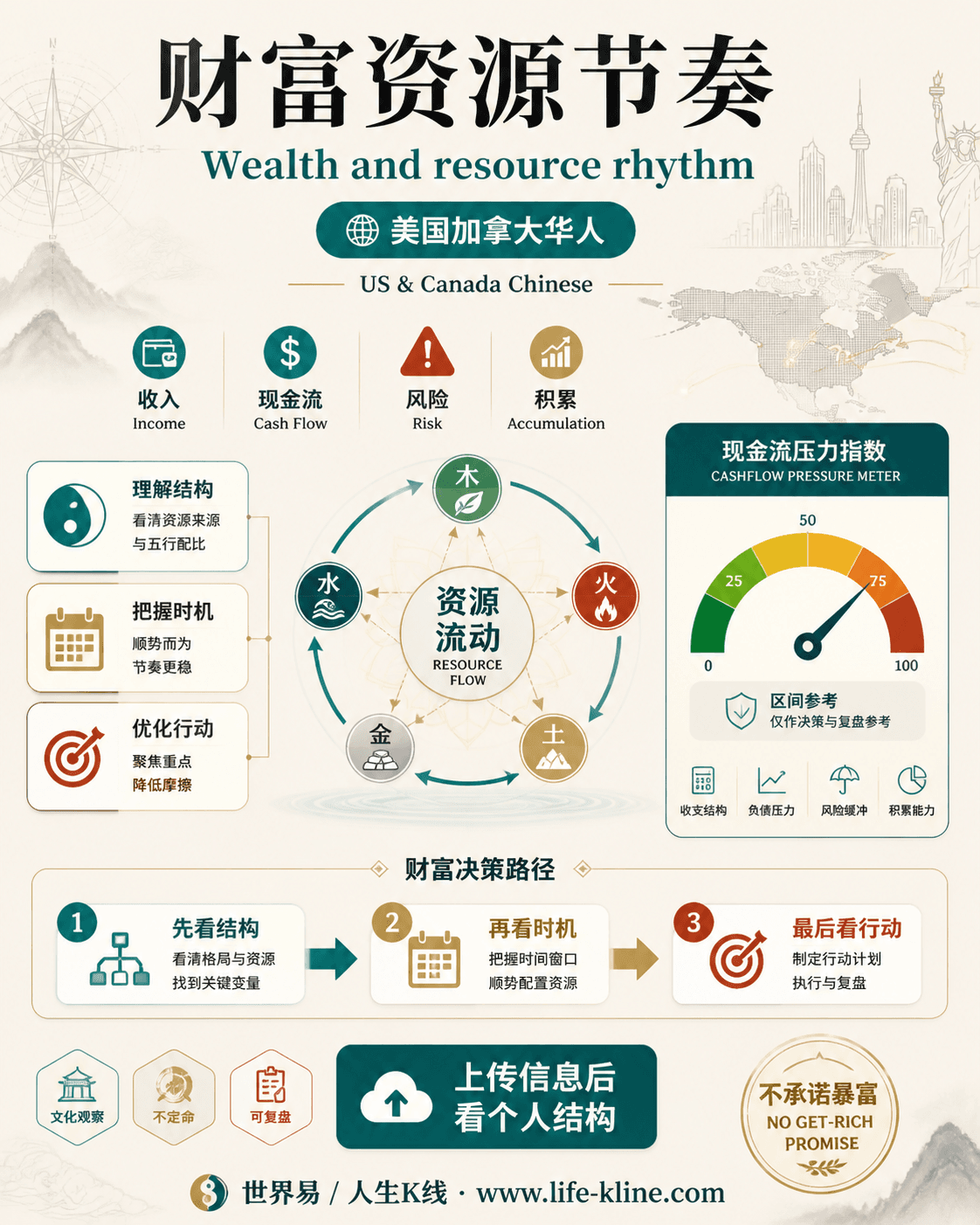
财富资源节奏|美国加拿大华人
这张图把《Identifying Danger Signals and Metaphysical Analysis in Partnership Equity Decisions》里的命理概念转成关系、边界和应用场景,适合先看图建立结构,再回到知识文章正文理解细节。
财富资源节奏不应被写成固定结论。更适合美国加拿大华人的读法,是把传统术语翻译成结构、时机、环境、行动和复盘。
查看图片解读