Post-Loss Review and Restart of Partnership Equity: Decision-Making Strategies from a Metaphysical Perspective
把这篇文章落到自己身上验证:先看结构,再进入个人分析,不做泛泛阅读。
Why This Decision Is Especially Difficult in This Wealth Scenario
The core difficulty in reviewing and restarting decisions after losses in partnership equity lies in balancing emotional trust and rational risk control. In reality, uneven equity ratios, family members joining the partnership, and breakdowns in trust often lead to biased decisions, exacerbating the subsequent impact of losses. Especially under the current macro environment of inflation and interest rate fluctuations, liquidity and asset preservation pressures are significant, making the timing of review particularly critical.
Psychologically, investors often fall into the intertwined pitfalls of regret and wishful thinking after losses, easily resulting in delayed acceptance of losses or blindly injecting more capital. The metaphysical structure amplifies the complexity of decisions at this stage; for example, a strong Bi Jian/Jie Cai may reinforce personal subjective will, while a weak or restrained Wealth Star indicates increased risks, requiring caution to avoid stubbornness.
Meanwhile, the interaction between Da Yun (decade luck cycle) and Liu Nian (annual fortune) affects the timing of actions. The stability of Da Yun combined with the adaptability of Liu Nian means that the review is not only a summary of the past but also a forecast of future trends. This multidimensional complexity makes simple financial analysis insufficient for comprehensive control, and metaphysical judgment provides an important auxiliary perspective.
Therefore, in this wealth scenario, decision-makers must integrate real financial constraints, psychological states, and metaphysical structure to clarify the boundaries between accepting losses and remediation, avoiding greater losses due to blind persistence or missing recovery opportunities due to premature abandonment.
Three Core Dimensions of Metaphysical Judgment
The first is the relationship between the Day Master and the Wealth Star. The Day Master represents the individual's core energy, while the Wealth Star relates to wealth and partnership interests. A relatively strong Day Master with moderate Wealth Star implies strong personal energy and smooth wealth flow, making it easier to rationally assess loss causes during review; conversely, a weak Day Master or restrained Wealth Star suggests caution during review, as there may be information asymmetry or decision blind spots.
The second is the influence of Bi Jian/Jie Cai on cooperative relationships. Bi Jian/Jie Cai represent peer competition or cooperative forces; when strong, they tend to cause internal competition and resource dispersion, affecting partnership stability. After losses, a strong Bi Jian/Jie Cai may cause individuals to insist on their own views, hindering rational acceptance of losses and cooperative repair; when weak, it facilitates accepting external advice and benefits restarting.
The third is the clash and harmony between Da Yun and Liu Nian. Da Yun represents medium- to long-term trends, while Liu Nian reflects short-term environments. A stable Da Yun combined with adaptable Liu Nian suggests the current environment is suitable for maintaining status quo and flexible adjustments. If the Wealth Star or Yong Shen in Da Yun or Liu Nian is clashed or restrained, caution is needed to avoid exacerbating losses due to adverse external factors; otherwise, timely remediation is favorable.
By synthesizing these three dimensions, one can scientifically determine when to decisively accept losses and exit or when to consider remediation and restart after losses, avoiding interference from emotions and environmental factors.
Three Real BaZi Chart Cases
Case 1: Female, Day Master Xin Metal (辛, Xin) relatively strong, Bi Jian pattern, Yong Shen Fire and Wood, Ji Shen Earth, currently in Jia Xu (甲戌, Jia Xu) Da Yun (ages 29-38, stable and suitable for maintaining), Liu Nian Bing Wu (丙午). The relatively strong Xin Metal Day Master represents strong personal will, and the Bi Jian pattern indicates a self-leading tendency in the partnership. The Yong Shen Fire and Wood help harmonize and mitigate the Ji Shen Earth influence. Both Da Yun and Liu Nian show a combination of stability and adaptability, suitable for maintaining but not for aggressive moves. In reviewing partnership equity losses, this chart suggests focusing on observing external environmental changes and avoiding neglecting partners' opinions due to strong personal will. The recommended judgment sequence is: first evaluate external environmental changes (Liu Nian influence), then examine internal cooperative relationships (Bi Jian pattern influence), and finally decide whether to accept losses and exit or adjust strategy for remediation.
Case 2: Male, Day Master Yi Wood (乙, Yi) relatively weak, Zheng Cai (Direct Wealth) pattern, Yong Shen Water, Ji Shen Fire and Earth, currently in Jia Yin (甲寅, Jia Yin) Da Yun (ages 32-41, stable and suitable for maintaining), Liu Nian Bing Wu (丙午). The weak Yi Wood Day Master means insufficient personal energy; the Zheng Cai pattern reflects wealth as the main focus. Yong Shen Water helps nourish the Day Master, while Ji Shen Fire and Earth represent potential risks. Both Da Yun and Liu Nian are stable, but the weak Yi Wood suggests susceptibility to external environment influence and inner wavering during loss review. Under this structure, review should cautiously prevent emotional fluctuations causing blind decisions, especially when family members join or trust crises occur, requiring objective loss assessment. The recommended judgment sequence is: prioritize confirming the stability of Yong Shen Water (fund and information flow), then assess the interference level of Ji Shen Fire and Earth on decisions, and finally combine Da Yun and Liu Nian trends to decide whether to timely accept losses or seek remediation opportunities.
Case 3: Male, Day Master Jia Wood (甲, Jia) relatively strong, Yang Ren (羊刃) pattern, Yong Shen Wood, Ji Shen Water, currently in Ding You (丁酉, Ding You) Da Yun (ages 35-44, stable and suitable for maintaining), Liu Nian Bing Wu (丙午). The relatively strong Jia Wood Day Master and Yang Ren pattern indicate strong personal execution ability and initiative to break through difficulties. Yong Shen Wood supports the Day Master, while Ji Shen Water may become an adverse external factor. Both Da Yun and Liu Nian suggest maintaining and adaptable conditions, suitable for adjusting strategy. This chart shows strong personal will in reviewing partnership equity losses, tending to insist on restart plans but needing to guard against ignoring external risks (Ji Shen Water). The recommended judgment sequence is: first confirm whether the risk from Ji Shen Water is controllable, then examine the resource support from Yong Shen Wood, and finally combine Da Yun and Liu Nian to judge the timing of review, avoiding blind actions causing greater losses.
Common Misjudgments and Blind Spots in This Scenario
First, overreliance on subjective will, especially in structures with strong Bi Jian/Jie Cai or strong Day Master, where investors tend to be stubborn, ignoring partners' opinions and market changes, delaying acceptance of losses and causing continued loss expansion.
Second, neglecting the dynamic influence of Yong Shen and Ji Shen. Yong Shen represents regulating forces, while Ji Shen indicates potential risks. During review, failure to timely identify Ji Shen interference or overestimating Yong Shen support leads to erroneous judgments about remediation possibilities.
Third, insufficient consideration of the interaction between Da Yun and Liu Nian. Many investors focus only on current loss figures, ignoring the guidance of Da Yun and Liu Nian on overall trends, overlooking the timing value of maintaining versus adapting, and missing optimal exit or restart windows.
Finally, emotional factors and family relationship complexities are often underestimated. Trust breakdowns when family members join greatly increase decision difficulty, easily triggering blind capital injections or impulsive exits, causing secondary losses.
Practical Judgment Sequence
Step one: Confirm the strength of the Day Master and whether the Yong Shen is effective. After losses, the primary judgment is whether personal subjective energy is sufficient (relatively strong or weak) and whether the regulating power of Yong Shen is stable, determining if the basic conditions for remediation exist.
Step two: Assess the relationship between the Wealth Star and Bi Jian/Jie Cai. The Wealth Star represents wealth interests, Bi Jian/Jie Cai represent cooperative or competitive forces. Their strength and interaction determine the possibility and risk of cooperation during review, especially focusing on whether strong or weak Bi Jian/Jie Cai causes tension or stability in partnerships.
Step three: Combine current Da Yun and Liu Nian to judge the external environment and timing. Stable Da Yun combined with adaptable Liu Nian is suitable for maintaining and flexible adjustment; otherwise, caution is required. Based on the clash and harmony between Da Yun and Liu Nian, choose the best timing to accept losses and exit or remediate and restart.
In summary, rational review and restart decisions should start from the metaphysical structure, combined with financial realities and psychological dynamics, gradually checking whether remediation conditions exist and when to timely stop losses, ensuring decisions align with personal metaphysical advantages and market environment changes.
FAQ
Question 1: How does the Yong Shen in the BaZi chart specifically influence decisions after partnership equity losses? Answer: Yong Shen in metaphysics represents the element that harmonizes and supports the Day Master. After partnership equity losses, a strong and stable Yong Shen indicates the individual has good resources and environmental support, suitable for active remediation; a weak or clashed Yong Shen signals increased risks, advising cautious acceptance of losses or waiting for a better timing.
Question 2: What negative impact does a strong Bi Jian/Jie Cai have on loss review? Answer: A strong Bi Jian/Jie Cai indicates strong peer forces, easily causing internal competition and opinion divergence, leading to tense cooperation. During loss review, those with strong Bi Jian/Jie Cai may be stubborn, hindering rational assessment and adjustment, increasing difficulty in accepting losses and creating blind spots in review.
Question 3: How do Da Yun and Liu Nian assist in judging the specific timing for review? Answer: Da Yun reflects medium- to long-term trends, while Liu Nian reflects short-term environments. A stable Da Yun combined with adaptable Liu Nian indicates the current environment suits maintaining and flexible adjustment, favoring remediation and restart; if the Wealth Star or Yong Shen in Da Yun or Liu Nian is clashed or restrained, it signals increased risks and suggests considering accepting losses and exiting.
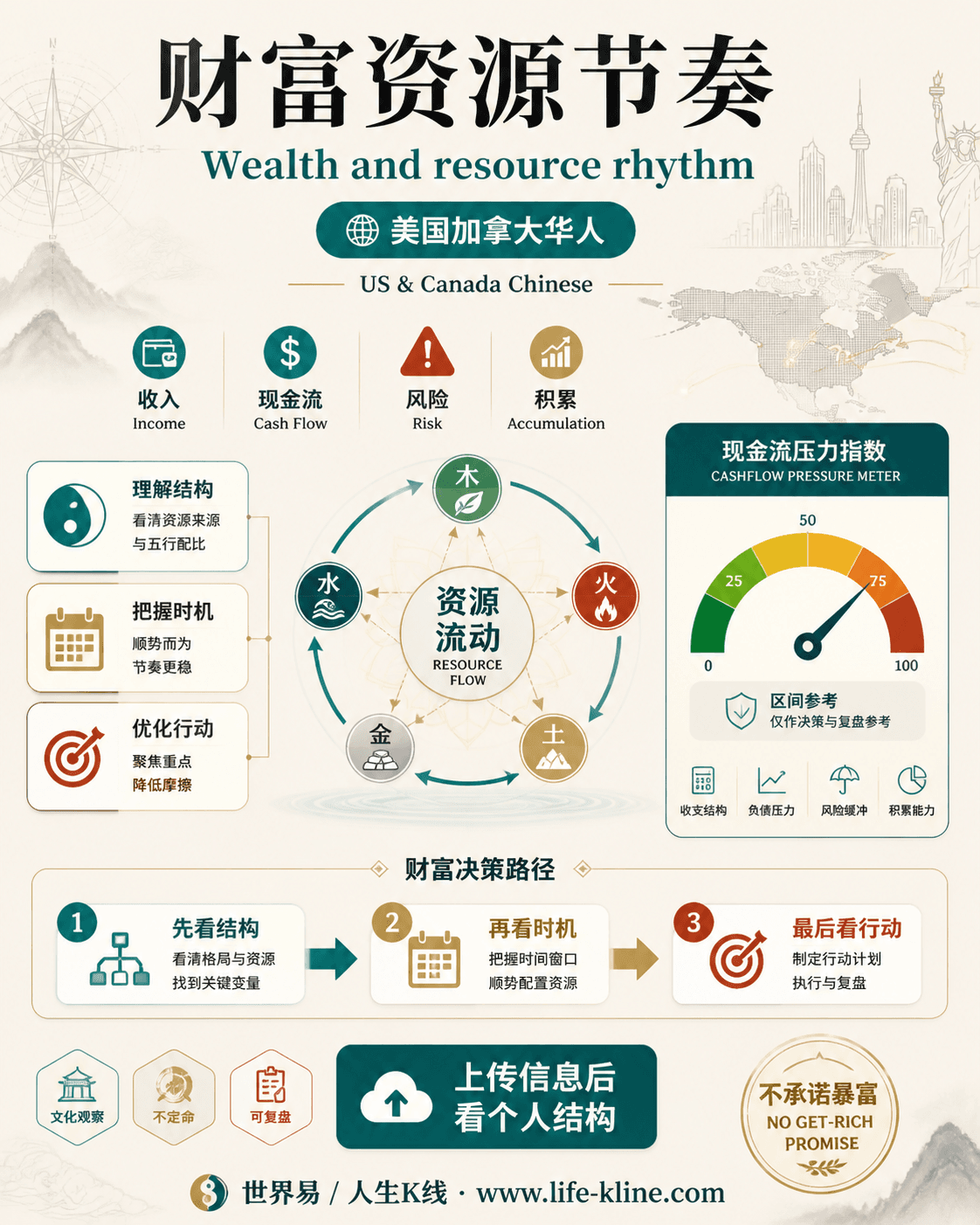
财富资源节奏|美国加拿大华人
这张图把《Post-Loss Review and Restart of Partnership Equity: Decision-Making Strategies from a Metaphysical Perspective》里的命理概念转成关系、边界和应用场景,适合先看图建立结构,再回到知识文章正文理解细节。
财富资源节奏不应被写成固定结论。更适合美国加拿大华人的读法,是把传统术语翻译成结构、时机、环境、行动和复盘。
查看图片解读