Action and Waiting in Partnership Equity Decisions: A Metaphysical Perspective
把这篇文章落到自己身上验证:先看结构,再进入个人分析,不做泛泛阅读。
Why This Decision Is Especially Difficult in This Wealth Scenario
The core of partnership and equity decisions lies in balancing equity ratio, timing of joining, and risk control. In reality, equity distribution directly affects future profit sharing and control rights; any carelessness may lead to breakdown of cooperation or even intensify family conflicts. Especially when involving family members joining and trust foundations, psychological burdens and emotional factors often complicate decisions and affect rational judgment.
Under the current Chinese economic environment, inflation pressure, high housing prices, and interest rate fluctuations increase financial uncertainty. Capital liquidity and risk tolerance become key considerations. Ambiguities in partners’ capital contributions and exit arrangements often trigger risks of capital chain breaks, thereby affecting project progress and profit realization.
Metaphysical structures play an amplifying or buffering role in these decisions. The strength of the Day Master determines personal initiative and stress tolerance; the pattern reflects cooperation mode and resource allocation; Yong Shen serves as the indicator for action or waiting. The clash and harmony between Da Yun (decade luck cycle) and Liu Nian (annual fortune) further influence the current financial environment and cooperative atmosphere, deciding whether it is suitable to act or to delay.
In summary, partnership equity decisions require balancing real-world conditions with metaphysical signals. One must neither act impulsively nor miss good opportunities due to fear of risk. Understanding core metaphysical dimensions combined with the current economic situation is key to rational decision-making.
Three Core Dimensions of Metaphysical Judgment
First, the strength of the Day Master reflects personal energy and stress resistance. A relatively weak Day Master often needs external resources (Yong Shen) to supplement; action should be cautious to avoid over-exhausting personal energy. A relatively strong Day Master possesses greater initiative and resource integration ability, suitable for seizing opportunities proactively.
Second, the combination of Cai Xing (wealth stars), Bi Jian (peer stars), and Yin Xing (resource stars) reveals cooperation relationships and resource flow. Cai Xing represents wealth and income; when strong, it indicates favorable financial luck, suitable for investment and partnership. Bi Jian symbolizes peer competition or support; excessive strength may lead to resource contention and needs balancing. Yin Xing is a supportive force that can stabilize relationships and buffer risks.
Finally, the clash and harmony between Da Yun and Liu Nian reflect the current environment’s auspicious or inauspicious changes. Favorable Da Yun combined with smooth Liu Nian indicates mature timing for action and smooth resource flow. Conversely, if Da Yun is stable or Liu Nian presents clashes, it is better to consolidate or wait to prevent impulsive losses.
Integrating these three dimensions, the metaphysical structure provides a scientific reference for partnership equity decisions, helping determine when to act proactively to secure rights and when to maintain observation to mitigate risks.
Three Real BaZi Chart Cases
Case 1: The Day Master is 癸 (Gui) Water, relatively weak, belonging to the Shang Guan (Hurting Officer) pattern. The Yong Shen is Fire, and the Ji Shen (unfavorable element) is Wood. Currently in the 9th year of the 丙辰 (Bing Chen) Da Yun, with the 丙午 (Bing Wu) Liu Nian, both auspicious luck. Career and financial luck are progressing. The Water Day Master is weak and in a Shang Guan pattern; Fire as Yong Shen represents action and motivation. The favorable Da Yun and Liu Nian imply strong motivation to act, suitable for actively pursuing partnership opportunities. In reality, the individual is young and in a career growth phase. When facing equity partnership timing, focus should be on the Fire element’s manifestation in own resources and cooperation relationships, such as team support and capital liquidity. The recommended judgment sequence is first to confirm the circulation status of the Yong Shen Fire; if capital and cooperation relations are active and Da Yun and Liu Nian are favorable, decisive action is appropriate; otherwise, delay to avoid over-exhausting personal energy.
Case 2: The Day Master is 丁 (Ding) Fire, balanced, Shang Guan pattern, with Yong Shen Wood and Ji Shen Water. The Da Yun is 癸巳 (Gui Si), a stable luck cycle, suitable for consolidation; the current Liu Nian is 丙午 (Bing Wu), requiring flexibility. The 丁 (Ding) Fire Day Master is balanced; Wood as Yong Shen represents continuous support and growth momentum. However, the current Da Yun favors consolidation, and the Liu Nian shows changes but no significant auspicious or clash effects. Considering real-world partnership equity risks, the individual is older and in a consolidation phase; partnership actions should be cautious, especially regarding trust risks and capital liquidity. The suggested judgment sequence is to first assess the vitality of Yong Shen Wood and the stability of Da Yun; if team support and capital security are sufficient, limited action may be considered; if unfavorable changes appear in Da Yun or Liu Nian or the cooperative environment is unstable, it is advisable to maintain observation and focus on consolidating existing rights.
Case 3: The Day Master is 戊 (Wu) Earth, relatively strong, with Pian Yin (Indirect Resource) pattern. Yong Shen are Wood and Water; Ji Shen is Fire. Currently in the 癸酉 (Gui You) Da Yun, an auspicious cycle, with career and financial progress; the Liu Nian is 丙午 (Bing Wu), aligned with the trend. The 戊 (Wu) Earth Day Master is strong; Pian Yin pattern indicates strong resource support and learning ability. Wood and Water as Yong Shen symbolize external assistance and financial liquidity; Fire as Ji Shen warns against over-exhausting resources. In reality, the individual is a middle-aged woman with improving career and financial status, possessing strong resource integration and cooperative foundation. The judgment sequence should first confirm the activity level of Yong Shen Wood and Water; if capital flows smoothly and the cooperative environment is stable, actively seizing partnership opportunities is suitable; if the Fire Ji Shen is prominent causing resource depletion, caution is advised to avoid blind expansion.
These three cases illustrate how different Day Master strengths and Yong Shen combinations influence partnership equity decisions. Combined with the current Da Yun and Liu Nian environment, they help clarify reasonable judgments between action and waiting.
Common Misjudgments and Blind Spots in This Scenario
A common misjudgment in partnership equity decisions is overreliance on emotional factors while neglecting capital liquidity and financial risks, leading to blind joining or premature exit and financial loss. Neglecting the Day Master’s strength and Yong Shen status in metaphysical analysis also causes mistimed actions and missed optimal windows.
Another blind spot is insufficient understanding of the clash and harmony relationship between Da Yun and Liu Nian. Some assume that as long as Da Yun is auspicious, action is warranted, ignoring whether Liu Nian is aligned, resulting in mistimed actions and increased risks. Emotional interference is especially amplified when family members are involved.
Additionally, some decision-makers underestimate the competitive nature of Bi Jian stars; overcrowded cooperative relationships may cause resource contention and trust collapse. Metaphysical structure should be used to identify cooperation pressure points and risks.
Finally, ignoring the potential destructive effects of Ji Shen, especially during capital shortages or market volatility, can amplify negative impacts and lead to decision failures.
Practical Judgment Sequence
First, confirm the strength of the Day Master to assess personal energy and risk tolerance. A weak Day Master should avoid blind expansion; a strong Day Master has conditions to proactively compete. Second, evaluate the circulation and vitality of Yong Shen, especially those related to Cai Xing (wealth stars), to judge capital flow and cooperation support. When Yong Shen is vigorous, action signals are strong; when constrained, caution and waiting are advised.
Next, consider the clash and harmony between Da Yun and Liu Nian to judge whether the current environment is favorable. Favorable Da Yun combined with aligned Liu Nian indicates mature timing for action; stable Da Yun or conflicting Liu Nian suggests consolidation or observation. Finally, factor in the influence of Bi Jian stars and Ji Shen to identify cooperation pressure and potential risks, avoiding trust collapse caused by internal competition or external pressure.
Overall judgment should follow the sequence: Day Master — Yong Shen — Da Yun & Liu Nian — Bi Jian & Ji Shen, conducting layered screening to form a dynamic evaluation. Only when Yong Shen is vigorous, Da Yun and Liu Nian are aligned, and the cooperative environment is stable, is active action appropriate; otherwise, moderate waiting and risk prevention with flexible adaptability are recommended.
FAQ
Question 1: How to judge whether the Yong Shen in a BaZi chart is vigorous? Answer: Yong Shen vigor mainly depends on whether the corresponding Five Elements in the Four Pillars (Heavenly Stems and Earthly Branches) and Da Yun & Liu Nian are strong, and whether it is free from restraint or clash by Ji Shen. Specifically, observe if the Yong Shen element is supported by Yin Xing (resource stars) or generated by Cai Xing (wealth stars), and whether Da Yun and Liu Nian bring corresponding assistance.
Question 2: When the Day Master is weak, how should partnership equity decisions be adjusted? Answer: A weak Day Master indicates limited personal energy; it is recommended to rely heavily on Yong Shen support and avoid excessive risk-taking. Decision-making should observe the circulation of Yong Shen; if Yong Shen is vigorous and the environment stable, moderate action is feasible; otherwise, maintain caution and wait for more favorable timing.
Question 3: How significant is the impact of clash and harmony between Da Yun and Liu Nian on equity actions? Answer: Da Yun represents mid-to-long-term trends, while Liu Nian reflects annual changes. Favorable Da Yun combined with aligned Liu Nian means less resistance to action, conducive to expansion and cooperation; if Liu Nian clashes with Da Yun, the environment is unstable and risks increase. In such cases, consolidation or waiting is advised to avoid major losses caused by short-term fluctuations.
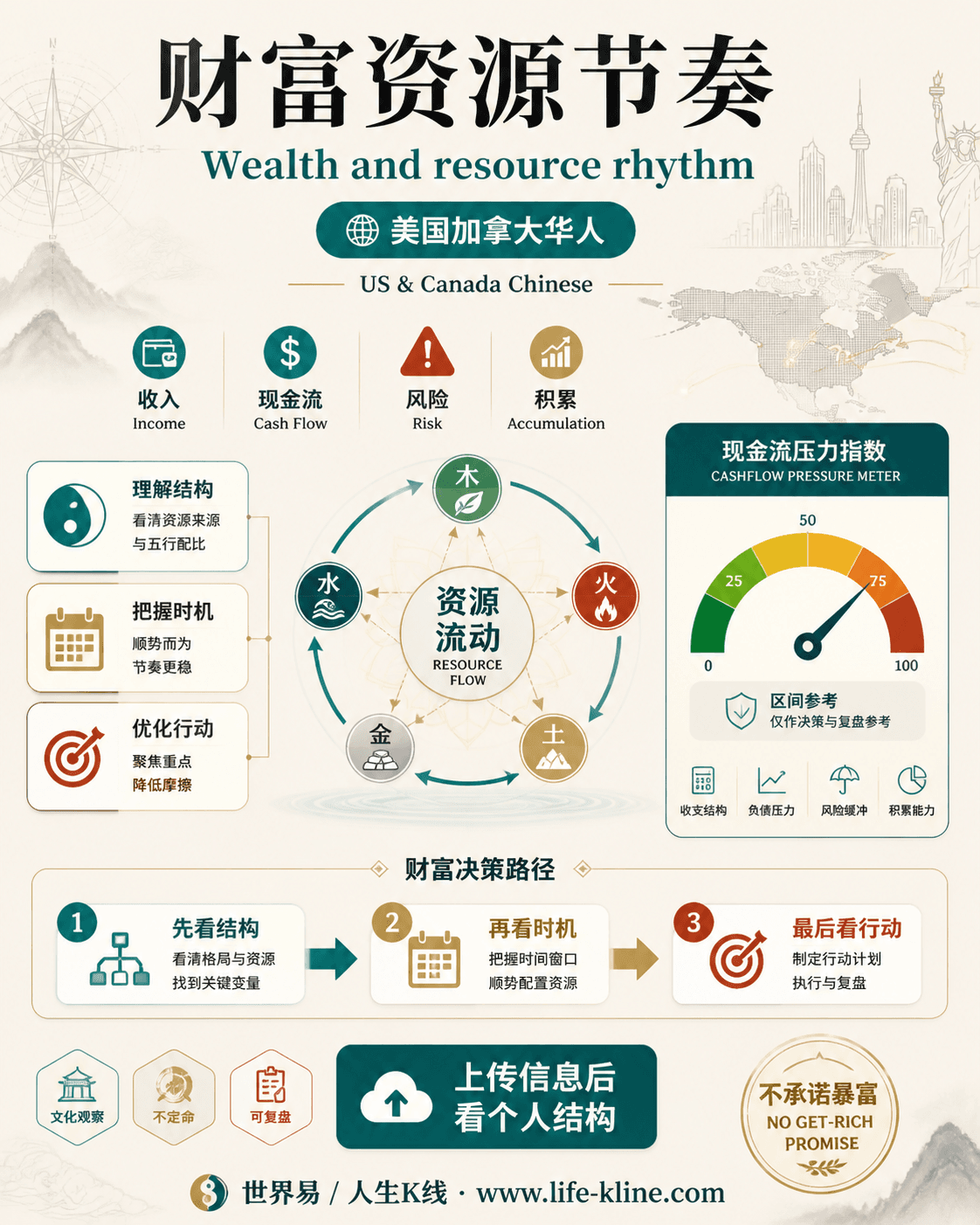
财富资源节奏|美国加拿大华人
这张图把《Action and Waiting in Partnership Equity Decisions: A Metaphysical Perspective》里的命理概念转成关系、边界和应用场景,适合先看图建立结构,再回到知识文章正文理解细节。
财富资源节奏不应被写成固定结论。更适合美国加拿大华人的读法,是把传统术语翻译成结构、时机、环境、行动和复盘。
查看图片解读