Analysis of Litigation and Settlement Strategies in Partnership and Equity Disputes
把这篇文章落到自己身上验证:先看结构,再进入个人分析,不做泛泛阅读。
Why This Decision Is Especially Difficult in This Legal Scenario
Partnership and equity disputes typically involve multiple complex factors, such as equity dilution, uneven profit distribution, unclear withdrawal settlements, hidden shareholders, and contractual betting clauses. The legal process itself is not only time-consuming and labor-intensive but also difficult in evidence collection, with long litigation cycles and uncertain enforcement. From a legal practice perspective, the civil litigation statute of limitations and the principle of prioritizing mediation require parties to weigh pros and cons and timely decide whether to persist in litigation or proceed with settlement first.
On the other hand, attorney fees and litigation risks are also important considerations in decision-making. During litigation, if evidence is insufficient or the opposing party is uncooperative, blindly initiating a lawsuit may lead to wasted resources and deteriorated relationships. Conversely, choosing to settle too early may forfeit rightful interests, especially when hidden equity and betting clauses are involved, requiring extra caution.
From a metaphysical perspective, the strength of the disputant’s Day Master, the combination of Qi Sha / Zheng Guan (representing law and authority), Shang Guan (representing expression and conflict), and Bi Jian / Jie Cai (representing competition and contention) among the Ten Gods can indicate the appropriate rhythm for the party’s actions. The influence of Da Yun (decade luck cycle) and Liu Nian (annual fortune) on current fortune is particularly critical; stable Da Yun suggests maintaining the status quo, while conflicting or harmonizing Liu Nian signals possible changes and increased conflicts.
Therefore, the decision to litigate or settle in partnership equity disputes is influenced not only by legal procedure costs and evidence conditions but can also be assisted by BaZi structure to judge the party’s current rhythm, avoiding blind actions or missed opportunities.
Three Core Dimensions of Metaphysical Judgment
The first is the strength of the Day Master and the BaZi pattern. A relatively strong or exclusively strong Day Master indicates the party has greater confidence and leadership ability, tending to take the initiative in disputes; a weaker Day Master requires caution to avoid excessive actions. The Shi Shen (Food God) pattern and Qi Sha (Seven Killings) pattern emphasize different aspects of expression and authority, directly affecting litigation attitude.
The second is the combination of Zheng Guan / Qi Sha and Shang Guan. Zheng Guan / Qi Sha symbolize legal authority and restraint, while Shang Guan represents expression, resistance, and demands. When Zheng Guan / Qi Sha are strong and supported by the Yong Shen (favorable element), it suggests smoother legal procedures and suitability for actively pursuing litigation; if Shang Guan is strong while Zheng Guan / Qi Sha are suppressed, intense confrontation is likely, and settlement should be considered to ease tensions.
The third is the interaction between Da Yun and Liu Nian. Da Yun represents medium- to long-term trends, while Liu Nian reflects current environmental changes. Within a stable Da Yun, if Liu Nian shows clashes or harmonies, it indicates critical points in the dispute, requiring reasonable arrangement of litigation rhythm. The relationship between Yong Shen and Ji Shen (unfavorable element) also advises the party to avoid emotional decisions and seek a balance between legal procedures and practical interests.
In summary, the strength of the Day Master combined with Zheng Guan / Qi Sha and Shang Guan, along with the cyclical changes of Da Yun and Liu Nian, provides auxiliary references for legal dispute decisions, helping parties reasonably control the timing of litigation or settlement.
Three Real BaZi Case Studies
Case 1: Male, 40-45 years old, Day Master Ji (己, Earth), relatively strong, Shi Shen (Food God) pattern, Yong Shen are Wood and Water, Ji Shen is Fire. Current Da Yun is Bing Shen (丙申, 41-50 years, stable and suitable for maintaining), Liu Nian is Bing Wu (丙午). In this BaZi, the Day Master is relatively strong, and the Shi Shen pattern indicates the party has strong expressive ability and clear thinking. Zheng Guan / Qi Sha are not strong, lacking obvious legal constraint signals, suggesting legal procedures may be relatively smooth. However, with the Liu Nian Bing Wu Fire being strong, attention should be paid to emotional escalation and increased confrontation risks. In partnership equity disputes, this structure suggests the party can first attempt communication and settlement; if the opposing party is uncooperative or hidden shareholder issues are involved, it is advisable to prepare litigation evidence and initiate legal procedures timely. The judgment sequence should first assess evidence completeness and the opposing party’s attitude, confirm whether the party’s Yong Shen Wood and Water are impaired, then decide whether to proceed with legal action immediately.
Case 2: Female, 20-25 years old, Day Master Wu (戊, Earth), relatively strong and exclusively strong pattern, Yong Shen is Fire, Ji Shen is Water. Da Yun is Gui Mao (癸卯, 24-33 years, stable and suitable for maintaining), Liu Nian is Bing Wu (丙午). Fire as Yong Shen represents proactiveness and enthusiasm, but Ji Shen Water may bring obstacles or information flow issues. The exclusive strong pattern shows the party has determined will and clear opinions, but the Liu Nian Bing Wu Fire may easily trigger conflict emotions. In legal practice, this structure is suitable for prioritizing mediation and settlement, using Fire’s positivity to drive negotiations and avoid premature litigation that could damage relationships. However, if the opposing party persistently conceals information or clearly breaches agreements, and the Ji Shen Water is obviously impaired, decisive legal action should be taken. The judgment sequence should emphasize transparency and evidence collection, switching strategies appropriately, negotiating first, then deciding on litigation based on circumstances.
Case 3: Male, 45-50 years old, Day Master Geng (庚, Metal), relatively strong, Qi Sha (Seven Killings) pattern, Yong Shen are Fire and Wood, Ji Shen is Earth. Da Yun is Xin Wei (辛未, 44-53 years, stable and suitable for maintaining), Liu Nian is Bing Wu (丙午). The Qi Sha pattern represents strong authority and conflict traits; Zheng Guan / Qi Sha are strong, indicating clear legal authority power. The BaZi shows the party is more aggressive and decisive in disputes. Yong Shen Fire and Wood support conflict resolution, but Ji Shen Earth may bring obstacles and pressure. In practice, if evidence is solid and the opposing party clearly breaches agreements, it is recommended to file a lawsuit promptly and actively engage in litigation to protect rights. Conversely, if evidence is insufficient and the opposing party’s attitude is acceptable, settlement is advisable to avoid high litigation costs. The judgment sequence should first evaluate evidence strength and legal risks, then combine metaphysical indications to arrange litigation rhythm reasonably.
Common Misjudgments and Blind Spots in This Scenario
A common misjudgment in partnership and equity disputes is initiating litigation too early, leading to wasted resources and intensified conflicts, especially when evidence is not yet sufficient. Legal procedures have long cycles and high costs; a misstep in timing may miss mediation opportunities and exacerbate opposition.
On the other hand, over-reliance on settlement while neglecting legal procedural protections can also cause rights losses, particularly in complex interests involving betting clauses and hidden shareholders. Some parties overlook the civil litigation statute of limitations, delaying litigation until rights are lost.
From a metaphysical standpoint, ignoring the rhythm changes of Da Yun and Liu Nian and the impact of Yong Shen and Ji Shen on the party’s emotions and actions is another blind spot. If the rhythm indicated by metaphysical signals is neglected, it is easy to misjudge when to proactively litigate and when to patiently negotiate.
Therefore, reasonably combining legal procedures with metaphysical auxiliary judgment to avoid single-perspective misjudgments is key to reducing risks and improving dispute resolution efficiency.
Practical Judgment Sequence
Step one: The party should comprehensively assess the evidence status, the opposing party’s attitude, and legal risks of the dispute, confirming compliance with the civil litigation statute of limitations to avoid expiration due to delay. This stage should be supplemented by metaphysical judgment of Day Master strength and whether the Yong Shen is impaired, serving as auxiliary references for adjusting action rhythm.
Step two: If metaphysics indicates the current Da Yun is stable and Liu Nian shows no major clashes, and evidence is not yet sufficient, it is recommended to prioritize settlement or mediation, utilizing the Shang Guan’s expressive advantage in metaphysics to promote negotiation, striving for maximum rights protection while reducing costs.
Step three: When evidence is clear and metaphysics shows strong Zheng Guan / Qi Sha representing significant legal authority, with no interference from Ji Shen, legal procedures should be decisively initiated, actively preparing for litigation to avoid losing initiative due to delay. The coordination of Da Yun and Liu Nian in metaphysics should be monitored for Liu Nian clashes and harmonies signaling critical points, to reasonably grasp the best timing for litigation.
FAQ
Question 1: Can metaphysics determine litigation outcomes? Answer: Metaphysics serves only as auxiliary reference to judge the party’s rhythm and emotional state; it cannot replace legal procedures and evidence rules. Legal disputes should primarily rely on formal lawyer representation and statutory procedures, with metaphysics helping to arrange timing and strategy reasonably.
Question 2: When should settlement be prioritized? Answer: When evidence is insufficient, the opposing party’s attitude is acceptable, and metaphysics shows the Yong Shen is not impaired and Liu Nian shows no clashes, prioritizing settlement helps reduce litigation risks and costs while maintaining cooperative relationships.
Question 3: What does strong Zheng Guan / Qi Sha in metaphysics mean? Answer: Zheng Guan / Qi Sha represent legal authority and restraint. When strong and supported by Yong Shen, it indicates smoother legal procedures favorable to litigation advancement, and the party can consider actively filing lawsuits.
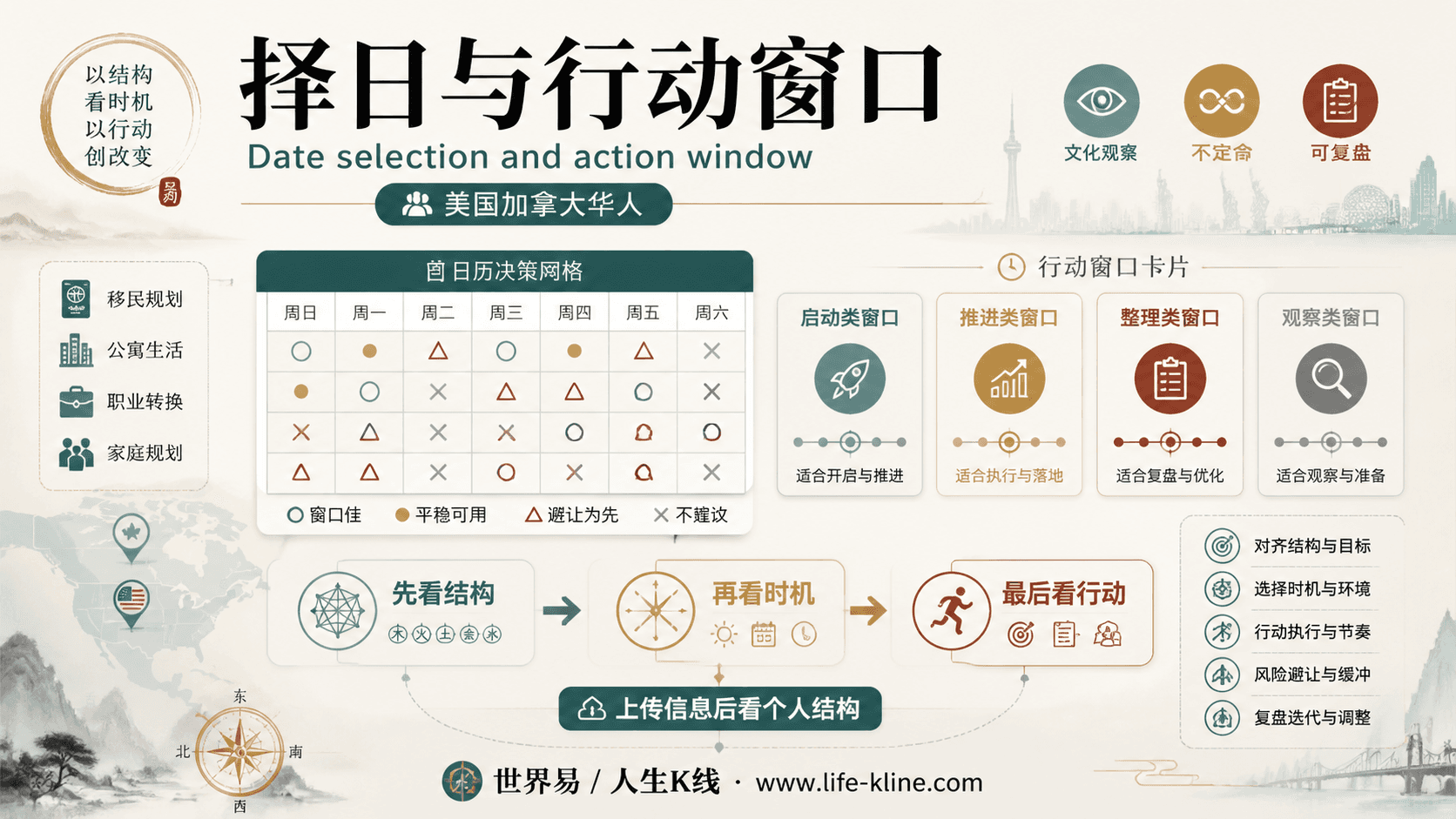
择日与行动窗口|美国加拿大华人
这张图把《Analysis of Litigation and Settlement Strategies in Partnership and Equity Disputes》里的命理概念转成关系、边界和应用场景,适合先看图建立结构,再回到知识文章正文理解细节。
择日与行动窗口不应被写成固定结论。更适合美国加拿大华人的读法,是把传统术语翻译成结构、时机、环境、行动和复盘。
查看图片解读