Choosing a Partner During the Parenting Phase: Analysis of Chart Rhythms and Boundary Signals
把这篇文章落到自己身上验证:先看结构,再进入个人分析,不做泛泛阅读。
Why This Decision Is Especially Difficult at This Life Stage
The parenting phase (ages 30-42) is a period in life concentrated with responsibilities and pressures. At this time, individuals not only bear the heavy duties of child-rearing and family management but also face critical career development milestones. The dual-track demands make time and energy allocation extremely tight. Social expectations impose high standards for stable family relationships and child upbringing; partner choice directly affects the family atmosphere and future rhythm.
Partner selection at this stage is not merely a matter of emotions but a choice involving life rhythm and responsibility sharing. A wrong choice may lead to family conflicts, career obstacles, and even negatively impact children’s growth. The rhythms and boundary signals in BaZi can reflect an individual’s internal emotional needs and the compatibility with the external environment, helping identify potential conflicts or support.
Moreover, the energy flow indicated by Yong Shen (favorable element) and Ji Shen (unfavorable element) in the chart directly influences an individual’s psychological boundaries and adaptability in intimate relationships. The interaction between Da Yun (decade luck cycle) and Liu Nian (annual fortune) amplifies or mitigates these energy expressions, further increasing the complexity and difficulty of partner selection.
Therefore, when choosing a partner during the parenting phase, attention must be paid not only to the quality of intimate relationships in reality but also to the metaphysical rhythms and boundary cues, avoiding misjudgments that could lead to family imbalance and personal development limitations.
Three Core Dimensions of Metaphysical Judgment
The strength of the Day Master reflects the individual’s internal energy state and self-drive. A relatively strong Day Master often shows strong self-awareness and initiative, while a weak Day Master may manifest emotional dependence or self-protective tendencies. In partner selection, the Day Master’s state determines the need for active or passive roles in the relationship.
The pattern (Ge Ju) determines the overall energy configuration of the chart and the main life themes. For example, a Zheng Cai (Proper Wealth) pattern usually relates to stable wealth and family responsibility; a Pian Cai (Indirect Wealth) pattern may reflect flexibility in financial or emotional attitudes; a Zheng Guan (Proper Officer) pattern emphasizes social status and order. Different patterns influence an individual’s expectations of a partner and the division of responsibilities in the relationship.
Yong Shen and Ji Shen reveal elements in the chart that need adjustment or avoidance, corresponding to emotional boundaries and interaction modes. Yong Shen is generally beneficial energy that helps balance internal and external relationships, while Ji Shen is a source of potential conflict. The combination of Da Yun and Liu Nian reflects how luck cycles strengthen or suppress these energies, affecting the timing and stability of partner selection.
Three Real BaZi Chart Cases
Case 1: Female, age 50-55, Day Master 丙 (Bing, Fire), relatively strong, Zheng Cai (Proper Wealth) pattern, Yong Shen are Water and Metal, Ji Shen is Wood. Currently in the 丙戌 (Bing Xu) Da Yun (ages 45-54), a stable luck cycle suitable for consolidation, with the Liu Nian (annual fortune) being 丙午 (Bing Wu). Although this chart is in the later half of the parenting phase, the relatively strong Day Master and Zheng Cai pattern reflect a strong sense of responsibility and need for family stability. The Yong Shen Water and Metal elements harmonize the Fire strength, indicating partner choice should focus on balancing emotion and rationality. The stable Da Yun favors maintaining and solidifying relationships, while the Liu Nian suggests flexibility in responding to changes within the partnership. The rhythm in this chart’s partner selection is stability and responsibility, with clear boundaries but requiring moderate flexibility. The recommendation is first to confirm whether the partner can support family stability and personal growth, then assess if both parties’ emotional boundaries are compatible.
Case 2: Female, age 20-25, Day Master 癸 (Gui, Water), relatively weak, Pian Cai (Indirect Wealth) pattern, Yong Shen is Metal, Ji Shen are Wood and Fire. Currently in the 乙丑 (Yi Chou) Da Yun (ages 14-23), a relatively weak luck cycle requiring caution, with Liu Nian 丙午 (Bing Wu). This chart is at the early boundary of the parenting phase; the weak Day Master reflects inner dependence, while the Pian Cai pattern brings financial and emotional flexibility. Yong Shen Metal indicates the need to find a partner who can provide support and stability, while Ji Shen Wood and Fire suggest avoiding excessive conflict and emotional volatility. The weak Da Yun and cautious Liu Nian imply that the relationship must be built steadily, avoiding impulsive commitments. The rhythm in partner selection here is slow and requires careful observation; boundaries need strengthening for self-protection. The advice is to prioritize screening potential partners for stability and support, then evaluate both parties’ emotional adjustment capabilities.
Case 3: Male, age 35-40, Day Master 癸 (Gui, Water), relatively strong, Zheng Guan (Proper Officer) pattern, Yong Shen are Earth and Fire, Ji Shen is Metal. Currently in the 甲辰 (Jia Chen) Da Yun (ages 32-41), a favorable luck cycle with career and financial progress, and Liu Nian 丙午 (Bing Wu). This chart is in the core stage of the parenting phase; the relatively strong Day Master and Zheng Guan pattern reflect a strong sense of social responsibility and order. Yong Shen Earth and Fire support the Day Master, enhancing stability and initiative, while Ji Shen Metal warns against external interference and conflicts in relationships. The auspicious Da Yun and smooth Liu Nian improve conditions for partner selection but require the relationship to coordinate with career rhythm. The rhythm emphasizes balancing career and family, with clear boundaries but caution against excessive control. The recommendation is to first evaluate if the partner can adapt to the individual’s career rhythm, then confirm mutual respect and support of emotional boundaries.
Common Misjudgments and Blind Spots at This Stage
A common misjudgment in partner selection during the parenting phase is ignoring the chart’s Yong Shen and Ji Shen cues, relying excessively on external factors such as economic strength or superficial emotions. In reality, the metaphysical rhythm signals often better reflect the long-term stability of the relationship; neglecting these signals can lead to imbalance.
Another blind spot is overlooking the interaction between Da Yun and Liu Nian. Many focus only on immediate feelings without considering how luck cycles affect relationship development, making rash decisions during unfavorable years that increase family conflicts and instability.
Additionally, some fail to correctly understand the relationship between Day Master strength and pattern, causing mismatched expectations of partners versus actual needs. A strong Day Master may require more space and autonomy, while a weak Day Master needs more support and security; ignoring this leads to boundary conflicts.
Finally, societal expectations for individuals in the parenting phase with multiple roles often cause neglect of true inner relationship needs, resulting in unfocused decisions and dilemmas between career and family responsibilities.
Practical Judgment Sequence
First, check your own chart’s Day Master strength and pattern to clarify your internal energy state and key life themes, which determine your fundamental partner needs. Next, combine Yong Shen and Ji Shen to identify suitable partner traits and assess energy balance and conflict points in potential relationships.
Then, focus on the interaction of Da Yun and Liu Nian to evaluate current and upcoming years’ fortune trends, avoiding major decisions in unfavorable years and choosing timing that aligns with the flow of luck.
Finally, integrate real-life family responsibilities and career rhythms to verify if the partner can match your pace, ensuring clear boundaries and mutual support.
The entire judgment process should be gradual, starting from metaphysical internal needs, then combining objective luck cycles and real environment, avoiding haste. The optimal time for action is when both Da Yun and Liu Nian are favorable and real conditions permit; otherwise, it is better to hold and wait.
FAQ
Question 1: How to identify Yong Shen and Ji Shen in partner selection? Answer: Yong Shen represents elements that need supplementation or harmonization in the chart. When choosing a partner, focus on whether the partner can bring positive energy corresponding to the Yong Shen. Ji Shen are elements to avoid, preventing the partner from bringing negative influences associated with Ji Shen.
Question 2: How significant is the impact of Da Yun and Liu Nian on partner choice? Answer: Da Yun and Liu Nian determine the strength and changing trends of the chart’s energy. Favorable luck cycles help stabilize and develop relationships, while unfavorable ones require caution to avoid relationship fluctuations caused by poor timing.
Question 3: How does Day Master strength affect mate selection strategy? Answer: A relatively strong Day Master tends to be more independent and self-driven, so the partner should respect their autonomy. A weak Day Master requires more security and support, so the partner should have protective and stabilizing qualities.
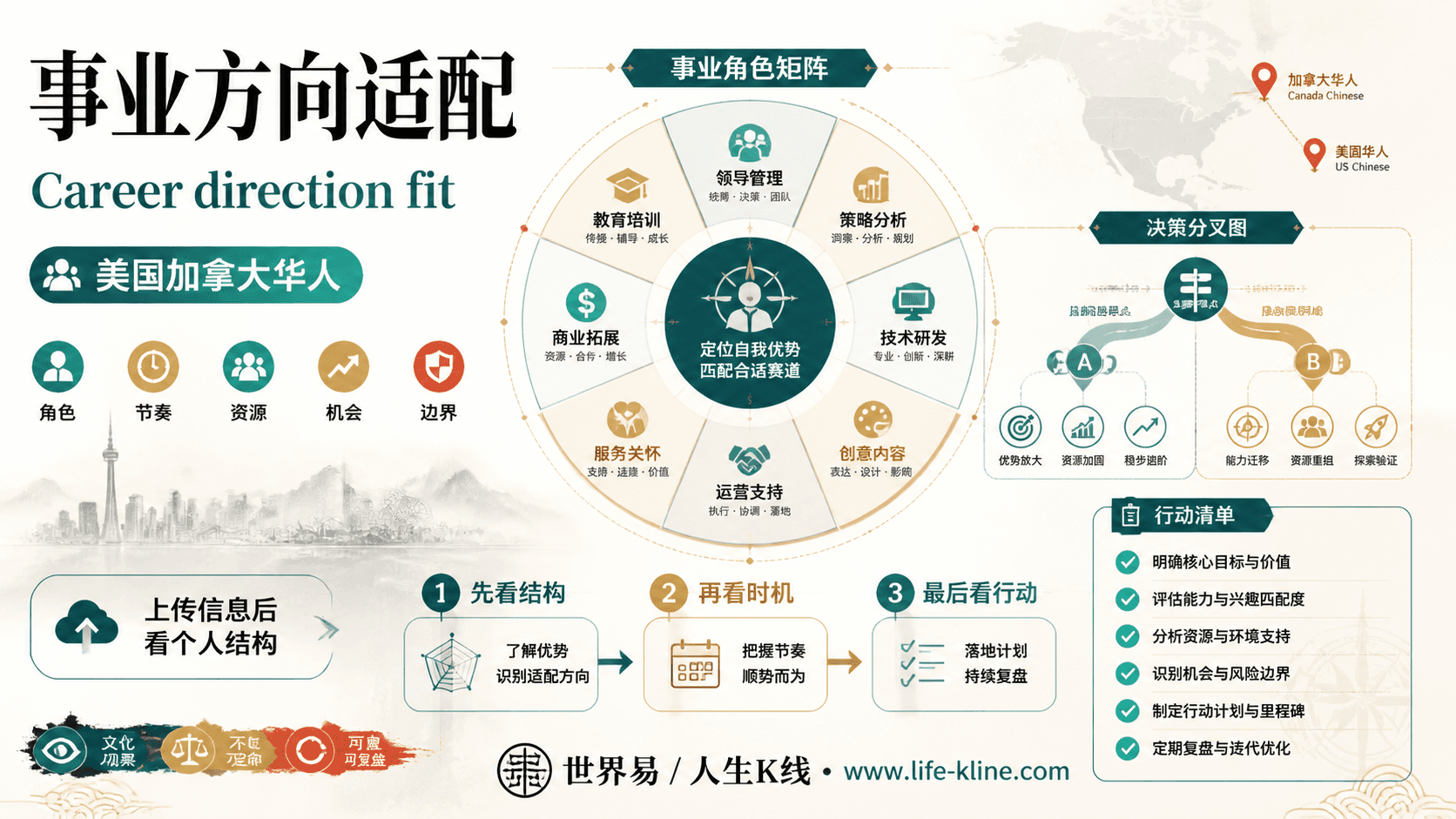
事业方向适配|美国加拿大华人
这张图把《Choosing a Partner During the Parenting Phase: Analysis of Chart Rhythms and Boundary Signals》里的命理概念转成关系、边界和应用场景,适合先看图建立结构,再回到知识文章正文理解细节。
事业方向适配不应被写成固定结论。更适合美国加拿大华人的读法,是把传统术语翻译成结构、时机、环境、行动和复盘。
查看图片解读