Parenting Rhythm Decision-Making from Age 30 to 42: Analysis of Tightness and Flexibility Strategies for Different Day Masters
把这篇文章落到自己身上验证:先看结构,再进入个人分析,不做泛泛阅读。
你现在搜索的,
其实是一个要落到自己身上的判断。
当前页面主要回答「Parenting Period」这类搜索问题;真正有价值的下一步是把这套结构带进自己的报告、工具与案例验证。
Why This Decision Is Especially Difficult at This Life Stage
The parenting period from age 30 to 42 is a life stage characterized by concentrated responsibilities and pressures. Parents not only bear the crucial duties of educating and raising their children but also face pressures from career development and the need to support the family financially. The family rhythm during this stage requires balancing work and life, especially in how to manage the child’s discipline without being overly strict or excessively lenient, which is a common challenge for parents.
Societal expectations impose high demands on parental roles at this stage: ensuring the child’s physical and mental health, fostering independence, while parents themselves must maintain career competitiveness and family harmony. Different BaZi structures amplify or suppress parental tendencies in parenting rhythm decisions. For example, parents with a relatively weak Day Master tend to feel more anxious and lean toward strictness, while those with a relatively strong Day Master are more adaptable and flexible in adjusting their parenting methods.
Moreover, the current Da Yun and Liu Nian directly affect parents’ psychological state and external environment. During unfavorable Da Yun or Liu Nian, parents experience increased emotional stress, leading to conservative or anxious decisions. Conversely, favorable cycles provide more resilience and flexibility in adjusting family rhythm. Therefore, parenting rhythm decisions are influenced not only by parental will but also by the combined effects of BaZi structure and external environment.
In summary, the difficulty in parenting rhythm decisions during the 30-42 age parenting period lies in managing multiple overlapping pressures, scientifically recognizing one’s BaZi strengths and limitations, and reasonably controlling the degree of child discipline to promote overall family harmony and healthy child development.
Three Core Dimensions of BaZi Judgment
First, the strength and pattern of the Day Master determine the dominant energy parents bring to the parenting rhythm. A relatively weak Day Master is usually sensitive and easily disturbed by external factors, leading to emotional fluctuations and a tendency toward strong control and tighter parenting. A relatively strong Day Master exhibits more confidence and control, enabling more flexible parenting strategies. Patterns such as Zheng Yin (Proper Seal) or Zheng Guan (Proper Officer) reflect the parents’ emphasis and style in child education.
Second, the Yong Shen (favorable element) and Ji Shen (unfavorable element) reveal beneficial factors and potential obstacles in the parenting process. Parents whose Yong Shen is Water (e.g., Jia Wood Day Master) need to supplement moistening energy, which benefits emotional communication and tolerance. Parents with Yong Shen of Fire or Wood (e.g., Geng Metal or Ding Fire Day Masters) focus more on action and emotional expression. The presence of Ji Shen may bring unfavorable family atmospheres or external pressures, affecting the parenting rhythm.
Third, the Da Yun and Liu Nian environment adjust parents’ psychology and decision-making abilities. During adverse luck cycles, parents are more likely to feel urgency from life changes, possibly resulting in overly strict parenting. Stable Da Yun helps parents maintain patience and flexibility. The interaction between Liu Nian and Da Yun requires close attention to assess whether it is suitable to adjust or maintain the current parenting strategy.
Combining these three dimensions, BaZi judgment offers parents a scientific perspective to observe their strengths and limitations, revealing the parenting rhythm pressures and adjustment paths faced by different Day Masters during the 30-42 age parenting period.
Three Real BaZi Case Studies
Case 1: This gentleman’s Day Master is Jia Wood (甲 Jia), relatively weak, with a Zheng Yin (Proper Seal) pattern. His Yong Shen is Water, and Ji Shen are Fire and Earth. He is currently in the Ji Si (己巳 Ji Si) Da Yun, which is an unfavorable luck cycle, aged approximately 35-40, right in the parenting period. The relatively weak Jia Wood Day Master combined with a weak Da Yun makes the parent prone to pressure and anxiety in parenting rhythm, tending to use strict control to ensure family stability. The Bing Wu (丙午 Bing Wu) Liu Nian brings Fire influence, so emotional loss of control or excessive tension should be guarded against. It is recommended to prioritize the supplementation of the Yong Shen Water when judging, moderately loosening the parenting rhythm to avoid strained parent-child relationships caused by anxiety from adverse luck cycles.
Case 2: This lady’s Day Master is Geng Metal (庚 Geng), relatively strong, with a Zheng Guan (Proper Officer) pattern. Her Yong Shen are Fire and Wood, and Ji Shen is Earth. She is in the Ji Hai (己亥 Ji Hai) Da Yun, a stable luck cycle, aged about 25-30, just entering the early parenting period. The relatively strong Geng Metal Day Master and abundant Yong Shen Fire and Wood indicate she has good decision-making and action abilities, able to flexibly adjust the parenting rhythm to balance family and career. The stable Ji Hai Da Yun and the Bing Wu (丙午 Bing Wu) Liu Nian with strong Fire support her emotional expression and parent-child interaction, making it suitable to maintain a balanced degree of tightness and looseness in parenting. It is recommended to focus on the support status of Yong Shen by Da Yun and Liu Nian, adjusting the parenting rhythm timely to meet the child’s developmental needs.
Case 3: This gentleman’s Day Master is Ding Fire (丁 Ding), relatively weak, with a Zheng Guan (Proper Officer) pattern. His Yong Shen is Fire, and Ji Shen are Earth and Metal. He is currently in the Yi Mao (乙卯 Yi Mao) Da Yun, a stable luck cycle, aged about 30-35, in the mid-parenting period. The relatively weak Ding Fire Day Master is supported by Yong Shen Fire, indicating some dominant ability in parenting rhythm but still needing to manage emotions carefully. The stable Yi Mao Da Yun and Bing Wu (丙午 Bing Wu) Liu Nian with strong Fire favor parents showing warmth and care. However, Ji Shen Earth and Metal may bring internal family conflicts or external pressures. It is recommended to focus judgment on the strength of Yong Shen Fire and interference from Ji Shen, combined with external environment, to avoid emotional fluctuations causing imbalance in parenting rhythm, favoring a steady yet flexible parenting approach.
Common Misjudgments and Blind Spots at This Stage
A common misjudgment during the 30-42 parenting period is over-reliance on a single BaZi indicator to formulate parenting rhythm strategies, such as only considering the Day Master’s strength while neglecting the coordination of Yong Shen and Da Yun/Liu Nian, leading to one-sided decisions that fail to adapt to actual family environment changes.
Another blind spot is ignoring the accumulation of real-life pressures at this stage, such as career stress, social expectations, and financial burdens, all of which affect parents’ emotions and disciplinary methods. Purely BaZi-based approaches may not fully grasp the need for flexible parenting rhythm adjustments.
Additionally, parents often fall into extremes of either too tight or too loose parenting, overlooking the dynamic balance of parenting rhythm. The complex relationship between Ji Shen and Yong Shen in BaZi means that failure to reasonably assess Ji Shen’s impact on family atmosphere may cause strained or distant parent-child relationships, which is detrimental to healthy child development.
Finally, overemphasizing the auspiciousness or inauspiciousness of Da Yun or Liu Nian while neglecting parents’ own emotional management and communication skills is a major error. BaZi is only an auxiliary tool; practical actions and psychological adjustments are equally crucial.
Practical Judgment Sequence
First, clarify the Day Master’s strength and pattern to determine the parent’s dominant energy and internal tendencies, understanding whether they lean toward tight or loose parenting rhythms. Next, focus on evaluating the status of Yong Shen and Ji Shen, especially under the current Da Yun and Liu Nian context. Whether the Yong Shen is supported or restrained directly affects parental emotional stability and decision-making flexibility.
Second, combine stage-specific real-life constraints such as career pressure, family finances, and social expectations to comprehensively assess whether parents have the capability and space to adjust the parenting rhythm. The interaction between Da Yun and Liu Nian requires close monitoring to decide if active adjustment strategies are suitable or if maintaining the status quo is better to avoid disrupting family rhythm through frequent changes.
Finally, parents are advised to pay attention to improving their emotional management and parent-child communication skills. BaZi judgment is only an auxiliary tool; practical application of BaZi information combined with real circumstances should progressively optimize the parenting rhythm, achieving the goal of utilizing Yong Shen effectively, reducing Ji Shen’s influence, and realizing family harmony and healthy child growth.
FAQ
Question 1: Why are parents with a relatively weak Day Master more prone to overly tight parenting? Answer: A relatively weak Day Master means the parent’s internal energy is insufficient. When facing family and career pressures, they tend to experience anxiety and insecurity, leading them to seek stability and control by strictly managing their children, resulting in a tighter parenting rhythm.
Question 2: How to judge if the current Da Yun is suitable for adjusting the parenting rhythm? Answer: One must consider the interaction between Da Yun and Liu Nian. If the Da Yun is stable or supported by the Yong Shen, and the Liu Nian does not have obvious Ji Shen interference, it is suitable to actively adjust parenting strategies. Otherwise, it is advisable to maintain the current rhythm to avoid family conflicts caused by unstable environments.
Question 3: What impact does Ji Shen have on parents’ parenting rhythm? Answer: Ji Shen usually represents obstacles or negative factors encountered by parents during child-rearing, such as emotional fluctuations, family conflicts, or external pressures. Excessive Ji Shen may cause parents to be overly strict or too lenient, affecting the quality of parent-child relationships. Therefore, controlling Ji Shen’s influence and maintaining balance with Yong Shen is essential.
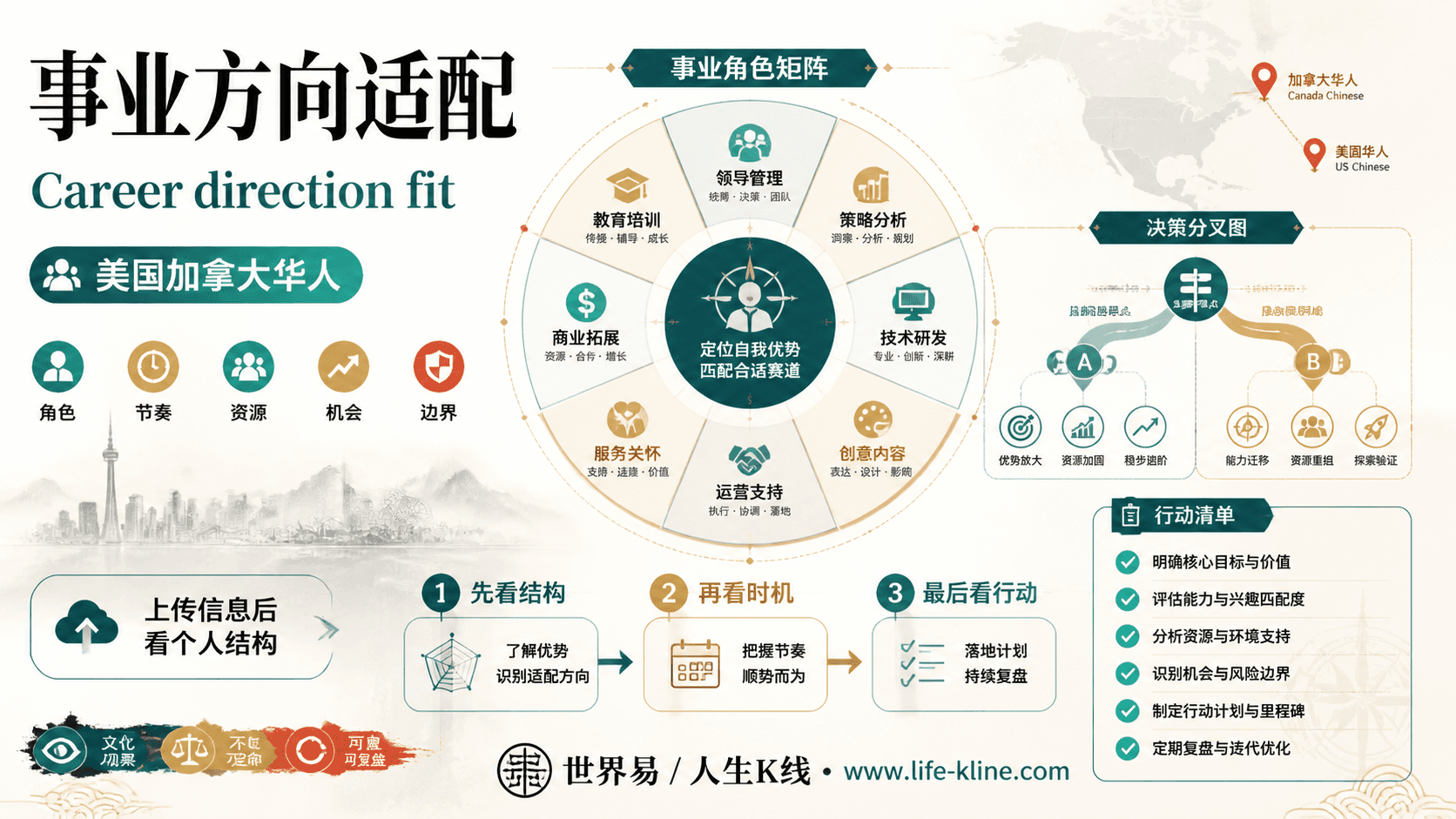
事业方向适配|美国加拿大华人
这张图把《Parenting Rhythm Decision-Making from Age 30 to 42: Analysis of Tightness and Flexibility Strategies for Different Day Masters》里的命理概念转成关系、边界和应用场景,适合先看图建立结构,再回到知识文章正文理解细节。
事业方向适配不应被写成固定结论。更适合美国加拿大华人的读法,是把传统术语翻译成结构、时机、环境、行动和复盘。
查看图片解读