Educational Decision-Making During Parent-Child Conflict Periods: A Metaphysical Guide to Advancing or Waiting
把这篇文章落到自己身上验证:先看结构,再进入个人分析,不做泛泛阅读。
Why This Decision Is Especially Difficult at This Educational Stage
Adolescence is a high-risk period for parent-child relationships in Chinese families. Children face intense academic pressure, peer influences, and rapid changes in self-awareness, which can lead to problems such as online gaming addiction, emotional volatility, and even self-harm. Parents, on one hand, hope to correct these issues promptly through educational intervention, but on the other hand, they worry that premature and forceful involvement may provoke stronger resistance and worsen the parent-child relationship.
In the current Chinese educational environment, although the 'Double Reduction' policy has somewhat alleviated academic pressure, the competition in the high school entrance examination (Zhongkao) and college entrance examination (Gaokao) remains fierce, leaving parents anxious. Meanwhile, significant generational differences in educational philosophies intensify conflicts in values and communication styles between parents and children, making the decision to advance or wait especially complex.
BaZi structure plays an auxiliary role in judgment at this stage, especially the strength of the Day Master, the manifestations of Shi Shen (Eating God)/Shang Guan (Hurting Officer) and Yin stars (Seal stars), as well as the influence of Da Yun and Liu Nian on the child's learning and expressive abilities. These factors help parents identify the rhythm of emotional fluctuations and potential risks, determining whether to actively intervene or moderately slow down and wait.
Therefore, by combining the real educational environment with metaphysical rhythms, scientifically recognizing the signals for 'advancing' or 'waiting' becomes key for parents to make rational decisions, helping reduce parent-child conflicts and psychological crises.
Three Core Dimensions of Metaphysical Judgment
First, the strength of the Day Master determines the child’s own energy capacity and coping ability. A relatively strong Day Master indicates the child has strong internal motivation and may show strong resistance or backlash when faced with educational interventions; a relatively weak Day Master may suggest the child lacks energy or is easily influenced by external factors, making gentle guidance more suitable.
Second, Shi Shen (Eating God)/Shang Guan (Hurting Officer) and Yin stars (Seal stars) represent expressive ability and internal support, respectively. Children with strong Shi Shen/Shang Guan tend to express themselves and release emotions more directly, making communication and expressive therapy effective for advancing education; those with strong Yin stars show spiritual support and self-regulation ability, making waiting and giving space more appropriate.
Third, the current Da Yun (decade luck cycle) and Liu Nian (annual fortune) significantly affect the child’s growth environment and psychological state. When Da Yun is stable and the Yong Shen (favorable element) is supported, the risks of advancing education are lower; conversely, during unfavorable luck cycles or when Ji Shen (unfavorable elements) are clashing, caution is advised to avoid aggravating conflicts.
Additionally, attention should be paid to the interaction between the parents’ BaZi charts and the child’s palace, especially the strength of the Guan Sha stars (Zheng Guan / Qi Sha), which relate to family authority and discipline, influencing the intensity of parent-child conflicts and resolution approaches.
Three Real BaZi Case Studies
Case 1: This chart’s Day Master is Ren Shui (壬, Ren Water), relatively strong, belonging to the Shang Guan (Hurting Officer) pattern with abundant Shi Shen (Eating God), indicating a child with strong expressive desire and noticeable emotional fluctuations. The Yong Shen are Earth and Fire, while Metal is the Ji Shen (unfavorable element). Currently in the Ren Wu (壬午) Da Yun and Bing Wu (丙午) Liu Nian, the decade luck is stable and suitable for maintaining progress. In reality, the girl is entering early adulthood and may exhibit strong self-awareness and emotional expression during parent-child conflicts. The BaZi shows she has strong adaptability and flexibility, and the current Da Yun and Liu Nian support steady advancement. Therefore, when facing issues like online gaming addiction or school withdrawal tendencies, educational intervention should be prioritized through positive expression and communication channels to reduce conflict, while avoiding excessive pressure that could trigger the Ji Shen Metal and intensify resistance. The judgment recommendation is to first assess the child’s expressive state and emotional adjustment ability; if expression is smooth and the Da Yun supports progress, advance immediately; if severe resistance or emotional breakdown occurs, short-term waiting combined with professional psychological counseling is advised.
Case 2: This chart’s Day Master is Ji Earth (己, Ji Earth), relatively strong, with a Jie Cai (劫财) pattern, indicating a child with strong self-awareness and competitiveness. The Yong Shen is Water, and the Ji Shen is Fire. The child is currently in the Jia Yin (甲寅) Da Yun and Bing Wu (丙午) Liu Nian, with stable decade luck suitable for maintaining progress. The boy is in a growth phase and tends to show strong self-protection and resistance during parent-child conflicts. The Jie Cai pattern combined with Water as Yong Shen suggests the child needs external gentle support to ease internal conflicts. Although the current Da Yun and Liu Nian are stable, the impact of the Ji Shen Fire should not be overlooked; overly harsh parental education methods may provoke rebellion. Regarding educational decisions, if the child’s emotions are stable and there is some willingness for proactive communication, advancing the educational plan can be considered; if emotions are intense or there are signs of school withdrawal or self-harm, waiting is recommended, using the stable Da Yun and Liu Nian period to strengthen psychological counseling and improve the family atmosphere, avoiding escalation of conflicts.
Case 3: This chart’s Day Master is Geng Metal (庚, Geng Metal), relatively weak, belonging to the Zheng Guan (正官) pattern. The Yong Shen is Earth, and the Ji Shen are Water and Wood. The child is currently in the Yi Mao (乙卯) Da Yun and Bing Wu (丙午) Liu Nian, overall an unfavorable luck cycle with a need to guard against major incidents. The boy is in early youth; the BaZi indicates insufficient energy and significant external pressure, with limited expressive ability. The Zheng Guan pattern implies strong family discipline and authority, but the current unfavorable Da Yun increases the risk of excessive internal pressure leading to severe emotional crises. Under this chart, strong intervention during the parent-child conflict period carries high risk and may provoke greater backlash or psychological issues. The educational recommendation is to prioritize waiting, closely monitor changes in Liu Nian and the child’s mental state, cooperate with professional psychological assistance, steadily adjust family relationships, and gradually advance educational plans once the Da Yun improves.
These three cases collectively illustrate quantifiable criteria for advancing or waiting during parent-child conflict periods under different BaZi structures, combined with real educational focal points, providing scientific reference for parents.
Common Misjudgments and Blind Spots at This Stage
The most common misjudgment by parents during the parent-child conflict period is assuming that all conflicts require immediate and strong intervention, neglecting the child’s energy capacity and adjustment rhythm indicated by BaZi, leading to premature advancement that exacerbates conflicts. This is especially true when the Day Master is weak or the Da Yun is unfavorable.
Another blind spot is waiting passively without dynamic monitoring, ignoring signals from Liu Nian and Yong Shen changes. Some children, although emotionally unstable, are suitable for gradual intervention according to BaZi; excessive waiting may miss the optimal educational window, causing problems to accumulate.
Additionally, parents often overlook the roles of Shi Shen (Eating God)/Shang Guan (Hurting Officer) and Yin stars (Seal stars), failing to flexibly adjust strategies based on the child’s expressive and internal support status, resulting in educational interventions that do not meet the child’s true psychological needs and reduce effectiveness.
Finally, ignoring the interaction between the parents’ own BaZi and the child’s palace, relying solely on the child’s chart for judgment, often overlooks the overall resonance effect of the family system, increasing the blindness of decisions.
Practical Judgment Sequence
Step one: Assess the strength of the child’s Day Master and pattern to determine whether the internal energy supports active advancement. Prioritize advancing when the Day Master is relatively strong and Shi Shen/Shang Guan are abundant; lean towards waiting when the Day Master is weak or the luck cycle is unfavorable.
Step two: Analyze the relationship between Yong Shen (favorable elements) and Ji Shen (unfavorable elements), combined with the current Da Yun and Liu Nian, to judge external environmental support or pressure. When Yong Shen is supported and Da Yun is stable, the risk of advancing is lower; if Ji Shen is clashing or Da Yun is unfavorable, exercise caution and wait.
Step three: Observe the child’s expressive ability and emotional state, especially the performance of Shi Shen/Shang Guan (expression) and Yin stars (internal support). If expression is smooth and emotions are stable, advancement is suitable; if expression is blocked or emotions are extreme, waiting with psychological support is recommended.
Finally, integrate the parents’ BaZi and the interaction with the child’s palace to adjust family communication and authority strategies, avoiding unilateral forceful advancement that escalates conflicts. Overall, the timing for advancement should be based on a dynamic balance between metaphysical rhythms and real-world conditions, maintaining flexibility and adaptability.
FAQ
Question 1: How does BaZi identify early warning signs of a child’s emotional crisis? Answer: Mainly by observing the strength of the Day Master and whether the Ji Shen are clashing, especially when unfavorable Da Yun and Liu Nian overlap. If Shi Shen/Shang Guan are restrained or Yin stars are insufficient, large emotional fluctuations may occur, requiring attention to the child’s psychological state and professional psychological assistance if necessary.
Question 2: What metaphysical signals support advancing educational intervention? Answer: When the Day Master is relatively strong with abundant Shi Shen/Shang Guan, and the current Da Yun and Liu Nian are stable with Yong Shen supported, it indicates the child has strong expressive ability and adaptability, suitable for advancing education through communication and positive guidance.
Question 3: If BaZi suggests waiting but real-world pressure is high, how should parents balance this? Answer: BaZi provides rhythmic reference only; real-world pressure cannot be ignored. It is recommended that parents strengthen family support and improve communication methods during the waiting period, cooperate with professional psychological counseling to prevent deterioration, and dynamically monitor the child’s condition to adjust strategies timely.
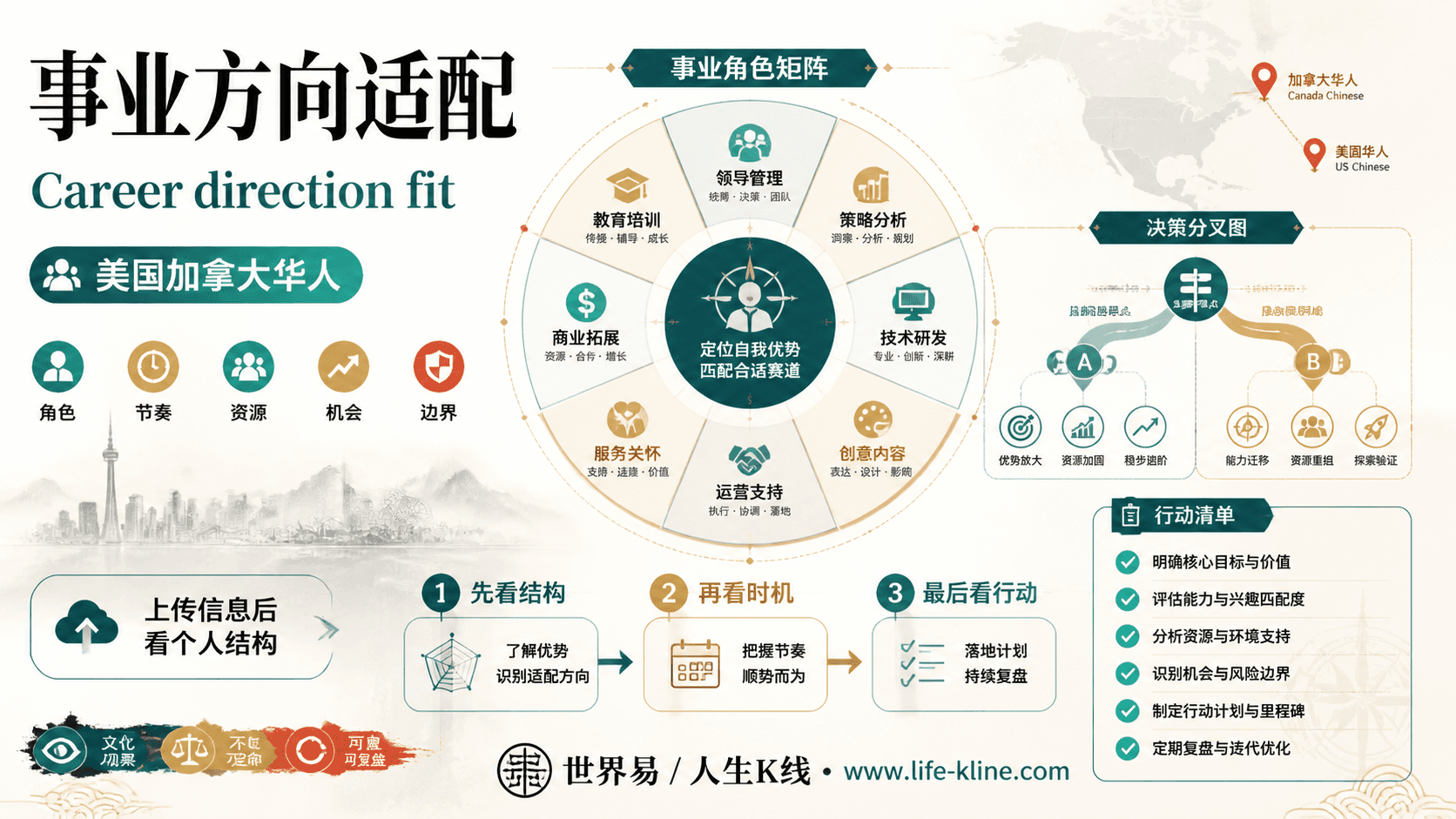
事业方向适配|美国加拿大华人
这张图把《Educational Decision-Making During Parent-Child Conflict Periods: A Metaphysical Guide to Advancing or Waiting》里的命理概念转成关系、边界和应用场景,适合先看图建立结构,再回到知识文章正文理解细节。
事业方向适配不应被写成固定结论。更适合美国加拿大华人的读法,是把传统术语翻译成结构、时机、环境、行动和复盘。
查看图片解读