School and Pathway Matching Decisions During Parent-Child Conflict Period: Rhythm Control from a Metaphysics Perspective
把这篇文章落到自己身上验证:先看结构,再进入个人分析,不做泛泛阅读。
你现在搜索的,
其实是一个要落到自己身上的判断。
当前页面主要回答「parent-child conflict」这类搜索问题;真正有价值的下一步是把这套结构带进自己的报告、工具与案例验证。
Why This Decision Is Especially Difficult at This Educational Stage
Adolescence is a critical period of rapid psychological and physiological changes for children, during which parent-child conflicts frequently occur. Especially when facing academic pressure, online gaming temptations, and challenges of self-identity, parents often fall into anxiety. Educational pathway decisions at this stage involve not only school districts and the choice between public and private schools but also the balance between international curricula and vocational education, with complex social realities intensifying the difficulty of decision-making.
Contemporary Chinese “Double Reduction” policies and the high school entrance examination diversion mechanism have heightened families’ urgency in competing for educational resources and planning pathways. Parents hope their children can both advance smoothly in their studies and maintain psychological health, avoiding paths such as suspension or marginalization. However, adolescent rebellion and intergenerational cognitive differences make communication extremely difficult.
If parents can integrate their child's metaphysical structure, especially the strength of the Day Master, the pattern, and the characteristics of the Yong Shen, to understand the child’s intrinsic learning and expression rhythm, they can more precisely grasp the suitable educational environment and adjustment strategies. For example, the influence of Shi Shen (Eating God) and Yin Star (Seal Star) on expression and learning motivation, and the reaction of Guan Sha (Officer and Seven Killings) stars to rules and pressure, all play key roles in decision-making.
In summary, pathway matching decisions at this stage are not merely choices of educational resources but precise responses to the child's psychological rhythm and growth needs, requiring consideration of real policies, family intergenerational relationships, and metaphysical structures simultaneously.
Three Core Dimensions of Metaphysical Judgment
First, the Day Master and its strength directly affect the child’s fundamental vitality and self-driven motivation. An overly strong Day Master usually indicates strong internal drive, prone to autonomy and rebellious emotions, requiring a suitable environment to release positive energy; a weak Day Master may manifest dependence and expression difficulties, needing more external support.
Second, the configuration of Shi Shen (Eating God) and Yin Star (Seal Star) reflects the dynamic relationship between learning and expression. Shi Shen represents creativity and outward expression; when strong, it benefits verbal and written expression but may cause rebellion and emotional fluctuations if excessive. Yin Star represents support and internal absorption; when strong, it aids solid learning and emotional stability but may suppress initiative if overly dominant.
Third, the interaction of Da Yun (decade luck cycle) and Liu Nian (annual fortune) mirrors the rhythm changes of the real environment. Da Yun reflects long-term trends; a stable Da Yun suits consolidation and steady progress, while auspicious Da Yun favors transformation and breakthroughs. Liu Nian reflects the randomness and opportunities of the current environment. The resonance between parents’ and children’s palace positions also affects the harmony and communication effectiveness of the parent-child relationship.
By integrating these three dimensions, parents can more scientifically understand their child’s current educational adaptation status and potential future challenges, thereby making more targeted school pathway matching decisions.
Three Real BaZi Cases
Case 1: This BaZi chart has a Day Master of Yi Wood (乙, Yi) that is relatively strong, exhibiting a Yang Ren (羊刃) pattern, indicating the child has strong internal vitality and a certain sharpness. The Yong Shen is Fire, and the Ji Shen (unfavorable element) is Water. Currently in the Wu Chen (戊辰) Da Yun, overall stable, with the Bing Wu (丙午) Liu Nian bringing some randomness. The Yang Ren pattern typically shows a strong self-awareness and desire for expression but is prone to conflicts with parents. Considering adolescent parent-child conflict, the child is more suited to a private or international school environment that allows a certain degree of freedom and stimulates creativity. This can utilize the child’s strong Shi Shen (Eating God) expressive talent while avoiding the rebellion caused by excessive suppression. The judgment sequence is recommended as follows: first check the relationship between the Day Master and Yong Shen to confirm whether the child’s expression is restricted; then evaluate whether the current Da Yun supports transformation; finally, adjust the timing of pathway selection by combining Liu Nian randomness.
Case 2: This BaZi chart has a Day Master of Xin Metal (辛, Xin) that is relatively weak, belonging to a Zheng Guan (正官) pattern. The Yong Shen is Water, and the Ji Shen is Wood. The Da Yun is Ren Xu (壬戌), an auspicious luck cycle, and the Liu Nian is Bing Wu (丙午), following the trend. Children with a Zheng Guan pattern usually have a strong sense of rules and responsibility, but a weak Day Master means self-expression may lack firmness and is easily influenced by the environment. During the parent-child conflict period, the child may show internal pressure and contradictions in conforming to the outside world. Such children may feel safer under the regulated management of public schools but also require guidance to express themselves. The judgment sequence recommendation is: first confirm the nourishing degree of the Yong Shen Water, assess whether there is sufficient psychological support; then combine the auspiciousness of the Da Yun to appropriately leverage the advantages of environmental rules, avoiding excessive strictness that triggers rebellion.
Case 3: A boy with a Day Master Ding Fire (丁, Ding) that is relatively strong, showing a Zheng Yin (正印) pattern. The Yong Shen is Water, and the Ji Shen is Wood. The Da Yun is Xin Mao (辛卯), stable, with the Liu Nian Bing Wu (丙午) bringing adaptability. The Zheng Yin star represents a good support system and absorption ability. The strong Ding Fire Day Master indicates the child is energetic with strong learning motivation, but the presence of Ji Shen Wood warns to pay attention to environmental stressors. During the parent-child conflict period, this child may show strong inner resilience and thirst for knowledge, suitable for vocational paths or international curricula that emphasize individual development. The judgment sequence recommendation is: first confirm the strength of the Yin Star support to ensure psychological and learning resources; then adjust the educational rhythm according to Liu Nian changes to avoid emotional fluctuations caused by sudden environmental shifts.
All three cases emphasize the impact of metaphysical structure on adolescent parent-child conflict and school pathway selection, helping parents scientifically evaluate the child’s internal rhythm and adaptability, reducing the risk of blind decision-making.
Common Misjudgments and Blind Spots at This Stage
First, ignoring the internal energy flow of the Day Master’s strength and the Yong Shen and Ji Shen in the child’s metaphysics, blindly pushing forward along traditional paths, which intensifies the child’s rebellious emotions and causes loss of learning motivation. Adolescence inherently involves emotional fluctuations; without adjusting strategies according to metaphysical rhythms, the best educational window is easily missed.
Second, overemphasizing Liu Nian opportunities or Da Yun trends while neglecting the foundational role of the Day Master and pattern, resulting in frequent short-term adjustments of educational pathways that decrease the child’s adaptability and increase psychological pressure. The core should be the Day Master and pattern, with Liu Nian and Da Yun as auxiliary, to form a stable educational rhythm.
Third, failure to fully identify and address intergenerational conflicts between parents, causing imbalance in the resonance between parents’ and children’s palace positions in the BaZi chart, leading to tense parent-child relationships and deepened communication barriers. If signals such as self-harm or depression appear at this stage, professional psychological assistance should be sought promptly; metaphysical rhythms serve only as reference.
In summary, to avoid the above misjudgments, it is necessary to base decisions on the metaphysical structure, scientifically combine real educational policies and family relationships, and develop practical and feasible educational pathway matching plans.
Practical Judgment Sequence
Step one: Clarify the child’s Day Master attribute and its strength to judge intrinsic drive and expression needs. Combine Yong Shen and Ji Shen to assess the suitable external environment attributes such as degree of freedom, regulation, and support.
Step two: Combine the current Da Yun trend to determine whether the child is in a consolidation phase or a transformation phase. Consolidation phases should focus on stable educational pathways; transformation phases may introduce new educational resources or methods cautiously to avoid excessive fluctuations.
Step three: Pay attention to the influence of the current Liu Nian, assessing the possibility and risks of adaptability, especially during frequent adolescent parent-child conflicts. Reasonably arrange the timing of key decisions to avoid emotional loss of control or study interruption caused by sudden environmental changes.
Overall, it is recommended that parents first check whether the child’s expression and learning status are smooth and confirm psychological health. Then, adjust the educational environment and pathway according to metaphysical rhythms. When necessary, seek professional psychological or educational consultation to ensure decisions are scientific and flexible.
FAQ
Question 1: How should parents guide adolescent children with a relatively strong Day Master to ease parent-child conflicts? Answer: Children with a strong Day Master have strong vitality and strong desires for expression. Parents should provide appropriate freedom and space for expression, avoiding excessive suppression. Adjust the environment temperature according to the Yong Shen, for example, using Fire to enhance expression and avoiding Water which may cause emotional fluctuations. Meanwhile, keep communication channels open, monitor psychological signals, and seek professional help if necessary.
Question 2: How does the Yin Star (Seal Star) in metaphysics affect a child’s learning motivation? Answer: The Yin Star represents support and absorption. When strong, it helps children learn solidly and maintain emotional stability, which is beneficial for cultivating concentration. However, if overly strong, it may suppress initiative and lead to strong dependence. Parents should flexibly adjust the level of support according to the Yin Star’s strength, providing both space and necessary guidance.
Question 3: During the parent-child conflict period, which is more suitable: international schools or vocational schools? Answer: This depends on the child’s BaZi pattern and Yong Shen. Children with strong Shi Shen (Eating God) and relatively strong Day Master are more suited to the open expressive environment of international schools; children with Zheng Yin pattern and strong Water Yong Shen may find vocational paths more aligned with their internal rhythm. The key is to match the child’s expression and learning rhythm and avoid blindly following trends.
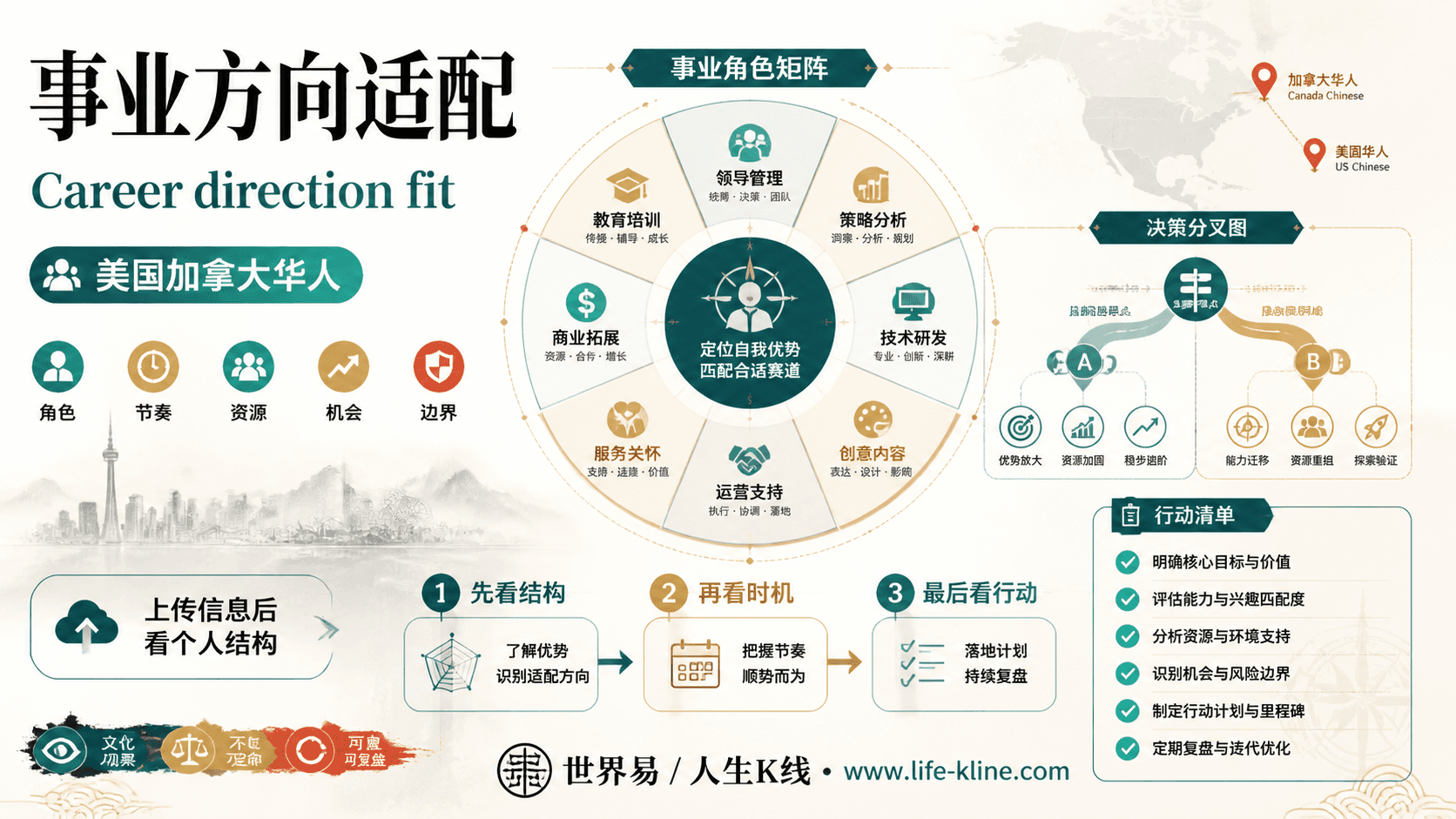
事业方向适配|美国加拿大华人
这张图把《School and Pathway Matching Decisions During Parent-Child Conflict Period: Rhythm Control from a Metaphysics Perspective》里的命理概念转成关系、边界和应用场景,适合先看图建立结构,再回到知识文章正文理解细节。
事业方向适配不应被写成固定结论。更适合美国加拿大华人的读法,是把传统术语翻译成结构、时机、环境、行动和复盘。
查看图片解读