Supporting Aging Parents and Retirement Decisions: An Analysis of Withdrawal and Continued Support from a Metaphysical Perspective
把这篇文章落到自己身上验证:先看结构,再进入个人分析,不做泛泛阅读。
你现在搜索的,
其实是一个要落到自己身上的判断。
当前页面主要回答「Eldercare Scenarios」这类搜索问题;真正有价值的下一步是把这套结构带进自己的报告、工具与案例验证。
Why This Decision Is Especially Difficult in This Scenario
Supporting aging parents while approaching retirement is a multidimensional, compounded pressure scenario in eldercare. At this time, one must not only bear the medical care and daily support for parents but also plan for one’s own retirement security, involving complex matters such as social security benefits, long-term care insurance, and tax planning. The financial burden increases, psychological pressure rises accordingly, often leading to emotional biases during decision-making, such as excessive optimism or worry, which affect objective judgment.
The division of responsibilities among family members and communication coordination between siblings often become decision-making difficulties. In BaZi structures, the combination of Zheng Guan (Proper Authority), Qi Sha (Seven Killings), and Yin stars (印星, representing support) relates to children and medical dependency. Ignoring this relationship easily causes misallocation of resources, impacting eldercare quality. Especially when the Yong Shen (favorable element) conflicts with Ji Shen (unfavorable element), real financial pressures and psychological burdens tend to be amplified.
Moreover, the time window for eldercare decisions is limited. Financial accumulation and eldercare planning before retirement require timely adjustments. Missing the critical nodes for either “withdrawing” or “continuing support” may lead to resource waste or increased risks. The Da Yun (decade luck cycle) and Liu Nian (annual fortune) rhythms in BaZi provide timing assistance but must be combined with professional legal, financial, and medical advice to form a comprehensive decision-making system.
Therefore, the difficulty of decision-making in this scenario lies in the dynamic balance of multiple pressures and resources. Under the dual influence of psychological biases and metaphysical rhythms, accurately identifying signals and reasonably allocating assets and caregiving resources is the core challenge to ensuring eldercare quality.
Three Core Dimensions of Metaphysical Judgment
Firstly, the strength of the Day Master (日主) and the pattern (格局) determine the individual’s internal energy and external adaptability. A relatively strong Day Master usually has better stress resistance and resource allocation ability, but when the Yong Shen is constrained or the Ji Shen interferes, pressure signals are amplified. In the scenario of approaching retirement while supporting parents, the Day Master’s strength reflects the balance point between bearing family obligations and self-eldercare capacity.
Secondly, the Wealth stars (财星) represent disposable economic resources, while Shi Shen (食神) and Shang Guan (伤官) relate to preferences and psychological states in later life. Zheng Guan (Proper Authority), Qi Sha (Seven Killings), and Yin stars respectively reflect children’s support and medical dependency. Insufficient or damaged Wealth stars indicate greater financial pressure, necessitating careful planning of social security and insurance; abundant Shi Shen and Shang Guan suggest diverse late-life needs, possibly increasing expenses; unfavorable Zheng Guan and Qi Sha combinations may lead to insufficient children’s support, while excessive Yin stars correspond to increased medical dependency.
Lastly, Da Yun and Liu Nian reveal current and future rhythm changes. The auspiciousness of Da Yun combined with Liu Nian interactions affects timing choices. Stable Da Yun suits maintaining the status quo with lower risk; auspicious Da Yun with favorable Liu Nian supports moderate progress. Conversely, active Ji Shen or weakening Da Yun signals caution, suggesting timely contraction and optimized resource allocation to reduce future burdens.
Integrating these three dimensions, BaZi provides rhythmic references for eldercare decisions, helping identify when to “withdraw” and when to “continue support.” However, it must be emphasized that metaphysics serves only as an aid; decisions must also consider actual financial status, legal compliance, and medical resources.
Three Real BaZi Chart Cases
Case 1: Male, age 40-45, Day Master is Geng (庚, Metal), relatively strong, Zheng Guan pattern, Yong Shen are Fire and Wood, Ji Shen is Earth. Currently in Xin Chou Da Yun (辛丑, age 38-47), a stable luck cycle suitable for maintaining status quo. In the third year of this Da Yun, the Liu Nian is Bing Wu (丙午), showing adaptability characteristics. This chart’s relatively strong Day Master and Zheng Guan pattern indicate a strong sense of responsibility and good capacity to bear family obligations. The Yong Shen Fire and Wood stimulate motivation, but the presence of Ji Shen Earth warns of potential financial or health obstacles. The stable Da Yun suggests avoiding rash moves, favoring steady support of caregiving duties. If financial pressure increases or health signs appear, timely withdrawal should be considered to avoid resource depletion. It is recommended to prioritize long-term care insurance and medical protection, combined with legally clarifying sibling responsibility divisions to ensure balanced eldercare burdens.
Case 2: Female, age 45-50, Day Master is Wu (戊, Earth), relatively strong, Bi Jian pattern, Yong Shen are Wood and Water, Ji Shen is Fire. Currently in Ren Yin Da Yun (壬寅, age 37-46), a very auspicious luck cycle with smooth affairs. The Liu Nian is Bing Wu (丙午), overall following favorable trends. This chart’s relatively strong Day Master and Bi Jian pattern show strong self-support and independence. The Wealth stars Wood and Water as Yong Shen indicate good financial liquidity and life adaptability, but the presence of Ji Shen Fire suggests vigilance against emotional and health stresses. The auspicious Da Yun and favorable Liu Nian indicate a good current state, suitable for continuing to support both caregiving and self-eldercare responsibilities. It is advised to leverage financial advantages reasonably, strengthen psychological health management and family communication, and prepare appropriate insurance products for contingencies.
Case 3: Female, age 25-30, Day Master is Ding (丁, Fire), relatively strong, Zheng Yin pattern, Yong Shen is Fire, Ji Shen is Wood. Currently in Bing Zi Da Yun (丙子, age 19-28), an auspicious luck cycle with career and financial progress. The Liu Nian is Bing Wu (丙午), following favorable trends. This chart’s relatively strong Day Master and Zheng Yin pattern show strong support and caregiving ability. The strong Yong Shen Fire benefits personal energy and resource mobilization, but the presence of Ji Shen Wood requires attention to potential depletion risks. Although younger and not near retirement, under the pressure of supporting parents, the metaphysical chart indicates some energy advantage, suitable for continuing efforts but with attention to personal health and emotional maintenance. It is recommended to combine career development planning with reasonable time and financial arrangements, prepare long-term care products in advance, and manage psychological stress proactively.
These three cases represent different age groups, Day Master attributes, and patterns, reflecting diverse metaphysical signals at the intersection of supporting parents and personal retirement. By integrating Da Yun, Liu Nian, and the dynamic changes of Yong Shen and Ji Shen, one can judge when to maintain stability and when to continue support, forming a more scientific eldercare decision-making framework.
Common Misjudgments and Blind Spots in This Scenario
One common misjudgment in eldercare decisions is over-reliance on a single metaphysical signal while neglecting real financial conditions and legal frameworks. For example, when the chart shows a relatively strong Day Master and favorable Yong Shen, there is a tendency to adopt a “forceful support” mindset, overlooking insufficient long-term care insurance and medical resources, leading to rapid resource depletion and increased subsequent risks.
Secondly, neglecting the division of responsibilities and communication among family members easily causes misunderstandings in the relationships among Zheng Guan, Qi Sha, and Yin stars in BaZi. When children’s support is insufficient or medical dependency increases, failure to timely adjust division of labor or involve professionals may cause eldercare burdens to fall unevenly on one party, creating both psychological and financial pressures.
Furthermore, treating metaphysical rhythms as absolute guidance ignores the complex interaction between Da Yun, Liu Nian, and real-life events. For instance, blindly advancing during a stable Da Yun or prematurely giving up during a weak Da Yun may miss the optimal eldercare planning window.
Finally, psychological biases lead to unbalanced decisions. When the pressures of supporting parents and retirement overlap, anxiety or overly high self-expectations can cause neglect of professional financial planning, legal consultation, and medical resource integration, relying solely on metaphysical rhythms and increasing decision blind spots.
Practical Judgment Sequence
Step one: Conduct a comprehensive assessment of current financial status and social security and insurance coverage, focusing on whether long-term care insurance and medical protection are sufficient. Combined with the Wealth stars and Yong Shen status in BaZi, judge the sustainability of economic resources and assess the risk of fund depletion as the primary reference for whether to withdraw.
Step two: Focus on the combination of Zheng Guan, Qi Sha, and Yin stars in BaZi, analyzing the dynamics of children’s support and medical dependency. Combine this with the actual strength and communication among family members to judge the rationality of caregiving responsibility division. If conflicts arise among Zheng Guan, Qi Sha, and Yin stars or Ji Shen is active, early legal planning and family negotiation should be initiated to avoid escalation of conflicts.
Step three: Integrate Da Yun and Liu Nian rhythms to evaluate current timing risks and opportunities. When Da Yun is stable or auspicious and Liu Nian is favorable, moderate continuation of support is possible. However, if Ji Shen is active in Da Yun or Liu Nian pressure increases, strategies should be adjusted promptly, prioritizing withdrawal to reduce future risks. Throughout this judgment process, BaZi serves only as rhythmic assistance and must be combined with professional financial planning, legal consultation, and medical management to form a scientific and stable eldercare decision-making plan.
FAQ
Question 1: Can metaphysics alone decide whether I should retire now or continue working? Answer: Metaphysics provides auxiliary reference regarding individual energy and environmental rhythms and should not be used alone to decide retirement timing. Retirement involves financial planning, taxation, medical protection, and legal factors, which must be combined with professional advice. Metaphysics only assists in judging when risks or opportunities are greater.
Question 2: If my chart shows many Ji Shen (unfavorable elements), does that mean I must withdraw to retirement early? Answer: An increase in Ji Shen signals stronger pressure or obstacles and calls for heightened caution but does not mean immediate withdrawal is mandatory. A comprehensive evaluation combining financial, health, and family support status is needed to adjust eldercare strategies timely and avoid blind actions.
Question 3: How can I use metaphysical rhythms to reasonably plan long-term care insurance and medical resources? Answer: By analyzing Da Yun, Liu Nian, and the status of Yong Shen and Ji Shen, one can identify possible future pressure windows and prepare long-term care insurance and medical resources in advance to enhance eldercare protection. At the same time, actual health conditions and family support should be considered to dynamically adjust insurance and caregiving plans, improving eldercare quality.
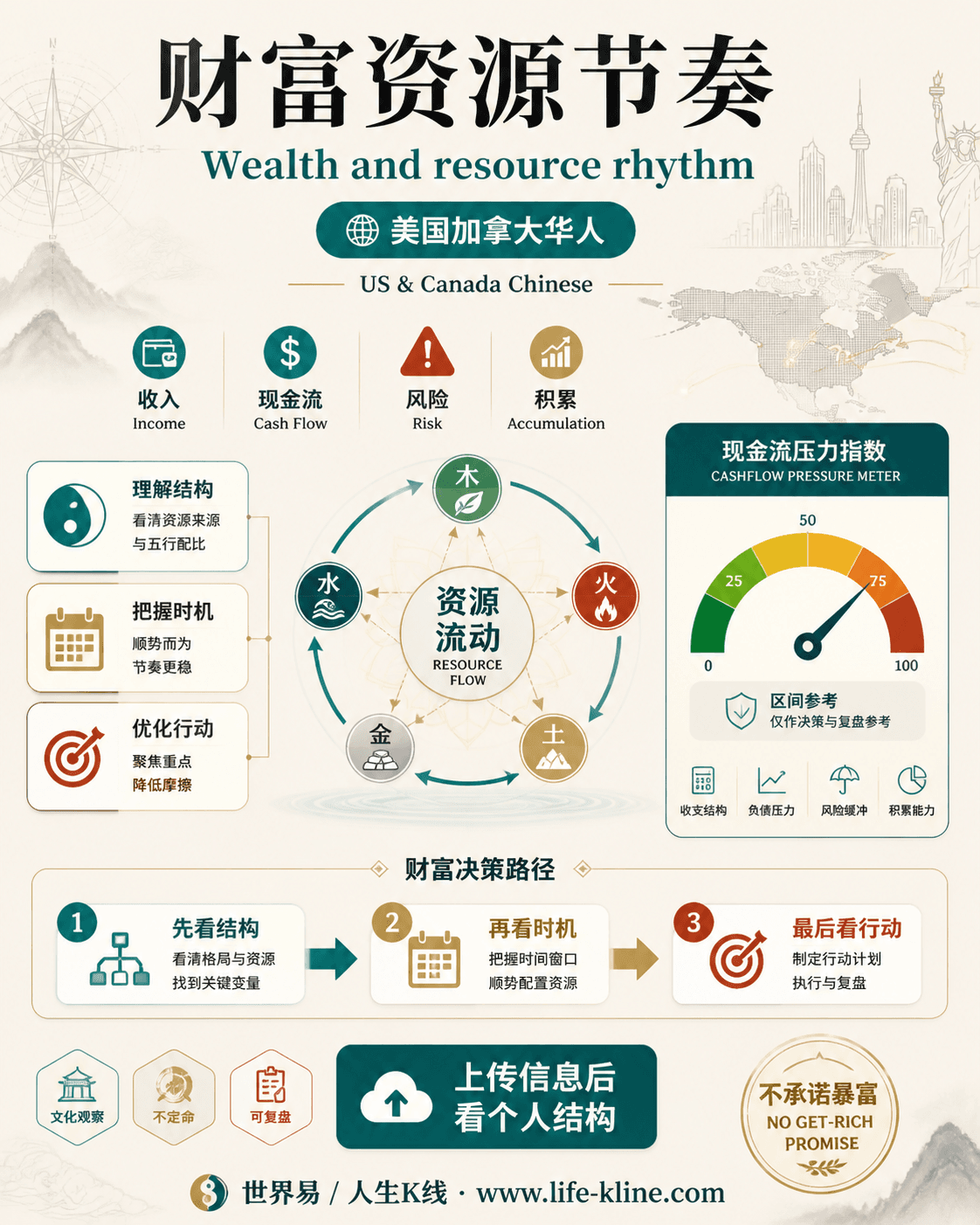
财富资源节奏|美国加拿大华人
这张图把《Supporting Aging Parents and Retirement Decisions: An Analysis of Withdrawal and Continued Support from a Metaphysical Perspective》里的命理概念转成关系、边界和应用场景,适合先看图建立结构,再回到知识文章正文理解细节。
财富资源节奏不应被写成固定结论。更适合美国加拿大华人的读法,是把传统术语翻译成结构、时机、环境、行动和复盘。
查看图片解读