Metaphysical References and Decision-Making Strategies for Parental Discipline Flexibility During Overseas Study
把这篇文章落到自己身上验证:先看结构,再进入个人分析,不做泛泛阅读。
Why This Decision Is Particularly Difficult at This Educational Stage
During the overseas study and education phase, parents face numerous practical challenges: complex country choices, significant differences in educational systems, tight application schedules, increased difficulties in parent-child communication due to family separation, and decisions about whether children will return home or stay abroad. These factors make the degree of discipline flexibility a critical issue. Parents worry that too loose discipline will lead to insufficient self-discipline in children, while overly strict discipline may cause parent-child conflicts and affect children’s mental health.
Under China’s current “Double Reduction” policy, domestic educational pressure has eased somewhat, but families with children studying abroad still face multicultural shocks and language adaptation challenges, especially since learning and expression abilities are directly related to the Shi Shen (食伤) and Yin stars (印星) structures in metaphysics. Yin stars represent parental protection and support, while Shi Shen relates to children’s learning, expression, and creativity abilities. Both play amplifying or mitigating roles in discipline strategies.
Moreover, parents’ own BaZi charts’ Da Yun (大运, decade luck cycles) and Liu Nian (流年, annual fortune) states directly affect their emotional management and decision-making styles. When Da Yun is stable, parents tend to be conservative and rational; when Da Yun is unfavorable, they may exhibit extreme or indecisive behaviors. In the uncertain environment of overseas study, reasonable interpretation of metaphysical information helps parents adjust discipline intensity and balance expectations with reality.
Therefore, combining metaphysical structures with contemporary overseas education realities to scientifically judge the necessity and timing of parental discipline flexibility is key to improving parent-child relationship quality and children’s developmental potential.
Three Core Dimensions of Metaphysical Judgment
First, the Day Master (日主) and its strength determine the parents’ basic energy and ability to cope with pressure. A relatively weak Day Master often requires support from Yin stars, which symbolize parental nurturing and support. A strong Yin star indicates rationality and patience in discipline; meanwhile, Shi Shen relates to children’s learning, expression, and innovation abilities. When Shi Shen is strong, children have strong expressive abilities, and parents should loosen discipline appropriately to encourage free development.
Second, the interaction between Da Yun and Liu Nian affects parents’ psychological state and decision-making style. When Da Yun is stable or auspicious, parents can maintain rationality and patience, suitable for gradual discipline strategies. When Da Yun is unfavorable or Liu Nian causes clashes, parents’ emotions fluctuate greatly, leading to overly strict or permissive discipline, increasing the risk of parent-child conflicts.
Third, the resonance between parents’ and children’s palace positions (宫位) in BaZi should not be overlooked. The balance between Guan Sha stars (官杀, representing authority and discipline) and Yin stars (印星) in parents’ BaZi determines the intensity and style of discipline. When Yin stars are relatively strong, parents tend to be protective and tolerant; when Shi Shen is strong, it indicates children have strong self-expression, and parents should reduce intervention and provide space.
By integrating these three dimensions and considering the unique educational realities of the overseas study phase, parents can scientifically judge discipline flexibility, avoiding excessive strictness or permissiveness, thus promoting healthy growth of children.
Three Real BaZi Case Studies
Case 1: Male, 30-35 years old, Day Master Yi Wood (乙木) relatively weak, Zheng Yin (正印) pattern, Yong Shen (用神) is Water, Ji Shen (忌神) are Fire and Earth. Currently in stable Ji Mao (己卯) Da Yun, with Bing Wu (丙午) Liu Nian allowing flexible response. This BaZi shows strong Yin stars, indicating parents have strong nurturing and protective intentions, rational and patient. Considering family separation and cultural adaptation pressures during overseas study, parents tend to maintain status quo in discipline and should keep moderate looseness to ensure children’s psychological safety. They should also use the support of Yin stars to stabilize children’s emotions. It is recommended to prioritize observing children’s expression (Shi Shen) for any discomfort signals and relax discipline timely to avoid rebellion caused by excessive strictness.
Case 2: Female, 25-30 years old, Day Master Jia Wood (甲木) relatively weak, Zheng Guan (正官) pattern, Yong Shen is Water, Ji Shen are Fire and Earth. Currently in dangerous Wu Wu (戊午) Da Yun, with Bing Wu (丙午) Liu Nian requiring caution. This BaZi has prominent Guan Sha stars, representing strong parental authority, but the unfavorable Da Yun increases emotional risk, possibly causing overly harsh or emotional discipline. During overseas study, parents may become anxious and controlling, causing children to feel excessive pressure. It is recommended that parents strengthen self-emotional management during discipline, avoid harsh suppression, moderately loosen control to ease tension, and closely monitor children’s psychological state, seeking professional support if necessary.
Case 3: Male, 20-25 years old, Day Master Wu Earth (戊土) relatively strong, Yang Ren (羊刃) pattern, Yong Shen are Wood and Water, Ji Shen is Fire. Currently in auspicious Jia Xu (甲戌) Da Yun, with Bing Wu (丙午) Liu Nian following momentum. This BaZi shows a relatively strong Day Master with Yang Ren, indicating parents have abundant energy and tend to discipline strongly, but the Yong Shen Wood and Water suggest room for adjustment. Facing differences in educational systems and environments during overseas study, parents tend to actively push children to adapt and progress. It is recommended to balance discipline to avoid causing resentment, and use the harmonizing function of Shi Shen and Yin stars to provide freedom and support timely, promoting children’s autonomous growth.
Common Misjudgments and Blind Spots at This Stage
First, ignoring the dynamic changes of Yin stars and Shi Shen in metaphysics and blindly applying fixed discipline strategies. Some parents increase discipline intensity based solely on subjective anxiety, neglecting children’s actual learning and expression needs, resulting in tense parent-child relationships.
Second, lacking awareness of emotional fluctuations during unfavorable Da Yun periods, leading to extreme discipline behaviors—either overly strict to control anxiety or overly permissive to let things slide—both detrimental to children’s stable development.
Third, overlooking the impact of cultural differences and family separation on children’s emotions in the complex overseas education environment, relying only on metaphysical judgment for discipline intensity without practical communication, easily causing misjudgments.
Fourth, neglecting the importance of timely professional psychological assistance. Metaphysics can serve as a rhythm reference, but when children face severe psychological crises, parents should prioritize professional intervention.
Practical Judgment Sequence
Step one: Assess parents’ Day Master strength and the Yin stars and Shi Shen structure to judge their discipline capacity and children’s learning and expression characteristics. When Yin stars are strong and Yong Shen is effective, loosening discipline to encourage children’s autonomy is suitable; otherwise, appropriate support should be strengthened without excessive strictness.
Step two: Combine current Da Yun and Liu Nian to analyze parents’ emotional fluctuation risks. When Da Yun is stable, maintain status quo and adopt gentle discipline strategies; when Da Yun is unfavorable, pay attention to emotional regulation to avoid impatience and extreme discipline behaviors.
Step three: Observe children’s adaptation and psychological signals in the overseas environment, especially their Shi Shen-related expression abilities and stress responses, and adjust discipline intensity accordingly. If obvious psychological crises appear, seek professional psychological assistance promptly, using metaphysics only as a rhythm reference.
Step four: Dynamically adjust discipline strategies, integrate actual parent-child communication, balance looseness and strictness, and promote children’s healthy growth and family harmony.
FAQ
Question 1: If parents’ BaZi shows strong Yin stars, does that mean discipline should definitely be loosened? Answer: Strong Yin stars represent strong parental support, but whether to loosen discipline still needs to consider Day Master strength, Da Yun and Liu Nian conditions, and children’s specific performance. One cannot make an absolute judgment based solely on strong Yin stars.
Question 2: During unfavorable Da Yun periods, how can parents avoid overly strict discipline causing parent-child conflicts? Answer: Parents first need self-emotional management, recognize the psychological fluctuation risks brought by Da Yun, moderately relax discipline standards, strengthen communication, and seek third-party support if necessary to avoid emotional decision-making.
Question 3: If children’s expression ability is weak during overseas study, how should parents adjust discipline strategies? Answer: When Shi Shen is weak, children’s expression ability is limited. Parents can appropriately increase guidance and attention but must avoid excessive control, giving children space to express and try, while using Yin stars’ support to stabilize and nurture.
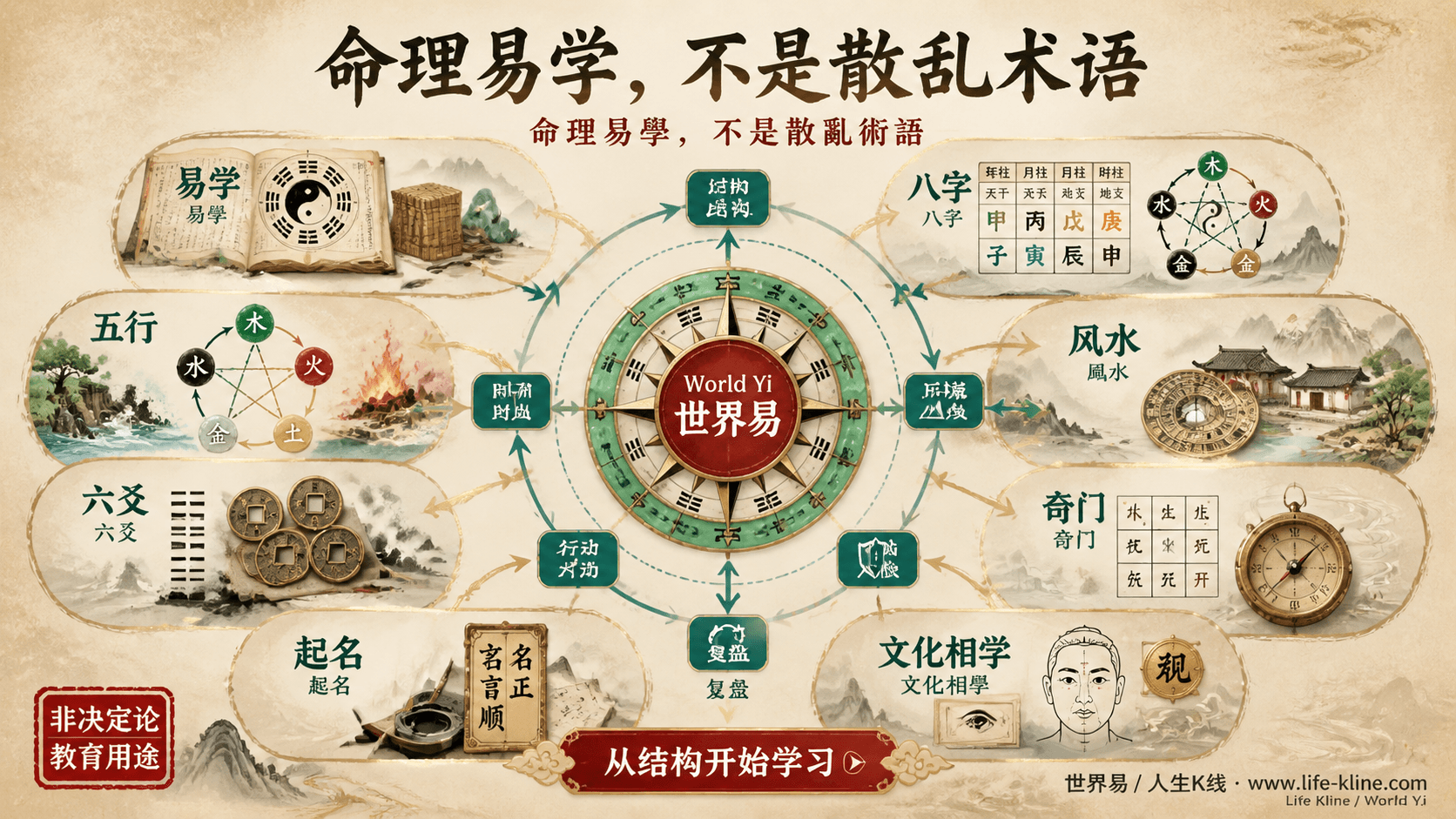
命理易学知识全景地图
这张图把《Metaphysical References and Decision-Making Strategies for Parental Discipline Flexibility During Overseas Study》里的命理概念转成关系、边界和应用场景,适合先看图建立结构,再回到知识文章正文理解细节。
用一张图说明易学、八字、风水、奇门、六爻、相学、起名与世界易的关系。
查看图片解读