Analysis of Financial Stars and Da Yun in the Family Financial Dynamics of Overseas Education Investment
把这篇文章落到自己身上验证:先看结构,再进入个人分析,不做泛泛阅读。
Why This Decision Is Especially Difficult at This Educational Stage
Decisions regarding investment in overseas education and further studies abroad are complex, involving differences in academic systems, application timelines, family member separation, and choices about returning home or staying abroad. Chinese families, facing the "Double Reduction" policy and pressure from high school entrance exam streaming, often turn their attention overseas, hoping to improve education quality and development opportunities through studying abroad. However, the high tuition fees and living costs of overseas education create significant economic pressure, making family financial capacity the core limiting factor in decision-making.
Parents’ anxiety at this stage stems not only from economic burdens but also from uncertainties about their children’s future development and adjustments in parent-child relationships. The tension between education investment and family finances often causes parents to hesitate between persistence and giving up. Particularly in overseas education environments, children’s ability to live independently and psychological resilience also become hidden concerns.
The financial stars in the BaZi structure reflect the flow and accumulation of wealth, while Da Yun represent the rhythm and energy release at different age stages. Combined with the real educational environment, metaphysics can provide temporal rhythmic references for the family’s financial baseline, helping parents judge when it is appropriate to increase investment and when to maintain stability, avoiding blind risk expansion.
Therefore, decisions on overseas education investment must comprehensively consider the family’s economic strength, the strength of the financial stars and the regulating role of the Yong Shen (favorable elements) in the child’s BaZi, as well as the coordination of Da Yun and Liu Nian (annual fortune), to form a rational plan that aligns with both family realities and the child’s developmental needs.
Three Core Dimensions of Metaphysical Judgment
First, the attribute and strength of the Day Master determine the child’s core energy and their adaptability to the external environment. A Bi Jian (比肩) pattern emphasizes self-competition and expression, while a Pian Cai (偏财) pattern highlights wealth operation and resource allocation. The choice of Yong Shen directly reflects the key to harmonizing the BaZi chart; for example, a Wood Yong Shen benefits growth and development, while Earth and Fire support stability and accumulation.
Second, the roles of Shi Shen (食神), Yin stars (印星), and Guan Sha (官杀) are especially critical. Shi Shen represents expression and creativity, Yin stars relate to learning assistance and psychological support, and Guan Sha involve rules and pressure. Their influence on learning attitude and expressive ability is particularly evident in overseas education environments, determining whether the child can adapt to multicultural and academic challenges.
Third, the interaction between the current Da Yun and Liu Nian reflects the rhythm of fortune at different stages. Stable Da Yun such as Ji Wei (己未) and Gui You (癸酉) suggest maintaining the status quo, indicating that education investment should be cautiously planned to avoid blind expansion. Liu Nian like Bing Wu (丙午) bring vitality but require flexibility; families need to maintain flexible financial arrangements and psychological support, adjusting education strategies promptly to respond to sudden changes.
The interaction between parents’ Da Yun and the child’s BaZi should not be overlooked, especially when financial stars appear. The rhythm of parental economic support and psychological endurance forms the baseline of decision-making. Reasonable coordination ensures the sustainability and maximization of education investment outcomes.
Three Real BaZi Case Studies
Case 1: This male has a Bing Fire (丙火) Day Master, moderately balanced, with a Bi Jian pattern and Wood as Yong Shen, Water as Ji Shen. Currently in the Ji Wei Da Yun (己未, ages 25-34), the Da Yun is stable and suggests maintaining the status quo. The Liu Nian Bing Wu (丙午) is active but requires adaptability. The Bi Jian pattern emphasizes self-competition and expression; Wood Yong Shen supports growth and learning adaptation during study abroad. Family investment should focus on maintaining stable cash flow, avoiding impulsive increases due to active Liu Nian. Parents are advised to keep investments steady, primarily supporting the child’s self-expression and independent problem-solving abilities, adjusting plans rather than aggressively expanding when facing sudden changes.
Case 2: This female has a weak Ding Fire (丁火) Day Master with a Bi Jian pattern, Wood as Yong Shen, Earth and Metal as Ji Shen. Currently in the Gui You Da Yun (癸酉, ages 35-44), the Da Yun is stable and suggests maintaining the status quo; Liu Nian Bing Wu (丙午) calls for adaptability. A weak Day Master needs Wood to harmonize, implying education investment should focus on creating a supportive growth environment. Female parents may face dual pressures from family and career; financial arrangements must consider overall family stability. It is recommended to prioritize basic expenses and psychological support in funding, avoid pressures from Ji Shen Earth and Metal, rationally evaluate study abroad costs versus expected benefits, and adjust investment pace appropriately.
Case 3: This male has a strong Ren Water (壬水) Day Master with a Pian Cai pattern, Earth and Fire as Yong Shen, Metal as Ji Shen. Currently in the Gui You Da Yun (癸酉, ages 23-32), the Da Yun is stable and suggests maintaining the status quo; Liu Nian Bing Wu (丙午) is active. The Pian Cai pattern emphasizes the use and allocation of wealth resources; Yong Shen Earth and Fire assist stability and enthusiasm, suitable for rational overseas education fund allocation. The chart indicates stable financial fortune at this stage but warns of risks from Ji Shen Metal affecting cash flow. Parents are advised to plan education funds reasonably in line with the Da Yun rhythm, avoid blindly pursuing high cost-performance study abroad programs, focus on fund safety and continuous supply, ensuring economic peace of mind during the child’s overseas study.
These three cases all reflect the principle of maintaining stability during stable Da Yun, with Liu Nian Bing Wu’s call for adaptability reminding families to flexibly adjust education investments. Meanwhile, the characteristics of financial stars and Yong Shen in the BaZi guide the focus of fund utilization.
Common Misjudgments and Blind Spots at This Stage
Many families ignore the rhythm of financial stars in metaphysics during overseas education investment, blindly following trends with high expenditures, resulting in excessive financial pressure that affects overall family life quality. Especially during active Liu Nian, families tend to be attracted by study abroad application seasons and popular countries, neglecting the match with their own BaZi and economic capacity.
Another common blind spot is overlooking the impact of Da Yun on family finances. When Da Yun suggests maintaining the status quo, families should avoid large-scale financial fluctuations, prioritizing stable investments and psychological support for children; otherwise, family conflicts and economic crises may arise.
The relationship between Yong Shen and Ji Shen in metaphysics is often neglected, leading to untargeted education investments. For example, when Ji Shen is overly strong, blindly increasing investment can backfire, exacerbating family disharmony and children’s academic pressure.
Moreover, parents often overlook psychological signals in their children’s BaZi. When signs of psychological crisis appear, relying solely on metaphysical rhythms and waiting is insufficient; families should seek professional psychological assistance promptly. Metaphysics serves only as an auxiliary reference.
Practical Judgment Sequence
Step one: Examine the strength of financial stars and the Yong Shen in the child’s BaZi to assess the family’s overall financial support capacity and potential risks. Combine this with the current Da Yun rhythm to determine whether to maintain stability or adjust investment strategies.
Step two: Evaluate the influence of Liu Nian on Da Yun, especially whether the annual fortune brings signals of activity or change. Anticipate possible fluctuations in funding needs and psychological pressure, and prepare financial and psychological support plans in advance.
Step three: Dynamically adjust the pace of education investment according to the real educational environment, including academic systems, application timelines, and family separation situations. When metaphysics indicates increasing Ji Shen pressure, prioritize fund safety and psychological health, avoiding blind expansion. If Yong Shen support is present, moderate increases can improve investment cost-effectiveness.
Throughout the process, parents should remain rational and patient, avoiding impulsive decisions. When uncontrollable psychological issues arise, seek professional psychological assistance promptly. Metaphysical rhythms are only auxiliary tools to help families maintain balance in complex environments.
FAQ
Question 1: Does a weak financial star in metaphysics mean the family cannot afford high overseas education costs? Answer: A weak financial star indicates relatively limited family finances but does not absolutely preclude affordability. It should be combined with Da Yun and Liu Nian to judge cash flow rhythms and plan investments reasonably, avoiding large lump-sum expenditures and prioritizing stability and continuous supply.
Question 2: How should parents adjust overseas education investment if the child’s BaZi shows overly strong Ji Shen? Answer: Overly strong Ji Shen means increased potential pressures and obstacles. Parents should be more cautious, prioritize psychological support and life stability, appropriately reduce investment risks, avoid aggressive expansion, and maintain fund liquidity and emergency capacity.
Question 3: Does a Da Yun favoring maintaining the status quo mean study abroad plans cannot be changed? Answer: Da Yun favoring stability emphasizes prudence and protection but does not exclude moderate adjustments during active Liu Nian. The key is to combine specific financial star and Yong Shen conditions, reasonably assess risks and benefits, and respond flexibly rather than blindly conservatively.
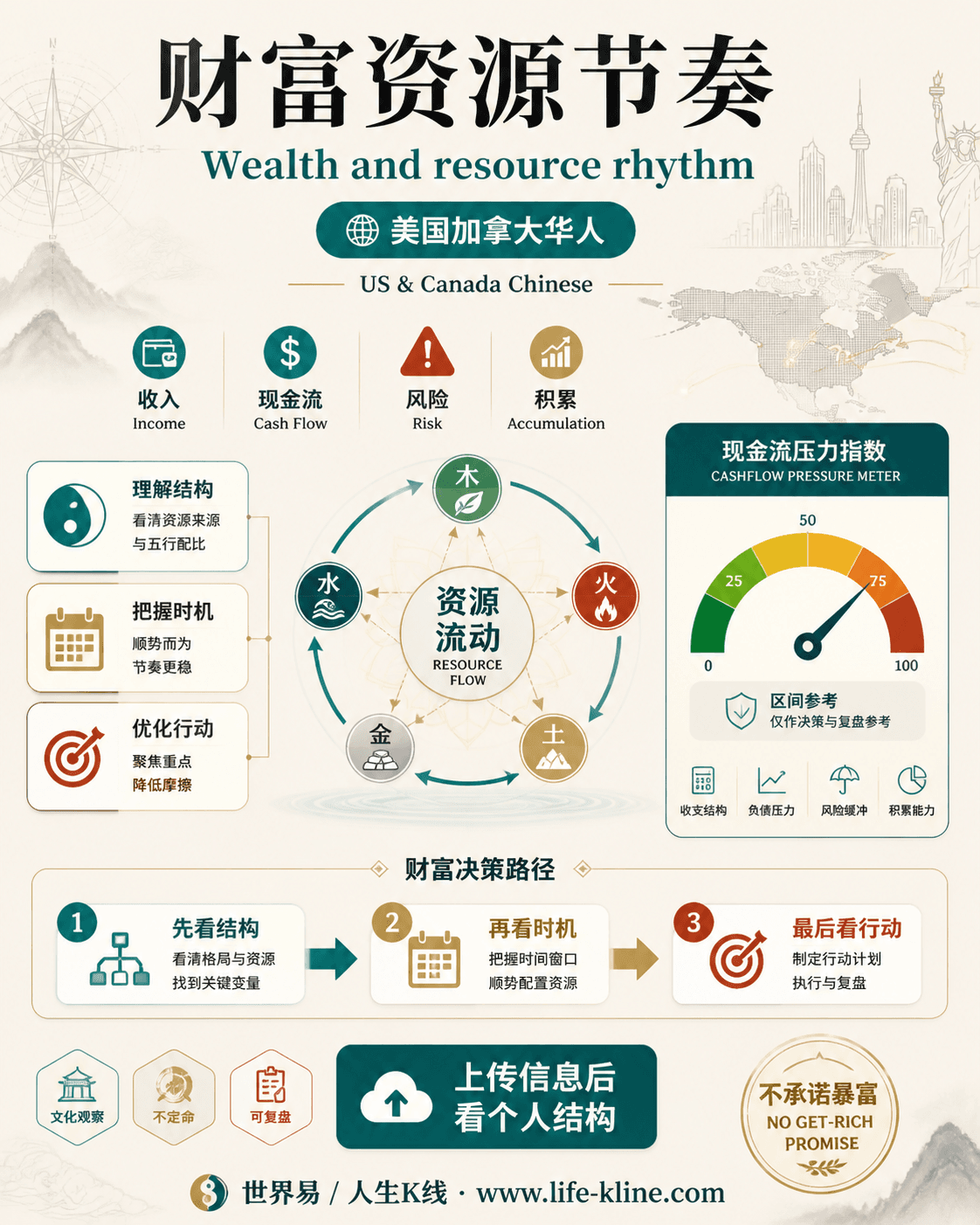
财富资源节奏|美国加拿大华人
这张图把《Analysis of Financial Stars and Da Yun in the Family Financial Dynamics of Overseas Education Investment》里的命理概念转成关系、边界和应用场景,适合先看图建立结构,再回到知识文章正文理解细节。
财富资源节奏不应被写成固定结论。更适合美国加拿大华人的读法,是把传统术语翻译成结构、时机、环境、行动和复盘。
查看图片解读