How the Financial Star, Shi Shen, and Yin Star Structures Affect Lean vs. Fat Retirement Decisions for Overseas Elder Care
把这篇文章落到自己身上验证:先看结构,再进入个人分析,不做泛泛阅读。
你现在搜索的,
其实是一个要落到自己身上的判断。
当前页面主要回答「Elder Care Scenarios」这类搜索问题;真正有价值的下一步是把这套结构带进自己的报告、工具与案例验证。
Why This Decision Is Especially Difficult in This Scenario
The core difficulty of overseas elder care lies in the unfamiliarity with medical systems and the psychological and practical support deficiencies caused by distant children. While elder care in Southeast Asia, Portugal, Japan, and other places offers affordable living costs and suitable climates, the medical security systems differ drastically from those in one’s home country. The availability and quality of medical resources become critical risk factors. Meanwhile, children living far away cannot provide frequent care, increasing the pressure on self-managed medical care and social support systems.
Economically, overseas elder care involves foreign exchange fluctuations, cross-border taxation, and social security coordination. Lean FIRE (Financial Independence, Retire Early) and fat FIRE differ significantly in asset preparation and cash flow. Choosing lean retirement may face risks of unexpected medical expenses and reduced living quality, whereas fat retirement entails higher tax burdens and more complex asset allocation.
Psychologically, social isolation and cultural differences make adapting to elder life challenging, especially when child support is limited. An individual’s emotional regulation ability and social resources become key determinants of life quality. In BaZi, Shi Shen represents personal expression and social vitality, Yin Star symbolizes dependence and support, and the Financial Star relates to wealth and resource reserves. These structures are amplified in overseas elder care environments, influencing risk and opportunity assessments during decision-making.
Therefore, deciding between lean and fat retirement is not merely a financial issue but a multidimensional interplay involving medical, family, and psychological factors. BaZi rhythm provides auxiliary perspectives to identify key timing and potential risks but must be combined with professional medical, legal, and financial planning to avoid misjudgments based on singular metaphysical conclusions.
Three Core Dimensions of BaZi Judgment
First, the strength of the Day Master (Ri Zhu) and the late-life Da Yun (decade luck cycle). The Day Master represents one’s vitality and intrinsic energy to cope with the environment. A relatively weak Day Master may rely more on external support in an unfamiliar overseas environment. Whether the late-life Da Yun remains stable or auspicious determines the individual’s psychological endurance and adaptability when facing complex medical and social environments.
Second, the Financial Star structure corresponds to disposable assets and wealth management ability. A strong Financial Star indicates robust wealth accumulation and resource mobilization capacity, suitable for considering fat retirement to bear higher living costs and medical insurance fees. A weak Financial Star suggests opting for lean retirement to avoid excessive risk exposure.
Third, Shi Shen and Yin Star reflect late-life lifestyle preferences and dependency relationships. Shi Shen represents personal expression, creativity, and social vitality; when strong, it indicates a greater need for rich social and spiritual fulfillment in elder life. Yin Star relates to support systems; when strong, it signifies robust medical and child support, whereas if it is a Ji Shen (unfavorable element), it indicates insufficient dependence, with higher risks of medical and social isolation.
The combination of Zheng Guan (Proper Authority) and Qi Sha (Seven Killings) relates to authority and regulations, affecting legal, tax compliance, and inheritance arrangements. Understanding the interactions among these Ten Gods (Shi Shen) helps accurately judge how to allocate assets and medical security in overseas elder care, balancing risks and quality of life.
Three Real BaZi Case Studies
Case 1: This lady’s Day Master is relatively weak Bing Fire (丙, Bing), belonging to the Qi Sha (Seven Killings) pattern. Her Yong Shen (favorable element) is Wood, and Ji Shen (unfavorable elements) are Earth and Metal. She is currently in the Ding Chou (丁丑, Ding Earth over Ox) Da Yun, which is a stable and conservative luck cycle, with the Liu Nian (annual fortune) Bing Wu (丙午, Bing Fire over Horse) allowing adaptability. Her Financial Star structure is relatively constrained — the Financial Star corresponds to Earth and Metal, which are Ji Shen, indicating limitations in wealth accumulation and liquidity. Shi Shen Wood is the Yong Shen, showing that spiritual life and social expression are key in her elder care. The Yin Star is weak, implying insufficient dependence; distant children and medical support may be concerns. Given the overseas elder care environment, this BaZi favors a lean retirement strategy, focusing on strengthening medical insurance and social network building to avoid amplified risks due to resource scarcity. The suggested judgment sequence is to first assess whether existing medical coverage is adequate, then adjust asset allocation according to foreign exchange and tax risks, and finally rely on spiritual and social activities to alleviate isolation.
Case 2: This gentleman’s Day Master is relatively strong Yi Wood (乙, Yi), belonging to the Zheng Guan (Proper Authority) pattern. His Yong Shen are Metal and Earth, with Water as Ji Shen. He is currently in the 10th year of the Bing Shen (丙申, Bing Fire over Monkey) Da Yun, which is a favorable luck cycle; the Liu Nian Bing Wu aligns well with his luck. The Financial Star elements Metal and Earth are Yong Shen, indicating strong wealth reserves and asset management capabilities, suitable for fat retirement. Neither Shi Shen nor Yin Star show significant Ji Shen, suggesting relatively stable social and support systems. In the context of overseas elder care, this male BaZi shows strong resource mobilization and risk resistance abilities, but unfamiliar overseas medical systems and distant children still require caution. Fat retirement is recommended, with emphasis on rational cross-border tax and insurance planning to ensure medical and legal compliance, while leveraging abundant resources to maintain good social connections and reduce isolation risk. The judgment sequence should prioritize confirming the robustness of cross-national financial arrangements, combined with Da Yun and Liu Nian rhythms to time optimal fund allocation.
Case 3: This lady’s Day Master is moderate Bing Fire (丙, Bing), belonging to the Zheng Yin (Proper Seal) pattern. Her Yong Shen is Wood, and Ji Shen is Water. She is currently in the Geng Wu (庚午, Geng Metal over Horse) Da Yun, a stable and conservative luck cycle, with Liu Nian Bing Wu allowing adaptability. A strong Yin Star indicates good medical and child support; the Financial Star shows no obvious Ji Shen, suggesting moderate wealth accumulation and support capacity. Shi Shen Wood as Yong Shen enhances spiritual life and social vitality. This structure is conducive to balancing medical dependence and self-expression in overseas elder care, suitable for flexibly choosing between lean or fat retirement based on specific medical resources and family conditions. It is recommended to prioritize evaluating the completeness of medical coverage and psychological adaptation according to the current Da Yun rhythm, then adjust retirement fund scale in financial planning to avoid overly aggressive or overly conservative strategies. The judgment sequence should focus on medical and social security assessments first, followed by detailed planning of wealth liquidity.
Common Misjudgments and Blind Spots in This Scenario
First, overreliance on the strength or weakness of the Financial Star alone. Although the Financial Star represents wealth, neglecting the influence of Shi Shen and Yin Star on spiritual and medical support can easily lead to underestimating psychological isolation and medical risks in elder life. The complex medical and social environment of overseas elder care requires multidimensional comprehensive analysis; decisions on lean or fat retirement cannot be based solely on wealth quantity.
Second, mistakenly believing that a stable late-life Da Yun guarantees no worries. Even if the Da Yun is stable, unexpected events may occur during Liu Nian’s adaptability phases, such as sudden medical expenses or tax changes, which can impact retirement plans. Especially in overseas elder care, unfamiliar medical systems and complex legal environments require vigilance against risk amplification from the interaction of Da Yun and Liu Nian.
Third, ignoring the support deficiency caused by distant children. If Yin Star is a Ji Shen, it indicates a weak dependence system. Being far from children means sudden medical and legal issues may be difficult to handle promptly, necessitating compensation through insurance and social resources. Blind optimism ignoring this point may lead to a significant decline in elder life quality.
Finally, BaZi cannot replace professional financial planning, medical consultation, and legal advice. Relying solely on BaZi rhythms for decision-making risks overlooking the complexities of cross-border taxation, asset allocation, and medical security, causing decision errors.
Practical Judgment Sequence
Step 1: Assess the strength of the Financial Star in the BaZi chart, combined with current assets and income status, to determine whether there is a financial foundation to support fat retirement. If the Financial Star is weak, focus on lean retirement to ensure sustainable basic living and medical security.
Step 2: Analyze the Shi Shen and Yin Star structures to evaluate personal spiritual life needs and medical dependence. A strong Shi Shen requires planning for rich social and spiritual activities; a strong Yin Star requires confirming whether medical and child support are sufficient. If insufficient, increase medical insurance and social support investments.
Step 3: Combine the current Da Yun and Liu Nian rhythms to judge risks and opportunities for retirement timing, adjusting asset allocation and medical insurance plans accordingly. Stable Da Yun suits conservative and steady planning, while adaptable Liu Nian phases require increased liquidity reserves to handle emergencies.
Throughout the process, coordinate with professional financial planners, medical consultants, and legal experts to ensure cross-border taxation, medical policies, and inheritance laws are properly integrated into the plan, avoiding blind spots from relying solely on BaZi judgment.
FAQ
Question 1: Does a strong Financial Star in BaZi necessarily mean fat retirement is suitable? Answer: A strong Financial Star indicates strong wealth accumulation ability, but overseas elder care involves many factors such as medical, tax, and social considerations. If Shi Shen or Yin Star structures are insufficient, it may lead to spiritual isolation or weak medical support. Therefore, retirement style should not be decided solely by the Financial Star’s strength but requires comprehensive evaluation.
Question 2: How to use BaZi to judge medical risks in overseas elder care? Answer: Yin Star represents dependence and support; when strong, it usually means a good medical support system, while as Ji Shen it indicates insufficient support. Observing current Da Yun and Liu Nian can assist in judging medical risk rhythms, but specific medical coverage still requires professional consultation and insurance planning. BaZi serves only as an auxiliary reference.
Question 3: What impact does distant children have on elder care decisions? Answer: Distant children often weaken the support function of the Yin Star, making medical and emergency handling more complicated. When Yin Star is weak or Ji Shen, special attention should be paid to establishing medical insurance and social support to avoid risk amplification due to insufficient dependence.
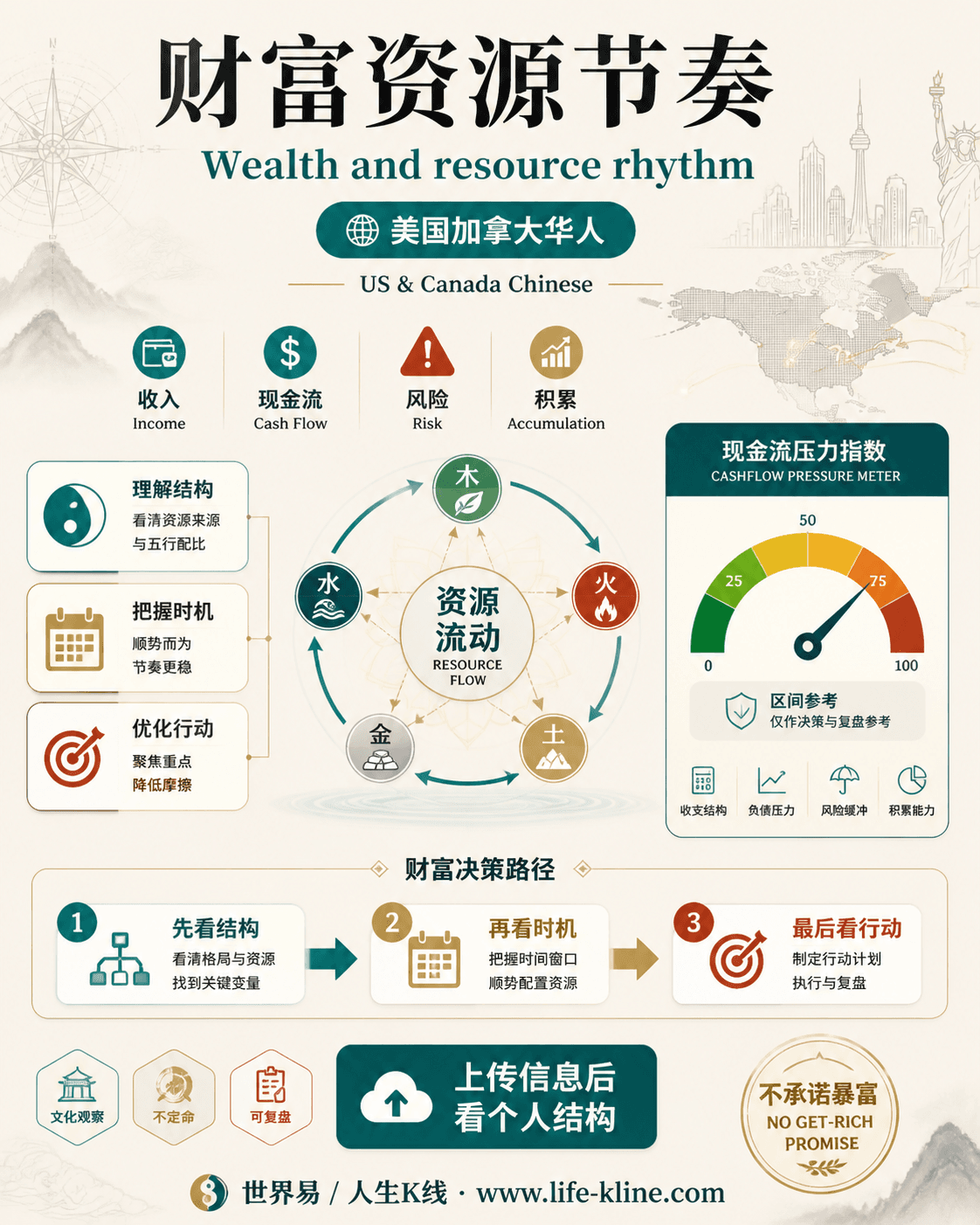
财富资源节奏|美国加拿大华人
这张图把《How the Financial Star, Shi Shen, and Yin Star Structures Affect Lean vs. Fat Retirement Decisions for Overseas Elder Care》里的命理概念转成关系、边界和应用场景,适合先看图建立结构,再回到知识文章正文理解细节。
财富资源节奏不应被写成固定结论。更适合美国加拿大华人的读法,是把传统术语翻译成结构、时机、环境、行动和复盘。
查看图片解读