Metaphysical Analysis of Risk Control and Stop-Loss in Overseas Asset Allocation
把这篇文章落到自己身上验证:先看结构,再进入个人分析,不做泛泛阅读。
Why This Decision Is Especially Difficult in This Category
The core difficulty of overseas asset allocation lies in the complex risks arising from overlapping multi-market environments. Frequent exchange rate fluctuations, changing cross-border tax policies, and regulatory rules require investors to consider a broader range of variables when controlling risks and executing stop-loss. Capital flows among multiple markets such as Hong Kong and US stocks, QDII, etc., with differences in transaction costs and taxes directly affecting risk exposure and exit timing.
Additionally, overseas assets usually involve longer investment cycles and family wealth inheritance planning. Investors often face psychological biases, such as overconfidence or panic selling, making precise execution of stop-loss decisions challenging. When market liquidity is insufficient, rapid position reduction may exacerbate losses, while excessive holding can amplify risks.
From a metaphysical perspective, the strength of the Day Master, the Yong Shen of the pattern, and the interaction with Da Yun and Liu Nian can assist in identifying the investor’s fortune fluctuations during specific cycles. This provides rhythmic references for judging when to decisively stop loss and when to maintain positions, helping reduce emotional interference and enhance the scientific nature of risk control.
Therefore, combining metaphysical structure with the characteristics of overseas asset markets can both amplify warning signals and avoid blind operations, which is key to improving the effectiveness of risk control decision-making.
Three Core Dimensions of Metaphysical Judgment
Firstly, the strength of the Day Master determines the core energy state of the individual, corresponding to a basic assessment of the investor’s risk tolerance. For example, a Geng Metal (庚, Geng) Day Master that is relatively strong reflects strong decisiveness but may be overly rigid; a Ren Water (壬, Ren) Day Master that is relatively weak suggests caution but susceptibility to external influences. The relationship between the Day Master and the Wealth Stars reflects the ability to attract and manage capital; when Wealth Stars are strong, capital attraction is easier, but excessive strength may expose the investor to higher risk.
Secondly, Bi Jian (比肩, Peer) and Jie Cai (劫财, Rob Wealth) relationships symbolize peer or competitive forces in investment, while the support of Yin Stars (印星, Resource Stars) to the Day Master represents external support and information resources. When Bi Jian and Jie Cai are strong, investors may face more internal competition or capital dispersion pressure; strong Yin Stars facilitate stable management and information acquisition, aiding risk identification and decision support.
Lastly, the interaction of Da Yun (decade luck cycles) and Liu Nian (annual fortune) reveals cyclical fortune changes, an important dimension for judging market risk windows. When Da Yun is stable, it is advisable to maintain positions; if Liu Nian shows clashes or combinations, flexible adjustments are needed, signaling investors to strengthen risk monitoring or decisively stop loss in certain years. The strength variations of Wealth Stars, Bi Jian/Jie Cai, and Yin Stars during Da Yun and Liu Nian directly influence the investor’s risk tolerance and stop-loss timing in overseas assets.
Three Real BaZi Chart Cases
Case 1: This chart’s Day Master is Geng Metal (庚, Geng), relatively strong, with a Qi Sha (七杀, Seven Killings) pattern. The Yong Shen is Water, and the Ji Shen (unfavorable element) is Earth. Currently in the 10th year of the Jia Chen (甲辰, Jia Chen) Da Yun, the fortune is stable, suitable for maintaining positions. In the context of overseas asset allocation, the strong Geng Metal Day Master indicates strong decisiveness, while the Qi Sha pattern suggests decisive action during market volatility. Water as the Yong Shen represents liquidity and capital allocation ability; Earth as Ji Shen warns of tax or regulatory risks related to Earth elements. During the Bing Wu (丙午, Bing Wu) Liu Nian, if exchange rate fluctuations or tax reform signals appear, priority should be given to monitoring liquidity indicators. If the Water Yong Shen is impaired, rapid position reduction and stop-loss are advised to prevent risk amplification despite stable Da Yun.
Case 2: This chart’s Day Master is Ren Water (壬, Ren), relatively weak, with a Pian Yin (偏印, Indirect Resource) pattern. The Yong Shen is Metal, and the Ji Shen are Wood and Fire. Currently in the 8th year of the Jia Yin (甲寅, Jia Yin) Da Yun, overall fortune is weak and major disruptions should be guarded against. The weak Ren Water Day Master indicates limited risk tolerance; the Pian Yin pattern reflects reliance on external information and support. Metal as Yong Shen helps stabilize asset allocation. Wood and Fire as Ji Shen warn of policy risks and market sentiment volatility. In overseas assets, especially QDII or Hong Kong and US stock markets facing regulatory changes, if Da Yun and Liu Nian coincide with damage to Wealth Stars or clashes involving Bi Jian/Jie Cai, investors should quickly identify risk signals and decisively execute stop-loss strategies to avoid severe capital damage caused by weak Da Yun.
Case 3: This chart’s Day Master is Geng Metal (庚, Geng), relatively strong, with a Shang Guan (伤官, Hurting Officer) pattern. The Yong Shen are Fire and Wood, and the Ji Shen is Earth. Currently in the 5th year of the Ji You (己酉, Ji You) Da Yun, fortune is weak, requiring caution. The Shang Guan pattern indicates an active mind and strong innovation ability, but attention is needed to the Fire and Wood Yong Shen representing market activity and liquidity, while Earth Ji Shen corresponds to tax and regulatory burdens. In overseas asset allocation, if tax policies tighten or exchange rates fluctuate, suppression of Fire and Wood Yong Shen signals reduced market liquidity. Investors should be alert to this and stop loss timely to protect asset safety, avoiding chain risks triggered by weak Da Yun.
These three cases all demonstrate the close relationship between metaphysical structure and overseas market risks. By judging the Day Master’s strength, the pattern’s Yong Shen, and the interaction with Da Yun and Liu Nian, investors can more scientifically identify when to strengthen risk control awareness and when to stop loss and exit, enhancing the overall stability of asset allocation.
Common Misjudgments and Blind Spots in This Category
In overseas asset allocation, investors often misjudge by relying solely on market trends or short-term data, neglecting cyclical risks. This neglect causes slow responses to sudden exchange rate or regulatory changes. The cyclical hints provided by metaphysical rhythms help fill this blind spot but should not be regarded as absolute prophecy.
Another blind spot is underestimating the impact of taxes and cross-border fees on stop-loss costs. In metaphysics, Ji Shen represented by Earth symbolizes tax burdens; ignoring this aspect leads to misjudgment of stop-loss timing and increased actual losses.
At the same time, psychological biases such as overconfidence, greed, or panic often cause risk control decisions to be emotionally driven. Combining metaphysical structure can assist in objectively assessing personal current fortune, reducing emotional interference, but it can never replace rational analysis and professional advice.
Finally, over-reliance on a single metaphysical signal while ignoring multidimensional market information easily leads to operational errors. The correct approach is to use metaphysics as an auxiliary tool, combined with market data and risk models, to form a scientific risk control framework.
Practical Judgment Sequence
First, investors should combine the strength of their own Day Master with the current Da Yun and Liu Nian situation to preliminarily assess their risk tolerance and the rhythmic characteristics of fortune fluctuations. When both Day Master and Da Yun/Liu Nian are weak, heightened vigilance is required, prioritizing position reduction or stop-loss plans.
Second, pay attention to market factors corresponding to Yong Shen and Ji Shen. When the Yong Shen is impaired or Ji Shen strengthens, it usually indicates increasing potential risks. By integrating overseas asset exchange rate changes, tax policy adjustments, and regulatory environment shifts, determine whether there are risk signals that cannot be ignored.
Finally, when obvious risk signals appear, especially during unstable fortune phases caused by Da Yun and Liu Nian clashes or combinations, formulate reasonable stop-loss points and position reduction steps considering market liquidity and transaction costs. Avoid blind panic or excessive delay; maintain rationality, reduce positions in batches, or adjust asset allocation to ensure stable family wealth inheritance.
FAQ
Question 1: Can metaphysics accurately predict when overseas assets will inevitably incur losses? Answer: Metaphysics provides rhythmic auxiliary references to help identify fortune fluctuations and risk windows but cannot replace market analysis and professional financial advice. There is no absolute prophecy of inevitable loss or gain.
Question 2: How to combine metaphysical judgment to determine stop-loss points? Answer: One should combine the strength of the Day Master, changes in Yong Shen and Ji Shen, and the clash/combination conditions of Da Yun and Liu Nian, along with actual market risk signals and liquidity status, to scientifically formulate stop-loss strategies and avoid emotional operations.
Question 3: In overseas asset allocation, which metaphysical signals indicate the need to accelerate position reduction? Answer: When Da Yun and Liu Nian exhibit clashes or combinations, and the Yong Shen is impaired or Ji Shen strengthens, especially during weak Day Master or weak Da Yun phases, risk control should be prioritized with timely position reduction and stop-loss.
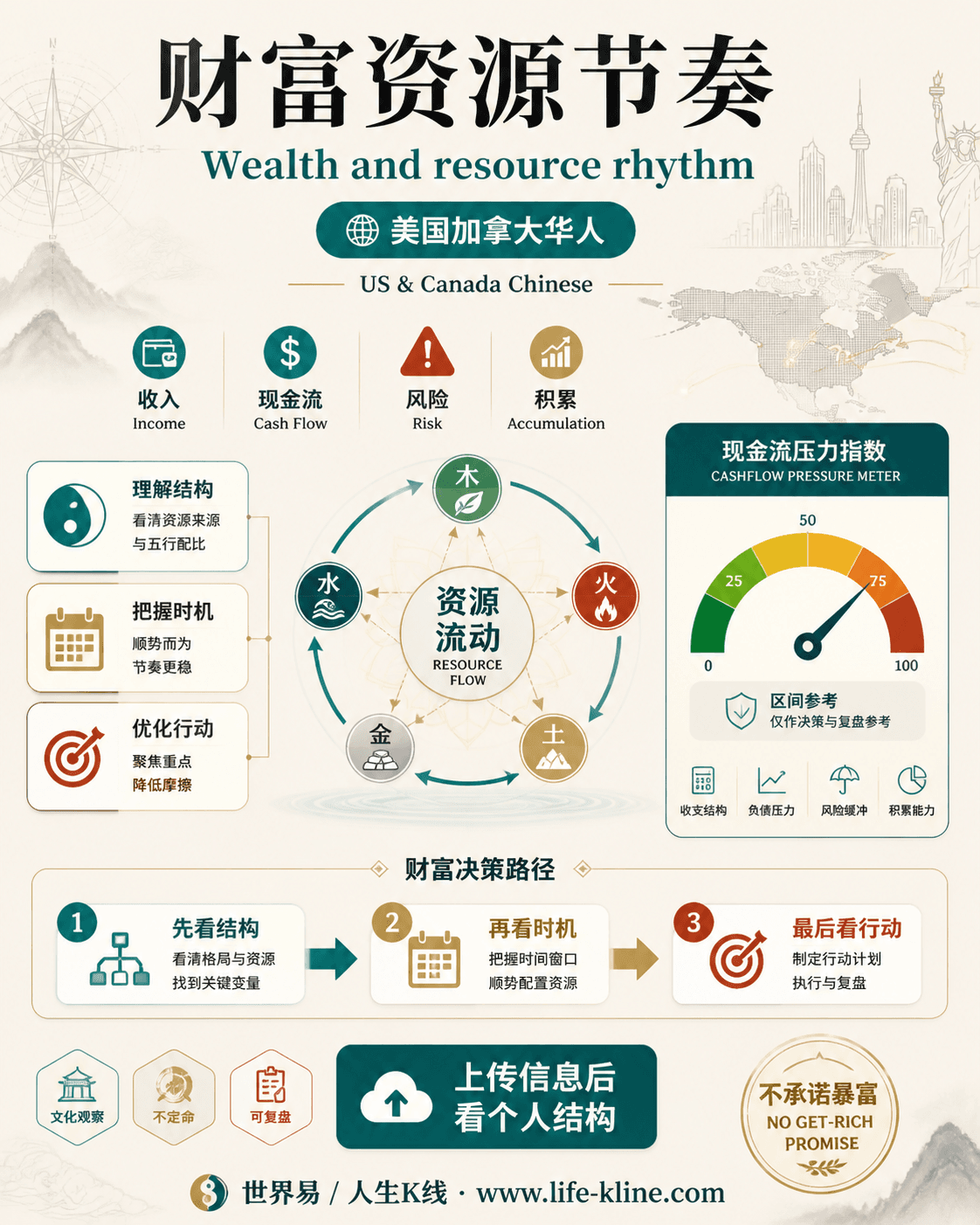
财富资源节奏|美国加拿大华人
这张图把《Metaphysical Analysis of Risk Control and Stop-Loss in Overseas Asset Allocation》里的命理概念转成关系、边界和应用场景,适合先看图建立结构,再回到知识文章正文理解细节。
财富资源节奏不应被写成固定结论。更适合美国加拿大华人的读法,是把传统术语翻译成结构、时机、环境、行动和复盘。
查看图片解读