Metaphysical Reference and Practical Judgement for Long-Term Overseas Asset Allocation Strategies
把这篇文章落到自己身上验证:先看结构,再进入个人分析,不做泛泛阅读。
Why This Decision Is Particularly Difficult in This Asset Category
The long-term holding strategy for overseas asset allocation is complex and full of challenges, mainly due to the multidimensional volatility of markets and the variability of regulatory environments. Exchange rate fluctuations not only affect the actual value of assets but also involve tax reporting and compliance risks related to cross-border capital flows. Although QDII and the Hong Kong and US stock markets provide quality diversification opportunities, they also bring pressure from fee structures and information asymmetry, making it difficult for investors to accurately judge when to increase or decrease holdings.
Against this backdrop, investors face pronounced psychological biases. Short-term market fluctuations easily trigger panic or greed, leading to frequent asset allocation adjustments that contradict the original intention of long-term holding. Additionally, overseas assets generally have weaker liquidity compared to domestic markets, with higher exit costs, making the timing of decisions especially critical.
Metaphysical structure offers an alternative auxiliary perspective, especially valuable in judging the investor’s long-term role positioning (core asset vs satellite asset). By analyzing the strength of the Day Master, the stability of the pattern, and the coordination of the Yong Shen, metaphysics can indicate the extent of volatility risk and capital lock-in time the investor is suited to bear, thereby optimizing asset allocation strategies.
By combining the multilayered market challenges with individual metaphysical rhythms, investors can more rationally assess their positioning in overseas asset allocation, avoid blind operations driven by emotional fluctuations, and achieve steady wealth accumulation and inheritance.
Three Core Dimensions of Metaphysical Judgement
First, the strength of the Day Master determines the stability of the investor’s own energy and their capacity to bear risk. A relatively weak Day Master often requires external resources (Yong Shen) to supplement energy, reflecting a reliance on external support; a relatively strong Day Master is more proactive and dominant, suitable for bearing larger risks and actively adjusting strategies.
Second, the pattern reflects the interaction between the Day Master and the wealth stars, resource stars, and peer stars, revealing the intrinsic logic of wealth acquisition and protection. The Shang Guan (Hurting Officer) pattern tends toward creativity and transformation, suitable for seizing market opportunities but requiring caution against excessive volatility; the Zheng Yin (Proper Resource) pattern emphasizes stability and preservation, suitable for steady holding and wealth accumulation; the Cong Cai (Following Wealth) pattern shows sensitivity and ability to utilize wealth, suitable for flexible allocation and risk management.
Finally, the combination of Yong Shen and Ji Shen (unfavorable element) is crucial in responding to market environments during the Da Yun (decade luck cycle) and Liu Nian (annual fortune). The Yong Shen provides energy supplementation to enhance the ability to cope with external fluctuations; the Ji Shen represents risk factors that need to be cautiously avoided. The stability or weakness of the Da Yun combined with Liu Nian changes determines the adjustment rhythm and risk tolerance of the investor’s long-term holding strategy.
Integrating these three dimensions, metaphysics not only indicates the investor’s core or satellite role in the long term but also assists in judging action strategies under different market cycles, enhancing the scientific and targeted nature of overseas asset allocation.
Three Real BaZi Chart Cases
Case 1: This gentleman’s Day Master is Ji (己, Earth), relatively weak, belonging to the Shang Guan pattern, suitable to be remedied by Fire. He is currently in the Jia Chen (甲辰) Da Yun, which is stable and suitable for preservation, with the Liu Nian Bing Wu (丙午) allowing flexible response. In overseas asset allocation, he tends to take a core role with steady holding, because the Shang Guan pattern indicates a need for innovation and change, but the weak Day Master and Ji Shen of Metal and Water warn sensitivity to exchange rate and tax risks. The long-term holding strategy should emphasize preservation, avoid frequent rebalancing, and utilize Fire energy to focus on growth-type overseas assets. The judgment sequence should first confirm whether the current Da Yun and Liu Nian support preservation, then assess market exchange rate and tax policy changes, and finally adjust positions according to personal liquidity needs to avoid emotional operations.
Case 2: This lady’s Day Master is Bing (丙, Fire), relatively strong, with a Zheng Yin pattern. Her Yong Shen are Water and Metal, and Ji Shen is Wood. She is in the Ding Si (丁巳) Da Yun stable period, with Liu Nian Bing Wu (丙午), suitable for preservation. She is suitable to act as a core role in overseas asset allocation because the Zheng Yin pattern represents stable accumulation, and the Yong Shen Water and Metal assist in information acquisition and capital security. Facing QDII and Hong Kong and US stock markets, she can better grasp tax compliance and risk diversification. The long-term holding strategy should maintain a steady posture, leveraging the Zheng Yin pattern’s preservation strength, avoiding excessive pursuit of short-term gains. The recommended judgment sequence is to first evaluate whether Da Yun and Liu Nian support preservation, then combine market policy changes, and finally regularly review asset allocation to ensure synchronization with metaphysical rhythms and strengthen wealth inheritance.
Case 3: This lady’s Day Master is Ding (丁, Fire), balanced, with a Cong Cai (Following Wealth) pattern. Her Yong Shen are Metal and Earth, and Ji Shen are Wood and Fire. She is currently in the Jia Zi (甲子) Da Yun, which is relatively weak, and Liu Nian Bing Wu (丙午) requires caution. Her chart shows high sensitivity to wealth and is suitable for flexible adjustment of overseas assets, taking on a satellite asset allocation role. Due to the weak Da Yun, the long-term holding strategy needs caution, especially when facing exchange rate and market volatility, requiring timely adjustments to prevent risk accumulation. The judgment sequence should prioritize the impact of Da Yun and Liu Nian on the Day Master’s energy, combined with market liquidity and tax policies, reasonably diversify investments to avoid concentration risk, and pay attention to liquidity needs to enhance the ability to respond to emergencies.
Common Misjudgments and Blind Spots in This Asset Category
A common misjudgment in long-term overseas asset allocation strategies is ignoring the impact of exchange rate fluctuations on actual returns, leading to biased expectations of asset value. Investors often focus excessively on the performance of the underlying market while neglecting exchange rate risk and the complexity of cross-border capital flows, which corresponds to warnings from the Ji Shen in metaphysics.
Another blind spot is underestimating the costs and restrictions brought by tax compliance. Tax policies vary greatly across countries and regions, and frequent rebalancing may trigger high taxes that erode returns. The relationship between Yong Shen and Ji Shen in metaphysics indicates the ability to cope with policy risks; ignoring this can cause strategy failure.
Additionally, investors are often influenced by short-term fluctuations, violating the principle of long-term holding. Frequent operations increase transaction costs and market risks. The stability of Da Yun and changes in Liu Nian in metaphysics indicate whether preservation or adjustment is appropriate; ignoring metaphysical rhythms may cause missed optimal wealth accumulation opportunities.
Finally, overreliance on a single information channel or investment target and lack of risk diversification awareness are common misjudgments. The combination of wealth stars and peer stars in metaphysics highlights the importance of capital diversification and shared risk. Ignoring these metaphysical signals can exacerbate portfolio vulnerability.
Practical Judgment Sequence
Step one: Investors need to combine their own metaphysical structure to confirm the support degree of the current Da Yun and Liu Nian to the Day Master and Yong Shen, judging whether it is a stage suitable for preservation or adjustment. When Da Yun is stable and Yong Shen is well supported, it is suitable to maintain a long-term holding strategy and reduce frequent rebalancing.
Step two: Combine the specific overseas market environment, focusing on exchange rate trends, tax policy changes, and regulatory dynamics, as these factors directly affect asset liquidity and net returns. The Ji Shen in metaphysics warns of risk points, prompting investors to prepare and prevent in advance.
Step three: Investors should reasonably distinguish core assets and satellite assets according to the risk tolerance and capital liquidity needs indicated by metaphysics. Core assets should be held steadily, while satellite assets can be adjusted timely to capture market opportunities. Decision-making should maintain discipline, avoid emotion-driven operations, and ensure strategy execution aligns with metaphysical rhythms.
In summary, by using metaphysical-assisted judgment combined with professional financial advice, investors can more scientifically grasp the rhythm of long-term overseas asset holding, enhancing steady wealth growth and inheritance efficiency.
FAQ
Question 1: How does metaphysics help judge core and satellite assets in overseas asset allocation? Answer: Metaphysics reveals the investor’s risk tolerance and capital allocation tendencies through the strength of the Day Master, pattern, and Yong Shen combination. A relatively strong Day Master and Zheng Yin pattern are more suitable for steady holding of core assets, while a relatively weak Day Master or Cong Cai pattern is better suited for flexible adjustment of satellite assets, helping to reasonably differentiate asset roles.
Question 2: What specific impact do Da Yun and Liu Nian have on long-term holding strategies? Answer: Da Yun represents medium- to long-term trends, while Liu Nian reflects short-term fluctuations. When Da Yun is stable and Yong Shen is strong, preservation is suitable; Liu Nian suggests flexible adjustment. When Da Yun is weak or Ji Shen is strong, caution is needed as market risks and capital pressure may increase, making it suitable to reduce holdings or wait and see.
Question 3: How to combine metaphysics with professional financial advice in investing? Answer: Metaphysics provides rhythm and risk warnings, helping identify suitable investment pace and risk tolerance; professional financial advice focuses on market fundamentals, taxation, and compliance. Combining both forms a scientific decision-making framework, avoiding blind following or emotional operations, and achieving steady wealth growth.
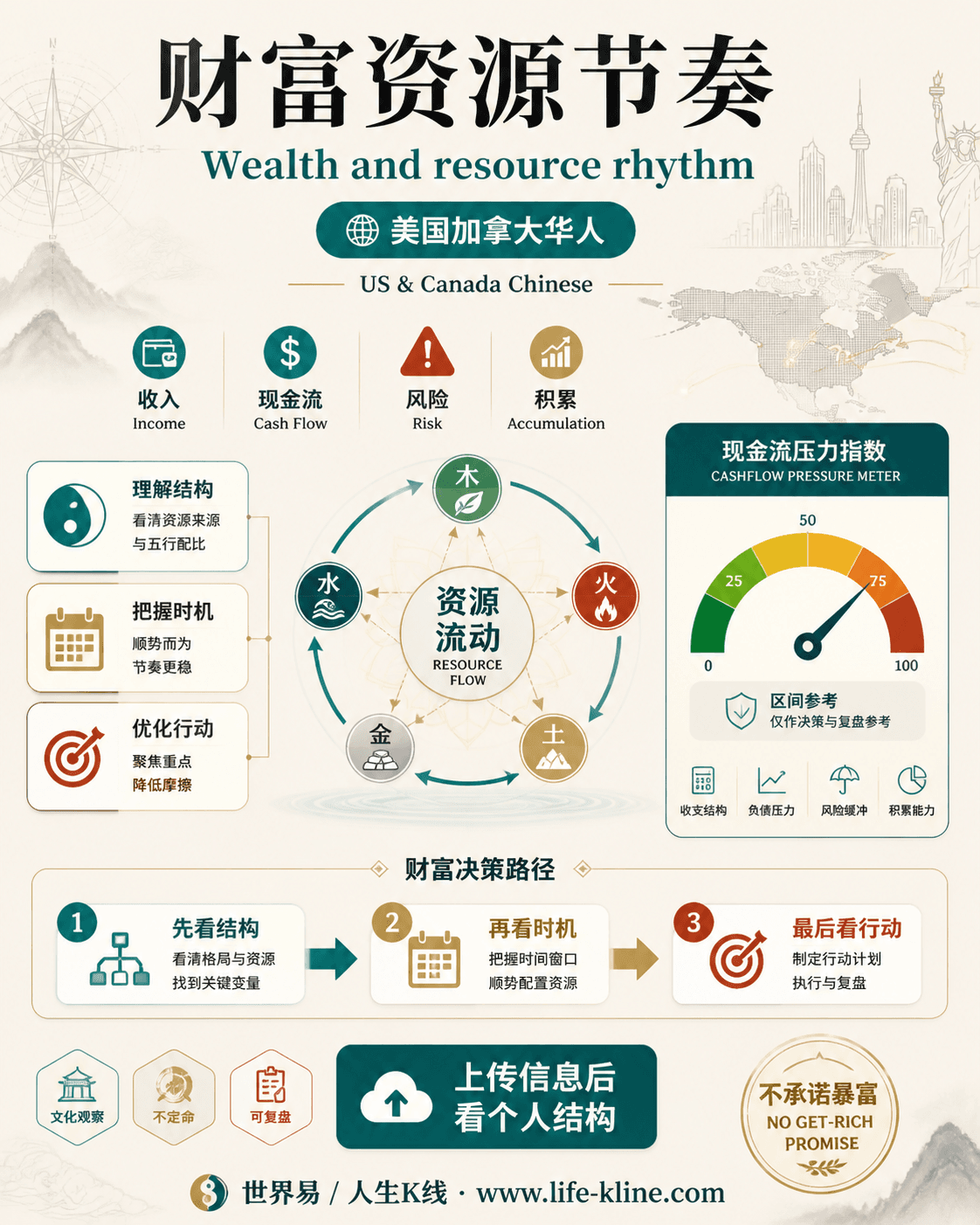
财富资源节奏|美国加拿大华人
这张图把《Metaphysical Reference and Practical Judgement for Long-Term Overseas Asset Allocation Strategies》里的命理概念转成关系、边界和应用场景,适合先看图建立结构,再回到知识文章正文理解细节。
财富资源节奏不应被写成固定结论。更适合美国加拿大华人的读法,是把传统术语翻译成结构、时机、环境、行动和复盘。
查看图片解读