Economic and Emotional Support Boundary Decisions Under Multiple Role Pressures for Only Children
把这篇文章落到自己身上验证:先看结构,再进入个人分析,不做泛泛阅读。
Why This Decision Is Especially Difficult in This Scenario
The upbringing environment of only children is often accompanied by the dual pressures of sole caregiving responsibility and emotional uniqueness. Parents tend to invest excessive attention and expectations in their only child, causing the child's self-worth to easily bind with parental expectations, creating a high-pressure growth environment. In this parent-child dynamic, parents worry both about the child's lack of support after independence and about excessive intervention eroding the child's autonomy, making it difficult to grasp the boundary of support intensity.
Against this backdrop, adjusting the intensity of economic and emotional support becomes a core decision challenge. Excessive economic support may increase the child's dependency, hindering self-growth; while excessive emotional support may exacerbate emotional burdens, forming a psychological dilemma of being overly focused upon. This pressure is particularly evident in only children, who often bear all parental expectations and emotional investments.
Metaphysical structures, through the strength of the Day Master, pattern types, configuration of Yong Shen (favorable elements) and Ji Shen (unfavorable elements), as well as changes in Da Yun (decade luck cycle) and Liu Nian (annual fortune), provide auxiliary references for the child's internal energy and external environmental pressures. Different charts reveal the child's capacity to withstand pressure and sensitivity to support, helping parents scientifically define economic and emotional support boundaries, avoiding blind reinforcement or neglect in parenting.
However, metaphysics is only an auxiliary tool and cannot replace professional psychological counseling and family therapy. Especially when children exhibit self-harm, depression, or behavioral deviations, professional help should be prioritized. The value of metaphysics lies in indicating risks and rhythms, assisting parents in finding more reasonable support strategies amid complex parent-child relationships.
Three Core Dimensions of Metaphysical Judgment
The strength of the Day Master reflects the child's internal self-power. A relatively strong Day Master usually indicates strong self-drive and adaptability, while a weak Day Master may rely more on external support. Under the multiple pressures faced by only children, those with a strong Day Master may better endure higher economic and emotional support without losing autonomy, whereas those with a weak Day Master require moderate limits to prevent increased dependency.
Yin stars (印星, Pian Yin / Zheng Yin) and Bi Jian / Jie Cai (比肩/劫财) represent attachment and peer competition energies. A strong Yin star helps the child obtain parental emotional nourishment, forming secure attachment, but if overly strong may lead to emotional dependency or excessive attention. A strong Bi Jian / Jie Cai may reflect strong competitiveness among siblings or power struggles in the parent-child relationship, affecting the setting of support boundaries.
Guan Sha (官杀, Zheng Guan / Qi Sha) and Shi Shang stars (食神/伤官) symbolize authority and self-expression. Strong Guan Sha often represents parental authority and expectation pressure, while Shi Shang indicates the child's ability to express self and innovate. Excessive Guan Sha may lead to increased parental control over economic and emotional support, hindering the child's autonomous development; a strong Shi Shang means the child needs emotional space and reasonable support to avoid repression.
The interaction of Da Yun and Liu Nian shows the environmental rhythm the child is experiencing. Stable Da Yun favors maintaining the status quo, with support levels kept reasonably steady; when encountering conflicting or changing Liu Nian, support strategies should be flexibly adjusted to promptly respond to the child's psychological and growth signals. Integrating these three dimensions enables a more scientific definition of economic and emotional support boundaries.
Three Real Case Studies
Case 1: This female has a relatively strong Day Master of Geng Metal (庚, Geng), with a Zhuan Wang (专旺) pattern, Yong Shen is Earth (土), and Ji Shen is Wood (木). She is currently in the third year of the Ren Xu (壬戌) Da Yun and the Bing Wu (丙午) Liu Nian. A strong Geng Metal Day Master indicates strong internal self; the Zhuan Wang pattern shows outstanding ability, with Earth as the favorable element supporting stability. The Ren Xu Da Yun is stable, and the Bing Wu Liu Nian requires adaptability. Under the multiple pressures faced by only children, this chart's child has strong self-regulation ability. Economic and emotional support can be moderately increased, but attention should be paid to the disruptive influence of the Wood Ji Shen to avoid excessive emotional dependency or expectation binding. Parents should monitor emotional fluctuations, adjust support rhythm timely, and supplement with professional psychological counseling to prevent pressure accumulation.
Case 2: This female has a relatively strong Geng Metal (庚, Geng) Day Master, with a Zheng Cai (正财) pattern, Yong Shen are Fire (火) and Wood (木), and Ji Shen is Earth (土). She is currently in the sixth year of the Gui You (癸酉) Da Yun and the Bing Wu (丙午) Liu Nian. The Zheng Cai pattern reflects close ties to financial resources and external environment; Fire and Wood as favorable elements indicate a need for emotional and action support; Earth as Ji Shen suggests potential limitations on stability. This child's chart may be more sensitive to adjustments in economic support during parenting negotiations; excessive economic input may lead to dependency, while emotional support should focus on stimulating autonomy. Parents should consider the child's need for Fire and Wood energies when defining support boundaries, avoid excessive Earth constraints, and promote positive growth.
Case 3: This male has a relatively strong Wu Earth (戊, Wu) Day Master, with a Shi Shen (食神) pattern, Yong Shen is Metal (金), and Ji Shen is Fire (火). He is currently in the first year of the Bing Zi (丙子) Da Yun and the Bing Wu (丙午) Liu Nian. The Shi Shen pattern indicates strong expression and creativity; Metal as Yong Shen helps regulate and strengthen self; Fire as Ji Shen suggests emotional volatility. Under this structure, the child may exhibit strong self-expression needs under multiple role pressures. Emotional support is especially critical but must avoid emotional overheating that leads to conflicts. Economic support should remain steady to prevent insecurity caused by resource fluctuations. Parents should flexibly adjust support intensity according to Da Yun and Liu Nian changes, and timely introduce psychological counseling to ensure mental health.
These three cases collectively illustrate the role of metaphysical structures in raising only children, helping parents identify reasonable support boundaries and potential risks, combined with professional psychological interventions to achieve scientific parenting.
Common Misjudgments and Blind Spots in This Scenario
Parents often, driven by emotional anxiety or intergenerational expectations, tend to unconditionally increase economic and emotional support, mistakenly believing this will reduce the pressure on the only child, while neglecting the child's autonomy development and independent capability cultivation. This over-attention easily leads to the child forming dependency psychology, which actually intensifies internal pressure and conflicts.
In metaphysics, a common blind spot is ignoring the balance of Day Master strength and Yong Shen / Ji Shen. For example, overly restricting support for children with a strong Day Master may suppress their potential; conversely, excessive support for children with a weak Day Master may reinforce dependency and hinder growth. Therefore, metaphysical judgment must be combined with specific parenting dynamics, avoiding simplistic application.
Another misjudgment is neglecting the rhythm changes of Da Yun and Liu Nian. Adjustments in support intensity should follow the ups and downs of Da Yun and Liu Nian; blindly maintaining high input or suddenly withdrawing support may trigger emotional fluctuations and parent-child conflicts. Only by dynamic observation combined with metaphysical rhythms can reasonable support boundaries be achieved.
Finally, metaphysical assistance is often misused as a substitute for psychological counseling. The complex and variable psychological pressures of only children mean that metaphysics is only an auxiliary judgment tool and cannot replace professional psychological intervention. Parents should be wary of treating metaphysics as a universal key; timely seeking professional help is crucial to safeguarding children's mental health.
Practical Judgment Sequence
First, assess the child's Day Master strength and pattern type to determine their internal self-drive and sensitivity to external support. For children with a strong Day Master, economic and emotional support can be moderately increased but watch for emotional dependency; for those with a weak Day Master, support should be cautiously increased to promote independence.
Second, combine Yong Shen and Ji Shen observations with whether the current Da Yun and Liu Nian are stable. Stable Da Yun favors maintaining the status quo, with support strategies kept stable and continuous; when encountering Liu Nian conflicts or changes, support intensity should be flexibly adjusted to promptly respond to the child's psychological and behavioral signals, avoiding forced control or neglect.
Finally, continuously monitor the child's emotional and behavioral performance, especially during stress events or changes. If self-harm, depression, or violent tendencies appear, seek professional psychological counseling and family therapy immediately; metaphysical judgment serves only as auxiliary reference. Support adjustments should integrate professional advice to ensure overall balance of parent-child relationships and the child's mental health.
FAQ
Question 1: How exactly do Yong Shen and Ji Shen in metaphysics affect support intensity? Answer: Yong Shen represents the energies needed in the child's chart; supporting the Yong Shen benefits the child's growth and stability. Parents can provide appropriate economic and emotional support targeting the Yong Shen. Ji Shen represents unfavorable elements in the chart; over-activating the Ji Shen may increase the child's pressure or dependency, so support related to Ji Shen should be limited to avoid negative effects.
Question 2: When an only child experiences emotional fluctuations, how should parents adjust based on metaphysics? Answer: Parents should first assess changes in the current Liu Nian and Da Yun, understand the child's pressure points and support points in the chart. Combining metaphysical indications, they should moderately adjust the rhythm of economic and emotional support, increase emotional communication and understanding, and cooperate with professional psychological counseling when necessary, avoiding blindly strengthening or withdrawing support that could worsen emotions.
Question 3: Can metaphysics replace professional psychological counseling? Answer: No. Metaphysics is only an auxiliary tool to help parents understand the child's internal rhythms and pressure points. When facing mental health issues such as self-harm, depression, or violent tendencies, professional psychological counseling and family therapy should be prioritized. The role of metaphysical judgment is to assist decision-making rhythm, not to replace medical or psychological intervention.
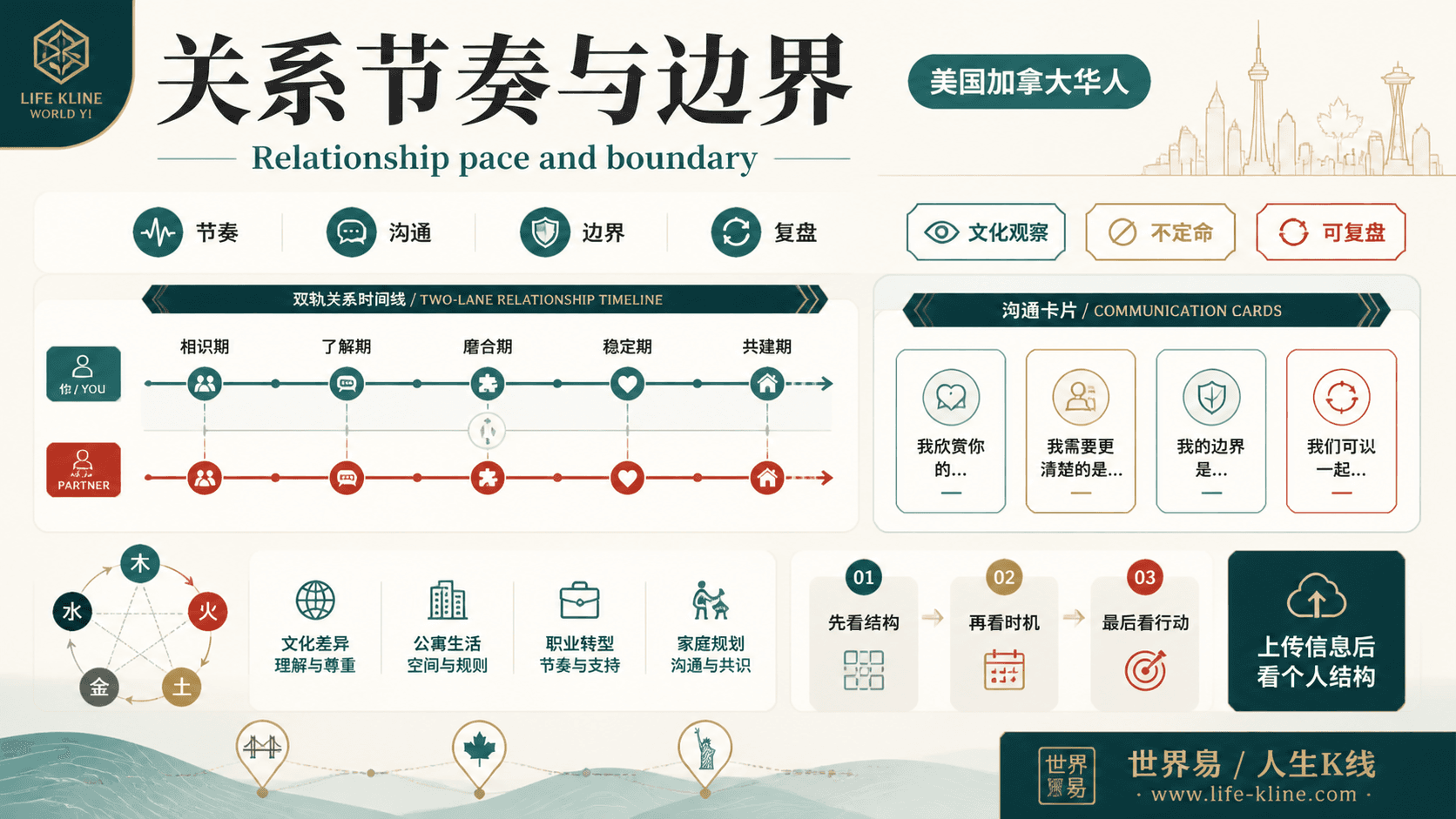
关系节奏与边界|美国加拿大华人
这张图把《Economic and Emotional Support Boundary Decisions Under Multiple Role Pressures for Only Children》里的命理概念转成关系、边界和应用场景,适合先看图建立结构,再回到知识文章正文理解细节。
关系节奏与边界不应被写成固定结论。更适合美国加拿大华人的读法,是把传统术语翻译成结构、时机、环境、行动和复盘。
查看图片解读