Parenting Decisions Under Multiple Pressures on Only Children: Analysis of Rigid Boundaries and Flexible Companionship
把这篇文章落到自己身上验证:先看结构,再进入个人分析,不做泛泛阅读。
Why This Decision Is Especially Difficult in This Context
Only children often carry multiple family expectations; they are not only the sole future caregivers but also the unique emotional focus. This 'only seedling' status causes parents to pay extremely high attention, posing risks of over-dependence and often tightly binding self-worth with parental expectations. Against this backdrop, parents face a particularly thorny choice between strict discipline and granting autonomy, needing to set effective boundaries to prevent spoiling while ensuring emotional companionship to promote the child’s autonomy.
Psychology points out that excessive discipline may trigger rebellious psychology and emotional repression in only children, while excessive autonomy may lead to lack of responsibility and insecurity. At this time, BaZi structures like Guan Sha (Officers and Killings) and Yin Xing (Seal Stars) serve as auxiliary indicators to observe parent-child authority relationships and emotional attachment, while Bi Jie (Peers) symbolizes self-awareness and peer competition, revealing the child's inner independent demands.
Different combinations of BaZi structures amplify or buffer these psychological dynamics. For example, a BaZi chart with strong Guan Sha may correspond to a strong sense of authoritative oppression; if parents adopt strict discipline, the child may rebel. Conversely, a chart with strong Yin Xing indicates high emotional dependence on parents; excessive autonomy might cause the child to feel insecure. Thus, the difficulty in parenting decisions lies in dynamically adjusting the degree of rigid boundaries and flexible companionship according to specific BaZi signals.
Moreover, cultural pressures of generational expectations and investment in educational resources often increase parental psychological burden, leading to extreme disciplinary strategies. BaZi rhythms such as Da Yun (decade luck cycles) and Liu Nian (annual fortune) indicate windows of changes in the child's psychological state, guiding parents to adjust discipline methods at appropriate times to reduce parent-child conflicts and promote healthy psychological growth.
Three Core Dimensions of BaZi Judgment
First, the combination of the Day Master and Shi Shen (Eating God and Hurting Officer stars) reflects the child's self-expression and creativity. Shi Shen stars, as child stars, represent psychological needs and outward behavior. When the Day Master is relatively weak, the child may show insufficient self-worth, and parents' discipline strategies should focus more on emotional support, avoiding rigid boundaries that cause frustration.
Second, Yin Xing (Seal Stars) symbolize attachment and protection. A chart with strong Yin Xing indicates deep emotional dependence on parents and a tendency toward emotional isolation fears. In the context of only children, such children have a higher need for flexible companionship; parents should avoid excessive rigidity to prevent emotional alienation and psychological pressure accumulation.
Third, Guan Sha (Officers and Killings) represent authority and discipline, symbolizing rigid discipline in BaZi. Children with strong Guan Sha are prone to rebellious emotions under authoritative oppression but may also gain security through appropriate rigid boundaries. The interaction of Liu Nian and Da Yun shows the changing trends of authoritative power, allowing parents to adjust discipline intensity accordingly to avoid escalating parent-child conflicts.
Additionally, Bi Jie (Peers) symbolize peer competition and self-awareness, which is especially important for only children. A strong Bi Jie indicates the child has strong autonomy demands; parents should appropriately grant autonomy to promote independence rather than being overly strict. Overall, by combining these three core dimensions, parents can more precisely grasp the balance point between discipline and companionship.
Three Real BaZi Case Studies
Case 1: The Day Master is 丁火 (Ding Fire), relatively weak, with a Pian Cai (Indirect Wealth) pattern; Wood is the Yong Shen (favorable element), Earth and Metal are Ji Shen (unfavorable elements). Currently in 丁酉 (Ding You) Da Yun, with 流年 (annual fortune) 丙午 (Bing Wu). The chart shows weak Yin Xing and inconspicuous Bi Jie; Guan Sha is present but not strongly expressed. This structure indicates the child is emotionally neutral in dependence and slightly lacking in self-worth. If parents are overly strict, they may suppress the child's inner potential. Since the Yong Shen is Wood, symbolizing growth and flexible support, it is recommended that parents focus on flexible companionship in discipline, establish safe emotional boundaries, and set rigid rules timely to prevent spoiling.
Case 2: The Day Master is 庚金 (Geng Metal), relatively weak, with a Shang Guan (Hurting Officer) pattern; Metal is Yong Shen, Water and Wood are Ji Shen. Currently in 丙寅 (Bing Yin) Da Yun, with Liu Nian 丙午 (Bing Wu). The strong Shang Guan indicates abundant Shi Shen stars; the child has strong expressive power and prominent self-awareness, but the weak Day Master shows insufficient inner resilience. Guan Sha is not evident, Yin Xing is weak, indicating low emotional dependence and clear autonomy demands. This type of only child is more suitable for parents adopting a flexible autonomy strategy, avoiding strict discipline that triggers rebellion, encouraging independent exploration while maintaining necessary rules and guidance.
Case 3: The Day Master is 己土 (Ji Earth), relatively strong, with a Qi Sha (Seven Killings) pattern; Wood and Water are Yong Shen, Fire is Ji Shen. Currently in 壬午 (Ren Wu) Da Yun, with Liu Nian 丙午 (Bing Wu). The strong Qi Sha and prominent Guan Sha indicate significant tension in authority relationships; emotional dependence is limited but the child is sensitive to rules. In this BaZi structure, if parents rely solely on autonomy, the child may lose direction; excessive rigidity may provoke rebellion. Therefore, it is recommended that parents establish clear rigid boundaries while providing high-quality flexible companionship to help the child find balance between authority and freedom.
All three cases demonstrate that BaZi structures not only reveal the child's inner needs and psychological state but also suggest a dynamic adjustment path between strict discipline and flexible companionship. Combined with professional psychological counseling or family therapy, this approach can more effectively address the multiple role pressures on only children.
Common Misjudgments and Blind Spots in This Context
Many parents easily fall into the misconception that 'the stricter, the more effective,' neglecting the complex needs of only children regarding emotional dependence and self-worth development. Strict discipline may shape behavioral norms in the short term but can exacerbate rebellious psychology and emotional repression in the long term, especially in charts with strong Yin Xing, where negative effects are more likely.
Another common blind spot is simply pursuing autonomy and companionship, believing freedom is the best parenting method, ignoring that children may lack security when authority and structure are absent. Particularly in charts with strong Guan Sha, lacking rigid boundaries may weaken responsibility and self-control, increasing psychological stress and anxiety risks.
BaZi interpretation detached from real parenting dynamics and focusing solely on the single meaning of one star can also lead to misjudgment. For example, a strong Bi Jie star should not be simply interpreted as 'must grant autonomy'; it must be combined with Day Master strength and Liu Nian and Da Yun rhythms to dynamically observe the child's psychological changes and avoid blindly adjusting discipline methods.
Finally, the mental health of only children results from multiple overlapping factors. BaZi is only a rhythmic auxiliary tool and cannot replace professional psychological counseling and medical advice. Ignoring this may exacerbate family conflicts and delay professional intervention.
Practical Judgment Sequence
Step one: Assess the child’s psychological endurance and self-worth by evaluating the strength of the Day Master in their BaZi chart. A relatively weak Day Master indicates a need for more emotional support and flexible companionship; a relatively strong Day Master suits moderate rigid boundaries combined with companionship.
Step two: Focus on the strength and interaction of Yin Xing and Guan Sha. Strong Yin Xing indicates high attachment needs, recommending less rigid discipline and more emotional companionship; strong Guan Sha requires clear rules to prevent rebellion caused by authority imbalance.
Step three: Combine Bi Jie and Shi Shen stars to judge the child's autonomy and expression needs. Strong Bi Jie indicates the child needs some freedom space; parents should grant autonomy appropriately to avoid excessive control. Strong Shi Shen calls for attention to the child's emotions and creativity, with flexible companionship supporting healthy growth.
Step four: Pay attention to Da Yun and Liu Nian rhythms to identify windows of changes in the child’s psychological and behavioral states. Stable Da Yun periods suit maintaining and gently adjusting strategies; during Liu Nian clashes or combinations, parents should closely monitor parent-child dynamics and timely adjust discipline strategies.
Finally, any BaZi judgment should be combined with the family’s specific situation and professional psychological consultation. If the child shows self-harm, depression, or violent tendencies, professional help should be prioritized. BaZi serves only as auxiliary reference to avoid simplistic attributions and decisions.
FAQ
Question 1: Does a strong Guan Sha in BaZi mean strict discipline is necessary? Answer: Strong Guan Sha represents strong authority awareness but does not mandate strict discipline. Without flexible companionship, the child may rebel or become alienated. Adjustments should be made based on Yin Xing and Day Master strength to balance rigid boundaries with emotional support.
Question 2: Are only children with strong Yin Xing suitable for complete autonomy? Answer: Strong Yin Xing reflects emotional dependence on parents; complete autonomy may cause insecurity and confusion. Flexible companionship should be strengthened while setting reasonable boundaries to ensure coexistence of autonomy and security.
Question 3: Can BaZi replace professional psychological counseling? Answer: BaZi is an auxiliary tool that helps understand the child's personality and psychological rhythms but cannot replace professional psychological counseling, family therapy, or medical intervention. In cases of mental health crises, professional help should be sought first.
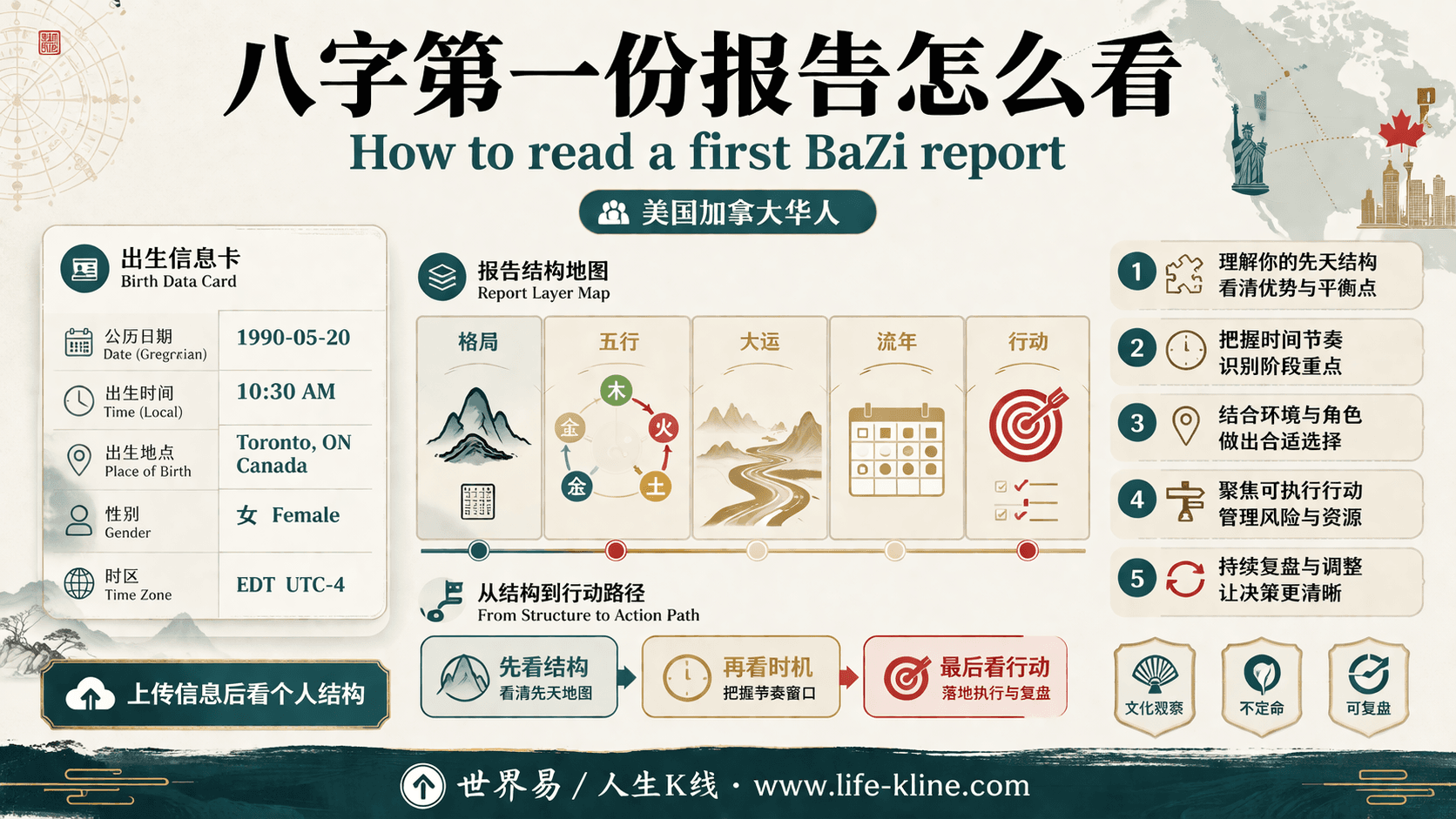
八字第一份报告怎么看|美国加拿大华人
这张图把《Parenting Decisions Under Multiple Pressures on Only Children: Analysis of Rigid Boundaries and Flexible Companionship》里的命理概念转成关系、边界和应用场景,适合先看图建立结构,再回到知识文章正文理解细节。
八字第一份报告怎么看不应被写成固定结论。更适合美国加拿大华人的读法,是把传统术语翻译成结构、时机、环境、行动和复盘。
查看图片解读