Whether to Stick to the Original Plan or Adjust After Statutory Retirement: An Analysis of Elderly Care Decisions from a Metaphysical Perspective
把这篇文章落到自己身上验证:先看结构,再进入个人分析,不做泛泛阅读。
你现在搜索的,
其实是一个要落到自己身上的判断。
当前页面主要回答「Elderly Care Scenarios」这类搜索问题;真正有价值的下一步是把这套结构带进自己的报告、工具与案例验证。
Why This Decision Is Particularly Difficult in This Scenario
The statutory retirement age is usually set between 55 and 60 years old, a stage where individuals face multiple elderly care challenges. Firstly, the insufficient social security replacement rate means that pensions cannot fully cover retirement living costs, increasing financial pressure. Secondly, with aging, skill depreciation becomes prominent, making it difficult for many to find reemployment based on their original professional skills, limiting further income growth. Declining health conditions also cannot be ignored, as they affect quality of life and increase medical burdens. Additionally, the shift in family roles, such as transitioning from economic pillar to dependent, brings psychological adaptation challenges, potentially increasing the complexity of retirement decisions.
Against this backdrop, whether to stick to the original retirement plan or adjust midway based on actual conditions becomes the core difficulty in elderly care decision-making. Psychologically, many retirees exhibit a "plan dependency" bias, making it hard to objectively assess changes in external environment and personal status, resulting in delayed decisions or blindly sticking to plans. Meanwhile, the BaZi structure—Day Master strength, pattern Yong Shen, and the combination of Da Yun and Liu Nian—reflects an individual's life rhythm and energy flow, possibly indicating their adaptability and risk tolerance amid changes. Combining metaphysical judgment with real elderly care structures and psychological factors can provide dynamic reference for decisions but requires caution to avoid over-forecasting.
Especially under the intertwined influences of social security, healthcare, family, and psychology, elderly care decisions are not driven by a single factor but are a comprehensive game of multiple systemic risks and resources. The metaphysical rhythm can help identify key adjustment points and signal phases of risk accumulation or relief but cannot replace professional financial planning, legal consultation, and medical advice. Therefore, decision-makers need to flexibly adjust under the guidance of metaphysical rhythms, integrating real conditions to avoid falling into the "trap" of fixed plans or exacerbating risks through blind changes.
Three Core Dimensions of Metaphysical Judgment
The first dimension is the Day Master and the late-life Da Yun (decade luck cycle). The Day Master represents the fundamental life energy of the individual; its strength reflects support capacity and stress resistance. The late-life Da Yun embodies the rhythm and trend of environmental changes after retirement. If the Day Master is relatively weak and the late-life Da Yun is inauspicious, it indicates limited adaptability, suggesting cautious adjustment of elderly care plans to avoid blindly persisting; conversely, if the Da Yun is stable, it is suitable to maintain the status quo and support stable elderly care.
The second dimension concerns the Wealth Star (Cai Xing) and disposable assets. The Wealth Star represents financial resources, especially social security, savings, and reemployment income sources. If the Wealth Star is strong and the Yong Shen is effective, it indicates a relatively stable economic foundation capable of bearing expenditure pressures during retirement, making the original plan likely feasible; if the Wealth Star is weak or Ji Shen (unfavorable elements) interfere, one should be alert to funding shortages and consider mid-course adjustments to enhance cash flow.
The third dimension involves the Food and Output Stars (Shi Shang) and late-life preferences, as well as the Officer, Killing, and Resource Stars (Guan Sha Yin) related to children and medical dependence. The Food and Output Stars reflect creativity and life enjoyment, aiding psychological health and reemployment motivation. The Officer, Killing, and Resource Stars relate to family support and health security, especially child relationships and medical resources. Those with favorable combinations have more secure elderly lives and greater room for adjustment; otherwise, early arrangements for medical and family support are necessary to prevent decision pressure caused by health risks.
Three Real BaZi Chart Cases
Case 1: This gentleman's Day Master is Geng Metal (庚, Geng) and relatively weak, with a Jie Cai pattern; the Yong Shen is Earth, and the Ji Shen are Water and Wood. He is currently in the Bing Zi Da Yun (丙子, 46-55 years), overall stable, with the Bing Wu Liu Nian (丙午) allowing flexible responses. This combination indicates his life energy is relatively weak and economic pressure may be significant, but the current Da Yun supports maintaining the status quo, suitable for a steady approach to retirement transition. The Jie Cai pattern reflects potential for resource sharing and mutual assistance; although the Day Master is weak, the Yong Shen Earth can generate Metal, providing some internal regulation. Facing insufficient social security replacement and health decline, priority should be given to assessing existing assets and family support, maintaining the original plan while flexibly adjusting reemployment strategies.
Case 2: This gentleman's Day Master is Xin Metal (辛, Xin) and relatively weak, with a Pian Yin pattern; the Yong Shen is Earth, and the Ji Shen are Water and Wood. He is currently in the Jia Zi Da Yun (甲子, 46-55 years), an inauspicious luck cycle requiring caution against major upheavals; the Bing Wu Liu Nian (丙午) also calls for prudence. The Pian Yin pattern often indicates stronger dependency; combined with a weak Day Master and unfavorable Da Yun, this suggests he may face significant pressure during retirement transition, with skill depreciation and health risks especially prominent. Persisting with the original plan carries high risk; it is recommended to actively adjust elderly care strategies according to metaphysical indications, enhance personal capabilities and medical protection, and seek legal and financial professional support to avoid exacerbation of sudden risks.
Case 3: This lady's Day Master is Ding Fire (丁, Ding) and relatively weak, with a Pian Yin pattern; the Yong Shen is Fire, and the Ji Shen are Earth and Metal. She is currently in the Geng Wu Da Yun (庚午, 41-50 years), which is stable, with the Bing Wu Liu Nian (丙午) allowing flexible responses. The Pian Yin pattern symbolizes resource support and wisdom; although the Day Master is weak, the Yong Shen Fire is activated, showing some adaptability and transformation potential. The stable Da Yun favors maintaining the status quo, suitable for gradually adjusting elderly care plans, balancing enjoyment and reemployment. This chart suggests focusing on health maintenance and child relationships while maintaining the original plan, reasonably utilizing medical and psychological support to enhance late-life quality.
Common Misjudgments and Blind Spots in This Scenario
Firstly, many retirees fall into the "fixed retirement plan mindset," overly relying on established economic and lifestyle arrangements while ignoring dynamic changes in society and personal health. This psychological bias causes reluctance to adjust plans when facing insufficient social security replacement or skill depreciation, increasing financial and health risks.
Secondly, a common error in metaphysical analysis is treating the BaZi chart as an absolute predictive tool, neglecting that metaphysics only provides rhythm assistance. For example, upon seeing inauspicious Da Yun or Ji Shen, one might hastily make major adjustments, potentially missing opportunities for steady maintenance. Metaphysical insights should be combined with real resources and professional advice to avoid decisions driven by single-factor information.
Additionally, neglecting the role of family and medical support systems is also a blind spot. The Officer, Killing, and Resource Stars in BaZi indicate dependence on health and child relationships; failing to fully consider these factors may lead to isolated elderly care decisions and increased late-life risks.
Lastly, ignoring the interaction between Liu Nian (annual fortune) and Da Yun, especially at critical retirement nodes, can cause misjudgments. Although Liu Nian implies flexibility for random changes, if the overall Da Yun is inauspicious, greater caution is required to prevent external shocks from undermining decision effectiveness.
Practical Judgment Sequence
Step one: Assess the strength of the Day Master and the overall trend of the current Da Yun. If the Day Master is weak and the Da Yun is unfavorable, priority should be given to adjusting elderly care plans, strengthening economic and health protections. Conversely, if the Da Yun is stable and the Yong Shen effective, it is possible to moderately adhere to the original plan and steadily advance retirement life.
Step two: Combine the status of the Wealth Star to analyze disposable assets and income sources. If the Wealth Star is strong and supported by the Yong Shen, it indicates a relatively stable financial foundation, allowing for appropriate risk tolerance and plan flexibility. If the Wealth Star is disturbed by Ji Shen, timely adjustments are necessary to avoid cash flow disruption, coordinated with professional financial planning and legal consultation.
Step three: Focus on the relationships among Food and Output Stars and Officer, Killing, and Resource Stars to evaluate family support and medical security. Late-life preferences and psychological state affect quality of life; the Officer, Killing, and Resource Stars indicate dependence on children and medical resources. According to metaphysical rhythm indications and real health conditions, arrange reasonable medical insurance and family communication mechanisms to ensure effective execution of elderly care decisions.
Integrating the above steps, decision-makers should dynamically follow metaphysical rhythm guidance, combined with professional financial, legal, and medical advice, flexibly adjusting or adhering to plans to avoid being swayed by single factors, ensuring economic security and physical and mental health in retirement life.
FAQ
Question 1: How do Da Yun and Liu Nian affect elderly care decisions? Answer: Da Yun reflects long-term trends, determining the overall stability or risk level of the environment, while Liu Nian represents specific changes and challenges in a given year. Elderly care decisions should integrate both; if the Da Yun is unfavorable, cautious plan adjustments are generally needed; if the Liu Nian is stable, the established plan can be moderately executed, and if the Liu Nian is adverse, flexible responses are required.
Question 2: When social security replacement rates are insufficient, how can metaphysics assist in judging whether to seek reemployment? Answer: The strength of the Wealth Star and whether the Yong Shen is effective are key to evaluating economic support capacity. A strong Wealth Star supported by the Yong Shen indicates greater reemployment potential, suitable for maintaining or adjusting plans to increase income. If the Wealth Star is weak and disturbed by Ji Shen, priority should be given to protecting health and medical care to avoid negative effects from overexertion.
Question 3: Can metaphysical judgment replace professional financial and legal consultation? Answer: No. Metaphysical judgment mainly provides auxiliary reference on life rhythms and energy flow, helping identify timing for adjustments and risk signals. Specific financial planning, tax arrangements, legal inheritance, and medical arrangements must rely on professional advice to ensure comprehensive and scientific elderly care decisions.
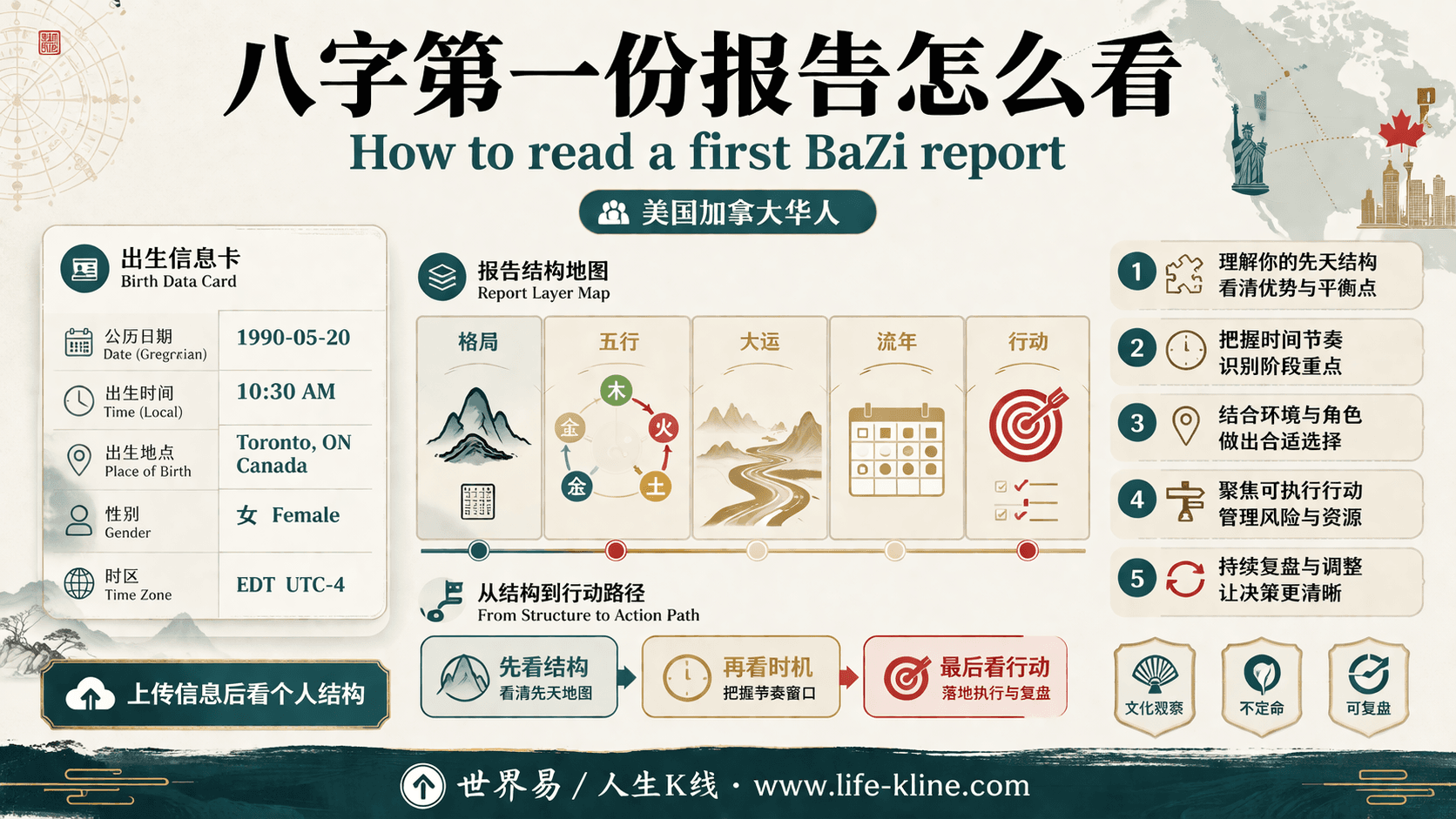
八字第一份报告怎么看|美国加拿大华人
这张图把《Whether to Stick to the Original Plan or Adjust After Statutory Retirement: An Analysis of Elderly Care Decisions from a Metaphysical Perspective》里的命理概念转成关系、边界和应用场景,适合先看图建立结构,再回到知识文章正文理解细节。
八字第一份报告怎么看不应被写成固定结论。更适合美国加拿大华人的读法,是把传统术语翻译成结构、时机、环境、行动和复盘。
查看图片解读