Astrological Analysis and Practical Guidance for Optimal Retirement and Career Transition Nodes at Statutory Retirement Age
把这篇文章落到自己身上验证:先看结构,再进入个人分析,不做泛泛阅读。
你现在搜索的,
其实是一个要落到自己身上的判断。
当前页面主要回答「Retirement Scenario」这类搜索问题;真正有价值的下一步是把这套结构带进自己的报告、工具与案例验证。
Why This Decision Is Especially Difficult in This Scenario
After the statutory retirement age (55-60 years old), the retirement structure faces multiple pressures. The social security replacement rate is generally insufficient, causing pension income to fall short of living expenses, prompting many to consider re-employment to supplement cash flow. At this stage, skills may depreciate due to industry changes, affecting the success rate and income level of re-employment. Meanwhile, physical health gradually declines, increasing medical needs and further burdening finances. Family roles also shift, with retirees possibly transitioning from workplace cores to family caregivers or care recipients, making psychological adaptation and family support critical.
Against this backdrop, choosing the retirement or career transition node becomes particularly crucial. Retiring too early may exacerbate financial pressure, while retiring late may result in missed opportunities due to health decline or skill obsolescence. Decision-makers often experience a psychological conflict between “security dependence” and “fear of change,” affecting objective judgment. BaZi structure, as an auxiliary tool, can provide timing references based on Day Master energy, Yong Shen (favorable element) configuration, and Da Yun and Liu Nian rhythms, but must be combined with real-world social security, taxation, insurance, and medical planning to avoid overreliance.
The BaZi elements such as Cai Xing (Wealth stars), Shi Shang (Output stars), Yin Xing (Resource stars), and Guan Sha (Officer and Killing stars) correspond respectively to economic resources, creative ability, support strength, and external pressure, directly reflecting asset protection, skill utilization, family medical support, and legal risks in retirement. Especially, the interactions between late-life Da Yun and Liu Nian reveal dynamic rhythms that indicate potential momentum or resistance in retirement transitions, helping decision-makers identify suitable action timing and risk prevention.
Therefore, the decision on the optimal retirement or career transition node after statutory retirement is a complex interplay of retirement structure, psychological biases, and BaZi rhythms. Scientific evaluation of BaZi information combined with professional financial and medical advice can achieve a stable retirement life plan.
Three Core Dimensions of Astrological Judgment
First, the strength of the Day Master and the configuration of the late-life Da Yun form the core basis of judgment. The Day Master represents personal vitality and subjective energy; if relatively strong, the individual is proactive and suitable for career transition or re-employment; if weak, a cautious approach favoring enjoying life is advisable. The stability and auspiciousness of the late-life Da Yun directly affect post-retirement life quality and adjustment space.
Second, the performance of the Cai Xing (Wealth stars) relates to disposable assets and economic security. A strong Cai Xing or Yong Shen supported by Earth and Fire elements indicates stable financial resources or asset management foundations, enabling asset optimization or reinvestment after retirement to alleviate social security insufficiency. Conversely, financial planning must be strengthened to avoid funding shortages that increase retirement risks.
Third, Shi Shang (Output stars) reflect personal creativity and skill application. A strong Shi Shang suggests suitability for re-employment to continue contributing social value and income. Yin Xing (Resource stars) symbolize family support and medical reliance; a strong Yin Xing usually means sufficient medical resources from children or relatives, beneficial for disease management and psychological adjustment. Guan Sha (Officer and Killing stars) involve external pressure and legal risks; if overly strong or clashed, they may cause inheritance disputes or health incidents, requiring preemptive arrangements.
The interaction between Da Yun and Liu Nian reveals cyclical auspicious and inauspicious changes, serving as an important reference for judging retirement transition timing. Following the trend facilitates successful transitions; acting against it calls for caution and waiting to avoid blind actions.
Three Real BaZi Chart Cases
Case 1: This female’s BaZi chart has Day Master Yi Wood (乙木, Yi Mu), a balanced pattern classified as a Cong Cai (from Wealth) pattern. Her Yong Shen are Earth and Fire, while Ji Shen (unfavorable elements) are Water and Wood. Her current Da Yun is Gui Si (癸巳, Gui Water - Si Fire Earth) from ages 41-50, a stable luck cycle, with Liu Nian Bing Wu (丙午, Bing Fire - Wu Fire Earth) requiring adaptability. In the retirement re-employment and enjoyment game, her Cong Cai pattern emphasizes the importance of stable financial sources. Although the Gui Si Da Yun is stable, its late phase enters a turning point requiring reliance on Earth and Fire Yong Shen to support asset management and health protection. The presence of Ji Shen Wood and Water warns of potential health and psychological stress fluctuations. At the retirement transition node, priority should be given to assessing the safety of asset allocation and family medical support, avoiding risk amplification caused by Ji Shen influence. The suggested judgment sequence is: first confirm the financial and health resource stability of the Earth and Fire Yong Shen, then formulate retirement income strategies combined with professional financial planning, and finally assess Liu Nian’s impact on health or psychology to timely adjust retirement plans.
Case 2: This male’s BaZi chart has Day Master Jia Wood (甲木, Jia Mu), relatively weak, with a Shi Shen (Output) pattern. His Yong Shen is Water, and Ji Shen are Fire and Earth. His current Da Yun is Geng Zi (庚子, Geng Metal - Zi Water) from ages 40-49, a stable cycle focused on preservation, with Liu Nian Bing Wu (丙午, Bing Fire) requiring adaptability. The Jia Wood Day Master’s relative weakness indicates limited initiative; the Shi Shen pattern emphasizes creativity and skill application, suitable for re-employment to leverage potential. However, Ji Shen Fire and Earth indicate environmental pressure and health risks. The stable Geng Zi Da Yun supports preservation, but the Liu Nian Bing Wu may bring fluctuations. In the retirement game, this chart is better suited for gradual career transition at the statutory retirement node to avoid sudden changes that increase financial or health risks. The judgment sequence is: prioritize strengthening Water Yong Shen for health care and skill upgrading, stabilize re-employment ability, evaluate Liu Nian’s impact on job opportunities, then decide on retirement or transition, along with tax and insurance planning.
Case 3: This male’s BaZi chart has Day Master Bing Fire (丙火, Bing Huo), relatively strong, with a Jie Cai (Rob Wealth) pattern. His Yong Shen are Water and Metal, and Ji Shen is Wood. His current Da Yun is Gui Hai (癸亥, Gui Water - Hai Water) from ages 37-46, a very auspicious cycle, with Liu Nian Bing Wu (丙午, Bing Fire) following the trend. The strong Bing Fire Day Master and Jie Cai pattern indicate strong initiative and resource-sharing capability. Yong Shen Water and Metal support his health and financial stability, while Ji Shen Wood warns of potential skill depreciation or environmental pressure. The auspicious Da Yun and favorable Liu Nian suggest strong re-employment ability and asset operation space after statutory retirement. This chart shows a high success rate at the retirement transition node but still requires attention to risks brought by Ji Shen. The judgment sequence is: first leverage the favorable Da Yun and Liu Nian momentum to actively plan re-employment or entrepreneurship paths, combine asset management strategies to secure funds, then assess health status and coordinate medical and legal risk management to avoid gaps caused by Ji Shen influence.
These three cases illustrate the auxiliary role of BaZi structure in decisions about re-employment and enjoyment after statutory retirement, emphasizing the comprehensive influence of Cai Xing, Shi Shang, Yin Xing, and Guan Sha, combined with Da Yun and Liu Nian rhythms to help identify optimal nodes. They also remind that professional financial, legal, and medical planning must be integrated to form a multidimensional risk control system.
Common Misjudgments and Blind Spots in This Scenario
One common misjudgment in retirement decisions is overreliance on BaZi predictions, treating BaZi rhythms as the sole basis for action. In reality, BaZi only reflects potential energy states and timing rhythms and cannot replace professional assessments of social security policies, tax planning, insurance design, and medical needs. Ignoring real economic and health conditions and blindly following BaZi rhythms may lead to financial strain or increased health risks.
Another blind spot is neglecting the potential risks of Ji Shen, especially under pressures of insufficient social security replacement rates and declining health, which amplify Ji Shen’s negative effects. For example, Ji Shen Water and Wood may correspond to health hazards; excessive or unbalanced Guan Sha may trigger legal disputes. Without preemptive risk mitigation, retirement plans lack stability.
Additionally, psychological biases such as retreat or greed can cause misuse of BaZi advice. Some decision-makers may prematurely transition due to auspicious Da Yun without considering whether their skills match or health supports it, resulting in adverse outcomes. Conversely, excessive conservatism during unfavorable Ba Zi periods may miss favorable opportunities.
Therefore, retirement decisions should be made with BaZi rhythms as auxiliary references combined with real policy environments, medical security, and family support, avoiding one-dimensional judgments to form comprehensive and scientific retirement plans.
Practical Judgment Sequence
Step one: Assess the current Da Yun and Liu Nian support for the Day Master and the status of Yong Shen. Confirm the stability of Cai Xing (Wealth stars) and whether sufficient economic resources exist to support retirement life or re-employment plans. Also check if Ji Shen are activated, evaluate potential health and psychological risks, and intervene medically or psychologically in a timely manner.
Step two: Combine social security replacement rates and personal skill status to analyze re-employment capability. Those with strong Shi Shang (Output stars) may prioritize career transitions; those with strong Yin Xing (Resource stars) should strengthen family and medical support systems. At this stage, engage professional financial planners and medical consultants to design tax optimization and health management plans to minimize action risks.
Step three: During favorable Da Yun and Liu Nian timing, formulate specific implementation plans, including retirement timing, asset management arrangements, and legal inheritance planning. If encountering adverse Da Yun or active Ji Shen periods, it is recommended to delay major decisions and wait for better timing. Throughout the process, BaZi rhythms serve as auxiliary references, with decisions primarily based on real data and professional advice to avoid emotional actions.
By following this sequence and integrating multidimensional risk management, a stable transition and continuous optimization of retirement life after statutory retirement can be achieved.
FAQ
Question 1: Can BaZi determine whether I will definitely succeed in re-employment after retirement? Answer: BaZi provides references on energy states and timing rhythms but cannot determine specific outcomes. Re-employment success depends on multiple factors including personal skills, health status, market environment, and professional financial planning.
Question 2: If my Da Yun is unfavorable, does that mean I am not suitable for career transition after statutory retirement? Answer: An unfavorable Da Yun indicates greater potential obstacles but is not an absolute taboo. It is advisable to adjust strategies during inactive Ji Shen periods or favorable Liu Nian, combined with medical and financial support, to cautiously plan transition paths and avoid blind actions.
Question 3: Does a strong Cai Xing in BaZi mean I will have no financial worries after retirement? Answer: A strong Cai Xing indicates a good asset base, but financial management, tax planning, and risk control are equally important. Retirement involves multiple legal and medical factors and must be combined with professional consultation; one cannot rely solely on BaZi Cai Xing strength to judge financial status.
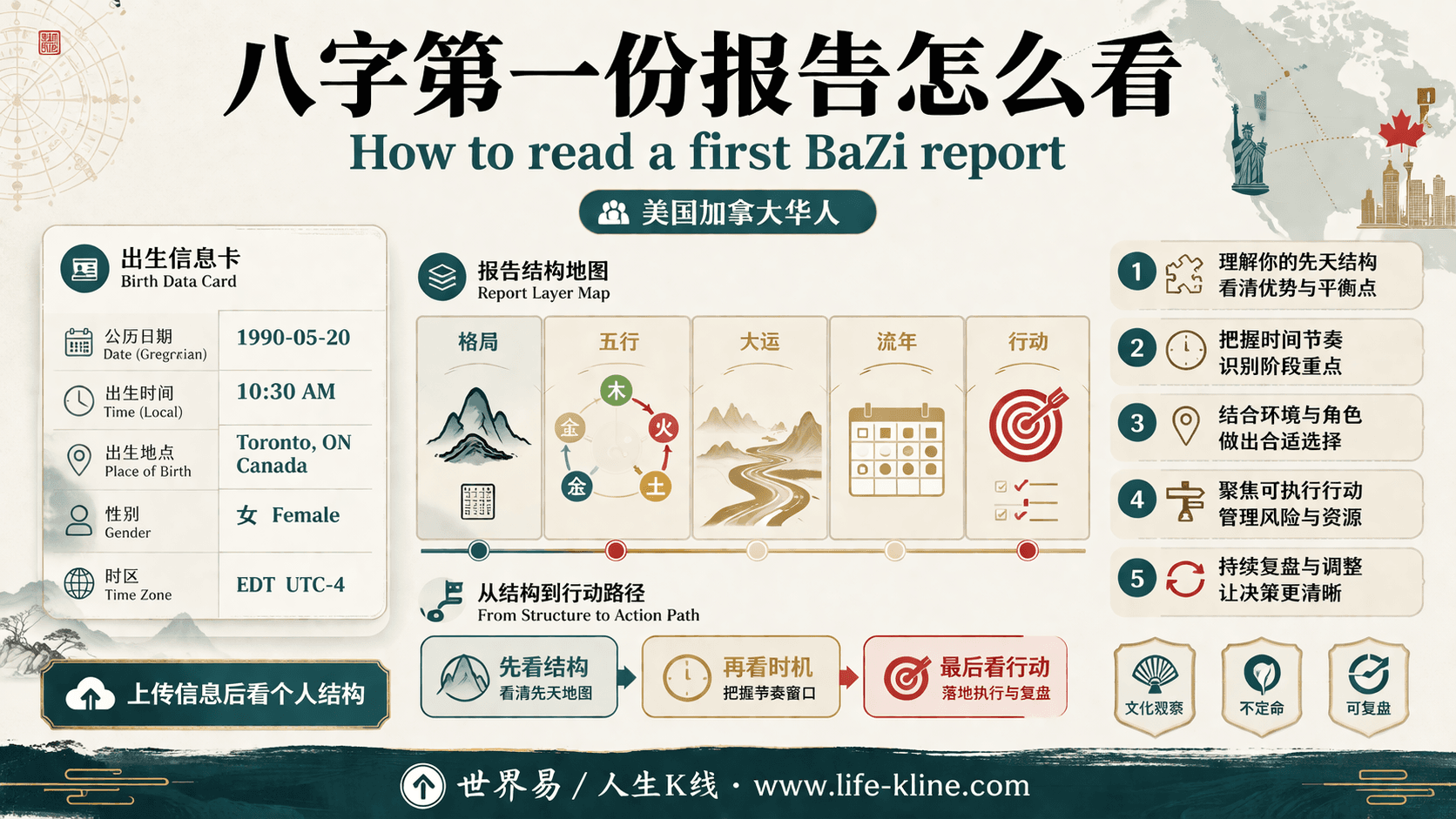
八字第一份报告怎么看|美国加拿大华人
这张图把《Astrological Analysis and Practical Guidance for Optimal Retirement and Career Transition Nodes at Statutory Retirement Age》里的命理概念转成关系、边界和应用场景,适合先看图建立结构,再回到知识文章正文理解细节。
八字第一份报告怎么看不应被写成固定结论。更适合美国加拿大华人的读法,是把传统术语翻译成结构、时机、环境、行动和复盘。
查看图片解读