Recognizing Health Warning Signs During Midlife Transitions: A Metaphysical Perspective on Body System Alerts
把这篇文章落到自己身上验证:先看结构,再进入个人分析,不做泛泛阅读。
Why This Decision Is Especially Difficult During This Life Stage
The midlife transition period (ages 38-52) is a critical stage in life where individuals often face career bottlenecks, gradual decline in physical functions, and pressures related to mature parent-child relationships. The difficulty in recognizing health warning signs lies in the potential hidden risks across multiple body systems, with early symptoms often subtle and easily overlooked or misdiagnosed, resulting in missed optimal intervention opportunities.
Moreover, societal expectations and responsibilities make it hard for individuals to focus on self-care, causing health issues to be inadvertently magnified. The dual burdens of family and career exacerbate physical and psychological stress, making health risks more complex.
From a metaphysical perspective, this stage often corresponds to a turning point in the Da Yun (decade luck cycle), where the interaction between Liu Nian (annual fortune) and Da Yun exerts multiple influences on the physical condition. If the Yong Shen (favorable element) is restrained or insufficiently supported, potential health hazards are more likely to surface, with corresponding body systems showing distinct differences.
Therefore, recognizing health warning signs during midlife requires not only medical testing but also comprehensive judgment based on BaZi chart structures, aiming for early warning and scientific management of potential risks.
Three Core Dimensions of Metaphysical Assessment
First, the strength of the Day Master is key to evaluating an individual's vitality and constitution. A relatively strong Day Master usually indicates robust self-regulation and resistance, whereas a weak Day Master is more susceptible to external environments and internal pressures, making health issues more likely.
Second, the chart structure reflects the overall aura and internal dynamics of the BaZi chart. Patterns such as Yang Ren (Yang Blade) structure, Shi Shen (Eating God) structure, or Qi Sha (Seven Killings) structure represent different personalities and energy flows, each affecting body systems differently. The Yong Shen and Ji Shen within the structure guide us to identify which body systems require more attention or protection; when the Ji Shen is restrained, it often corresponds to health vulnerabilities.
Finally, the interaction between Da Yun and Liu Nian reveals current and future fortune fluctuations. The stability of Da Yun and whether Liu Nian contains clashes or combinations significantly impact health status. Especially during the midlife transition, Da Yun often involves maintenance or transformation phases, and the fluctuations in Liu Nian either amplify or alleviate health risks.
By integrating these three dimensions along with palace environments and the relationships among the Ten Gods (Shi Shen), one can more accurately identify potential weaknesses in body systems, scientifically recognize health warning signs, and formulate reasonable prevention and nurturing strategies.
Three Real BaZi Chart Case Studies
Case 1: This male's BaZi chart has a relatively strong Day Master Wu (戊, Earth), with a Yang Ren (Yang Blade) structure. The favorable elements are Wood and Water, while Fire is the Ji Shen (unfavorable element). Currently in the Ding Mao (丁卯) Da Yun, a maintenance phase. Placed within the midlife transition (38-52 years), although the strong Earth Day Master shows robust vitality, the influence of the Ji Shen Fire may correspond to stress on the heart or blood systems. The impulsiveness of the Yang Ren structure combined with the Fire Ji Shen, especially if Da Yun and Liu Nian feature strong Fire, could amplify cardiovascular warning signs. The recommended assessment sequence is to first confirm the Fire element's impact and related body systems, then support with Wood and Water nurturing.
Case 2: This female's BaZi chart has a relatively weak Day Master Geng (庚, Metal), with a Shi Shen (Eating God) structure. The favorable element is Earth, while Water and Wood are Ji Shen. Currently in the Ding You (丁酉) Da Yun, also a maintenance phase. During midlife, the weak Geng Metal Day Master indicates lower physical resistance, particularly with the Ji Shen Water and Wood suggesting stress on the kidneys and liver/gallbladder systems. The Shi Shen structure highlights the need to focus on mental stress and the endocrine system. Considering real-world midlife health transitions in women, such as menopausal issues, the BaZi features suggest prioritizing monitoring of kidney and liver functions. The assessment sequence should first examine the specific effects of Ji Shen Water and Wood on the body, then incorporate Earth element nurturing strategies.
Case 3: This male's Day Master Ren (壬, Water) is relatively weak, with a Qi Sha (Seven Killings) structure. The Yong Shen is Metal, and the Ji Shen are Wood and Fire. He is in the Xin Chou (辛丑) Da Yun, a favorable luck phase. The weak Ren Water Day Master indicates insufficient vitality; the Qi Sha structure tends to generate pressure and conflict, while the Ji Shen Wood and Fire may point to liver and cardiopulmonary system stress. Although the Da Yun is auspicious, the Liu Nian Bing Wu (丙午) year with strong Fire may exacerbate the negative effects of the Fire Ji Shen. Health warning signs during midlife should particularly focus on cardiopulmonary and liver functions. The recommended judgment sequence is to first assess the impact scope of Ji Shen Fire and Wood, combined with nurturing support from the Metal Yong Shen, ensuring stress relief and vitality restoration.
Common Misjudgments and Blind Spots During This Stage
A common misjudgment in midlife health warning sign recognition is relying solely on physical symptoms or routine medical examinations while neglecting the BaZi Yong Shen and Ji Shen framework, thus overlooking latent risks in body systems. For example, individuals with a weak Day Master who do not emphasize nurturing the Yong Shen may suffer insufficient recovery capacity, missing the best prevention window.
Another blind spot is the inadequate understanding of chart structures, ignoring how impulsive or defensive traits within the structure specifically affect body systems, leading to generic health management plans lacking targeted focus.
Additionally, ignoring the interaction between Da Yun and Liu Nian, especially during the subtle changes of maintenance or transformation phases in midlife, can cause critical errors in health assessment.
Therefore, scientific recognition of health warning signs should avoid single-dimensional or linear thinking, instead combining the full BaZi context with real-life dynamics for a three-dimensional analysis to accurately identify which body systems are most vulnerable.
Practical Judgment Sequence
Step one: Determine the strength of the Day Master to assess the vitality foundation. For a weak Day Master, priority should be given to the body's recovery ability and immune system; for a strong Day Master, focus on preventing organ stress caused by overexertion.
Step two: Analyze the Yong Shen and Ji Shen in conjunction with the chart structure to identify key body systems requiring attention. Yong Shen indicates support and nurturing directions, while Ji Shen corresponds to potential burdens and risk areas.
Step three: Examine the current Da Yun and Liu Nian interactions to judge whether the individual is in a period of amplified health risk. Combine this with real-life health signals and symptoms to decide whether active intervention or cautious observation is appropriate.
Overall judgment should be dynamically adjusted, integrating regular medical check-ups and lifestyle habits, avoiding reliance on BaZi information alone, to achieve scientific early warning and timely action.
FAQ
Question 1: What unique perspectives can metaphysical assessment provide for recognizing health warning signs during midlife transitions? Answer: Metaphysical assessment reveals potential risks to body systems and vitality status through the strength of the Day Master, chart structure, and Yong Shen/Ji Shen, combined with Da Yun and Liu Nian environments. This offers an early warning perspective beyond traditional medicine and modern physical exams, helping individuals identify health hazards in advance.
Question 2: How can Yong Shen and Ji Shen be used to guide midlife health nurturing? Answer: Yong Shen represents elements that need to be supplemented and strengthened, while Ji Shen indicates negative factors to avoid or regulate. By identifying Yong Shen and Ji Shen, one can tailor diet, lifestyle habits, and emotional management to enhance physical resistance and reduce stress caused by Ji Shen.
Question 3: How should health warning signs be managed when Da Yun and Liu Nian clash? Answer: Clashes between Da Yun and Liu Nian often bring physical and emotional fluctuations. It is recommended to strengthen monitoring of key body system indicators, adjust daily rhythm, apply appropriate stress relief, and follow nurturing advice based on Yong Shen. Avoid impulsive actions and choose a stable health management approach.
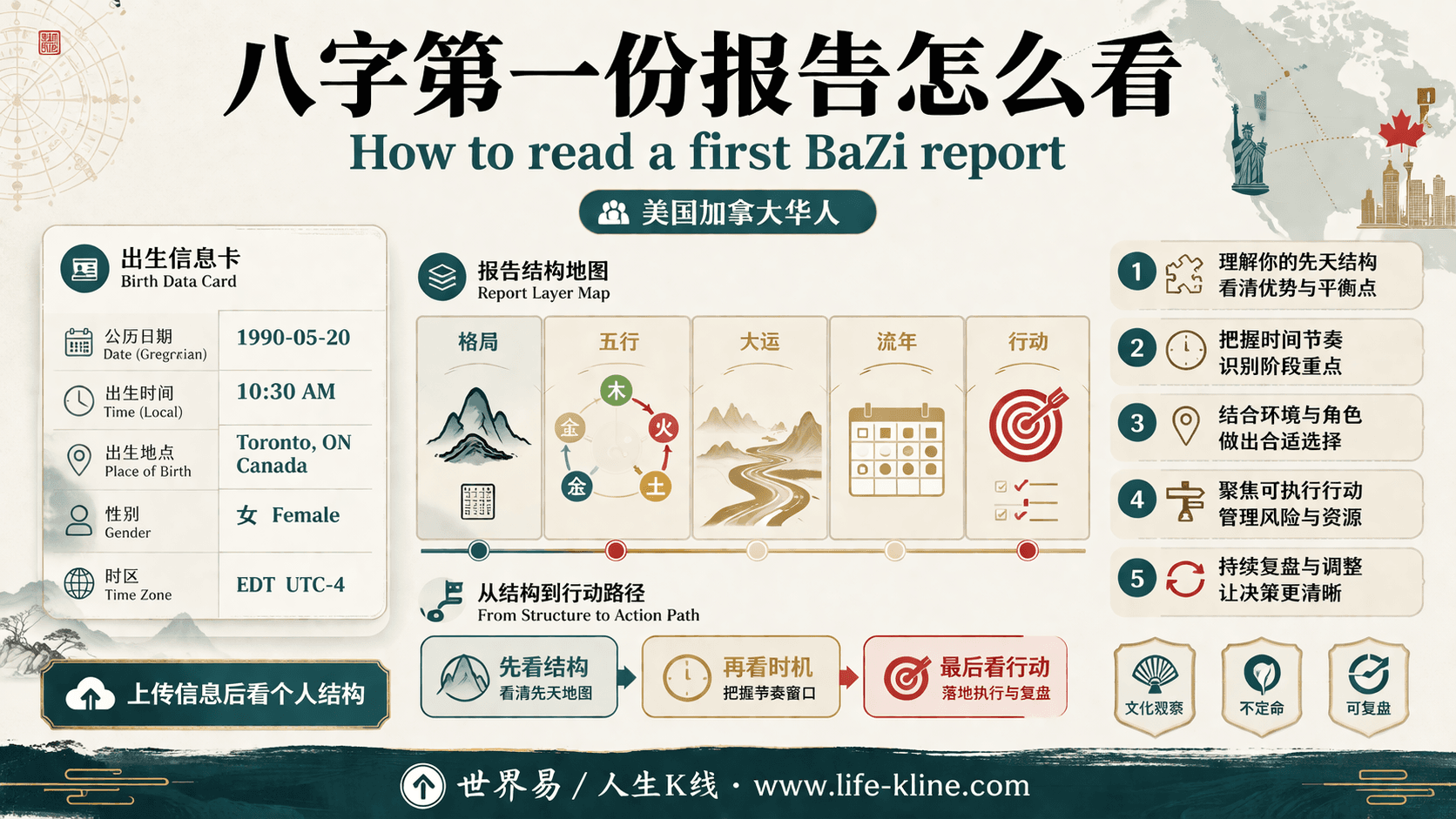
八字第一份报告怎么看|美国加拿大华人
这张图把《Recognizing Health Warning Signs During Midlife Transitions: A Metaphysical Perspective on Body System Alerts》里的命理概念转成关系、边界和应用场景,适合先看图建立结构,再回到知识文章正文理解细节。
八字第一份报告怎么看不应被写成固定结论。更适合美国加拿大华人的读法,是把传统术语翻译成结构、时机、环境、行动和复盘。
查看图片解读