Midlife Care and Distance Decisions: A Metaphysical Perspective on Family Responsibility and Self-Balance
把这篇文章落到自己身上验证:先看结构,再进入个人分析,不做泛泛阅读。
Why This Decision Is Especially Difficult at This Life Stage
The midlife transition period from ages 38 to 52 generally involves multiple realistic pressures: career development hitting a ceiling, emerging health warnings, and maturing parent-child relationships. At this time, parents gradually age and caregiving needs increase significantly, making the burden of family responsibility increasingly at odds with career advancement. Social expectations regard middle-aged individuals as the backbone of the family, responsible for both supporting aging parents and providing for their children, balancing complex intimate relationships.
At this stage, decisions about caregiving and maintaining appropriate distance are particularly difficult. Excessive close care may limit personal energy and career development, while excessive detachment may cause family conflicts and psychological burdens. In BaZi structure, the strength of the Day Master, the pattern, and the Yong Shen reflect an individual's energy allocation and capacity to handle family responsibilities. These metaphysical factors combined with real-world pressures influence the execution and effectiveness of decisions.
Moreover, fluctuations in health increase considerations for caregiving methods. The influences of Da Yun and Liu Nian on an individual's state mean that the same caregiving decision may yield different feedback and challenges in different years and stages. Overall, midlife caregiving and distance choices seek a sustainable balance amid multiple constraints and expectations, with metaphysical judgment providing crucial qualitative and quantitative references.
Therefore, understanding how BaZi structures amplify or suppress caregiving burdens helps middle-aged individuals make more scientific and humane decisions between family responsibility and personal development, avoiding emotional impulsiveness and resource misallocation.
Three Core Dimensions of Metaphysical Judgment
First, the Day Master and pattern reflect an individual's fundamental energy and personality tendencies. In midlife caregiving decisions, the strength of the Day Master determines psychological endurance and capacity for action in bearing family responsibilities. Different patterns such as Zheng Cai (Proper Wealth), Yang Ren (Yang Blade), and Pian Yin (Indirect Resource) exhibit distinct internal conflicts and adjustment mechanisms when facing family pressures, affecting the quality of intimate relationships and caregiving choices.
Second, the relationship between Yong Shen and Ji Shen reveals the individual's tendencies in resource allocation and emotional regulation. Yong Shen represents beneficial Five Elements that help resolve conflicts and promote balance; Ji Shen are elements to be restrained or avoided, whose excessive presence may lead to family tension or health risks. In caregiving decisions, rational use of Yong Shen’s strength and avoidance of Ji Shen’s aggravation are key to maintaining family harmony.
Third, Da Yun and Liu Nian provide a dynamic temporal perspective, reflecting the opportunities and challenges faced by the individual at different stages. Auspicious luck cycles support dual progress in career and family; stable Da Yun favor consolidation, while conflicting Da Yun require cautious handling of parent-child and caregiving relationships. Especially in balancing caregiving and distance, aligning attitudes and strategies with Da Yun and Liu Nian changes is central to metaphysical judgment.
Additionally, although the palace (house) environment is not explicitly given, the distribution of forces in the Four Pillars (Heavenly Stems and Earthly Branches) can be perceived to further refine the balance point between caregiving and self-growth. Overall, the organic combination of Day Master, pattern, Yong Shen, and Da Yun/Liu Nian constitutes the three core dimensions for assessing risks and potentials in caregiving and distance decisions.
Three Real BaZi Case Studies
Case 1: Male, aged 35-40, Day Master Jia (甲, Wood), balanced strength, Zheng Cai (Proper Wealth) pattern, Yong Shen Water, Ji Shen Metal, currently in Da Yun Ren Xu (壬戌, ages 30-39, auspicious luck), Liu Nian Bing Wu (丙午). This BaZi chart is in a period of career and financial progress. The Wood Day Master is balanced; the Zheng Cai pattern indicates a stable need for material and responsibility. Yong Shen Water nourishes vitality and promotes harmonious relationships. Facing midlife caregiving, the Wood Day Master tends to assume family responsibilities, but the presence of Ji Shen Metal requires caution against physical or psychological burdens caused by overexertion. The Ren Xu Da Yun is auspicious with moderate career pressure, favorable for balancing caregiving and personal space. It is recommended to prioritize assessing whether the strength of Yong Shen Water can support caregiving demands, adjusting caregiving intensity according to Da Yun and Liu Nian to avoid Ji Shen Metal aggravation causing health risks.
Case 2: Female, aged 30-35, Day Master Geng (庚, Metal), relatively strong, Yang Ren (Yang Blade) pattern, Yong Shen Fire and Wood, Ji Shen Earth, currently in Da Yun Ding Wei (丁未, ages 34-43, stable), Liu Nian Bing Wu (丙午). The Geng Metal Day Master is relatively strong; the Yang Ren pattern shows a strong, decisive personality. Fire and Wood as Yong Shen help soften the Metal’s harshness, promoting warmth and communication within the family. Ji Shen Earth warns against excessive adherence to traditional views or accumulated pressure during caregiving. The Ding Wei Da Yun is stable, suitable for consolidation and adjusting caregiving strategies. This BaZi chart tends to exhibit conflicts between firmness and tenderness in midlife caregiving and distance; Fire and Wood Yong Shen are key to harmonization. It is advised to first assess the activity level of Fire and Wood Yong Shen, combined with Da Yun and Liu Nian, to flexibly adjust caregiving modes and avoid family conflicts and psychological burdens caused by Ji Shen Earth.
Case 3: Male, aged 20-25, Day Master Ding (丁, Fire), balanced strength, Pian Yin (Indirect Resource) pattern, Yong Shen Wood, Ji Shen Water, currently in Da Yun Wu Yin (戊寅, ages 21-30, stable), Liu Nian Bing Wu (丙午). This BaZi chart is young and still in the exploration stage of career and life. The Pian Yin pattern indicates strong learning and auxiliary abilities. Yong Shen Wood helps enhance the Day Master’s energy, supporting the assumption of caregiving responsibilities. Ji Shen Water may bring emotional fluctuations or health risks. Although still young and not in the main midlife caregiving decision stage, this individual plays an important auxiliary role in the family. The Wu Yin Da Yun is stable, favorable for accumulating experience and gradually assuming responsibilities. It is recommended to focus on the vigor of Yong Shen Wood and the suppression of Ji Shen Water when judging, planning participation intensity and timing in caregiving reasonably to avoid bearing excessive burdens prematurely.
These three cases respectively illustrate how different Day Master attributes, patterns, and Yong Shen combinations manifest in midlife caregiving and distance decisions, providing concrete judgment ideas and adjustment strategies combined with Da Yun and Liu Nian changes.
Common Misjudgments and Blind Spots at This Stage
A common misjudgment in midlife caregiving decisions is neglecting the impact of Day Master strength and Yong Shen relationships on psychological and physical endurance. Some individuals with a weak Day Master or insufficient Yong Shen may worsen burdens by providing overly close care, leading to aggravated health and emotional issues. Conversely, when the Day Master is overly strong or Ji Shen is aggravated, blindly distancing oneself may deepen family conflicts and destabilize affection.
Another blind spot is insufficient consideration of the dynamic changes in Da Yun and Liu Nian. Many middle-aged people mistakenly assume caregiving responsibilities are fixed, failing to adjust caregiving intensity and methods according to auspicious or inauspicious luck, resulting in resource misallocation and psychological fatigue. During stable Da Yun, one should consolidate and proceed gently; during conflicting Da Yun, cautious decision-making is necessary to avoid exacerbating disputes.
Additionally, ignoring metaphysical differences among family members and applying a single standard to measure caregiving and distance often causes misunderstandings and conflicts. Caregiving is not merely a matter of physical distance but involves psychological energy adjustment and interaction, requiring multidimensional consideration to avoid partiality.
Finally, health warnings are often underestimated or ignored, especially in charts where Ji Shen is aggravated. Failure to timely adjust caregiving plans may lead to physical depletion and emotional breakdown. Overall, scientifically identifying the intersection of BaZi structure and real-world pressures, and avoiding emotional decisions, is key to solving midlife caregiving challenges.
Practical Judgment Sequence
First, evaluate the strength of the Day Master and its pattern to clarify the individual's basic energy foundation for undertaking caregiving responsibilities. Those with balanced or relatively strong Day Masters generally have stronger psychological and action capacities, suitable for more intimate caregiving tasks; those with weaker Day Masters need to weigh carefully to prevent overconsumption.
Second, clarify the status of Yong Shen and Ji Shen and their manifestations in the current Da Yun and Liu Nian. When Yong Shen is vigorous and aligns with Da Yun and Liu Nian, it is appropriate to actively undertake caregiving responsibilities; when Yong Shen is restricted or Ji Shen aggravated, maintaining appropriate distance is advisable to avoid increasing burdens. Adjust caregiving pace and methods flexibly according to annual changes.
Finally, integrate stage-specific real constraints such as career pressure, health conditions, and maturity of parent-child relationships to comprehensively determine the balance point between caregiving and distance. Prioritize personal health and psychological stability at critical moments to avoid dual losses to family and self caused by excessive sacrifice. Seek external support and assistance timely to ensure the sustainability of caregiving responsibilities.
Overall judgment follows the principles of stabilizing first then progressing, dynamic adjustment, and tailoring to individual and temporal circumstances, achieving harmonious coexistence between family responsibility and personal development.
FAQ
Question 1: How to determine if I am suited for close caregiving of parents or maintaining distance? Answer: The key is to assess the strength of the Day Master and the vigor of Yong Shen, combined with current Da Yun and Liu Nian trends. If the Day Master is balanced or relatively strong, Yong Shen is abundant, and Da Yun is auspicious, close caregiving is suitable; otherwise, maintaining appropriate distance is advisable to avoid overexertion.
Question 2: What specific impacts do Da Yun and Liu Nian have on caregiving decisions? Answer: Da Yun reflects long-term trends; auspicious luck supports bearing family responsibilities, stable Da Yun favors consolidation, and conflicting Da Yun require cautious actions. Liu Nian reflects annual fortune changes, which may bring opportunities or challenges. Caregiving methods should flexibly adjust accordingly to align with the times.
Question 3: How to avoid health and emotional problems caused by caregiving responsibilities? Answer: First, use metaphysical judgment to understand your own bearing capacity and allocate time and energy reasonably, avoiding Ji Shen aggravation. Second, combine with real health conditions to adjust caregiving intensity timely. Finally, establish good communication mechanisms and leverage family and social support to reduce psychological pressure.
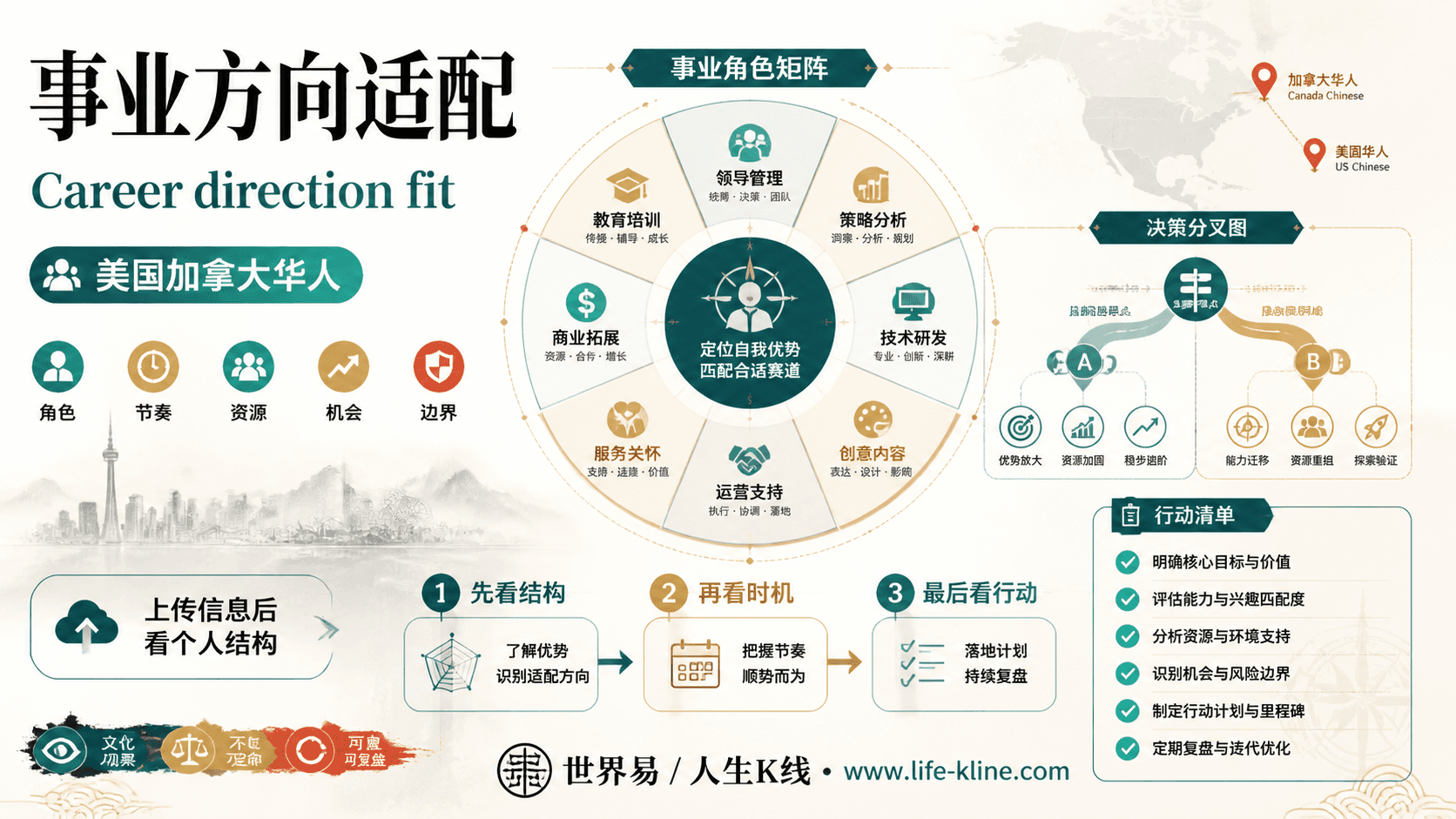
事业方向适配|美国加拿大华人
这张图把《Midlife Care and Distance Decisions: A Metaphysical Perspective on Family Responsibility and Self-Balance》里的命理概念转成关系、边界和应用场景,适合先看图建立结构,再回到知识文章正文理解细节。
事业方向适配不应被写成固定结论。更适合美国加拿大华人的读法,是把传统术语翻译成结构、时机、环境、行动和复盘。
查看图片解读