BaZi Reference for MCN Content Creators' Partnership vs Sole Proprietorship Decisions
把这篇文章落到自己身上验证:先看结构,再进入个人分析,不做泛泛阅读。
Why This Decision Is Especially Difficult in This Industry
The core operational challenges in the MCN and content creator industry lie in high account risks, unpredictability of viral content, and frequent platform policy changes, all of which complicate entrepreneurial decisions. While partnership startups allow resource and pressure sharing, they also bring trust and distribution conflicts. Sole proprietorship assumes all risks but offers stronger control. The psychological toll in this industry is significant; entrepreneurs often experience decision anxiety due to uncertainty, easily swayed by emotions and neglecting systemic risks and their own resource compatibility.
From an operational structure perspective, MCN startup costs include content production, team management, and platform promotion expenses. Monetization paths are diverse but heavily reliant on platform rules, where policy shifts can sharply reduce income. Partnership models can share costs and pressures but require coordination of interests and value alignment. Sole proprietorship demands stronger risk resistance and decision execution ability to avoid financial crises caused by blind expansion.
In BaZi terms, the Wealth Star symbolizes monetization capability, Bi Jian represents both cooperation and competition, Officer and Killing Stars reflect external pressures and market regulations, and Yin Stars relate to information support and resource acquisition. The strength and combination of these Ten Gods in different charts reveal an entrepreneur’s adaptability and potential risk points in partnership or sole proprietorship. Proper interpretation of BaZi rhythms helps entrepreneurs adjust strategies at critical junctures, avoiding blind following or premature rigidity.
Therefore, the decision between partnership or sole proprietorship in MCN startups is highly challenging, requiring a multidimensional judgment integrating business environment, psychological state, and BaZi structure, combined with commercial due diligence and financial analysis to reduce blind risks and increase success probability. BaZi is not an absolute guide but an auxiliary reference sensitive to rhythm and risk.
Three Core Dimensions in BaZi Judgment
First, the relationship between the Day Master and the Wealth Star represents the entrepreneur’s inherent ability and monetization drive. A strong Day Master with effective Yong Shen (favorable element) usually manages resources and navigates entrepreneurial fluctuations better. The strength and Sheng-Ke (generating/controlling) relationship of the Wealth Star indicate the controllability of cash flow and market opportunities. In the MCN industry, a strong Wealth Star means more monetization channels, favoring sole proprietorship with full operational control; a constrained Wealth Star suggests partnership to share risks.
Second, Bi Jian reflects the dual nature of cooperation and competition. Entrepreneurs with strong Bi Jian are often more suitable for partnerships due to better collaborative ability and stress resistance but may also cause internal consumption, requiring clear division of labor and trust mechanisms. Weak or restrained Bi Jian favors sole proprietorship to reduce internal friction and avoid extra psychological burden from partnerships.
Third, Officer and Killing Stars alongside Yin Stars illustrate external pressure and support systems. Strong Officer and Killing Stars indicate intense policy regulation and market competition, demanding entrepreneurs possess resilience and adaptability; otherwise, they risk being overwhelmed by external forces. Yin Stars represent information support and resource introduction; strong Yin Stars facilitate access to platform resources and industry intelligence, while weak ones call for cautious decision-making. The interactions of Da Yun (decade luck cycle) and Liu Nian (annual fortune) with Officer, Killing, and Yin Stars further influence entrepreneurial rhythm, signaling when to expand actively or consolidate and wait.
In summary, BaZi judgment for partnership or sole proprietorship should focus on analyzing the Day Master and Wealth Star’s monetization ability, Bi Jian’s cooperative potential, and the external environment adaptation of Officer, Killing, and Yin Stars, combined with dynamic Da Yun and Liu Nian to form a multidimensional risk assessment aiding entrepreneurial decisions.
Three Real BaZi Chart Case Studies
Case 1: This female chart has a Ren Water (壬, Ren) Day Master that is slightly strong, classified as a specialized strong pattern. Wood is the Yong Shen (favorable element), Metal is the Ji Shen (unfavorable element). Currently in the Gui You Da Yun (癸酉, Gui-You decade luck cycle), which is stable and suitable for consolidation, and the Bing Wu Liu Nian (丙午, Bing-Wu annual fortune), requiring flexible adaptation. The Wealth Star is not prominent, but the Yin Star Wood supports Ren Water to generate wealth, and there is abundant Bi Jian Jia Wood, indicating rich cooperative resources. Placed in the MCN industry, the slightly strong Ren Water Day Master implies strong content creation ability; the Wood Yong Shen suggests good team collaboration and resource support. The abundant Bi Jian Jia Wood favors partnership, sharing account risks and psychological pressure. The stable Da Yun advises against blind expansion. This chart suits steady partnerships leveraging team strength to navigate industry uncertainties. The judgment sequence recommends first evaluating partner value alignment and resource compatibility, combined with financial stability, to avoid internal consumption from over-reliance on Bi Jian.
Case 2: This male chart has a Jia Wood (甲, Jia) Day Master balanced in strength, with a Zheng Cai (正财, Direct Wealth) pattern. Fire is the Yong Shen, Metal is the Ji Shen. Currently in the Jia Yin Da Yun (甲寅, Jia-Yin decade luck cycle), which is stable for consolidation, and the Bing Wu Liu Nian (丙午, Bing-Wu annual fortune). The Wealth Star Fire is strong, indicating robust monetization ability and effective fund management. Bi Jian is balanced without significant strength or weakness; Officer and Killing Stars are not prominent, implying moderate pressure. In MCN operation, this chart shows the entrepreneur has good self-control and financial management capability, suitable for sole proprietorship, as a strong Wealth Star benefits concentrated fund use and quick decision-making. Sole proprietorship avoids partnership conflicts and psychological consumption. The judgment sequence suggests focusing on personal financial strength and risk resistance, supplemented by market due diligence, to proceed sole proprietorship timely and avoid diluting resources through blind partnerships.
Case 3: This female chart has a Geng Metal (庚, Geng) Day Master that is slightly weak, with a Zheng Guan (正官, Direct Officer) pattern. Earth is the Yong Shen, Water and Wood are the Ji Shen. Currently in the Jia Yin Da Yun (甲寅, Jia-Yin decade luck cycle), considered an unfavorable luck cycle requiring caution, and the Bing Wu Liu Nian (丙午, Bing-Wu annual fortune). Officer and Killing Stars are relatively strong, indicating considerable pressure. The Wealth Star is not prominent; the Yin Star Earth Yong Shen is weak. This chart faces significant external pressure and instability in the MCN industry, with a weak Day Master unable to bear all risks independently. Partnership can share pressure, but the Jia Yin Da Yun’s unfavorable luck warns of increased partnership risks, necessitating careful partner selection. It is recommended to adopt a cautious partnership strategy, prioritizing evaluation of partners’ Yin Star and Officer/Killing Star structures to avoid major incidents caused by partnership. The judgment sequence should start with risk assessment and legal/financial due diligence, confirming partnership contracts and risk-sharing mechanisms for steady progress.
These three cases, combined with MCN industry operational characteristics, closely link BaZi structures with partnership or sole proprietorship decisions, providing entrepreneurs with a rhythm-based risk awareness and strategic selection framework.
Common Misjudgments and Blind Spots in This Industry
MCN entrepreneurs often misjudge the sustainability of viral content, overly relying on short-term traffic while neglecting long-term brand and team building, leading to cash flow breakdowns. In BaZi terms, neglecting the balance between Day Master and Wealth Star and blindly expanding can cause financial and psychological crises. In partnerships, insufficient examination of Bi Jian’s internal consumption risks leads to intensified team conflicts and reduced operational efficiency.
Additionally, entrepreneurs often overlook the indications of Officer/Killing and Yin Star structures when facing policy and platform regulations, resulting in blind optimism or pessimism and lack of flexible response strategies. Especially when Da Yun and Liu Nian are in conflict or combination phases, ignoring risk management causes sudden risks to be ineffectively mitigated. BaZi only provides rhythm references; ignoring actual business data and market feedback easily causes decision biases.
Many entrepreneurs also have psychological biases, treating BaZi as absolute prophecy, lacking commercial due diligence and financial planning, resulting in blind following of partnership or sole proprietorship trends. Partnership relations often lack contracts and risk-sharing mechanisms, neglecting proactive introduction of Yin Star resources, missing platform support and informational advantages, further increasing failure risks.
In summary, BaZi assistance in MCN entrepreneurship should be tightly integrated with commercial due diligence, financial analysis, and team management to avoid misleading from a single dimension and form a scientific, dynamic, and comprehensive decision-making system.
Practical Judgment Sequence
Step one: Assess the strength of your own Day Master and the favorability or adversity of Yong Shen, clarifying monetization capability and risk resistance potential. A relatively strong Day Master with effective Yong Shen may consider sole proprietorship to leverage decision efficiency and resource concentration; otherwise, partnership suits better to share risks and pressures. Combine this with current Da Yun and Liu Nian to judge industry cycles and operational rhythm, avoiding blind expansion during unfavorable luck or conflict/combination years.
Step two: Analyze the strength of Bi Jian and internal consumption risks. Strong Bi Jian favors partnership but requires trust and division of labor mechanisms to prevent team splits caused by internal competition. Weak or restrained Bi Jian suggests prioritizing sole proprietorship or cautious partnership to avoid additional psychological and operational risks from cooperation.
Step three: Combine Officer/Killing and Yin Star structures to determine external pressure and support. Strong Officer and Killing Stars require enhanced policy and market risk management; strong Yin Stars facilitate information and resource introduction, favoring active expansion and partnership. If Da Yun and Liu Nian show conflict or combination, it is advised to consolidate and wait, avoiding major investments or partnership changes. All judgments should be accompanied by commercial due diligence, financial analysis, and legal consultation to ensure scientific and reasonable decisions.
By conducting multidimensional screening as above, entrepreneurs can more accurately grasp the risks and opportunities of partnership or sole proprietorship in the MCN industry, improving decision quality.
FAQ
Question 1: Does a weak Wealth Star in BaZi mean sole proprietorship is unsuitable? Answer: A weak Wealth Star indeed indicates insufficient monetization ability, and sole proprietorship bears greater financial risk, but it is not absolutely unsuitable. One should consider the Day Master’s strength, Yong Shen conditions, and Da Yun/Liu Nian to evaluate overall risk resistance and resource support before deciding on sole proprietorship or seeking partnership to share risks.
Question 2: Are entrepreneurs with strong Bi Jian always suitable for partnership? Answer: Strong Bi Jian symbolizes strong cooperative ability but may also bring internal competition and consumption. Partnership suitability depends on establishing good trust and division of labor mechanisms; otherwise, internal conflicts may cause team disintegration. Therefore, strong Bi Jian requires cautious partner selection and commercial due diligence to ensure a solid cooperation foundation.
Question 3: How do Da Yun and Liu Nian conflicts or combinations affect partnership decisions? Answer: Conflicts or combinations in Da Yun and Liu Nian usually mean increased volatility and risk in the business environment. During such periods, it is recommended to avoid major partnership changes or expansions, adopting a consolidation strategy and waiting until conditions stabilize before adjustments. BaZi rhythms remind entrepreneurs to pay attention to cycle changes and reasonably arrange action timing to align with market dynamics.
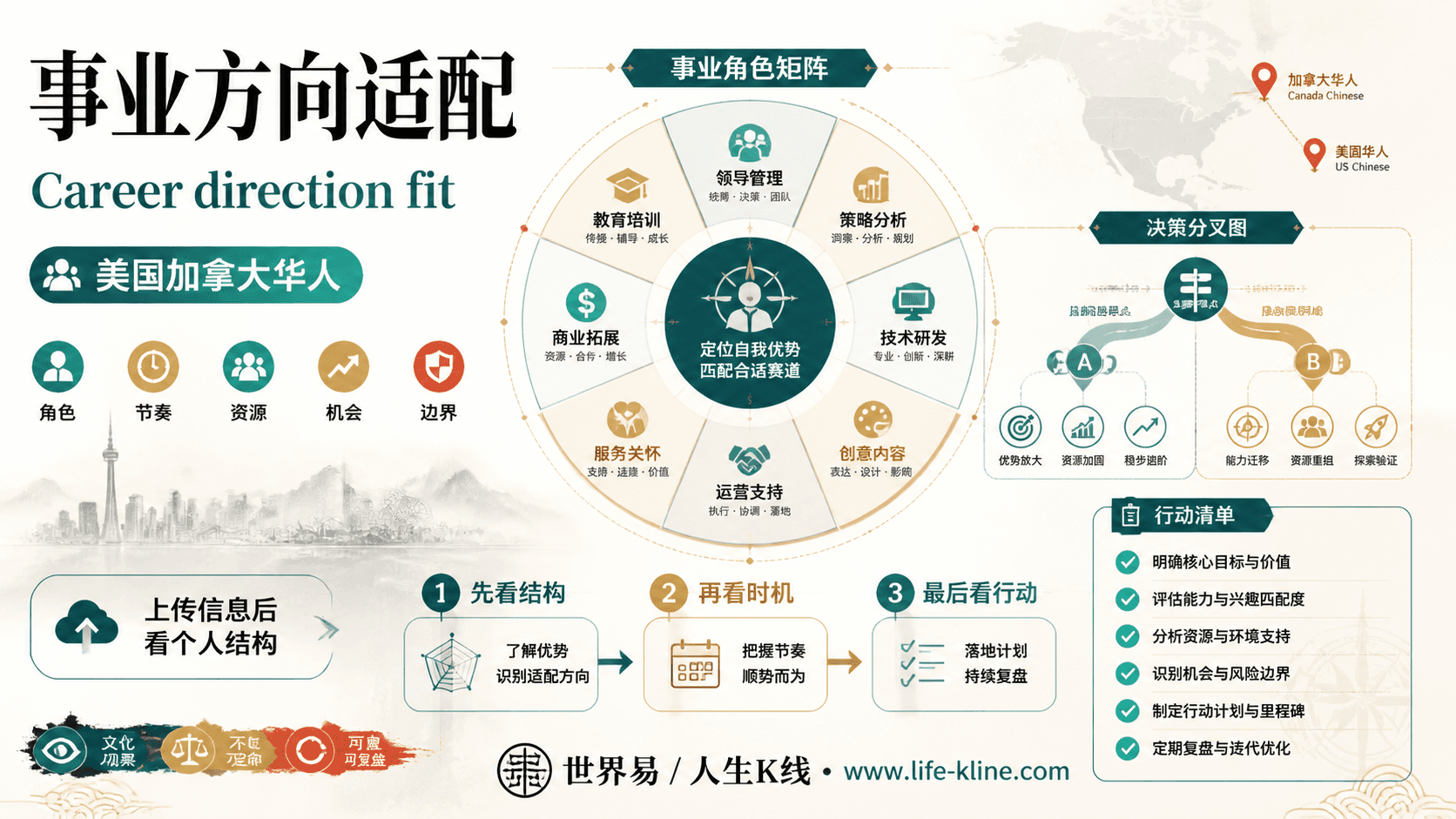
事业方向适配|美国加拿大华人
这张图把《BaZi Reference for MCN Content Creators' Partnership vs Sole Proprietorship Decisions》里的命理概念转成关系、边界和应用场景,适合先看图建立结构,再回到知识文章正文理解细节。
事业方向适配不应被写成固定结论。更适合美国加拿大华人的读法,是把传统术语翻译成结构、时机、环境、行动和复盘。
查看图片解读