BaZi Analysis and Practical Guidance on Repair and Withdrawal Decisions During Post-Marriage Adjustment Phase
把这篇文章落到自己身上验证:先看结构,再进入个人分析,不做泛泛阅读。
Why This Decision Is Especially Difficult at This Stage of Marriage
The post-marriage adjustment phase usually occurs within the first year after marriage and is a period of deep impact on couples’ living habits, values, and family backgrounds. At this time, real-world social pressures are particularly significant, including property issues, bride price, expectations from both families, and child custody matters. These external factors often exacerbate internal conflicts, making decisions about repairing the relationship or withdrawing complex and sensitive.
From a BaZi perspective, the marriage palace (夫妻宫) undergoes noticeable changes in the first year after marriage, and the spouse star (配偶星) is more easily triggered, which may cause cracks in the originally harmonious pattern. The strength of the Day Master, the stability of the pattern, and the balance of the Yong Shen (favorable element) directly affect whether the couple can smoothly overcome difficulties.
The stances of both families become particularly prominent during this stage. Many conflicts are not purely between the spouses but are intertwined with the cultures and interests of both families. If the marriage palace and spouse star in the BaZi structure experience clashes or combinations (冲合), real-life pressures will be amplified, challenging the couple’s tolerance and communication abilities.
Therefore, decisions about repair and withdrawal during the post-marriage adjustment period are not merely emotional issues but results of the combined effects of BaZi and real-world factors. Scientific and rational analysis helps clarify the essence of conflicts, avoiding impulsive actions or excessive compromise.
Three Core Dimensions of BaZi Judgment
First, the strength of the Day Master determines an individual’s dominant power and endurance capacity in the marriage. A relatively strong Day Master often has a strong self-awareness and resistance; when facing conflicts, they tend to take the initiative to resolve issues or insist on their views. Conversely, a relatively weak Day Master may show more dependence or compromise tendencies but is also more susceptible to external environmental influences.
Second, the position and condition of the marriage palace and spouse star are key to judging the quality of the post-marriage relationship. If the marriage palace is affected by clashes or combinations from Da Yun (decade luck cycle) or Liu Nian (annual fortune), it indicates that the marriage is prone to changes or tests during this phase. The Five Elements attribute of the spouse star and its relationship with the Day Master’s Yong Shen and Ji Shen (unfavorable element) reflect the compatibility of personalities and interaction patterns.
Third, the interaction between Da Yun and Liu Nian reflects the environmental changes and their impact at the current period. Auspicious luck combined with favorable annual fortune helps alleviate problems and repair relationships. In contrast, stable or highly conflicting Da Yun and Liu Nian combinations suggest that more patience and wisdom are needed, and structural adjustments may be necessary.
These three dimensions complement each other and together form the basis for judging the repair potential and withdrawal risks during the post-marriage adjustment phase, assisting in rationally analyzing the combined effects of real-life pressures and BaZi signals.
Three Real BaZi Chart Cases
Case 1: The male’s Day Master is 戊 (Wu, Earth), relatively strong, belonging to the Bi Jian (比肩) pattern. Both Yong Shen and Ji Shen are Fire. He is currently in the 9th year of the 癸巳 (Gui Si) Da Yun, with the Liu Nian being 丙午 (Bing Wu). Overall, the Da Yun is auspicious, and the Liu Nian is favorable. The Bi Jian pattern emphasizes self and equality in the marriage relationship. The spouse star is strongly influenced by Fire, indicating that emotions and action are prominent in the couple’s interactions. During post-marriage adjustment, clashes in living habits easily trigger the Ji Shen Fire traits, manifesting as emotional fluctuations or communication difficulties. However, the auspicious Da Yun and Liu Nian provide favorable conditions for repair. The judgment advice is to first observe whether conflicts related to the Fire element can be alleviated through communication and lifestyle adjustments. If the Fire Ji Shen conflicts are too severe and persistent, reconsideration of the relationship structure is needed.
Case 2: The male’s Day Master is 乙 (Yi, Wood), relatively weak, belonging to the Zheng Guan (正官) pattern. Yong Shen is Water, Ji Shen are Fire and Earth. He is currently in the 8th year of the 丙子 (Bing Zi) Da Yun, with the Liu Nian being 丙午 (Bing Wu). The Da Yun is stable, and the Liu Nian requires adaptive responses. The Zheng Guan pattern often reflects responsibility and norms. The spouse star is nourished by Water, indicating high expectations for stability and rules in the marriage. The relatively weak Day Master and the impact of Ji Shen Fire and Earth mean that post-marriage adjustment is easily influenced by external pressures. Differences in living habits and family environments often cause conflicts. Repair potential lies in the harmonizing effect of the Water Yong Shen. It is recommended to first improve communication patterns and adjust mutual expectations to ease conflicts. If conflicts escalate and the Yong Shen is severely damaged, cautious consideration of withdrawal is advised.
Case 3: The male’s Day Master is 乙 (Yi, Wood), relatively weak, belonging to the Pian Cai (偏财) pattern. Yong Shen is Water, Ji Shen are Fire and Earth. He is currently in the 9th year of the 庚申 (Geng Shen) Da Yun, with the Liu Nian being 丙午 (Bing Wu). The Da Yun is stable, and the Liu Nian requires adaptive responses. The Pian Cai pattern indicates strong material and responsibility aspects in the marriage. The spouse star and Day Master relationship is close, making living rhythm and financial arrangements focal points of conflict during post-marriage adjustment. The relatively weak Day Master combined with Ji Shen Fire and Earth means the marriage is susceptible to real-life pressures such as economic burdens or family interference. The key to repair is the function of the Water Yong Shen, coordinating differences through rationality and emotional support. If the Da Yun and Liu Nian increasingly disrupt the Yong Shen and frequent couple conflicts occur, relationship adjustment or temporarily reducing friction should be considered.
These three cases all demonstrate how BaZi structures influence repair and withdrawal decisions during the post-marriage adjustment phase, emphasizing the need to combine real-life details with BaZi information for dynamic adjustments.
Common Misjudgments and Blind Spots at This Stage
First, over-reliance on a single BaZi factor for decision-making. The complexity of the post-marriage adjustment phase lies in the interplay of multiple factors. The strength of the Day Master, Yong Shen and Ji Shen, and the marriage palace must be considered as a whole. Ignoring any link may lead to misjudgment, such as focusing only on the auspiciousness of Da Yun while neglecting clashes in the marriage palace.
Second, neglecting the influence of both families and social environment in real life. Although BaZi structures reveal underlying trends, concrete issues like bride price, property, and child custody often have a more direct impact on the marriage. BaZi judgments need to be integrated with these factors for comprehensive analysis.
Third, hastily deciding to withdraw at the early stage of conflict. The appearance of clashes and Ji Shen in BaZi is more a reminder to pay attention and adjust rather than an immediate verdict on relationship termination. In many cases, reasonable communication and lifestyle adjustments can alleviate conflicts. Blind withdrawal may miss repair opportunities.
Fourth, failure to identify the repair time window. Whether the Liu Nian and Da Yun are favorable determines the adjustment space. Missing the right timing for action may worsen the relationship or miss positive turning points.
Practical Judgment Sequence
First, analyze the current state of the marriage palace and spouse star to determine if there are obvious clashes or Ji Shen influences. If the marriage palace and spouse star are relatively stable or auspicious, prioritize repair strategies by adjusting living habits and communication methods.
Second, combine the strength of the Day Master and the status of Yong Shen and Ji Shen to assess whether the current BaZi supports emotional management and problem-solving. A relatively strong Day Master with a well-supported Yong Shen indicates stronger endurance and higher repair potential; a relatively weak Day Master with a damaged Yong Shen requires cautious repair to avoid emotional escalation.
Finally, observe the interaction between the current Da Yun and Liu Nian to judge the external environment’s support for the marriage. When auspicious Da Yun aligns with favorable Liu Nian, active repair is suitable. When the environment is stable or highly conflicting, gradual strategies are recommended, with moderate withdrawal considered if necessary to protect one’s interests.
Overall, decision-making should start from the marriage palace status, integrate the Day Master and Yong Shen conditions, then reference the favorability of Da Yun and Liu Nian, dynamically adjusting repair and withdrawal plans to rationally cope with the complex post-marriage adjustment situation.
FAQ
Question 1: If there are clashes in the marriage palace during the post-marriage adjustment phase, should withdrawal be considered immediately? Answer: Clashes in the marriage palace indicate conflicts and pressure but do not necessarily mean withdrawal is required. The strength of the Day Master and Yong Shen should be considered to observe repair potential, especially focusing on the actual effects of communication and lifestyle adjustments.
Question 2: How should a person with a relatively weak Day Master respond to post-marriage conflicts? Answer: A relatively weak Day Master usually has lower endurance and is more affected by external influences. It is recommended to first enhance the Yong Shen (such as emotional support and Water element harmonization) to relieve pressure, while reasonably adjusting the external environment and living habits to avoid escalation.
Question 3: Does a stable Da Yun and Liu Nian mean there is no risk in the relationship? Answer: Stable Da Yun and Liu Nian provide a relatively stable external environment, but the risk in the post-marriage relationship still needs to be judged in combination with the marriage palace and Day Master Yong Shen conditions. Stable periods are more suitable for repair and building emotional foundations but still require attention to internal detail management.
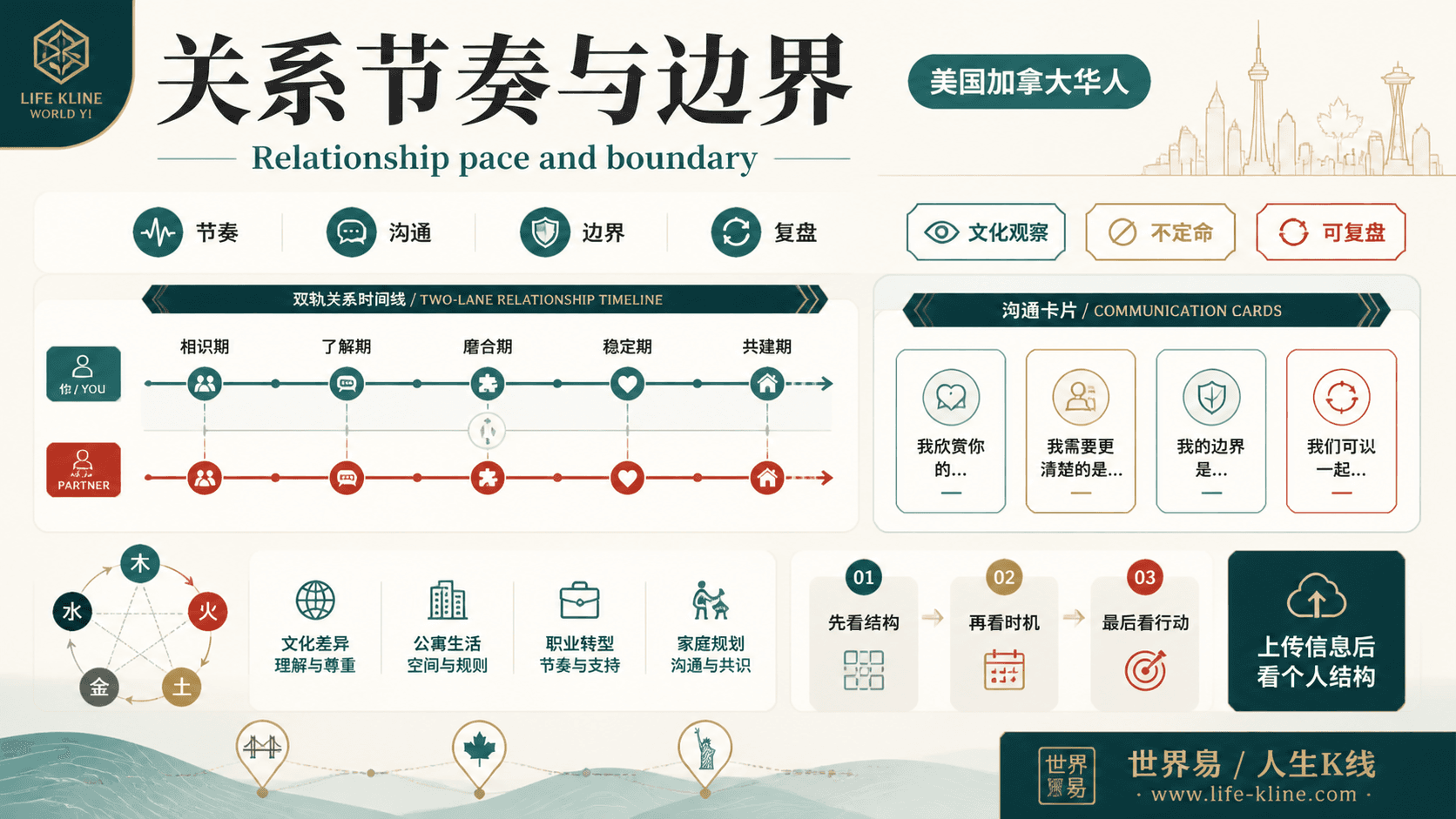
关系节奏与边界|美国加拿大华人
这张图把《BaZi Analysis and Practical Guidance on Repair and Withdrawal Decisions During Post-Marriage Adjustment Phase》里的命理概念转成关系、边界和应用场景,适合先看图建立结构,再回到知识文章正文理解细节。
关系节奏与边界不应被写成固定结论。更适合美国加拿大华人的读法,是把传统术语翻译成结构、时机、环境、行动和复盘。
查看图片解读