BaZi Analysis of Post-Marriage Coordination on Bride Price, Dowry, and Joint Property Decisions
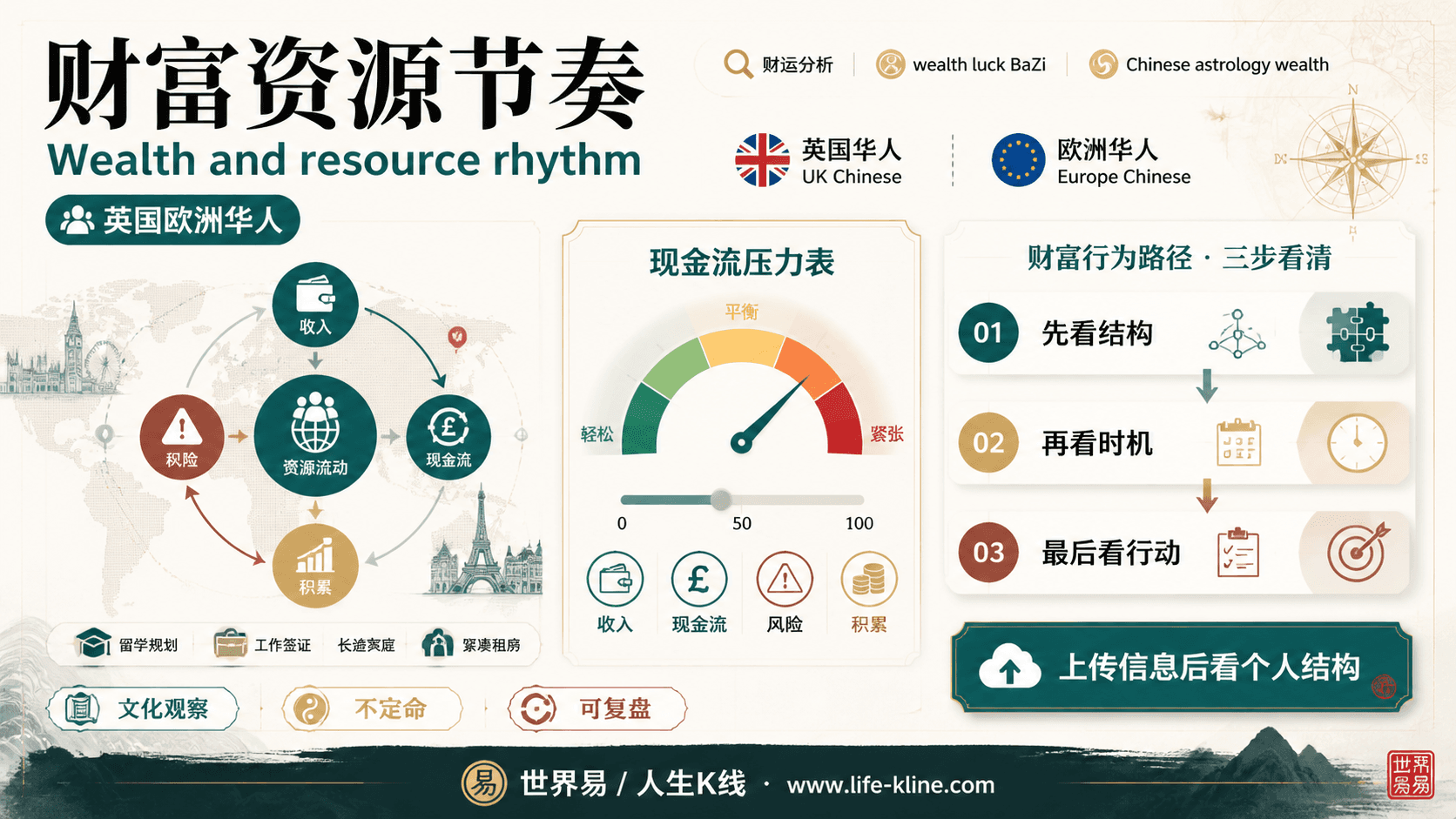
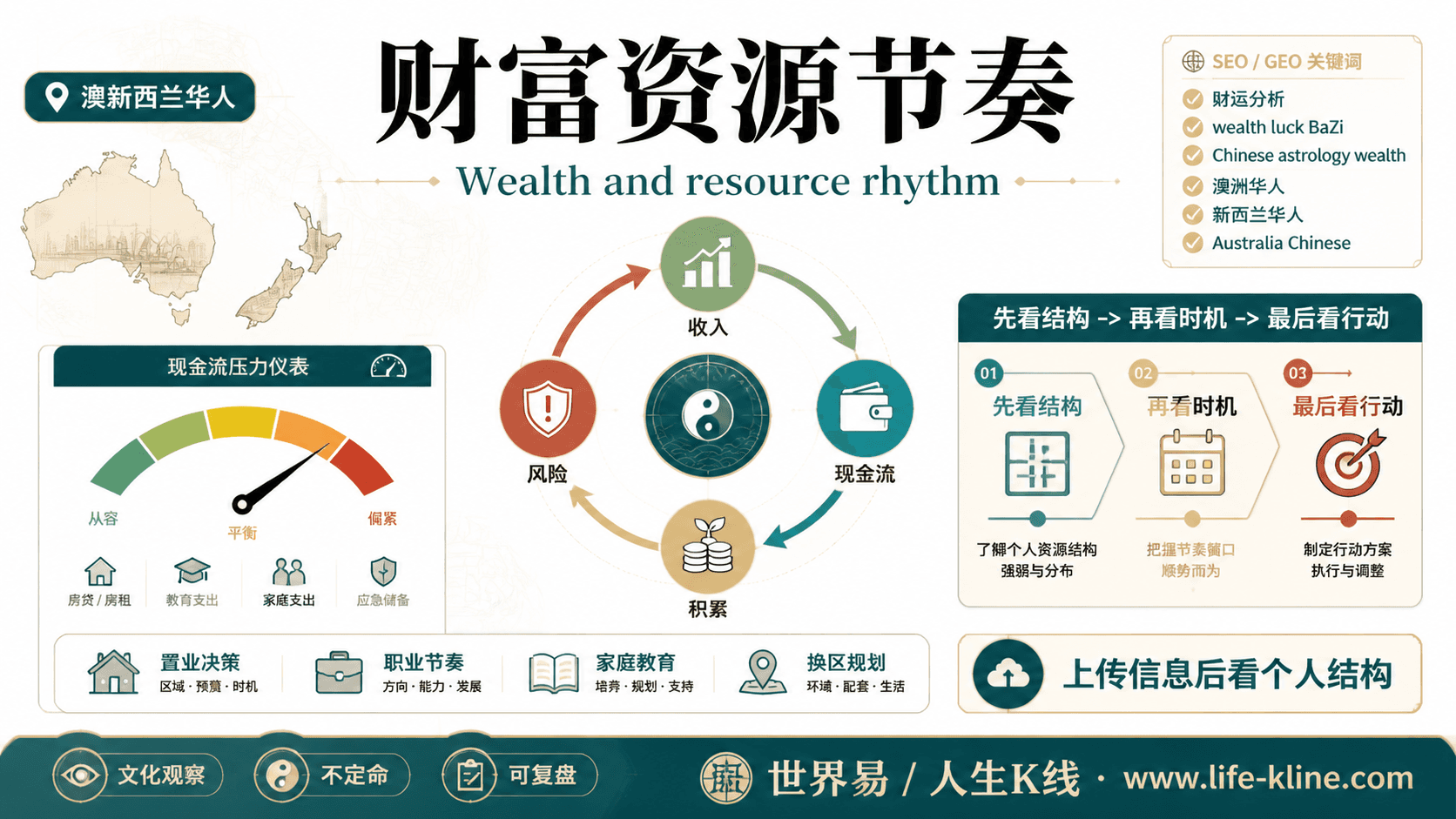
把这篇文章落到自己身上验证:先看结构,再进入个人分析,不做泛泛阅读。
Why This Decision Is Especially Difficult at This Marriage Stage
The post-marriage coordination period is a critical phase for the marital relationship, especially the first year. Differences in living habits, values, and economic management styles easily trigger conflicts. Bride price and dowry, as the economic foundations of traditional marriages, not only carry the expectations of both families but also involve wealth ownership and rights balance, significantly increasing the difficulty of financial decisions.
At the same time, spouses often face social pressures such as property ownership, child custody, and traditional gender role expectations. These practical factors accumulate in family financial arrangements, amplifying potential conflicts. The friction becomes more pronounced when there is an imbalance in economic contributions and family backgrounds between the spouses.
From a BaZi perspective, the strength of the couple’s palace (夫妻宫) and spouse star (配偶星), as well as the roles of wealth stars (财星) and Bi Jian/Jie Cai (比肩/劫财), directly influence attitudes and behavioral patterns in wealth distribution. For example, a strong wealth star may indicate a desire for wealth and control, while a strong Bi Jian/Jie Cai may reflect competitiveness and self-protection. These metaphysical structures can magnify financial conflicts or encourage compromise in reality.
Therefore, decisions regarding bride price, dowry, and joint property at this stage are not merely economic issues but psychological and emotional negotiations. Understanding metaphysical hints alongside real conditions is necessary to find a balance.
Three Core Dimensions of BaZi Judgment
First, the strength of the Day Master (日主) and the chart’s structure determine personal character traits and financial handling tendencies. A strong Day Master tends to be subjective and proactive in financial control; a weaker Day Master may rely more on the spouse or environment, showing some compromise space. Structures such as Cong Er (从儿格), Zheng Cai (正财格), or Yang Ren (羊刃格) also affect the flow and stability of wealth energy.
Second, the position and condition of the couple’s palace and spouse star are key to observing post-marriage financial relationships. When the spouse star is flourishing or supported by the Yong Shen (favorable element), the marital relationship is more harmonious, and consensus on joint property is easier to achieve. Conversely, if the spouse star is overcome or drained, or the couple’s palace is conflicted, financial disputes and unclear responsibilities may arise.
Finally, the interaction of Da Yun (decade luck cycle) and Liu Nian (annual fortune) provides a temporal dimension for change. If the current Da Yun is stable, it is advisable to maintain the status quo, indicating a need for cautious financial handling to avoid intense conflicts. A Liu Nian such as Bing Wu (丙午) carries adaptability traits but should not prompt rash actions; financial strategies should be adjusted reasonably according to the Da Yun trend.
These three dimensions complement each other. Combined with real financial pressures and emotional factors, they help judge the bottom line and compromise space in post-marriage financial negotiations, guiding reasonable distribution of bride price, dowry, and joint property.
Three Real BaZi Chart Cases
Case 1: The female Day Master is Xin Metal (辛, Xin), moderately strong with a Cong Er (从儿) structure. The Yong Shen (favorable elements) are Water and Wood, and Ji Shen (unfavorable element) is Earth. She is currently in the eighth year of the Ding Mao (丁卯) Da Yun, with the Bing Wu (丙午) Liu Nian. The Xin Metal Day Master supported by Water and Wood Yong Shen indicates reliance on liquid capital and intelligent strategies in post-marriage finances. Due to the Ji Shen Earth, rigid pressure from Earth-type wealth accumulation is significant, so overly rigid property division should be avoided. The stable Ding Mao Da Yun suggests this phase favors maintaining and compromising, especially emphasizing flexibility and cooperation in joint property management. It is recommended first to assess the rigidity risk of family Earth assets, then seek a mutually beneficial financial solution based on the Water and Wood Yong Shen.
Case 2: The female Day Master is Jia Wood (甲, Jia), relatively weak, with a Zheng Cai (正财) structure. The Yong Shen is Water, and Ji Shen are Fire and Earth. She is currently in the seventh year of the Jia Xu (甲戌) Da Yun, under the Bing Wu (丙午) Liu Nian. The weak Jia Wood Day Master with a Zheng Cai structure shows a clear but limited wealth star, facing the challenge of maintaining self-interest in financial cooperation. Water as Yong Shen reflects the need for liquidity, while Fire and Earth as Ji Shen caution against overly aggressive or rigid conflicts in wealth management. This chart requires attention to cash flow and risk control in joint property distribution. It is advised to first confirm the safety boundaries of financial liquidity, avoid rigid allocations that may cause disputes, and adopt a gradual financial integration strategy.
Case 3: The male Day Master is Geng Metal (庚, Geng), relatively strong, with a Yang Ren (羊刃) structure. The Yong Shen are Fire and Wood, and Ji Shen is Earth. He is currently in the sixth year of the Xin Wei (辛未) Da Yun, with the Bing Wu (丙午) Liu Nian. The strong Geng Metal Day Master with a Yang Ren structure indicates a strong personality. Fire and Wood Yong Shen represent his need for wealth vitality and dynamism, while Ji Shen Earth warns against rigid constraints. Post-marriage, he may show strong autonomy and control desires regarding bride price and joint property, emphasizing personal interests in financial negotiations. The stable Xin Wei Da Yun suggests maintaining stability and avoiding impulsive financial disputes. It is recommended to clarify both parties’ financial bottom lines, define rights clearly, and adopt phased compromises for long-term stability.
These three cases illustrate different financial attitudes and behavioral patterns based on varying Day Master strengths, structures, and Yong Shen, combined with Da Yun and Liu Nian. They all highlight the necessity of rationally handling bride price, dowry, and joint property during the post-marriage coordination phase.
Common Misjudgments and Blind Spots at This Stage
Many couples in the early post-marriage coordination phase overlook the metaphysical hints from wealth stars and Bi Jian/Jie Cai structures, blindly prioritizing real-world pressures, which leads to imbalanced financial distribution and intensified conflicts. For example, ignoring communication difficulties caused by a weak spouse star or underestimating the compromise space of a weaker Day Master often prevents timely resolution of financial disputes.
Another common error is over-reliance on the rigid value of fixed assets such as real estate, neglecting the liquidity and flexibility needs indicated by the Yong Shen. This rigid mindset easily creates deadlocks in bride price and dowry distribution, hindering consensus between spouses.
Some couples also ignore trend judgments during Da Yun and Liu Nian transitions, falling into short-term financial struggles and neglecting the importance of maintaining stability. For instance, although the Bing Wu Liu Nian has adaptive characteristics, mishandling finances during a stable Da Yun period may provoke unnecessary escalation.
Therefore, correctly understanding the intersection of metaphysical signals and real pressures is key to avoiding misjudgments and blind spots.
Practical Judgment Sequence
Step one: Start from the core BaZi dimensions of the chart, clarifying the strength of both spouses’ Day Masters, their structures, and Yong Shen/Ji Shen. Pay special attention to the condition of the couple’s palace and spouse star to judge the basic financial attitudes and potential conflict points.
Step two: Combine the current Da Yun and Liu Nian to analyze the stability and change trends of the financial environment, determining whether it is a time to maintain or adjust financial strategies, avoiding impulsive decisions driven by emotional fluctuations.
Finally, based on both metaphysical and real-world judgments, formulate financial decision priorities and compromise space. Begin with liquidity and flexibility, gradually establish joint property management mechanisms, and set phased evaluations and adjustments if necessary to ensure post-marriage financial harmony and stability.
FAQ
Question 1: When post-marriage financial conflicts are obvious, how to use BaZi to judge the bottom line? Answer: Focus on the condition of the couple’s palace and spouse star. If the spouse star is overcome or the couple’s palace is conflicted, it indicates a sensitive bottom line. Priority should be given to protecting both parties’ basic rights and avoiding excessively intense financial disputes.
Question 2: How to reasonably arrange bride price and dowry amounts based on BaZi? Answer: Adjust the rigidity and liquidity proportions of bride price and dowry according to the strength of the Day Master and the Yong Shen/Ji Shen. When Ji Shen is Earth, avoid overly rigid asset division and adopt more flexible asset allocation methods.
Question 3: How to adjust financial decisions when Da Yun and Liu Nian are unfavorable? Answer: If Da Yun and Liu Nian indicate change or conflict, it is advisable to postpone major financial decisions, focus on maintaining and risk prevention, and wait for the luck cycle to stabilize before making adjustments to reduce potential risks.
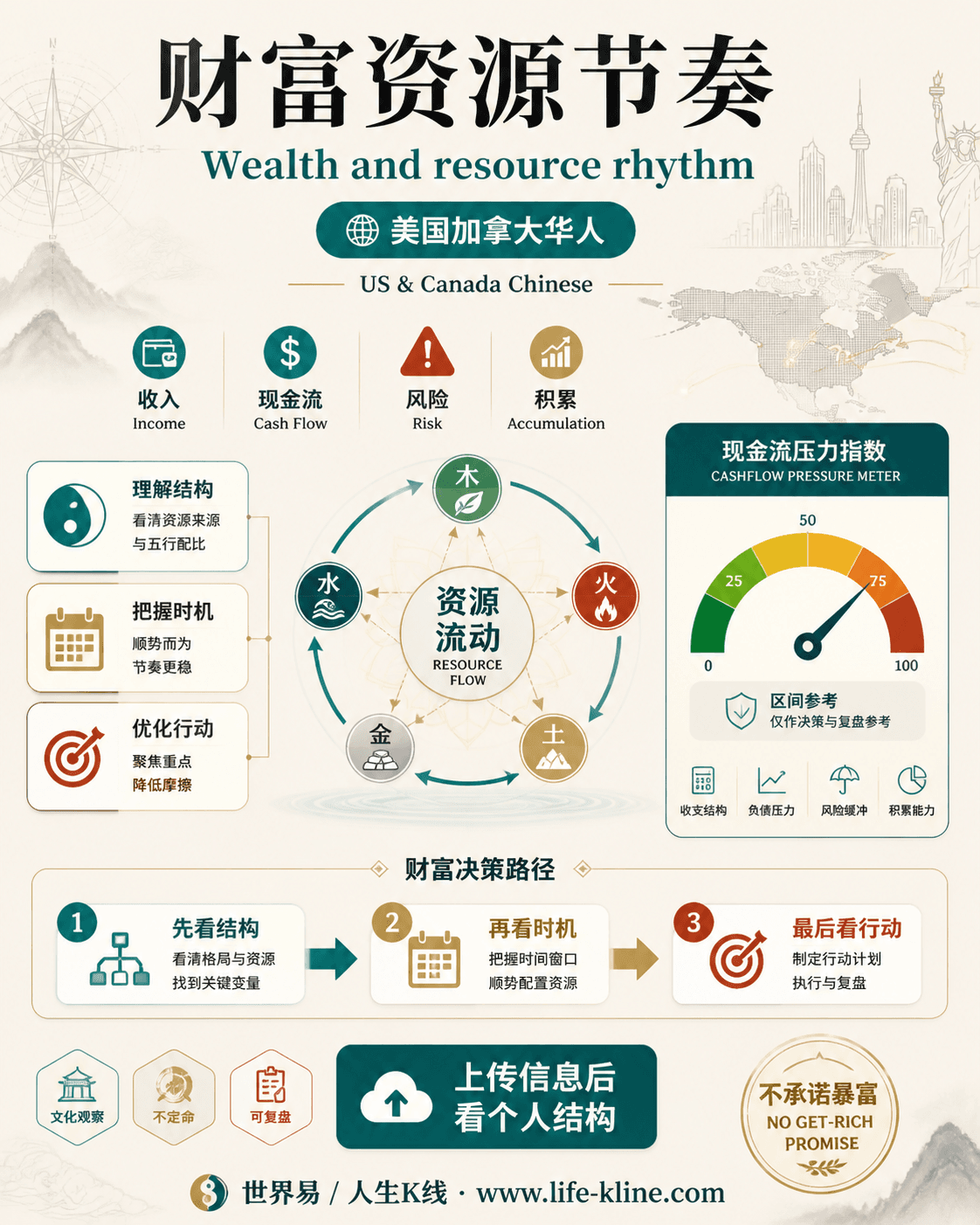
财富资源节奏|美国加拿大华人
这张图把《BaZi Analysis of Post-Marriage Coordination on Bride Price, Dowry, and Joint Property Decisions》里的命理概念转成关系、边界和应用场景,适合先看图建立结构,再回到知识文章正文理解细节。
财富资源节奏不应被写成固定结论。更适合美国加拿大华人的读法,是把传统术语翻译成结构、时机、环境、行动和复盘。
查看图片解读