Practical BaZi Analysis on Repair and Withdrawal Decisions During Marital Conflict Periods
把这篇文章落到自己身上验证:先看结构,再进入个人分析,不做泛泛阅读。
Why This Decision Is Especially Difficult at This Marital Stage
The marital conflict period is often accompanied by complex emotional entanglements and real-life pressures, especially during the so-called “seven-year itch” phase, where couples tend to experience emotional fatigue and tests of trust. At this time, the ties of children add the weight of family responsibilities, and the emergence of third-party signals further intensifies conflicts, making the choice between repair and withdrawal particularly challenging.
The stances and expectations of both families often become key variables in decision-making. Parents’ focus on dowry, property, and other material conditions, traditional gender role expectations, and custody of children are real pressures that often make marital conflicts not just a matter between two people but a complex intertwining of multiple interests and emotions.
The metaphysical structure’s role in amplifying or buffering conflicts during this stage cannot be ignored. The strength of the Day Master directly affects an individual’s internal energy and coping ability, while the position of the spouse star and the spouse palace reflect the essential state of the relationship. The influence of Da Yun (decade luck cycle) and Liu Nian (annual fortune) on the marital state makes the dynamics of the conflict period more complex, adding uncertainty to decisions about repair or withdrawal.
Therefore, decisions on repair and withdrawal during marital conflict require not only a comprehensive consideration of multiple real-life pressures but also precise grasp of the relational signals hidden in the metaphysical structure, so as to scientifically formulate action plans and avoid blind or impulsive choices.
Three Core Dimensions of Metaphysical Judgment
First, the strength of the Day Master is the fundamental dimension of judgment. A relatively weak Day Master means the individual may feel more pressure and insecurity within the marriage, often taking a passive position during conflicts. Conversely, a relatively strong Day Master usually possesses stronger self-regulation and coping abilities, showing initiative and potential for repair.
Second, the position of the spouse palace and spouse star and their Sheng-Ke (productive and controlling) relationships are key to judging the state of the relationship. The favorable and unfavorable elements (Ji Shen and Yong Shen) in the spouse palace indicate the harmony level of the marriage, while the strength and degree of restriction on the spouse star reflect the partner’s contribution and influence on the relationship. Together, they reveal the potential energy field of the marriage.
Third, the interaction between Da Yun and Liu Nian provides a temporal dimension reference for current trends. Da Yun represents long-term trends, while Liu Nian reflects short-term changes. Their auspiciousness and strength affect the intensity of marital conflicts and the space for repair. For example, when Da Yun is stable and Liu Nian adapts flexibly, the marital relationship is more likely to find a buffer point; when Da Yun is auspicious and Liu Nian follows the trend, it is conducive to proactive actions.
In summary, the Day Master’s strength determines the individual’s coping baseline, the spouse palace and spouse star reveal the relationship’s essence, and Da Yun and Liu Nian indicate the timing and possibility of current actions. Together, these three dimensions form the metaphysical foundation for repair or withdrawal decisions during marital conflict periods.
Three Real BaZi Chart Cases
Case 1: The female Day Master is Jia (甲, Wood) and relatively weak, belonging to the Shi Shen (食神) pattern. Her Yong Shen is Water, and Ji Shen are Fire and Earth. She is currently in the Geng Zi (庚子) Da Yun (age 32-41, suitable for maintaining status quo), with Liu Nian being Bing Wu (丙午). The chart shows that the weak Day Master means she may feel considerable pressure during marital conflicts. The Shi Shen pattern brings some emotional expression ability, but the Yong Shen Water needs nurturing to balance. The current Liu Nian Bing Wu’s strong Fire brings some changes. Considering her age (35-40), she faces the dual pressures of the seven-year itch and children’s ties. The presence of Ji Shen Fire and Earth in the spouse palace indicates that conflicts in the marriage are easily intensified.
In repair and withdrawal decisions, this chart structure indicates that repair is somewhat difficult, especially during emotional fluctuations. Focus should be on introducing and protecting the Yong Shen Water, leveraging external support and rational communication to ease conflicts. The suggested judgment sequence is: first assess whether both parties can jointly find practical measures to nurture the Yong Shen (such as emotional counseling or third-party intervention). If no obvious improvement appears, rationally consider the practical conditions for withdrawal and arrangements for children.
Case 2: The female Day Master is Geng (庚, Metal) and relatively strong, belonging to the Bi Jian (比肩) pattern. Her Yong Shen are Fire and Wood, and Ji Shen is Earth. She is in the Jia Zi (甲子) Da Yun (age 33-42, auspicious luck), with Liu Nian Bing Wu (丙午). The strong Geng Metal Day Master shows a strong self-awareness and considerable stress resistance. The Bi Jian pattern strengthens her self-support system, and the Yong Shen Fire and Wood harmonize Metal’s hardness, helping balance emotion and action. The current auspicious Da Yun and favorable Liu Nian provide a good external environment for marital repair.
Considering the marital conflict period around ages 30-35, this chart shows a high potential for repair and the ability to proactively seek change and adjustment. The support of Fire and Wood Yong Shen in the spouse palace helps resolve conflicts caused by third-party interference and children’s ties. The repair decision should focus on leveraging the Day Master’s strength and the harmonizing effect of the Yong Shen, making good use of the auspicious Da Yun’s momentum.
The specific judgment sequence suggested is: prioritize assessing whether both parties are willing to use their strengths to actively adjust the relationship, observe improvements in emotion and communication during the Liu Nian. If positive developments continue, actively promote repair; if irreconcilable conflicts arise, then evaluate the feasibility of withdrawal and subsequent arrangements.
Case 3: The male Day Master is Jia (甲, Wood) and relatively strong, belonging to the Yang Ren (羊刃) pattern. His Yong Shen is Fire, and Ji Shen is Water. He is currently in the Yi Wei (乙未) Da Yun (age 42-51, suitable for maintaining status quo), with Liu Nian Bing Wu (丙午). The Yang Ren pattern with a strong Jia Wood Day Master shows very strong self-assertion and decisiveness. The Yong Shen Fire helps stabilize emotions and enhance action power, but the presence of Ji Shen Water indicates that if emotional fluctuations get out of control, conflicts may intensify. The current Da Yun is stable, and Liu Nian adapts flexibly, making the overall environment suitable for steady handling of marital issues.
During the marital conflict period between ages 45-50, men typically face dual pressures from career and family. The strong Yang Ren characteristic may amplify confrontational aspects of conflicts. The state of the spouse palace and spouse star determines whether balance can be found amid conflicts. This chart shows repair space exists, but caution is needed to prevent emotional loss of control from causing shocks.
The suggested judgment sequence is: first examine self-emotion management and communication skills, use the Yong Shen Fire to strengthen rationality and patience, observe how Da Yun and Liu Nian mitigate conflicts. If both parties can reach consensus based on rationality, active repair is appropriate; if emotions run wild and third-party influence worsens, rationally evaluate the necessity and impact of withdrawal.
Common Misjudgments and Blind Spots at This Stage
A common misjudgment in marital conflict decisions is over-relying on momentary emotional judgments while neglecting the long-term trends and structural support indicated by BaZi, leading to blind withdrawal or forced repair, thereby increasing burdens on both parties and families. The strength of the Day Master and the Yong Shen/Ji Shen relationships signal an individual’s endurance and regulatory capacity; ignoring these signals often results in decisions lacking scientific basis.
Another blind spot is equating the state of the spouse palace and spouse star simply with the quality of the marriage, while overlooking the spatiotemporal dynamics of Da Yun and Liu Nian. Marital conflict is a dynamic process; the adaptability of Liu Nian suggests the need for flexible responses based on current realities rather than rigid persistence or blind abandonment.
Additionally, social real-life pressures such as dowry, property, and child custody have significant impact during conflict periods. If metaphysical judgments do not incorporate these external constraints, decisions may become detached from reality and fail to truly resolve problems.
In summary, avoiding emotional decisions, integrating the three-dimensional BaZi framework with multiple real-life factors, and scientifically judging the timing for repair or withdrawal are key to overcoming marital conflict difficulties.
Practical Judgment Sequence
Step one: assess the Day Master’s strength and the state of Yong Shen and Ji Shen to judge the individual’s endurance and regulatory potential during the current marital conflict. A weak Day Master requires focus on introducing and protecting the Yong Shen, while a strong Day Master should be evaluated for risks of Ji Shen intensification.
Step two: analyze the harmony and potential conflict points in the relationship by combining the favorable and unfavorable element relationships in the spouse palace and spouse star. Identify any signals of the spouse star being restricted or the spouse palace being clashed, which determine the difficulty of repair and the necessity of withdrawal.
Step three: examine the interaction between the current Da Yun and Liu Nian to judge whether the trend favors maintaining, adjusting with the momentum, or faces significant turbulence. A stable Da Yun with a flexible Liu Nian suits steady repair; an auspicious Da Yun with a favorable Liu Nian suits active change; otherwise, withdrawal should be carefully considered.
In summary, the practical approach starts by confirming the individual and relational baseline from the BaZi structure, then integrates real-life pressures and Da Yun/Liu Nian trends, setting phased specific plans for repair or withdrawal. This avoids emotionally driven blind decisions and achieves rational and pragmatic marital management.
FAQ
Question 1: During marital conflict, does a weak Day Master necessarily mean repair is unfavorable? Answer: A weak Day Master indicates lower stress tolerance and greater repair difficulty, but with reasonable adjustment of the Yong Shen and external support, repair is still possible. The key lies in effectively introducing the nurturing Yong Shen to alleviate emotional pressure.
Question 2: Does a clashed spouse palace or restricted spouse star mean withdrawal is mandatory? Answer: A clashed spouse palace or restricted spouse star signals marital conflicts but does not necessarily mandate withdrawal. One must consider the trends of Da Yun and Liu Nian and individual regulatory ability to judge repair potential. If conflicts are intense and persist without improvement, withdrawal can be a rational choice.
Question 3: If Da Yun is auspicious but Liu Nian shows conflict, how should one decide? Answer: Da Yun provides long-term trend support, while Liu Nian reflects short-term changes. When Da Yun is auspicious, even if Liu Nian has conflicts, one should avoid rushing to withdraw. Focus on maintaining and adjusting, observe if trends recover after Liu Nian, and avoid making extreme decisions based on short-term fluctuations.
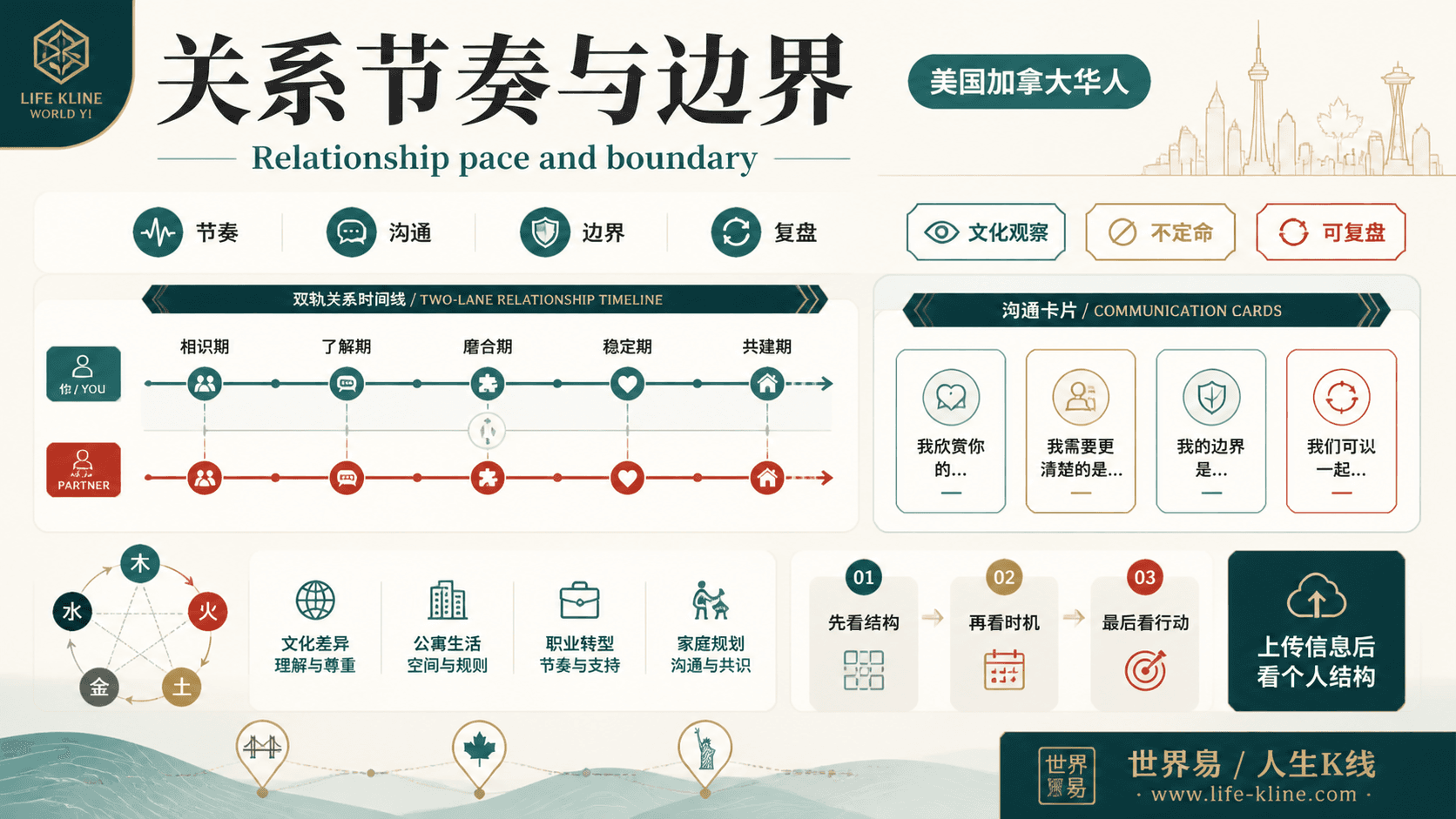
关系节奏与边界|美国加拿大华人
这张图把《Practical BaZi Analysis on Repair and Withdrawal Decisions During Marital Conflict Periods》里的命理概念转成关系、边界和应用场景,适合先看图建立结构,再回到知识文章正文理解细节。
关系节奏与边界不应被写成固定结论。更适合美国加拿大华人的读法,是把传统术语翻译成结构、时机、环境、行动和复盘。
查看图片解读