Dowry and Joint Property Decisions During Marital Conflict Periods: Analysis of Wealth Stars and Bi Jie in BaZi
把这篇文章落到自己身上验证:先看结构,再进入个人分析,不做泛泛阅读。
Why This Decision Is Particularly Difficult at This Marital Stage
When marriage enters a conflict period, often associated with the so-called “seven-year itch,” the emotional and interest relationships between spouses face severe tests. At this stage, entanglements involving children, frequent signals from third parties, combined with economic factors such as dowry, bride price, and joint property in contemporary society, make the financial struggles between both parties increasingly complex. Economic interests are both the focal point of conflicts and the ties that maintain the relationship; mishandling these can easily escalate disputes.
In contemporary Chinese marital contexts, dowry and bride price are not only reflections of traditional culture but also symbols of family status and sincerity from both sides. Additionally, the ownership and responsibility for children often involve economic distribution issues, especially during conflict periods when family financial expectations and pressures significantly increase. The stances of both sets of parents and social public opinion further complicate decision-making.
BaZi structures often amplify or suppress these real-world conflicts at this stage. The strength or weakness of Wealth Stars and Bi Jian/Jie Cai, and their relationship with the Day Master (Ri Zhu), reflect an individual’s attitude towards wealth and their capability to manage it, as well as potential risks in financial distribution within the marriage. Changes in Da Yun (decade luck cycles) and Liu Nian (annual fortune) indicate fluctuations and turning points during the conflict period, guiding when to adopt a cautious approach and when to seek proactive adjustments.
Therefore, financial decisions at this stage are not merely economic considerations but complex topics intertwining emotions and metaphysical factors. Balancing real-world pressures with metaphysical signals is essential to find feasible bottom lines and concession strategies.
Three Core Dimensions of BaZi Judgment
First, the strength or weakness of the Day Master directly affects an individual’s control over finances and ability to respond to changes. A relatively weak Day Master usually relies on the Yong Shen (favorable element) for financial management, indicating dependence on external resources and support; whereas a balanced or relatively strong Day Master demonstrates stronger self-regulation and risk resistance.
Second, the configuration of the Spouse Palace and the spouse star reveals the core of financial interaction within the marriage. The prosperity or decline of the Spouse Palace indicates the stability level of the relationship, while the attributes of the spouse star reflect the spouse’s role in financial negotiations. The distribution of Wealth Stars and Bi Jian/Jie Cai, especially in positions related to the Spouse Palace, points to potential points of conflict and cooperation in wealth matters.
Third, the interaction between the current Da Yun and Liu Nian indicates dynamic changes during the conflict period. The strength of the Da Yun combined with the clashes or harmonies among the Heavenly Stems and Earthly Branches in Liu Nian reflect external environmental impacts on marital financial status, especially signaling when to act cautiously to avoid escalating conflicts and when to take opportunities to adjust financial distribution and promote relationship repair.
Through comprehensive analysis of these three dimensions, one can better understand the metaphysical implications of dowry, bride price, and joint property during marital conflicts, thus guiding practical financial negotiations and decisions.
Three Real BaZi Case Studies
Case 1: This female chart has a relatively weak Day Master 癸水 (Gui Water), with a Pian Yin (偏印, Partial Resource) pattern. The Yong Shen is Metal, and the Ji Shen (忌神, unfavorable element) are Wood and Fire. Currently in the 乙丑 (Yi Chou) Da Yun (ages 52-61), the luck is relatively weak. The 流年 (Liu Nian) 丙午 (Bing Wu) year signals caution. The Spouse Palace and spouse star are constrained by Pian Yin and Ji Shen, indicating strong financial dependence in the marriage and considerable pressure. During the marital conflict period, disputes over dowry and joint property distribution are prone to intensify. Due to the weak Day Master and unfavorable Da Yun, it is advised to maintain caution during negotiations, prioritize protecting one’s basic interests, and avoid excessive concessions that could lead to future risks.
Case 2: This female chart features a relatively weak Day Master 甲木 (Jia Wood) with a Bi Jian (比肩, Companion) pattern. Water is the Yong Shen, while Fire and Earth are Ji Shen. The current Da Yun is 辛巳 (Xin Si) (ages 30-39), a stable period, but the Liu Nian 丙午 (Bing Wu) requires adaptability. The Spouse Palace is influenced by the Bi Jian pattern, reflecting a certain degree of competition and financial independence between spouses, but also susceptibility to emotional fluctuations causing disagreements. In negotiations over dowry and joint property at this stage, the individual should utilize the regulating effect of the Yong Shen Water to maintain emotional stability and conduct rational discussions, avoiding impulsive actions that could cause unnecessary financial loss or emotional rifts.
Case 3: This male chart has a balanced Day Master 癸水 (Gui Water) with a Cong Sha (从杀, Following the Seven Killings) pattern. Earth and Fire are the Yong Shen, while Metal and Water are Ji Shen. Currently in the 癸亥 (Gui Hai) Da Yun (ages 34-43), which is an unfavorable luck cycle, with the Liu Nian 丙午 (Bing Wu) year requiring caution. The Spouse Palace and spouse star are affected by the interplay of Yong Shen and Ji Shen, indicating complex marital financial relations easily disturbed by external factors. Especially in disputes over joint property, the individual must be vigilant against financial risks and external shocks. It is recommended to strengthen communication during decision-making, avoid intense conflicts, and prioritize prudent financial arrangements to prevent major incidents.
These three cases demonstrate the complexity of financial decisions during marital conflict periods under different BaZi structures. Understanding the Day Master’s strength, pattern Yong Shen, and Da Yun/Liu Nian, combined with real social pressures, provides a scientific basis for negotiations over dowry and joint property.
Common Misjudgments and Blind Spots at This Stage
First, over-reliance on emotional judgment while ignoring BaZi structure. Emotional fluctuations during marital conflicts often cause imbalanced financial decisions. Failure to consider the Day Master’s strength and the guidance of Yong Shen and Ji Shen can lead to blind concessions or stubbornness, potentially worsening conflicts.
Second, neglecting the influence of Da Yun and Liu Nian on marital financial relations. Changes in Da Yun and Liu Nian reflect external environmental turbulence and opportunities. Ignoring these signals may result in making major financial decisions at inopportune times, increasing risks.
Third, focusing solely on the amounts of dowry or bride price while overlooking ownership and responsibilities behind joint property. BaZi’s Wealth Stars and Bi Jian/Jie Cai structures reveal mechanisms of wealth generation and sharing. Blind pursuit of short-term gains without considering long-term relationship maintenance can escalate financial disputes.
Fourth, underestimating the interaction between the Spouse Palace and spouse star. A weak Spouse Palace or damaged spouse star indicates increased difficulty in financial cooperation. Failure to recognize these signals often results in ignoring the spouse’s true intentions and economic status, leading to one-sided struggles.
Practical Judgment Sequence
First, assess the strength of the Day Master and its Yong Shen and Ji Shen to determine one’s bottom line and tolerance in financial struggles. Those with weak Day Masters should prioritize protecting core interests and avoid excessive compromise; those with strong or balanced Day Masters can adjust more flexibly.
Second, observe the condition of the Spouse Palace and spouse star to judge the other party’s attitude and potential in financial negotiations. A prosperous Spouse Palace and strong spouse star facilitate consensus; if the Spouse Palace is damaged, more patience and communication are required to avoid escalating conflicts.
Finally, combine the auspiciousness or inauspiciousness of the current Da Yun and Liu Nian to choose the appropriate timing for action. When Da Yun and Liu Nian are unfavorable, maintain caution and handle financial details prudently; when luck is relatively stable or favorable, actively promote negotiations and seek reasonable concessions and cooperation.
Following this judgment sequence allows for rational responses to financial challenges during marital conflicts while leveraging metaphysical advantages to enhance the scientific and practical nature of decisions.
FAQ
Question 1: How to determine the reasonable bottom line for dowry and bride price? Answer: It should be based on the strength of the Day Master and the Yong Shen and Ji Shen, evaluating one’s own capacity and the other party’s financial situation to ensure rights within the bottom line are not infringed. At the same time, consider the overall resources and expectations of both families to avoid conflicts intensified by exceeding metaphysical capacity.
Question 2: Does a weak Spouse Palace mean financial negotiations are difficult? Answer: A weak Spouse Palace indeed indicates obstacles in financial communication within the marriage but is not irreconcilable. At this time, focus on emotional management and communication skills, combined with Yong Shen regulation, to seek gradual consensus and avoid intense confrontations leading to relationship breakdown.
Question 3: How to handle joint property disputes during unfavorable Da Yun and Liu Nian? Answer: During unfavorable Da Yun and Liu Nian, it is advisable to adopt prudent and conservative strategies, avoiding major property changes. It is better to wait for the situation to improve or resolve conflicts through third-party mediation to reduce the risk of escalation.
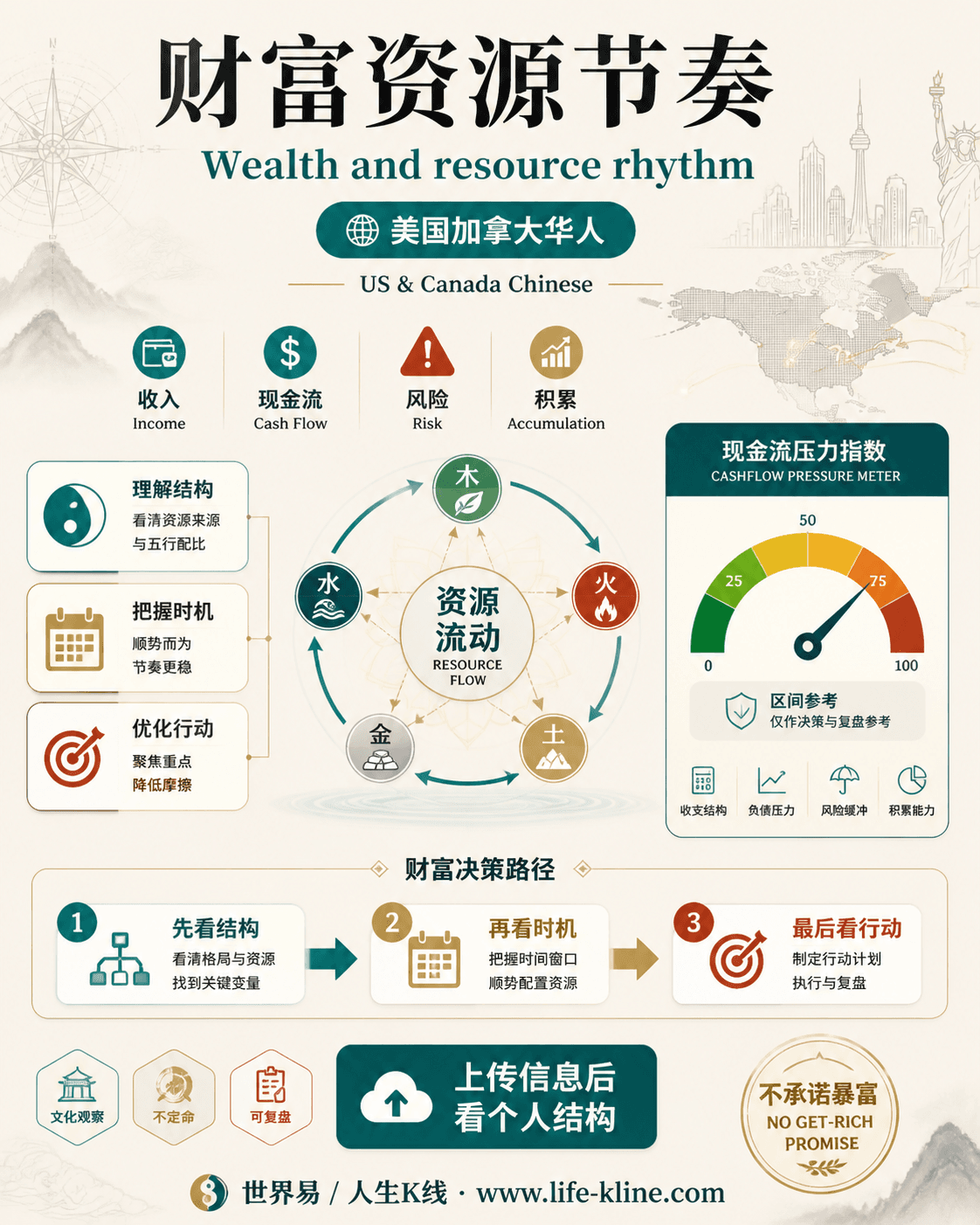
财富资源节奏|美国加拿大华人
这张图把《Dowry and Joint Property Decisions During Marital Conflict Periods: Analysis of Wealth Stars and Bi Jie in BaZi》里的命理概念转成关系、边界和应用场景,适合先看图建立结构,再回到知识文章正文理解细节。
财富资源节奏不应被写成固定结论。更适合美国加拿大华人的读法,是把传统术语翻译成结构、时机、环境、行动和复盘。
查看图片解读