Judging the Best Timing to Advance During Marital Conflict Periods: Da Yun, Liu Nian and Relationship Repair Strategies
把这篇文章落到自己身上验证:先看结构,再进入个人分析,不做泛泛阅读。
你现在搜索的,
其实是一个要落到自己身上的判断。
当前页面主要回答「Marital Conflict Period」这类搜索问题;真正有价值的下一步是把这套结构带进自己的报告、工具与案例验证。
Why This Decision Is Especially Difficult at This Stage of a Relationship
The marital conflict period is usually accompanied by multiple complex real-life factors such as the seven-year itch, child-related entanglements, and third-party signals. Both parties face not only emotional fluctuations but also social pressures involving bride price, property, child custody, and gender expectations. These intertwined factors make decisions about advancing or repairing the relationship extremely challenging.
At this stage, both families’ stances tend to be more entrenched. The clash between traditional concepts and modern values increases communication costs. Especially regarding child-related issues, the rights and custody become key focal points. Any action must carefully weigh multiple interests to avoid escalating conflicts.
From a metaphysical perspective, whether key actions during the marital conflict period succeed is significantly influenced by Da Yun (decade luck cycles) and Liu Nian (annual fortune). Da Yun reflects mid-to-long-term trends, while Liu Nian represents the specific energy of the current year. The interaction between the two determines the energy field and resistance level of actions.
Therefore, decisions at this stage are not only a contest between emotions and reality but also a superimposition of metaphysical structure and social reality. Precisely identifying favorable timing and rationally adjusting the pace of advancement are key to avoiding conflict escalation and achieving relationship repair.
Three Core Dimensions of Metaphysical Judgment
First, the strength of the Day Master and the pattern determine the individual’s internal energy state and ability to handle conflicts. A relatively strong Day Master tends to express emotions directly and act decisively; a relatively weak Day Master is more susceptible to external influences and experiences greater internal fluctuations. Patterns such as Zheng Cai (Proper Wealth), Yang Ren (Yang Blade), and Bi Jian (Peer) reflect fundamental modes of handling relationships.
Second, the position of the Spouse Palace and the Spouse Star is key to judging the quality of the marital relationship. The Spouse Palace’s interactions of clash, combination, or control often reflect real-life conflict points or mitigation pathways. The strength of the Spouse Star directly relates to the support from the spouse and the harmony of interactions.
Finally, Da Yun and Liu Nian represent important dynamic temporal dimensions. Da Yun indicates phase trends, while Liu Nian determines the specific energy flow of the year. When Da Yun is weak, caution is advised to avoid intensifying conflicts; when Da Yun is stable, steady progress is possible; and when Liu Nian presents favorable Heavenly Stem and Earthly Branch combinations, it is a golden opportunity for key actions.
Combining these three dimensions, judging the best timing to advance during marital conflict periods requires integrating the individual’s basic BaZi pattern with the external temporal environment. Only then can a practical advancement path be found under real-world pressures.
Three Real BaZi Case Studies
Case 1: The male’s Day Master is Ren Water (壬, Ren) and relatively strong, with a Zheng Cai (Proper Wealth) pattern. The Yong Shen (favorable elements) are Earth and Fire, and the Ji Shen (unfavorable element) is Metal. He is currently in the 6th year of the Geng Zi (庚子, Geng Zi) Da Yun, which is relatively weak. The Liu Nian is Bing Wu (丙午, Bing Wu). The Spouse Palace is in Xu Earth (戌土, Xu), and the Spouse Star is a Wealth Star (Ding You 丁酉 month Heavenly Stem). In reality, the seven-year itch and child-related issues intensify during this period. Although the Yong Shen Earth and Fire help stabilize the relationship, the weak Da Yun and fire-strong Liu Nian tend to trigger internal and external conflicts. It is recommended to prioritize emotional counseling and relationship repair during the fire-strong but Da Yun-weak period, avoiding rash declarations or proposals. Key actions should be taken when the Liu Nian’s fire energy slightly diminishes or the Da Yun strengthens.
Case 2: The female’s Day Master is Jia Wood (甲, Jia) and relatively strong, with a Yang Ren (Yang Blade) pattern. Fire is the Yong Shen, and Water is the Ji Shen. She is currently in the 2nd year of the Geng Shen (庚申, Geng Shen) Da Yun, which is stable. The Liu Nian is Bing Wu (丙午, Bing Wu), with strong fire energy. The Spouse Palace is in Wu Fire (午火, Wu), and the Spouse Star is strong, indicating concentrated emotional tension. Real-life conflicts often arise from third-party signals and child-related entanglements. The fire-strong Yong Shen supports emotional expression and proactive communication. Under this BaZi structure, the fire-strong Bing Wu Liu Nian is a favorable time to promote reconciliation or moving. However, caution is advised because the Ji Shen Water’s presence may cause emotional fluctuations. Emotional stability should be assessed before action to avoid impulsive mistakes.
Case 3: The male’s Day Master is Gui Water (癸, Gui) and relatively weak, with a Bi Jian (Peer) pattern. The Yong Shen is Metal, and the Ji Shen are Wood and Fire. He is currently in the 8th year of the Wu Zi (戊子, Wu Zi) Da Yun, which is stable. The Liu Nian is Bing Wu (丙午, Bing Wu), with strong fire energy. The Spouse Palace is in Wei Earth (未土, Wei), and the Spouse Star is relatively concealed. In reality, he relies more on external support, and the conflict period is prone to fluctuations due to outside interference. The stable Da Yun provides a foundation for maintenance, but the fire-strong Liu Nian is a Ji Shen that may intensify internal consumption. Key actions such as proposals or reconciliation should be chosen during Liu Nian periods when fire energy weakens or during Da Yun periods when Metal is strong to enhance stability and avoid rash advancement during emotional highs.
All three cases show that the interaction between BaZi structure and real-world pressures means the best timing to advance largely depends on the coordination of Da Yun and Liu Nian. It is also necessary to consider the specific conditions of the Spouse Palace and Spouse Star. Rationally following timing can improve the success rate of key actions.
Common Misjudgments and Blind Spots at This Stage
Many individuals in conflict periods tend to overlook the dynamic influence of Da Yun and Liu Nian, relying excessively on short-term emotions or single-year auspiciousness judgments, ignoring the foundational role of long-term trends in relationship stability. This leads to poor timing choices.
Another common blind spot is neglecting the actual state of the Spouse Palace and Spouse Star, simply judging relationship quality by Day Master strength or pattern quality, ignoring the spouse’s energy expression and the couple’s emotional endurance in real interactions.
There is also a misjudgment of overemphasizing the positive effects of a strong Liu Nian deity while ignoring the balance between Yong Shen and Ji Shen. Although a Liu Nian may be favorable, if the Ji Shen in the BaZi is activated, it can amplify conflicts, causing setbacks and reversals during advancement.
Therefore, a comprehensive consideration of all metaphysical dimensions combined with real-world pressures and family background is necessary to avoid blind actions and reduce risks caused by poor timing.
Practical Judgment Sequence
Step one: Clarify the strength of the Day Master and the pattern to assess the individual’s emotional capacity and basic conflict-handling ability, evaluating psychological readiness and energy state for advancing key actions.
Step two: Focus on examining the state of the Spouse Palace and Spouse Star to analyze core conflicts and support points in the relationship, identifying whether the current stage is suitable for specific actions such as declarations, proposals, moving, or reconciliation to ease tensions.
Step three: Combine the current Da Yun and Liu Nian to judge the external temporal environment’s support level. When Da Yun is weak, caution is advised; when Liu Nian features a strong Yong Shen, advancement can be considered. If necessary, wait for Da Yun to strengthen or Liu Nian to change to enhance the success rate of actions.
Overall, rationally screening the match between metaphysical structure and real-world pressures and choosing time windows when both parties’ emotions are relatively stable and metaphysical support is strong for key actions can maximize success rates and reduce the risk of conflict escalation.
FAQ
Question 1: Why is it not advisable to hastily advance the relationship when Da Yun is weak during a marital conflict period? Answer: A weak Da Yun usually indicates that the individual or the relationship as a whole is in an energy low point, with emotional volatility and communication barriers. Hastening actions may escalate conflicts and produce counterproductive results. Priority should be given to stabilizing emotions and the environment, advancing only when Da Yun strengthens.
Question 2: How does a fire-strong Liu Nian affect relationship advancement during marital conflict periods? Answer: A fire-strong Liu Nian enhances initiative and emotional expression, facilitating proactive communication and problem-solving. However, if the Ji Shen in the BaZi conflicts with fire, it may trigger emotional loss of control or third-party conflicts. The rhythm must be carefully managed to avoid impulsive decisions.
Question 3: How do the Spouse Palace and Spouse Star affect the timing of key actions? Answer: The Spouse Palace represents the core state of the couple’s relationship, and the Spouse Star reflects the spouse’s support level. When the Spouse Palace is clashed or the Spouse Star is weak, advancement actions are difficult to implement smoothly. Actions should be chosen during periods when the Spouse Palace is harmonious or the Spouse Star is strong to increase the success rate.
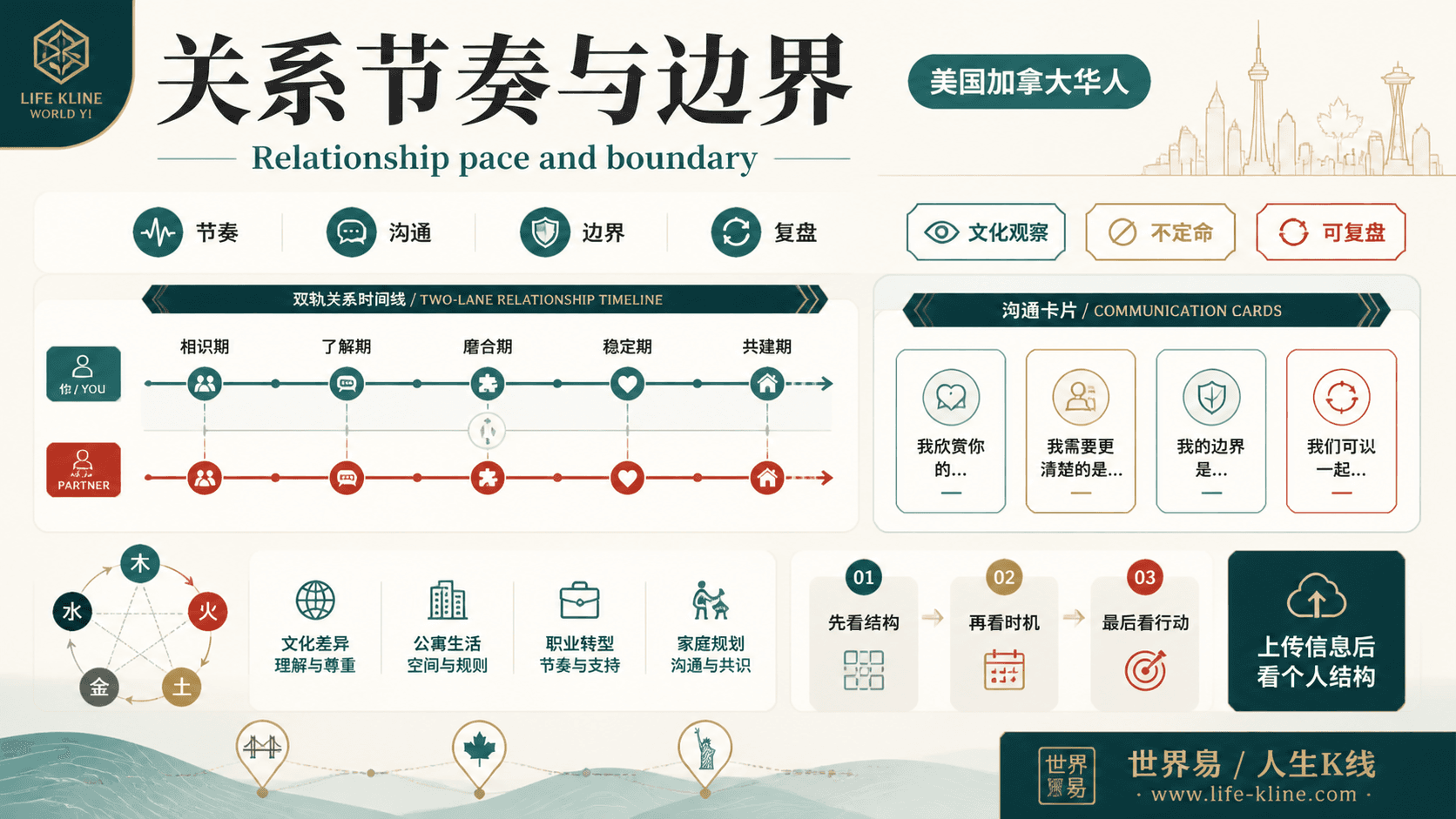
关系节奏与边界|美国加拿大华人
这张图把《Judging the Best Timing to Advance During Marital Conflict Periods: Da Yun, Liu Nian and Relationship Repair Strategies》里的命理概念转成关系、边界和应用场景,适合先看图建立结构,再回到知识文章正文理解细节。
关系节奏与边界不应被写成固定结论。更适合美国加拿大华人的读法,是把传统术语翻译成结构、时机、环境、行动和复盘。
查看图片解读