Long-term Financial Risk Tolerance Assessment: Analysis of Wealth Stars and Bi Jie Yin Star Structures in the Natal Chart
把这篇文章落到自己身上验证:先看结构,再进入个人分析,不做泛泛阅读。
你现在搜索的,
其实是一个要落到自己身上的判断。
当前页面主要回答「Wealth Scenarios」这类搜索问题;真正有价值的下一步是把这套结构带进自己的报告、工具与案例验证。
Why This Decision Is Particularly Difficult in This Wealth Scenario
Long-term financial planning involves a broad range of asset allocations, including insurance, annuities, REITs, and overseas assets. Facing the ever-changing inflation environment and real estate market, assessing risk tolerance becomes a core challenge. In reality, investors often struggle to rationally evaluate their risk preferences due to family reserve pressures and psychological expectation differences, leading to suboptimal asset allocations.
In financial decision-making, the apparent risk tolerance often differs from actual behavior, especially during market volatility or interest rate changes. Psychological biases such as overconfidence or risk aversion frequently interact with the combination of wealth stars, Bi Jian/Jie Cai, and Yin stars in the natal chart, influencing the investor’s true risk endurance.
In the current economic environment, with high housing prices and frequent stock market fluctuations, the sense of security in family savings is particularly important. In metaphysics, wealth stars represent wealth opportunities, Bi Jian/Jie Cai reflect competition among similar resources, and Yin stars symbolize support and protection. The dynamic relationship among these three is key to judging risk appetite.
Therefore, assessing risk tolerance in long-term financial planning is not merely a calculation of financial figures but requires integrating the energy flow within the metaphysical structure to reveal latent risk preferences and defense mechanisms, helping investors make more precise and stable wealth allocations.
Three Core Dimensions of Metaphysical Judgment
First, the relationship between the Day Master and the wealth star forms the foundation of risk tolerance assessment. The Day Master represents personal energy, while the wealth star corresponds to wealth inflow and investment opportunities. If the wealth star receives support from the Yong Shen (favorable element) and the Day Master is not disturbed by the Ji Shen (unfavorable element), it generally indicates greater confidence and proactivity in investments, with relatively higher risk tolerance.
Second, the presence of Bi Jian/Jie Cai reflects competition for resources and influence from similar forces. In wealth decisions, a strong and abundant Bi Jian/Jie Cai often indicates a strong self-protection awareness and peer resource competition mentality, which may lead to overly cautious or aggressive investments, requiring harmonization with the Yong Shen.
Third, Yin stars represent support and protection, especially critical in long-term financial planning. A strong and appropriate Yin star can alleviate pressure caused by an overly strong wealth star or intense Bi Jian/Jie Cai, enhancing risk management ability and enabling investors to be more resilient and patient during market fluctuations.
Additionally, the dynamic influence of Da Yun (decade luck cycles) and Liu Nian (annual fortune) on the metaphysical structure should not be overlooked. Favorable Da Yun can strengthen the Yong Shen’s power, promoting wealth growth and risk tolerance; conversely, caution is advised. The clash and combination relations between Liu Nian and Da Yun reveal the timing and risk volatility of current financial decisions and should be adjusted according to specific financial realities.
Three Real Natal Chart Cases
Case 1: The female chart has a relatively weak Day Master Bing Fire (丙), with a Shi Shen (Eating God) pattern. The Yong Shen is Wood, and the Ji Shen are Earth and Metal. Currently in the Gui Mao (癸卯) Da Yun, the luck is stable and suitable for maintaining gains. The Liu Nian Bing Wu (丙午) requires flexible adaptation. Although the wealth star is not prominent in this structure, Shi Shen represents wealth-generating ability, and the support from the Yong Shen Wood indicates a moderate potential for wealth growth. In long-term financial planning, stable assets like insurance and annuities are more suitable, with a moderate to low risk tolerance, avoiding aggressive investments. The judgment sequence suggests first confirming the Liu Nian support for the Yong Shen Wood; if Da Yun and Liu Nian have no significant clashes, steady allocation is appropriate; otherwise, observation and adjustment are advised.
Case 2: This female chart has a relatively weak Day Master Gui Water (癸), with a Pian Yin (偏印) pattern. The Yong Shen is Metal, and the Ji Shen are Wood and Fire. Currently in the Bing Xu (丙戌) Da Yun, representing a relatively weak luck period; the Liu Nian Bing Wu (丙午) calls for caution. The Pian Yin pattern typically indicates reliance on protection and resource accumulation, with the wealth star being restrained, leading to a conservative risk tolerance. For long-term financial planning, priority should be given to protective products such as annuities and stable REITs, avoiding high-risk overseas assets. It is recommended to focus on whether the Yin star’s strength persists and the Liu Nian status of the Yong Shen Metal. If Da Yun and Liu Nian show no favorable signs, defensive measures should be strengthened, reducing leverage and high-risk allocations.
Case 3: This male chart has a relatively strong Day Master Ren Water (壬), with a Bi Jian (比肩) pattern. The Yong Shen are Earth and Fire, and the Ji Shen is Metal. Currently in the Wu Chen (戊辰) Da Yun, a very auspicious cycle, with Liu Nian Bing Wu (丙午) supporting the trend. The Bi Jian pattern indicates a strong Day Master, and the Yong Shen Earth and Fire represent steady support and strong action. Although the wealth star is not dominant, it is harmonized by the Yong Shen. This structure has a relatively high risk tolerance in long-term financial planning, suitable for diversified allocations including a certain proportion of inflation-resistant assets and overseas investments. The judgment sequence should prioritize confirming whether Da Yun and Liu Nian continue to be auspicious; if no clashes occur, active positioning is recommended, moderately accepting market volatility risks to pursue asset appreciation.
Common Misjudgments and Blind Spots in This Scenario
Many investors mistakenly believe that risk tolerance in long-term financial planning can be judged solely by personal feelings or short-term market performance, ignoring the risk preference signals implicit in the metaphysical structure. For example, a strong wealth star does not necessarily mean suitability for high-risk investments; if Bi Jian/Jie Cai is overly strong, it may cause internal resource depletion, reducing actual endurance.
Another blind spot is neglecting the restraining effects of Yong Shen and Ji Shen, especially failing to timely adjust asset allocations during changes in Da Yun and Liu Nian, resulting in mismatches between financial arrangements and metaphysical energies, increasing financial volatility risks.
Some investors over-rely on a single metaphysical indicator, such as focusing only on the wealth star while ignoring the protective role of the Yin star, leading to insufficient risk management. When facing adverse market conditions, emotional fluctuations may impair decision quality.
Finally, failing to integrate metaphysical judgment with the real economic environment—such as inflation, interest rate changes, and housing prices—can cause financial strategies to become disconnected, distorting risk tolerance assessments.
Practical Judgment Sequence
First, confirm the strength of the Day Master and the pattern type, clarifying the specific combination of Yong Shen and Ji Shen, with particular attention to the positions and strengths of the wealth star, Bi Jian/Jie Cai, and Yin stars in the natal chart. This forms the foundational framework for assessing risk tolerance.
Second, combine the current Da Yun and Liu Nian to evaluate whether the Yong Shen benefits or is challenged, judging the dynamic changes in metaphysical energy. Favorable Da Yun and Liu Nian enhance risk tolerance, while unfavorable ones indicate caution.
Finally, integrate metaphysical judgment with actual financial goals and market conditions, making allocation decisions aligned with the natal chart characteristics for different risk attributes of insurance, annuities, REITs, and overseas assets. Those with high risk tolerance may moderately increase equity and overseas allocations; those with lower risk tolerance should adopt stable configurations to ensure steady wealth growth and inflation resistance.
FAQ
Question 1: Does a weak wealth star in the natal chart mean one cannot bear risk? Answer: A weak wealth star does not mean an inability to bear risk completely. It requires comprehensive judgment combined with the Yong Shen and Da Yun/Liu Nian. If the Yong Shen effectively supports the Day Master and the Da Yun is smooth, moderate risk-taking is still possible, but aggressive operations should be avoided.
Question 2: What risk management challenges does a strong Bi Jian/Jie Cai bring? Answer: A strong Bi Jian/Jie Cai often reflects competition among similar resources and strong self-protection awareness, which may cause overly conservative or impulsive investments. Yin stars or Yong Shen are needed to harmonize and enhance rational decision-making and risk control abilities.
Question 3: How to adjust family long-term financial planning based on metaphysics? Answer: By analyzing the wealth star, Bi Jian/Jie Cai, Yin stars, and changes in Da Yun and Liu Nian, combined with the current economic environment and family goals, one can formulate a dynamically adjustable asset allocation strategy that aligns with metaphysical risk tolerance and adapts to market fluctuations, ensuring steady wealth growth.
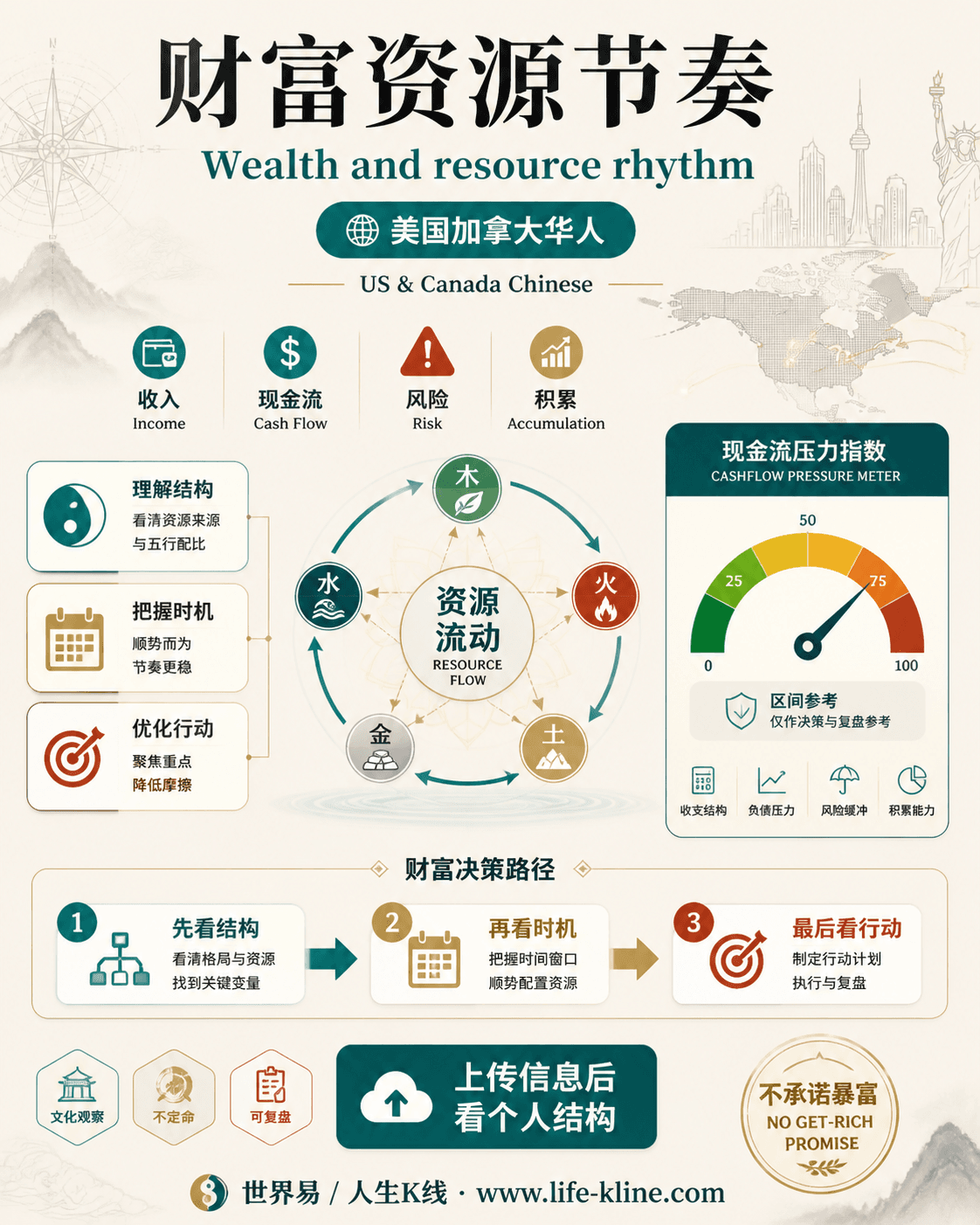
财富资源节奏|美国加拿大华人
这张图把《Long-term Financial Risk Tolerance Assessment: Analysis of Wealth Stars and Bi Jie Yin Star Structures in the Natal Chart》里的命理概念转成关系、边界和应用场景,适合先看图建立结构,再回到知识文章正文理解细节。
财富资源节奏不应被写成固定结论。更适合美国加拿大华人的读法,是把传统术语翻译成结构、时机、环境、行动和复盘。
查看图片解读