Analysis of the Best Time Windows for Long-Term Financial Planning: Enhancing Allocation Decisions with Metaphysics
把这篇文章落到自己身上验证:先看结构,再进入个人分析,不做泛泛阅读。
Why This Decision Is Especially Difficult in This Wealth Scenario
Long-term financial planning and asset allocation involve diversified investments, including insurance, annuities, REITs, and overseas assets, requiring a balance between inflation resistance and future family fund reserves. In reality, high housing prices, interest rate fluctuations, and inflation pressures intensify financial risks, highlighting the contradiction between liquidity and capital preservation and appreciation.
Psychologically, investors often exhibit shortsightedness or excessive optimism when facing complex market information, especially during stock market volatility or macro policy adjustments, which can cause them to miss optimal timing due to emotional influences. Additionally, loans among relatives and family responsibilities make fund allocation more cautious, increasing decision-making difficulty.
From the metaphysical structure perspective, success in long-term financial planning heavily depends on the coordination of the Ten Gods such as Cai Xing (Wealth Stars), Bi Jian (Peer Stars), and Yin Xing (Resource Stars), as well as the interactions of Da Yun (decade luck cycles) and Liu Nian (annual fortune). Different BaZi patterns correspond to different Yong Shen (favorable elements) and Ji Shen (unfavorable elements), whose mutual generation, control, and transformation directly affect risk tolerance and return potential.
Therefore, in this wealth scenario, investors must accurately interpret metaphysical signals while integrating contemporary economic realities, scientifically judging when to act or hold, in order to achieve stable wealth growth amid complex changes.
Three Core Dimensions of Metaphysical Judgment
First, the relationship between the Day Master and the Wealth Stars forms the foundation of wealth decisions. The strength of the Day Master determines its capacity to bear energy; a relatively weak Day Master needs support from the Yong Shen, while the exposure and restriction of Wealth Stars indicate the stability and risk of wealth inflow. For example, a weak Day Master in a Da Yun with strong Wealth Stars has a timing advantage for financial action.
Second, Bi Jian (Peer Stars) reflect forces related to cooperation and competition. When Bi Jian is strong, financial management may experience dispersion or resource contention. Investors need to balance Bi Jian with the Yong Shen to avoid breaks in the capital chain or blind expansion. This is especially important in family partnership investments or loans among relatives.
Third, the clash and combination relationships between Da Yun and Liu Nian determine the dynamic changes of the chart’s energy. A stable Da Yun suggests holding position, while Liu Nian that generates or combines with favorable elements usually indicates a good opportunity for wealth layout; conversely, if Liu Nian clashes with Da Yun, caution is advised to avoid external disruptions derailing plans.
Integrating these three points, metaphysical judgment emphasizes selecting financial timing scientifically by considering Day Master strength, Wealth Star performance, Bi Jian coordination, and Da Yun-Liu Nian interactions, combined with market conditions, to enhance the safety and profitability of long-term allocation.
Three Real BaZi Chart Cases
Case 1: The Day Master is 癸 (Gui) Water, relatively weak, belonging to the Shang Guan (Hurting Officer) pattern. The Yong Shen is Fire, and the Ji Shen is Wood. Currently in the 己亥 (Ji Hai) Da Yun (ages 47-56), the luck is stable, suitable for holding position. The Liu Nian 丙午 (Bing Wu) year has strong Fire, which generates the Yong Shen Fire, enhancing energy. In reality, this age group often considers insurance and annuity protection with clear inflation resistance requirements. The Yong Shen Fire is supported in this Liu Nian, implying that financial allocation should focus on stable returns with moderate increments in Fire-related industries or assets. The judgment sequence recommends first confirming Da Yun stability, then observing whether Liu Nian supports the Yong Shen. If Liu Nian Fire is strong and Da Yun is without conflict, it is an action window; otherwise, it is better to hold and wait.
Case 2: The Day Master is 乙 (Yi) Wood, relatively weak, belonging to the Pian Cai (Indirect Wealth) pattern. The Yong Shen is Earth, and the Ji Shen is Fire. Currently in the 辛亥 (Xin Hai) Da Yun (ages 18-27), also a stable holding period. The Liu Nian 丙午 (Bing Wu) year has strong Fire, which is the Ji Shen, causing some pressure. In reality, this age group has limited capital accumulation, with REITs and overseas asset allocation mainly focusing on stability. The strong Ji Shen Fire in Liu Nian indicates higher risk, so investors should avoid aggressive operations, emphasizing holding and gradual accumulation. The judgment sequence suggests first checking the strength of Ji Shen in Liu Nian; if Ji Shen is too strong, large adjustments are inadvisable, favoring diversified and conservative investments; when Ji Shen weakens, moderate increases are appropriate.
Case 3: The Day Master is 辛 (Xin) Metal, balanced, belonging to the Cong Sha (Following Seven Killings) pattern. The dual Yong Shen are Fire and Wood; the Ji Shen are Earth and Metal. Currently in the 辛丑 (Xin Chou) Da Yun (ages 42-51), an unfavorable luck period requiring caution against major upheavals. The Liu Nian 丙午 (Bing Wu) year has strong Fire, which supports the Yong Shen Fire, but the Da Yun is weak. At this age, focus is on family reserve goals and asset risk resistance. The chart indicates a volatile and pressured financial environment. In reality, cautious layout of insurance and annuities is advised, avoiding heavy positions in high-risk assets. The judgment sequence recommends prioritizing the assessment of the severity of Da Yun misfortune combined with Liu Nian Yong Shen support. If Liu Nian support is limited and Da Yun misfortune is obvious, major financial decisions should be postponed, focusing on risk control and liquidity protection.
Common Misjudgments and Blind Spots in This Scenario
Many investors neglect the balance between Yong Shen and Ji Shen in metaphysics, blindly pursuing short-term high returns. Especially when Ji Shen is strong in Liu Nian, aggressive operations can easily lead to asset shrinkage or liquidity shortages. The essence of long-term financial planning is steady accumulation, which must be emphasized in metaphysical judgment.
Another misconception is over-reliance on stable Da Yun to act blindly, ignoring the details of Liu Nian clashes or combinations. Although Da Yun represents medium- to long-term trends, Liu Nian changes significantly impact short-term decisions. Ignoring Liu Nian may cause missed optimal allocation windows or unnecessary risks.
Additionally, family responsibilities and economic environment complexities are often underestimated. Metaphysical analysis detached from real economic constraints, such as rising housing prices, inflation trends, and policy adjustments, can lead to disjointed financial plans unable to cope with emergencies or changes in fund demands.
Finally, psychological factors also cause blind spots, such as excessive trust in loans among relatives or panic selling. These should be scientifically adjusted by considering the role of Bi Jian (Peer Stars) in metaphysics to avoid emotional factors compromising fund security.
Practical Judgment Sequence
The primary step is to evaluate the nature of the current Da Yun; stable Da Yun suggests holding, while unfavorable Da Yun requires caution. Da Yun represents the medium- to long-term energy baseline and forms the foundation for judging whether financial decisions are appropriate to initiate.
Next, combine Liu Nian with Yong Shen and Ji Shen relationships, observing whether Liu Nian enhances the Yong Shen or intensifies the Ji Shen. When Yong Shen is supported and Liu Nian has no major clashes, it is often a good opportunity for financial allocation; otherwise, observation or strategy adjustment is recommended.
Finally, integrate real economic conditions and personal capital status to assess liquidity needs and risk tolerance. If metaphysical signals align with market trends, priority action is advised; if contradictions arise, it is better to hold or diversify risks, waiting for a better window.
FAQ
Question 1: How to judge when Liu Nian has the greatest impact on long-term financial planning? Answer: The key lies in the interaction between Liu Nian and the Yong Shen and Ji Shen. If Liu Nian strengthens the Yong Shen energy, financial layouts proceed more smoothly with lower risk; if Liu Nian activates the Ji Shen, financial risk increases and caution is necessary.
Question 2: If Da Yun is stable but Ji Shen is strong in Liu Nian, is it suitable to allocate to REITs or overseas assets? Answer: Generally, it is not advisable to increase allocations in years when Ji Shen is strong, especially for higher-risk assets. Priority should be given to capital safety with conservative strategies, increasing allocations only when Ji Shen weakens.
Question 3: How does a strong Bi Jian star assist long-term financial decisions in metaphysics? Answer: A strong Bi Jian star indicates potential resource dispersion or intensified competition. Financial planning should emphasize cooperation and risk diversification, avoiding breaks in the capital chain, and making good use of social or cooperative advantages brought by Bi Jian.
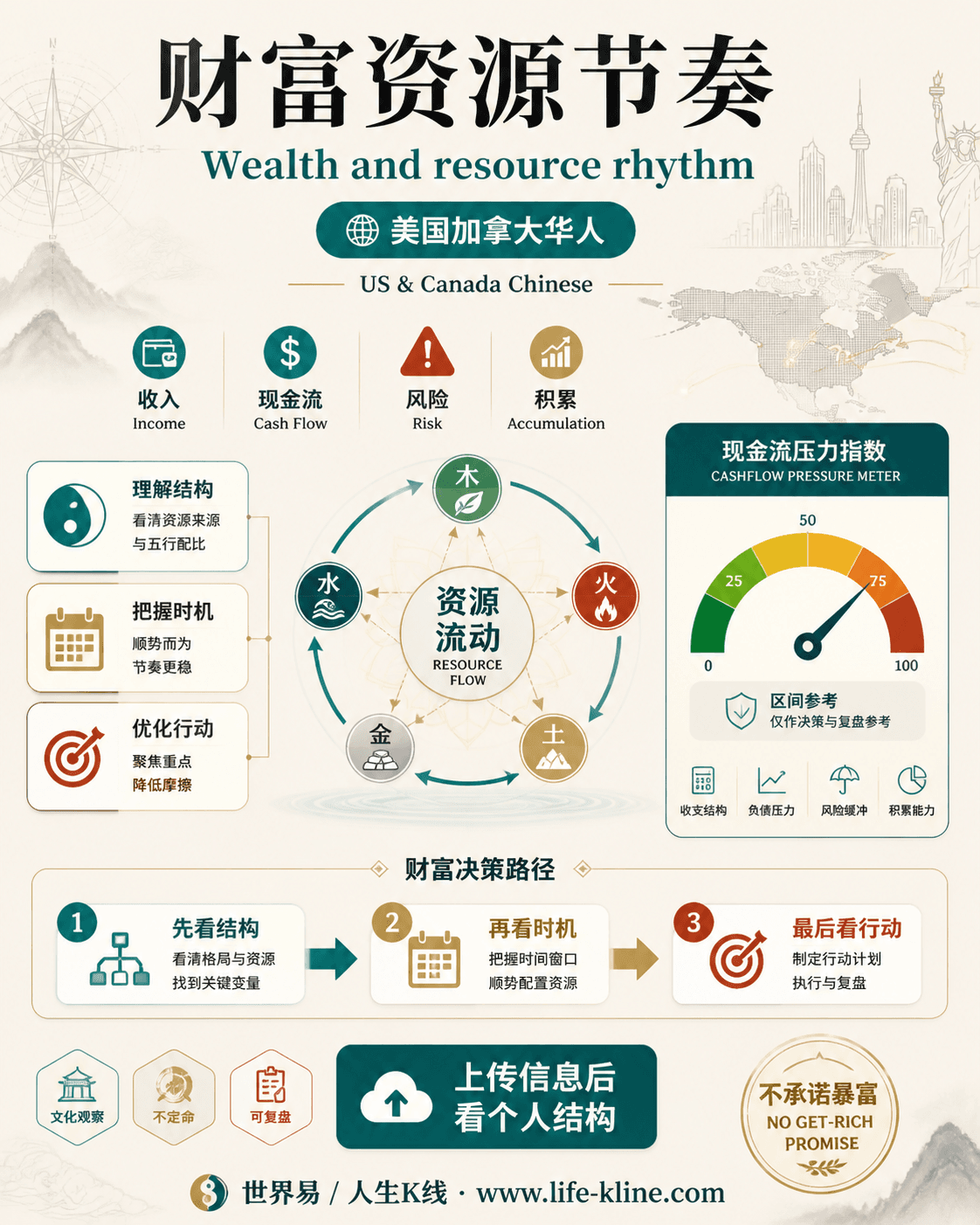
财富资源节奏|美国加拿大华人
这张图把《Analysis of the Best Time Windows for Long-Term Financial Planning: Enhancing Allocation Decisions with Metaphysics》里的命理概念转成关系、边界和应用场景,适合先看图建立结构,再回到知识文章正文理解细节。
财富资源节奏不应被写成固定结论。更适合美国加拿大华人的读法,是把传统术语翻译成结构、时机、环境、行动和复盘。
查看图片解读