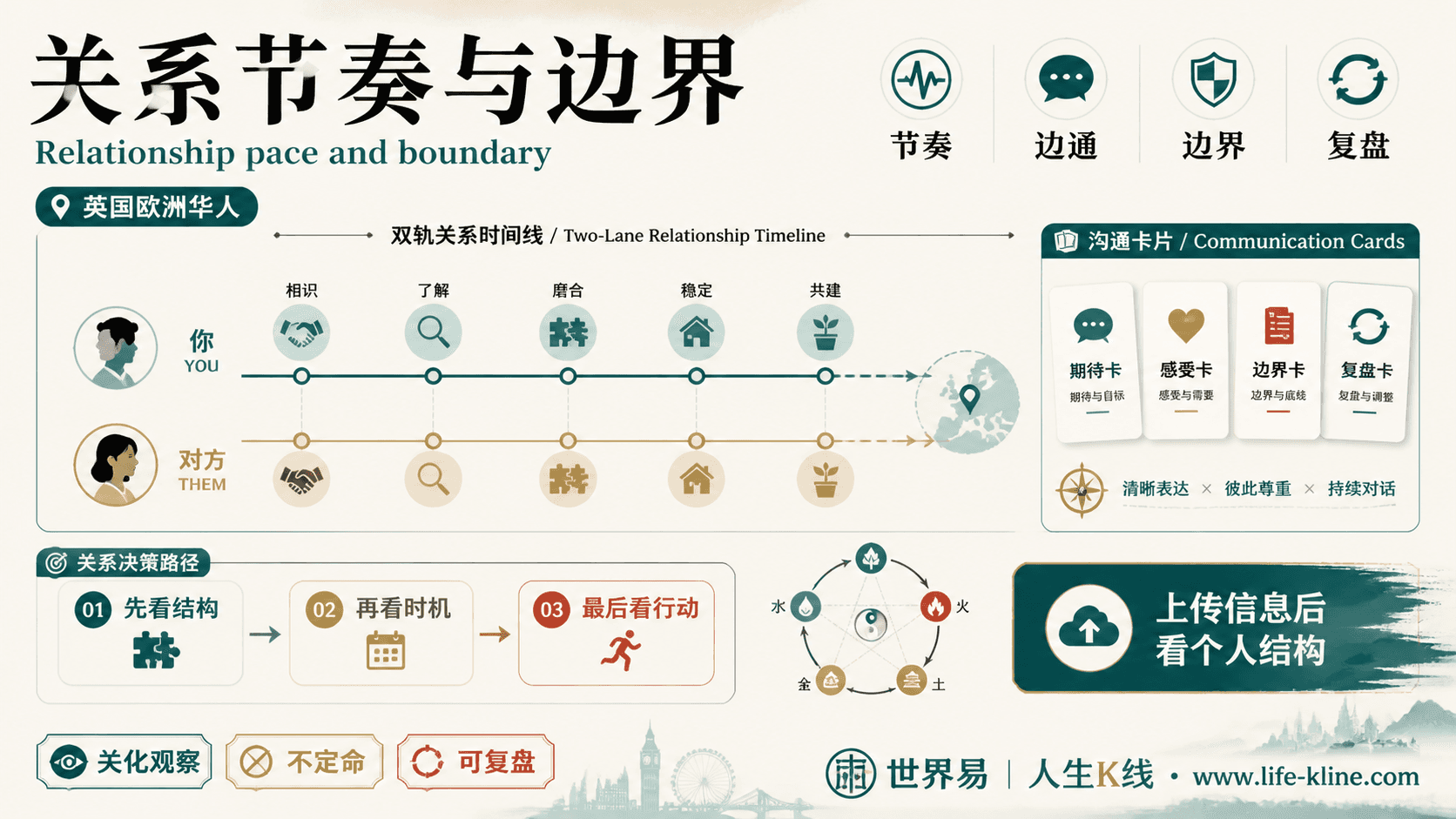
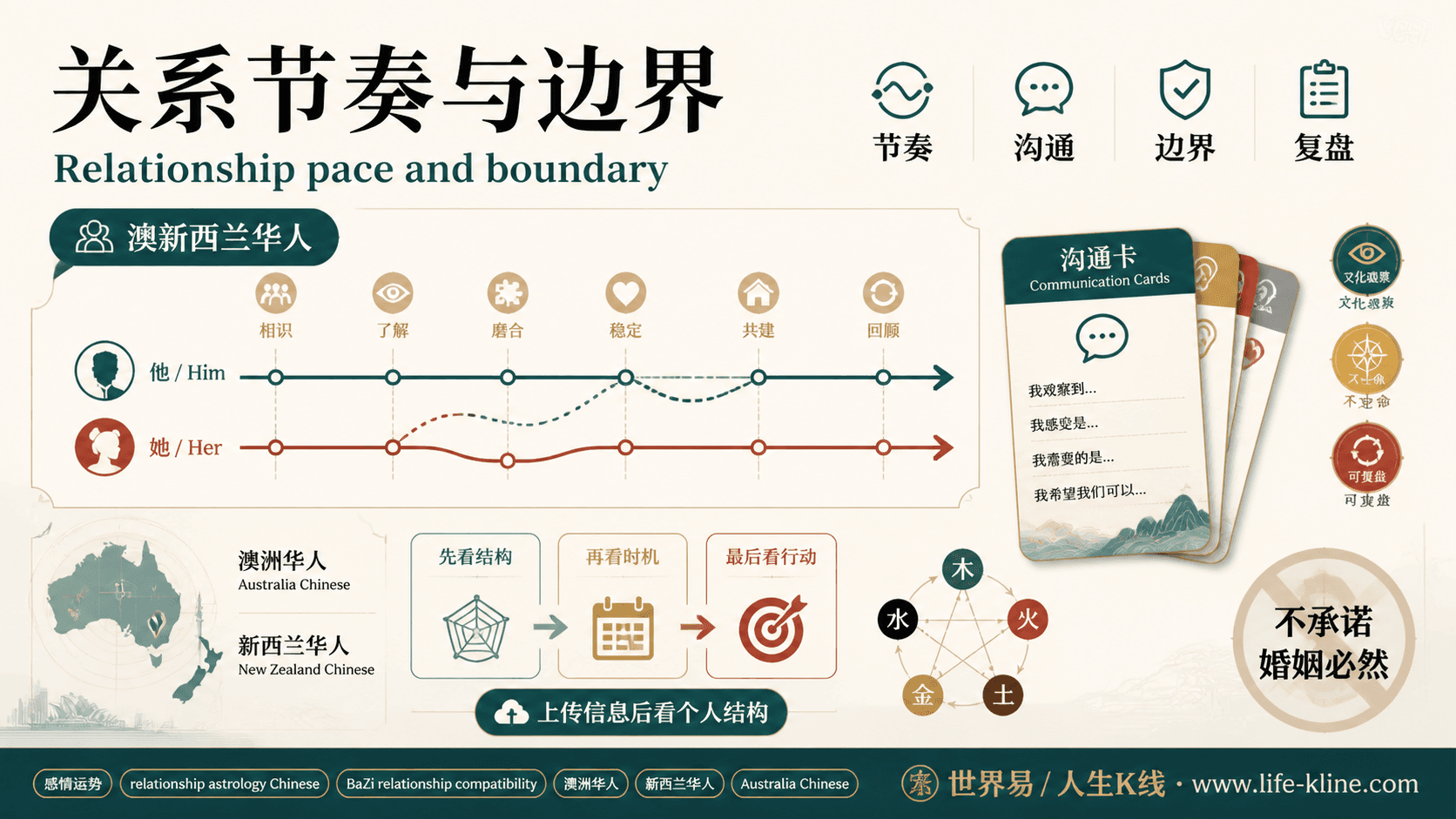
Metaphysical Methods for Judging Relationship Repair and Withdrawal During Long-Term Single Phases
把这篇文章落到自己身上验证:先看结构,再进入个人分析,不做泛泛阅读。
Why This Decision Is Especially Difficult at This Relationship Stage
The long-term single relationship phase is often accompanied by a fixed social circle and shifting mate selection criteria, making the decision to repair old relationships or withdraw from existing emotional ties complex. In reality, societal expectations of marriage and family demands—especially from both sets of parents regarding betrothal gifts, property, and child custody—increase decision-making pressure. Psychological fluctuations during active or passive periods further blur the timing and direction of judgments.
Moreover, long-term singles often have limited social circles, reducing opportunities to meet suitable partners and increasing dependence on existing relationships. Even when problems arise, it is difficult to decisively withdraw. Frequent adjustments in mate selection criteria reflect an ongoing inner search for an ideal partner; this psychological state often corresponds in metaphysics to the strength or weakness of the Day Master and the stability of the pattern, further amplifying internal conflicts.
From a metaphysical perspective, the condition of the Spouse Palace and Spouse Star directly affects the quality and trajectory of romantic relationships. When clashes or combinations appear in Da Yun and Liu Nian, or when the Yong Shen is restrained, these often indicate challenges and fluctuations in the relationship. Therefore, integrating metaphysical structures with real social factors to accurately judge whether to repair or withdraw becomes the most challenging issue during the long-term single phase.
In summary, the difficulty of decision-making at this stage lies in balancing inner expectations with real conditions, and scientifically identifying the potential and risks of the relationship based on metaphysical indications, thereby avoiding greater negative consequences caused by blind actions.
Three Core Dimensions of Metaphysical Judgment
First, the strength of the Day Master determines the individual's self-energy and ability to cope with the external environment. A relatively strong Day Master implies strong self-assertion and initiative, whereas a weak Day Master may manifest as emotional dependence and increased self-protection desires. Long-term singles with weak Day Masters need to cautiously evaluate their endurance and proactivity when repairing relationships.
Second, the position and condition of the Spouse Palace and Spouse Star are key to judging the stability of romantic relationships. If the Spouse Palace is afflicted by clashes or combinations, or if the Spouse Star is constrained by Ji Shen (unfavorable elements), it often indicates contradictions and fluctuations in the partnership. These signals are amplified under the influence of Da Yun and Liu Nian, reminding individuals to pay attention to potential risk points in the relationship.
Third, the interaction between Da Yun and Liu Nian reflects the auspiciousness or adversity of personal fate stages. Favorable luck cycles combined with supportive annual fortunes facilitate relationship repair and proactive actions; conversely, adverse luck cycles and conflicting annual fortunes suggest caution, or even consideration of withdrawal to avoid greater losses. The choice of Yong Shen and the influence of Ji Shen also manifest at this stage, supporting or hindering the relationship.
In summary, the strength of the Day Master, the condition of the Spouse Palace and Spouse Star, and the interaction of Da Yun and Liu Nian constitute the core dimensions of metaphysical judgment in relationships. Their interplay influences the decision tendencies and timing for long-term singles between repair and withdrawal.
Three Real BaZi Chart Case Studies
Case 1: This female’s BaZi chart has a Day Master of Bing Fire (丙), which is relatively weak. Her pattern is Qi Sha (Seven Killings), with Yong Shen being Fire and Ji Shen being Earth and Metal. She is currently in the Ji You (己酉) Da Yun (age 30-39), which is an unfavorable luck cycle, and the Liu Nian is Bing Wu (丙午), making the combined influence relatively weak. The Spouse Palace and Spouse Star are affected by Ji Shen, indicating considerable pressure and challenges in emotional relationships. In reality, a fixed social circle and shifting expectations of an ideal partner make her feel powerless and anxious in relationships. In decisions about repair or withdrawal, these chart characteristics amplify emotional vulnerability and conflict risks. Repair efforts should proceed steadily to avoid deterioration caused by external pressures. It is recommended to first check whether the Spouse Palace is impacted by Liu Nian clashes; if the clashes are severe and personal energy insufficient, appropriate withdrawal to wait for a favorable time before repairing is advisable.
Case 2: This male’s BaZi chart has a relatively strong Day Master Ji Earth (己), with a Yang Ren (Yang Blade) pattern. His Yong Shen is Water, and Ji Shen is Fire. He is currently in the Xin Hai (辛亥) Da Yun (age 44-53), first year, which is auspicious, and the Liu Nian is Bing Wu (丙午), harmonizing well with the Da Yun. The Spouse Palace and Spouse Star benefit from the support of the Yong Shen and the favorable Da Yun and Liu Nian, showing strong stability and repair potential in the relationship. In reality, he is experiencing career and financial growth, expanding his social circle, and maintaining relatively rational and stable mate selection criteria. In repair and withdrawal judgments, this chart structure favors proactive repair with good timing. It is recommended to focus on active communication and interaction improvement while monitoring annual changes to avoid rushing and causing new conflicts.
Case 3: This male’s Day Master is Gui Water (癸), balanced in strength, with a Cong Er (Following Son) pattern. His Yong Shen are Wood and Fire, and Ji Shen is Metal. Currently, he is in the Ji Hai (己亥) Da Yun (age 34-43), seventh year, representing a stable luck cycle where maintaining the status quo is advisable. The Liu Nian is Bing Wu (丙午), requiring flexible adaptation. The Spouse Palace and Spouse Star are in a moderate state without obvious clashes, but the combination of Da Yun and Liu Nian suggests the need for flexible emotional strategies. In reality, he has been single long-term with a stable social circle and fluctuating mate selection criteria. This chart indicates that decisions about repair or withdrawal require careful timing—neither blind persistence nor premature abandonment is appropriate. It is recommended to start by assessing personal emotional needs and environmental changes, observe the influence of Liu Nian, and adopt a gradual repair strategy, with strategic withdrawal considered when necessary to protect oneself.
These three BaZi charts illustrate the diversity of repair and withdrawal decisions among long-term singles under different metaphysical structures and real environments. By analyzing the conditions of the Spouse Palace and Spouse Star, Day Master strength, and Da Yun and Liu Nian interactions, more targeted guidance on timing and direction of actions can be provided.
Common Misjudgments and Blind Spots at This Stage
During the long-term single phase, many people tend to oversimplify emotional setbacks as due to personal conditions or external environments, neglecting the influence of the Spouse Palace and Spouse Star in the metaphysical structure. This leads to blind persistence or hasty withdrawal. Especially when the Day Master is weak or Da Yun and Liu Nian are unfavorable, emotional decisions often exacerbate tensions, creating a vicious cycle.
Another common blind spot is insufficient understanding of Yong Shen and Ji Shen, failing to combine Da Yun and Liu Nian changes to judge the timing and risks of repair. For example, when the Ji Shen is clearly restrained or Da Yun and Liu Nian conflict, forcing repair may backfire; ignoring opportunities brought by auspicious luck cycles also causes missed chances to improve relationships.
Additionally, long-term singles with fixed social circles easily fall into the trap of drifting mate selection standards. Frequent adjustments often relate to unstable Day Master energy in the chart. Ignoring this leads to blindly pursuing ideal partners, increasing repair difficulties and complicating withdrawal decisions.
In summary, misjudgments often stem from a one-dimensional view of metaphysical structures and real-life pressures, lacking systematic judgment and dynamic adjustment, resulting in imbalanced decisions that affect the healthy development of romantic relationships.
Practical Judgment Sequence
Step one: Focus on examining the condition of the Spouse Palace and Spouse Star, and confirm whether there are significant clashes or combinations in the current Da Yun and Liu Nian. If the Spouse Palace is severely clashed and the Spouse Star is suppressed by Ji Shen, carefully consider the possibility of withdrawal to avoid expanded emotional harm.
Step two: Assess the strength of the Day Master and whether the Yong Shen is effective. For weak Day Masters, priority should be given to restoring personal energy and avoiding forced repair during emotional lows. For strong Day Masters, proactive efforts can be considered, leveraging favorable Da Yun and Liu Nian timing to promote relationship improvement.
Step three: Combine real social environment and inner expectations to determine whether one is in a passive or active phase. In passive phases, observation and self-adjustment are recommended while waiting for favorable signals from Da Yun and Liu Nian; in active phases, actively seek communication and repair opportunities but guard against excessive aggression that may worsen conflicts.
Finally, it is advised to dynamically track changes in Da Yun and Liu Nian, flexibly adjusting repair or withdrawal strategies. Especially in critical years, combine metaphysical indications with real feedback to scientifically judge the timing of actions, avoiding impulsiveness or prolonged stagnation.
FAQ
Question 1: If the Day Master is weak but the Da Yun is auspicious, is it suitable to proactively repair the relationship? Answer: When the Day Master is weak, one should first focus on personal condition, ensuring emotional stability and energy recovery. An auspicious Da Yun provides good external support, making it appropriate to gradually take proactive repair actions after self-adjustment, but rushing should be avoided, and progress should be stepwise.
Question 2: Does a clash in the Spouse Palace mean withdrawal is mandatory? Answer: A clash in the Spouse Palace indicates pressure and challenges in the relationship but does not necessarily require withdrawal. It is necessary to consider the Spouse Star, the state of Yong Shen, and the overall Da Yun and Liu Nian comprehensively. If the overall metaphysical structure supports repair and real conditions permit, attempts to alleviate conflicts can be made; otherwise, withdrawal to protect oneself should be considered.
Question 3: How can long-term singles avoid decision difficulties caused by frequent drifting of mate selection criteria? Answer: Frequent drifting of mate selection criteria often relates to unstable Day Master energy or ineffective Yong Shen. It is recommended to first clarify one’s Yong Shen and Ji Shen through metaphysical analysis, then reasonably adjust criteria based on the real social environment, avoiding excessively high or low expectations, and gradually establish stable mate selection standards.
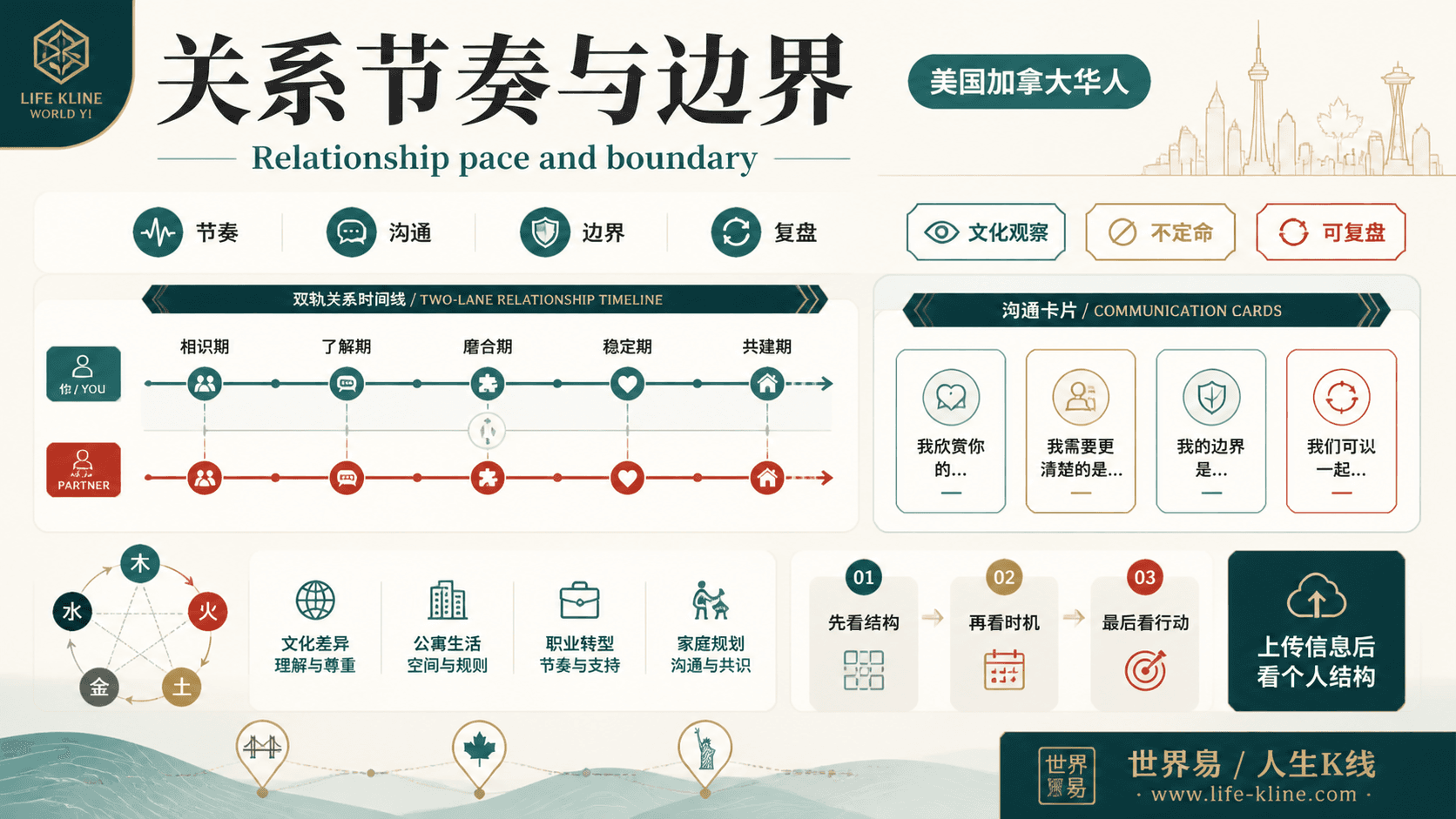
关系节奏与边界|美国加拿大华人
这张图把《Metaphysical Methods for Judging Relationship Repair and Withdrawal During Long-Term Single Phases》里的命理概念转成关系、边界和应用场景,适合先看图建立结构,再回到知识文章正文理解细节。
关系节奏与边界不应被写成固定结论。更适合美国加拿大华人的读法,是把传统术语翻译成结构、时机、环境、行动和复盘。
查看图片解读