Metaphysical Analysis and Decision-Making Guide for Partner Selection at the Semi-Retirement Stage of Age 55
把这篇文章落到自己身上验证:先看结构,再进入个人分析,不做泛泛阅读。
Why This Decision Is Especially Difficult at This Life Stage
After age 55, entering the semi-retirement or later years stage, physical functions gradually decline, making health management one of the life’s focal points. At this time, partner relationships involve not only emotional support but also caregiving, companionship, and spiritual resonance, with a marked increase in responsibility and dependence. Decision-making must consider the balance between physical condition and mental needs, while also facing societal and family expectations for lifestyle patterns in later life, which can bring additional pressure.
The later years also involve the complexity of intergenerational relationships. Most people at this stage bear inheritance responsibilities, including economic legacy, family traditions, and adjustments in the role of accompanying children. Therefore, partner selection is not merely an emotional matter but also a strategic reflection of inheritance and letting go. Metaphysical rhythm cues and boundary signals are amplified here, easily revealing their impact on interpersonal relationships and emotional interactions.
Societal expectations place great emphasis on the stability and life rhythm of partners in later years. Relationships at this stage prioritize harmony and symbiosis, with reduced conflicts and an emphasis on comfort and security. The difficulty in decision-making lies in how to reasonably balance dependence and independence according to one’s metaphysical strengths and limitations, ensuring partner choice meets health management needs while aligning with psychological rhythms to achieve an optimal life state.
Moreover, the cyclical changes of Da Yun (decade luck cycle) and Liu Nian (annual fortune) greatly influence emotional decisions in later life. When rhythms are stable, relationships develop more easily; if rhythms are imbalanced, emotional friction may arise. Interpreting these rhythms and boundaries from a metaphysical perspective is a core challenge in partner selection during the later years.
Three Core Dimensions of Metaphysical Judgment
The strength and pattern of the Day Master represent an individual’s intrinsic energy and personality foundation. In later-life partner selection, a relatively strong Day Master helps enhance self-assertion and independence, while a weaker Day Master requires reliance on the partner for support and stability. Patterns such as Pian Yin (偏印), Bi Jian (比肩), or Qi Sha (七杀) reflect different interpersonal interaction modes and needs, directly affecting role positioning and emotional flow in partner relationships.
Yong Shen (用神) and Ji Shen (忌神) indicate directions for physical and psychological regulation. In later years, the balance among the Five Elements—Metal, Wood, Earth, Water, and Fire—is especially important, as their waxing and waning reveal potential health and emotional risks. For example, the Yong Shen can provide beneficial effects, while the Ji Shen may signal conflicts or physical discomfort, which should be highly considered during partner selection.
Da Yun and Liu Nian reflect dynamic changes in life stages within the BaZi chart, showing fluctuations in personal destiny rhythms. Later-life Da Yun typically begins after age 60, with a slowing rhythm, while Liu Nian brings immediate environmental and emotional change signals. The harmony between Da Yun and Liu Nian determines the stability of emotional relationships and the ability to cope with external pressures. Although palace environments are not directly provided, the later-life stage emphasizes the manifestation of rhythm and boundary in the chart, relating to the frequency and quality of interpersonal interactions.
Three Real BaZi Chart Cases
Case 1 concerns a female with a relatively strong Day Master Yi Wood (乙木), a Pian Yin (偏印) pattern, Yong Shen being Metal and Earth, and Ji Shen Water. She is currently in the Bing Yin (丙寅) Da Yun with a stable rhythm, suitable for maintaining status quo. Entering semi-retirement, her chart shows strong self-power and regulatory ability. In partner selection, attention should be paid to whether the partner supports Metal and Earth elements, especially those who can stabilize her emotions and life rhythm. Regarding health management and inheritance, care should be taken about the Ji Shen Water’s potential discomfort, avoiding overinvestment in emotions that might blur physical boundaries.
Case 2 is a male with a relatively strong Day Master Ji Earth (己土), a Bi Jian (比肩) pattern, Yong Shen Metal, and Ji Shen Fire. His Da Yun is Ren Yin (壬寅), with a stable rhythm suitable for maintaining status quo. Partner selection in later years emphasizes strengthening the Metal element, as Metal harmonizes his overly strong Earth, benefiting health and emotional balance. The presence of Ji Shen Fire warns him to avoid partners with intense emotions or overly fast rhythms. Overall, partner traits should be steady, meticulous, and supportive of the Yong Shen Metal, meeting his needs for stability and spiritual communication in later life.
Case 3 is a female with a relatively weak Day Master Geng Metal (庚金), a Qi Sha (七杀) pattern, Yong Shen Wood, and Ji Shen Water. She is currently in the Jia Xu (甲戌) Da Yun, a favorable luck cycle with Liu Nian supporting it. Her chart leans toward extroversion and proactivity, but the weak Day Master makes her prone to fatigue or insecurity. Partner selection in later years should focus on partners who can nourish Wood and balance Water. From a rhythm perspective, a calm and slow pace is preferred, avoiding excessive intensity or turmoil. The Qi Sha pattern may bring challenges in relationships, but guidance from the Yong Shen Wood can help clarify boundaries and achieve mutual growth in health and spirit.
Across these three cases, regardless of Day Master strength, the critical role of Yong Shen, Ji Shen, and Da Yun/Liu Nian in perceiving rhythm is evident. Later-life partner selection is not only about emotional integration but also about precise control of personal health rhythms and emotional boundaries. The rhythm and boundary signals in each chart are crucial for decision-making and require detailed analysis before action.
Common Misjudgments and Blind Spots at This Stage
In later-life partner selection, it is easy to overlook the matching of physical and psychological rhythms, treating the partner solely as emotional support and ignoring metaphysical rhythm and boundary signals. This misjudgment often leads to frequent conflicts and increased health risks in the relationship. Many neglect the actual regulatory role of Yong Shen and Ji Shen, assuming emotional compatibility alone suffices, ignoring the negative impact of rhythm imbalance on long-term partnerships.
Another major blind spot is ignoring the influence of Da Yun and Liu Nian, assuming fate stabilizes in later years. In fact, Da Yun still fluctuates rhythmically, and Liu Nian brings immediate shocks. Failure to consider these cyclical changes in partner selection risks missing optimal timing, resulting in wasted emotional investment or relationship breakdown.
A common error is simply applying youthful partner selection standards without considering the different practical burdens and social expectations of later life. Later years involve not just emotional relationships but also health and inheritance responsibilities. Ignoring these realities causes partner choices to deviate from actual needs, leading to dual psychological and physiological burdens.
Practical Judgment Sequence
When judging partner selection in later years, first clarify your own Day Master strength and pattern, understand your Yong Shen and Ji Shen, and assess whether the other party can effectively nourish your Yong Shen while avoiding amplifying your Ji Shen, thereby establishing a foundational relationship framework of physical and mental balance. This is the primary step in overall energy matching.
Next, combine the current and upcoming Da Yun and Liu Nian to judge whether both parties’ rhythms can synchronize. Rhythm synchronization means coordinated moods and life pace, reducing conflict risk and favoring long-term stability of potential partner relationships. This is the appropriate time for proactive action; if Da Yun and Liu Nian indicate rhythm mismatch, it is advisable to adjust expectations, delay decisions, or improve one’s own condition.
Finally, during actual interactions, cautiously observe boundary signals in light of the above metaphysical information to ensure that emotional investment does not blur self-boundaries, allowing enjoyment of intimacy while maintaining independence. Only when rhythms are stable and boundaries clear can partner selection decisions in later life be more prudent and effective.
FAQ
Question 1: How to quickly determine if the Yong Shen in one’s BaZi chart is nourished by the partner during later-life partner selection? Answer: First identify the Yong Shen Five Element in your chart, then observe the prominence of that element in the partner’s chart and the support from their Liu Nian and Da Yun. If it clearly enhances or generates your Yong Shen, it is a beneficial match; otherwise, caution is needed.
Question 2: How should Da Yun and Liu Nian be weighted in later-life partner selection? Answer: Da Yun reflects medium- to long-term trends and rhythms, while Liu Nian brings immediate influences. Both must be considered comprehensively, prioritizing Da Yun stability first, followed by Liu Nian alignment, avoiding impulsive decisions when Liu Nian conflicts are severe.
Question 3: How to balance dependence and independence in partner relationships during later years? Answer: The key lies in recognizing metaphysical rhythm and boundary signals. By strengthening the balance of Yong Shen, one can enhance personal independence while allowing appropriate dependence, maintaining healthy relational dynamics. Keeping clear emotional boundaries is essential to achieving this balance.
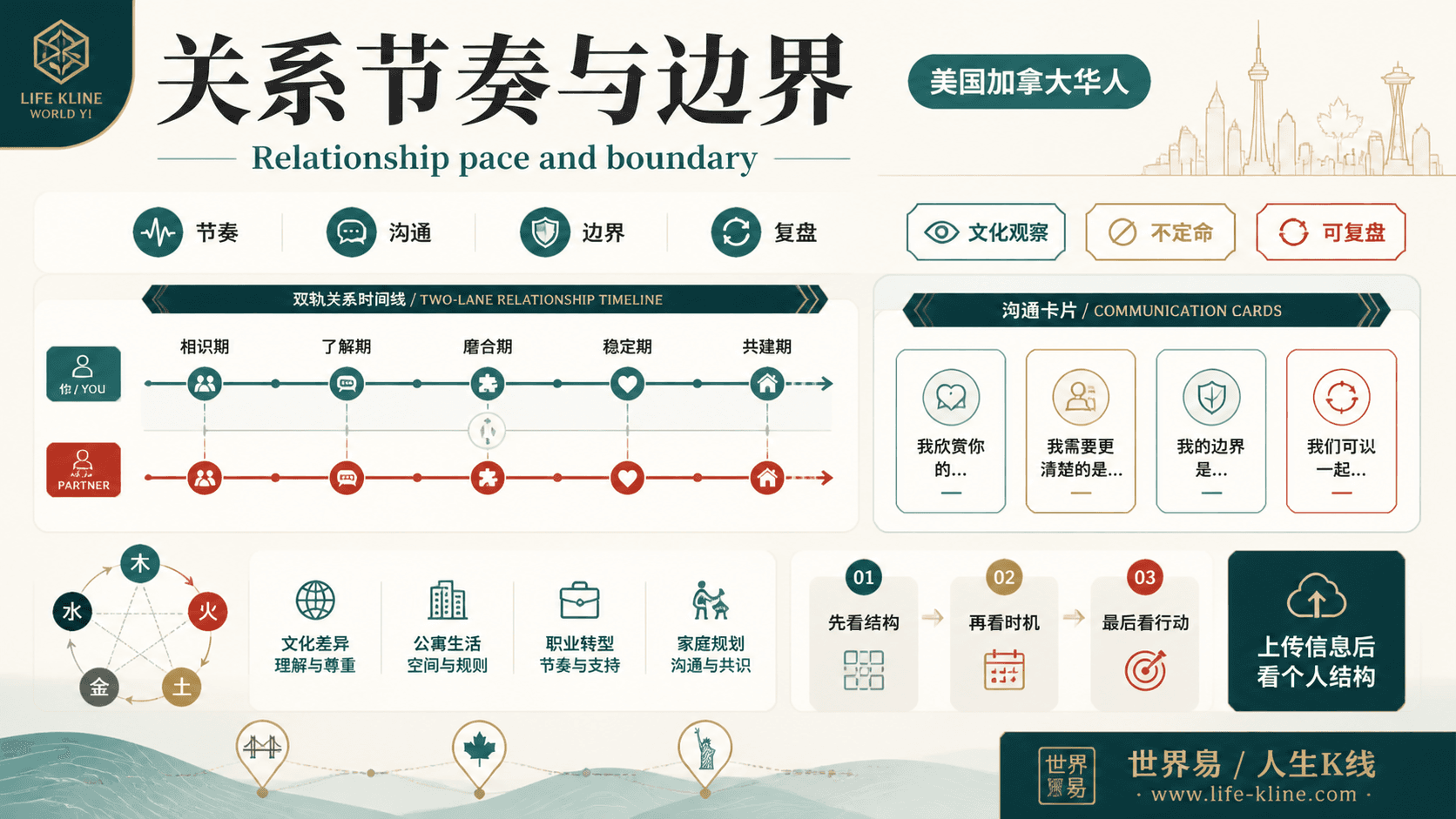
关系节奏与边界|美国加拿大华人
这张图把《Metaphysical Analysis and Decision-Making Guide for Partner Selection at the Semi-Retirement Stage of Age 55》里的命理概念转成关系、边界和应用场景,适合先看图建立结构,再回到知识文章正文理解细节。
关系节奏与边界不应被写成固定结论。更适合美国加拿大华人的读法,是把传统术语翻译成结构、时机、环境、行动和复盘。
查看图片解读