Identifying Health Warning Signs in Later Years: Body System Alerts from a Metaphysical Perspective After Age 55
把这篇文章落到自己身上验证:先看结构,再进入个人分析,不做泛泛阅读。
Why This Decision Is Especially Difficult at This Life Stage
Entering the later years at age 55 and above, bodily functions gradually decline. Adjusting to retirement life rhythm, the complexity of health management, and intergenerational relationships with descendants become significant practical issues. At this time, multiple body systems begin to show signs of aging, especially cardiovascular, digestive, and musculoskeletal systems, making identification of health warning signs critical.
From a social expectation perspective, later years are not only a personal life turning point but also bear the responsibility of passing down experience and wealth. This psychological and social pressure may further affect physical condition, increasing the risk of latent illnesses. Meanwhile, psychological factors such as loneliness and role changes also indirectly impact health.
From a metaphysical perspective, the Da Yun (decade luck cycles) during later years often enter a period of change or closure. The strength of the Day Master, the characteristics of the BaZi pattern, and the balance of the Yong Shen (favorable element) are amplified or suppressed at this stage, influencing the stability of body systems and the manifestation of warning signs. The interaction between Liu Nian (annual fortune) and Da Yun can either exacerbate or alleviate health hazards, increasing the difficulty of identifying health warnings.
Therefore, identifying health warning signs in later years is not only about monitoring physical signals but also requires analysis of the metaphysical structure to comprehensively and accurately predict risks, reasonably arrange health preservation and medical plans, and achieve dual assurance of health and quality of life.
Three Core Dimensions of Metaphysical Judgment
First, the strength of the Day Master is the foundation of metaphysical health assessment. A weak Day Master generally indicates relatively low physical resistance, prone to system imbalances or latent diseases, while an overly strong Day Master suggests robust constitution but may also cause internal consumption or increased burden on certain systems.
Second, the BaZi pattern and Yong Shen reveal the adjustment mechanisms and key influencing factors of the chart. A Pian Yin (偏印) pattern often reflects internal spirit and kidney-related energy states, while a Shang Guan (伤官) pattern relates to metabolism and respiratory systems. The five-element attribute of the Yong Shen corresponds to different organs: Metal governs lungs, Wood governs liver, Fire governs heart, Earth governs spleen and stomach, Water governs kidneys. Identifying the Yong Shen helps pinpoint vulnerable systems.
Third, Da Yun and Liu Nian are dynamic regulatory factors. Da Yun represents longer-term energy trends, while Liu Nian reflects the interaction between the yearly environment and personal condition. When Da Yun is weak or in an unfavorable phase combined with adverse Liu Nian, health risks increase; conversely, stable Da Yun and favorable Liu Nian benefit maintenance and recovery.
Integrating these three dimensions, identifying health warning signs in later years requires detailed analysis of Day Master strength, BaZi pattern Yong Shen’s five-element correspondence, and the current Da Yun and Liu Nian situation, mapping potential vulnerabilities in body systems to provide a scientific basis for health management.
Three Real BaZi Case Studies
Case 1: This male’s BaZi chart has a Day Master 癸 (Gui, Water), which is weak, with a Pian Yin (偏印) pattern. The Yong Shen is Metal, while Wood and Fire are Ji Shen (unfavorable elements). The current Da Yun is 丁丑 (Ding Chou, 33-42 years), which is weak, and the Liu Nian is 丙午 (Bing Wu), also requiring caution. In the context of the later years after age 55, this person’s physical resistance is low. The Pian Yin pattern symbolizes kidney-related functions, but the Yong Shen Metal (Metal governs lungs) indicates the pulmonary system requires special attention. The weakness in Da Yun and Liu Nian increases organ burden, with health warnings mainly manifesting in respiratory and kidney functions. It is recommended to prioritize lung and kidney function examinations, combine respiratory rehabilitation and kidney care programs, reasonably adjust daily routines and diet, and avoid environments with excessive Wood and Fire to prevent accelerated energy depletion and physical consumption.
Case 2: This female’s BaZi chart has a Day Master 丁 (Ding, Fire), which is weak, with a Pian Yin (偏印) pattern. The Yong Shen is Wood, and Earth and Metal are Ji Shen. The current Da Yun is 戊辰 (Wu Chen, 28-37 years), considered an unfavorable luck phase, and the Liu Nian is 丙午 (Bing Wu), also weak. In the later years, her immune and metabolic functions may have hidden risks. The Pian Yin pattern and Yong Shen Wood (Wood governs liver) correspond to the liver and gallbladder systems, so liver and digestive health warning signs should be emphasized. The unfavorable Da Yun and Liu Nian warn of increased health risks, especially metabolic abnormalities and liver stress. It is advised to conduct regular liver function tests, focus on dietary regulation and emotional management, avoid stimulation from Earth and Metal environments, maintain liver and gallbladder stability, and effectively identify early symptoms.
Case 3: This male’s BaZi chart has a Day Master 庚 (Geng, Metal), which is strong, with a Shang Guan (伤官) pattern. The Yong Shen is Water, and Earth is Ji Shen. The current Da Yun is 戊寅 (Wu Yin, 42-51 years), which is stable, and the Liu Nian is 丙午 (Bing Wu), with variable conditions. Approaching the later years at 50-55, the strong Geng Metal Day Master reflects a robust constitution, but the Shang Guan pattern may cause metabolic system burdens, requiring attention to heart, lung, and respiratory health. The Yong Shen Water (Water governs kidneys) indicates kidney function as a key regulator. Although Da Yun is stable, Liu Nian fluctuates, with health warnings often manifesting as metabolic and fluid metabolism imbalances. It is recommended to start with kidney function tests, combined with cardiopulmonary fitness assessments, scientifically develop exercise plans, avoid excessive Earth element causing bodily stagnation, and reasonably arrange lifestyle rhythm and rest.
These three cases collectively demonstrate that identifying health warning signs in later years requires integrating the complexity of Day Master strength, BaZi pattern Yong Shen, and Da Yun with Liu Nian interactions, assisting in discovering potential vulnerabilities in body systems and guiding personalized health management strategies.
Common Misjudgments and Blind Spots at This Stage
Misjudgments in identifying health warning signs during later years often stem from disconnection between the metaphysical Yong Shen and actual symptoms. Relying solely on superficial physical symptoms while ignoring metaphysical indications of latent system burdens often results in delayed preventive measures, missing the optimal intervention window.
Another blind spot is neglecting the dynamic influence of Da Yun and Liu Nian. Many people focus only on the basic BaZi structure and overlook the cyclical impact of Liu Nian and Da Yun on health status, failing to accurately grasp the fluctuations and trends of health risks, leading to untargeted and untimely health management.
At the same time, changes in social roles and psychological states during later years significantly affect health. Without combining psychosocial factors with metaphysical analysis, one easily falls into a single physical indicator judgment, neglecting holistic mind-body nurturing.
Therefore, avoiding misjudgments requires establishing a multidimensional judgment framework that integrates metaphysical fundamentals and dynamic changes, combining real health indicators and psychosocial status to form a comprehensive health risk identification and management pathway.
Practical Judgment Sequence
First, clarify the strength of the Day Master and the BaZi pattern, and identify the Yong Shen’s five-element correspondence to body systems, establishing a foundational framework for health warning identification. This step helps lock in the key organs and potential risk points.
Second, combine the current Da Yun and Liu Nian to assess whether the metaphysical environment is weak or afflicted, judging the fluctuation trend of health risks. When Da Yun is weak or in an unfavorable phase, vigilance should be heightened, and timely physical examinations and preventive interventions conducted.
Finally, integrate actual physical signals and social-psychological conditions to dynamically adjust health management strategies. Timely actions should be based on both metaphysical Liu Nian indications and bodily feedback. If both Da Yun and Liu Nian are unfavorable, focus on maintenance, avoid overexertion and emotional fluctuations, and wait for favorable timing before actively treating or changing lifestyle.
Following this sequence enables scientific identification of health warning signs while reasonably arranging actions and periods of rest, achieving the best balance in later years’ health management.
FAQ
Question 1: Why combine metaphysics with medical examinations to identify health warning signs in later years instead of relying solely on medical checks? Answer: Metaphysics reveals potential weaknesses and energy states of body systems through Day Master strength, BaZi patterns, and Yong Shen, supplementing the immediate data from medical tests. This helps predict risk trends for earlier and more personalized preventive interventions.
Question 2: How do Da Yun and Liu Nian specifically affect health in later years? Answer: Da Yun represents longer-term bodily energy trends, while Liu Nian reflects the specific environment and personal condition of the year. When Da Yun and Liu Nian are weak or afflicted, body systems are more prone to imbalance or illness, requiring increased attention to prevention and care.
Question 3: How to determine which body system corresponding to the Yong Shen should be prioritized for attention? Answer: The five-element attribute of the Yong Shen corresponds to the five viscera: Metal governs lungs, Wood governs liver, Fire governs heart, Earth governs spleen and stomach, Water governs kidneys. By assessing whether the Yong Shen is effectively utilized and how Ji Shen (unfavorable elements) restrict it, one can identify which body system is most likely to show warning signs and prioritize monitoring and regulation.
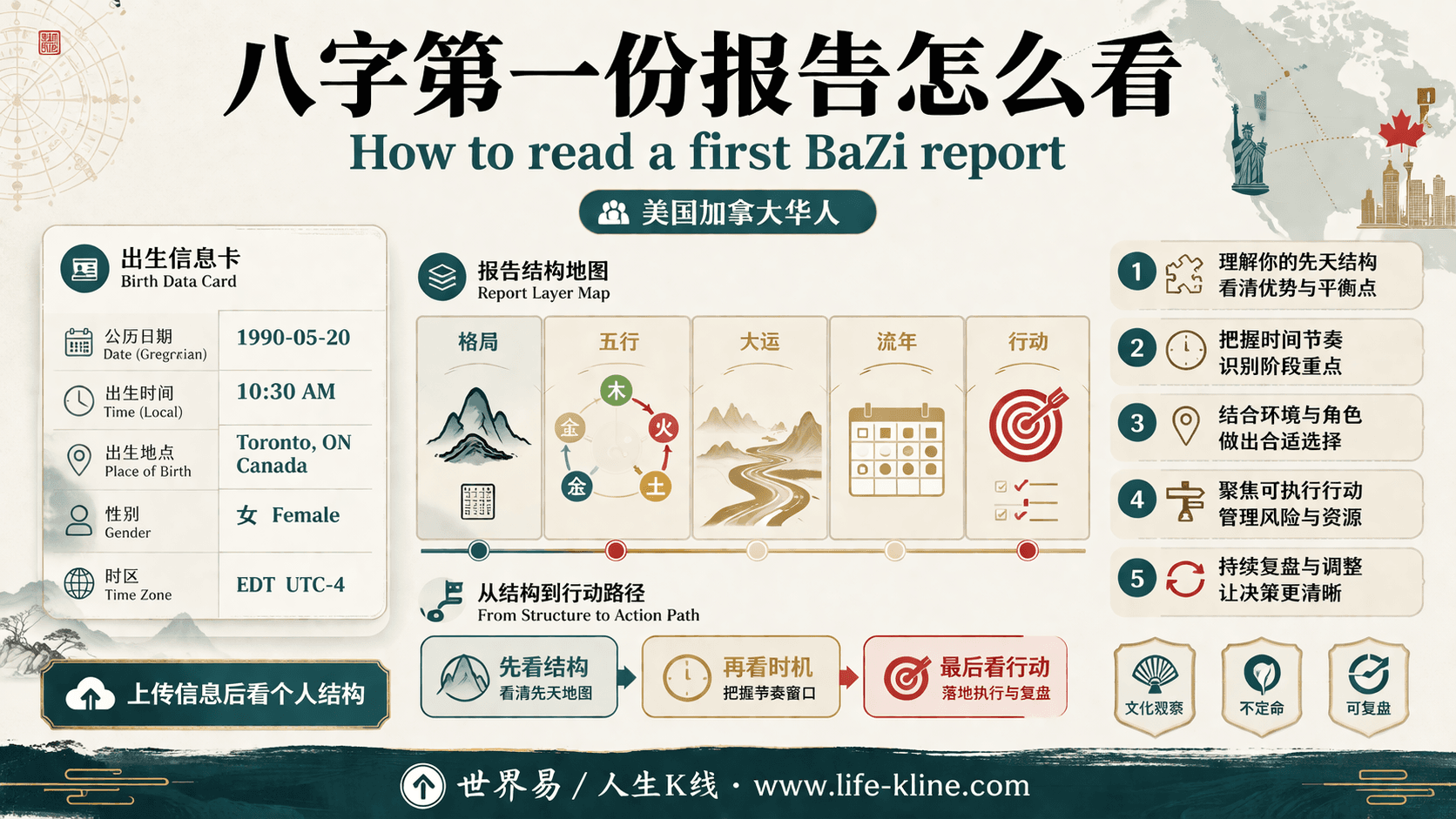
八字第一份报告怎么看|美国加拿大华人
这张图把《Identifying Health Warning Signs in Later Years: Body System Alerts from a Metaphysical Perspective After Age 55》里的命理概念转成关系、边界和应用场景,适合先看图建立结构,再回到知识文章正文理解细节。
八字第一份报告怎么看不应被写成固定结论。更适合美国加拿大华人的读法,是把传统术语翻译成结构、时机、环境、行动和复盘。
查看图片解读