Career Decisions in Later Years: BaZi Analysis and Practice on Entrepreneurship or Employment After Age 55
把这篇文章落到自己身上验证:先看结构,再进入个人分析,不做泛泛阅读。
Why This Decision Is Particularly Difficult at This Life Stage
After entering age 55, life transitions into a semi-retired or later stage, where individuals face adjustments in retirement pace, increased health management pressures, strengthened intergenerational responsibilities, and psychological conflicts between legacy and letting go. Economic stability becomes crucial, yet physical condition may decline compared to earlier years, creating a stark contrast between the risks of entrepreneurship and the stability of employment.
Social expectations also become prominent at this stage. The elderly are generally expected to reduce professional burdens and enjoy life, but actual economic pressures and psychological needs make the decision to continue working a focal point. Entrepreneurship represents proactive exploration that may bring a sense of achievement and financial returns but carries higher risks; employment tends to be more stable but may limit autonomy and development space.
From a BaZi perspective, changes in Da Yun (decade luck) and Liu Nian (annual fortune) during later years significantly impact career decisions. The stability or fluctuation of Da Yun directly affects personal energy deployment, especially when health and psychological endurance weaken. Whether the Yong Shen (favorable element) in the chart is strong becomes a crucial factor in assessing entrepreneurship risks.
The difficulty in decision-making at this stage lies in scientifically evaluating personal risk tolerance and career progression rhythm by integrating the Day Master strength, chart structure, and the roles of Yong Shen and Ji Shen (unfavorable elements). The goal is to align with physical condition while honoring inner career aspirations, avoiding blind entrepreneurship that could exacerbate physical and mental burdens.
Three Core Dimensions of BaZi Judgment
First, the Day Master and chart structure determine an individual's fundamental energy and personality tendencies. In later years, the strength of the Day Master reflects personal physical strength and willpower, while structures such as Pian Cai (Indirect Wealth), Qi Sha (Seven Killings), and Pian Yin (Indirect Resource) indicate career patterns and risk preferences. A relatively strong Day Master suits proactive entrepreneurship but requires attention to whether the Yong Shen receives adequate support.
Second, the roles of Yong Shen and Ji Shen are especially critical in later years. A strong Yong Shen means smooth career development with lower risk, while a constrained Yong Shen suggests caution. For example, if Wood and Water are the Yong Shen, environmental and resource support is indispensable; if Fire is the Ji Shen, one must prevent excessive Fire from triggering health and emotional fluctuations.
Third, Da Yun and Liu Nian provide dynamic temporal contexts. A stable Da Yun in later years indicates a relatively steady career environment, suitable for maintaining achievements or steady progress; if Da Yun or Liu Nian bring inauspicious stars, entrepreneurship should be approached cautiously with conservative strategies prioritized. The interaction between Da Yun and Liu Nian helps determine suitable timing for transformation or waiting.
Combining these three dimensions, BaZi not only reveals internal energy states but also reflects external environmental changes, assisting in rationally planning career rhythm in later years, weighing the pros and cons of entrepreneurship versus employment, and ensuring decisions are scientific and aligned with personal realities.
Three Real BaZi Case Studies
Case 1: Male, age 30-35, Day Master Wu (戊, Earth) relatively strong, chart structure is Pian Cai (Indirect Wealth) pattern, Yong Shen are Wood and Water. Current Da Yun is Bing Wu (丙午) Da Yun (ages 34-43), which is an unfavorable luck period requiring caution against major disruptions. Although this chart is not yet in the 55+ later stage, considering a semi-retirement context, the Pian Cai pattern shows a clear entrepreneurial tendency, and the relatively strong Day Master indicates good endurance. However, the Bing Wu Da Yun is weak and inauspicious, with Fire as a Ji Shen to avoid. Corresponding to later-year entrepreneurship decisions, if Da Yun and Liu Nian are unstable, priority should be given to steady progress to avoid excessive fluctuations caused by entrepreneurship. The recommended judgment sequence is to first assess the stability of Da Yun and Liu Nian, ensure Yong Shen support, then consider entrepreneurship.
Case 2: Male, age 25-30, Day Master Ding (丁, Fire) balanced, chart structure is Qi Sha (Seven Killings) pattern, Yong Shen is Earth, Ji Shen is Water. Current Da Yun is Xin Wei (辛未) Da Yun (ages 18-27), stable and suitable for maintaining achievements, with Liu Nian Bing Wu (丙午) allowing flexible responses. Although relatively young, the Qi Sha pattern indicates career drive, and Yong Shen Earth represents stable support. Applied to the 55+ later stage, a balanced Ding Fire Day Master with stable Da Yun suggests suitability for steady employment; flexible adaptation is strong but risky entrepreneurship is not recommended. The judgment sequence suggests first confirming sufficient Yong Shen Earth support, then combining Liu Nian changes to decide suitability for small-scale entrepreneurship or continued stable employment.
Case 3: Female, age 55-60, Day Master Geng (庚, Metal) balanced, chart structure is Pian Yin (Indirect Resource) pattern, Yong Shen is Fire. Current Da Yun is Gui You (癸酉) Da Yun (ages 48-57), stable and suitable for maintaining achievements, with Liu Nian Bing Wu (丙午) allowing flexible responses. This chart is fully in the later years. The balanced Day Master and stable Da Yun, combined with the Pian Yin pattern, provide wisdom and resource advantages. Yong Shen Fire represents vitality and motivation. Although in semi-retirement, there is still entrepreneurial potential. Liu Nian flexibility supports health and environmental adjustments. The judgment sequence recommends assessing current health and Da Yun support; if Yong Shen Fire is strong and Ji Shen interference absent, entrepreneurship can add life energy; otherwise, stable employment or light entrepreneurship is advisable.
These three cases demonstrate how different BaZi structures manifest in career decisions during the semi-retired later years, emphasizing the importance of Da Yun and Liu Nian stability and Yong Shen support, supplemented by real-world health and social responsibility considerations, helping elderly individuals reasonably balance entrepreneurship risks and employment stability.
Common Misjudgments and Blind Spots at This Stage
Career decisions in later years often fall into two misjudgments: one is neglecting physical and mental endurance, leading to blind entrepreneurship that causes overwork or health deterioration; the other is excessive conservatism, forfeiting personal potential and losing opportunities to recreate value. In BaZi, the strength of the Day Master and the gain or loss of Yong Shen are often overlooked, resulting in decisions detached from reality.
Another blind spot is insufficient judgment of Da Yun and Liu Nian changes. Many only focus on overall Da Yun stability but ignore the interaction between the current Liu Nian and Da Yun, overlooking short-term risks or opportunities. This is especially critical in later years due to weaker physical and psychological adaptability.
Additionally, many people simplistically apply BaZi conclusions to a binary choice between entrepreneurship and employment, ignoring the possibility of multiple adjustments within the stage. Later-life careers should be a dynamic adjustment process, considering actual health, family responsibilities, and economic needs rather than a one-time decision.
Therefore, correctly understanding the dynamic and phased nature of BaZi, and avoiding oversimplified judgments, is a crucial pitfall to avoid in later-year career decision-making.
Practical Judgment Sequence
First, confirm the strength of the Day Master and the chart structure to judge the foundational career energy and personality tendencies, clarifying whether the inclination is toward proactive exploration or steady maintenance. Next, focus on assessing whether the Yong Shen is strong and the influence of Ji Shen, ensuring sufficient career resource support and controllable risk factors.
Then, combine the current interactions between Da Yun and Liu Nian to confirm overall environmental stability and trends. If Da Yun and Liu Nian are stable and Yong Shen is supported, it is suitable to initiate entrepreneurial projects; if inauspicious stars appear or Yong Shen is constrained, it is recommended to prioritize employment or steady progress, waiting for better timing.
Finally, integrate personal health status and family responsibilities to dynamically adjust career rhythm. Later-year entrepreneurship should select projects with controllable risks that align with personal interests and physical capacity; employment should favor stable, low-pressure positions. The judgment sequence should consistently integrate BaZi and real-world considerations to ensure scientific and reasonable decisions.
FAQ
Question 1: What BaZi factors should be prioritized when considering entrepreneurship in later years? Answer: Focus on the strength of the Day Master, the effectiveness of the Yong Shen, and the stability of the current Da Yun and Liu Nian, as these directly reflect personal energy and environmental support. These should be combined with physical health and psychological endurance for a comprehensive judgment.
Question 2: Does an inauspicious Da Yun mean entrepreneurship is impossible? Answer: An inauspicious Da Yun indicates higher risks, so large-scale entrepreneurship is not recommended. However, low-risk steady projects or maintaining employment can be considered. The key is to adapt career strategies flexibly according to Da Yun and Liu Nian changes.
Question 3: How to balance entrepreneurship and employment in later years? Answer: This should be dynamically adjusted based on BaZi structure and real conditions. If Yong Shen is strong and physical health is good, entrepreneurship can bring a sense of achievement; if the environment is unstable or physical strength insufficient, stable employment is advisable to ensure quality of life and psychological balance.
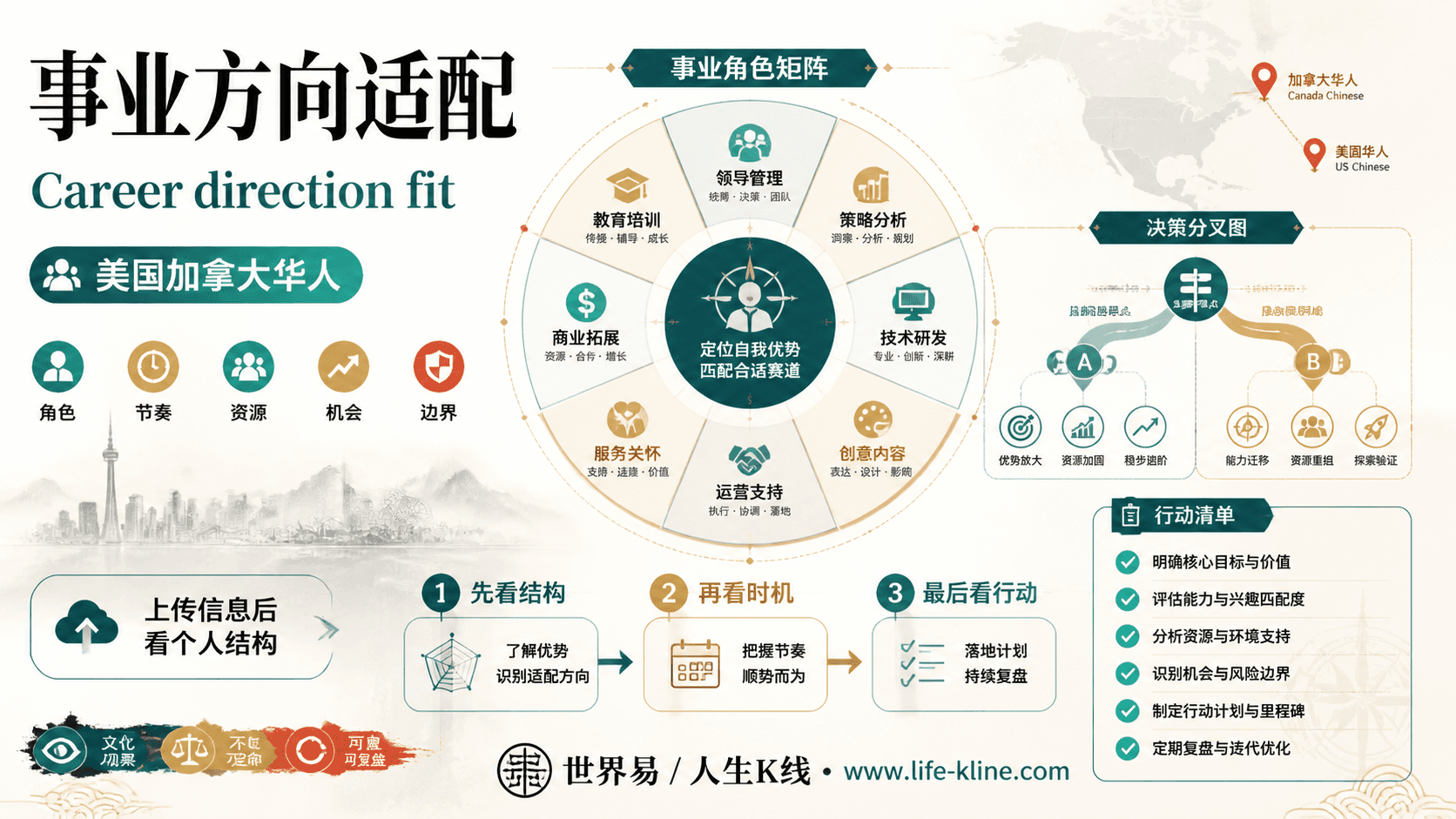
事业方向适配|美国加拿大华人
这张图把《Career Decisions in Later Years: BaZi Analysis and Practice on Entrepreneurship or Employment After Age 55》里的命理概念转成关系、边界和应用场景,适合先看图建立结构,再回到知识文章正文理解细节。
事业方向适配不应被写成固定结论。更适合美国加拿大华人的读法,是把传统术语翻译成结构、时机、环境、行动和复盘。
查看图片解读