Metaphysics and Legal Decision Guidance for Identifying Danger Signals in Labor Disputes
把这篇文章落到自己身上验证:先看结构,再进入个人分析,不做泛泛阅读。
Why This Decision Is Especially Difficult in This Legal Context
Labor disputes cover a wide range of complex issues such as overtime pay disagreements, severance compensation, non-compete restrictions, work injury recognition, and social security arrears. The legal procedures themselves involve practical constraints like difficulty in evidence collection, enforcement challenges, statute of limitations, and attorney fees. Decision-makers must judge early on whether to take immediate legal action or prioritize mediation or settlement to reduce costs and risks.
In this context, identifying danger signals in labor disputes is particularly critical. Failure to promptly detect potential risks may lead to insufficient evidence or missed litigation deadlines, thereby increasing legal costs and possibly resulting in unfavorable judgments. Conversely, premature litigation may worsen relations between parties and miss opportunities for successful mediation.
The BaZi structure—especially the strength of the Day Master, the pattern (格局), and the configuration of the Yong Shen—combined with the current Da Yun and Liu Nian, reflects the party’s emotional expression, resilience in conflict, and trends in the external environment. This information complements the rhythm of legal procedures, helping parties reasonably grasp the timing for rights protection and strategy adjustments.
Therefore, in labor dispute decision-making, the procedural constraints of legal practice combined with metaphysical rhythm cues form a more detailed risk identification framework. This effectively guides parties to adjust their action pace, avoiding losses caused by blind aggression or excessive conservatism.
Three Core Dimensions of Metaphysical Judgment
First, the strength of the Day Master determines the party’s resilience and resource mobilization capacity in the dispute. A relatively strong Day Master usually indicates abundant personal energy but requires caution against excessive strength leading to emotional reactions that impair rational decision-making. A relatively weak Day Master suggests caution to avoid passivity due to insufficient personal strength.
Second, the 官杀 (Zheng Guan / Qi Sha, authority and external pressure) and 伤官 (Shang Guan, expression and rebellion) are key conflict and expression signals. Guan Sha represents authority, rules, and external pressure, often related to legal confrontation; Shang Guan reflects individual expression and resistance tendencies. In labor disputes, a strong Shang Guan may cause overly intense reactions, increasing the risk of conflict escalation; an overly strong Guan Sha may indicate the opponent’s powerful legal means, requiring careful response.
Third, the interaction between Da Yun and Liu Nian with the Day Master indicates current environmental trends. When Da Yun is stable and the Yong Shen is supported, it signals overall smooth fortune, suitable for steady rights protection. If Da Yun is clashing or the Ji Shen (unfavorable element) is dominant, it warns of heightened risk and possible sudden changes, necessitating timely strategy adjustments to avoid losses. Liu Nian changes reflect the concentration of risks in the specific year and are critical time nodes in decision-making.
Three Real BaZi Case Studies
Case 1: Male, aged 25-30, Day Master 壬水 (Ren Water) relatively strong, Yang Ren pattern (羊刃格), Yong Shen are Earth and Fire, Ji Shen is Metal, currently in 丁酉 (Ding You) Da Yun, 丙午 (Bing Wu) Liu Nian. This chart shows a relatively strong Day Master with the Yang Ren pattern, indicating a strong fighting spirit in labor disputes and a tendency toward intense expression. The Yong Shen Earth and Fire suggest the importance of mediation and stabilizing relationships. The 丁酉 Da Yun is stable, while the 丙午 Liu Nian requires adaptability, with legal risks and opportunities coexisting. Under this structure, if the reality involves a tough layoff or overtime dispute, evidence should be collected first and responses kept calm to avoid the Yang Ren intensifying conflicts. Mediation is recommended initially, and if litigation occurs, evidence must be complete to prevent impulsive decisions leading to unfavorable judgments.
Case 2: Female, aged 30-35, Day Master 癸水 (Gui Water) relatively weak, Zheng Guan pattern, Yong Shen is Metal, Ji Shen are Wood and Fire, currently in 乙未 (Yi Wei) Da Yun, 丙午 (Bing Wu) Liu Nian. The relatively weak Day Master and Zheng Guan pattern indicate strong legal awareness but limited personal strength, requiring reliance on formal procedures. The Yong Shen Metal represents legal and authoritative support, while the Ji Shen Wood and Fire warn against emotional escalation and unfavorable environments. The 乙未 Da Yun is relatively weak, and the 丙午 Liu Nian calls for caution, implying high risk in facing layoffs or non-compete disputes and advising against rash moves. Special attention should be paid to statute of limitations and evidence completeness, prioritizing mediation and legal consultation to avoid resource wastage from blind litigation.
Case 3: Male, aged 20-25, Day Master 辛金 (Xin Metal) relatively weak, Zheng Cai pattern, Yong Shen is Earth, Ji Shen are Water and Wood, currently in 壬子 (Ren Zi) Da Yun, 丙午 (Bing Wu) Liu Nian. The relatively weak Day Master combined with the unfavorable 壬子 Da Yun indicates significant external pressure and change. The Zheng Cai pattern highlights economic interest disputes. The Yong Shen Earth helps stabilize the situation, but caution is needed in the current Liu Nian. This chart suggests high risk in work injury or social security arrears disputes, especially difficulties in evidence collection and enforcement. Timely legal consultation is advised, prioritizing assessment of evidence feasibility and litigation costs. If necessary, aggressive confrontation should be paused, waiting for a more favorable time to initiate litigation.
Common Misjudgments and Blind Spots in This Scenario
A common misjudgment in labor disputes is neglecting the statute of limitations and the difficulty of evidence collection, leading to delayed action when timely intervention was needed or premature litigation that escalates conflicts and worsens relations, ultimately complicating enforcement. Additionally, some parties overly rely on personal emotional expression, ignoring the importance of legal procedures and evidence preparation, thereby increasing the risk of losing the case.
Another blind spot is failing to adjust strategies according to external environmental changes. For example, when Da Yun and Liu Nian indicate increased risks, some still blindly adopt a hardline stance, ignoring mediation possibilities and legal risk management. Others disregard professional legal advice or over-rely on metaphysical judgment, deviating from proper legal paths and causing decision errors.
Moreover, parties often underestimate the significance of Guan Sha and Shang Guan signals in BaZi, failing to timely identify the opponent’s legal strength or the appropriateness of their own expression style, resulting in a passive position in legal bargaining. Reasonably combining metaphysics with legal practice is key to avoiding these misjudgments.
Practical Judgment Sequence
First, investigate the actual signals appearing in the dispute, such as whether the opponent has initiated layoff procedures, explicitly refuses to pay overtime, or if social security contributions are irregular. At this point, combine the BaZi Day Master’s strength and Yong Shen situation to assess personal resilience and environmental stability, deciding whether to take immediate legal action.
Second, if metaphysics indicates that the current Da Yun or Liu Nian is clashing or dominated by Ji Shen, signaling high risk, priority should be given to mediation and settlement to avoid blind litigation, reducing procedural costs and time consumption. Meanwhile, strengthen evidence collection and legal consultation to ensure full preparation for possible future litigation.
Finally, when both metaphysics and legal realities show relative stability and the statute of limitations window is approaching, decisively initiate legal procedures to avoid missing the best time for rights protection. Throughout the process, professional legal services and statutory procedures remain primary; metaphysics serves only as an auxiliary rhythm reference to help parties arrange their action pace more reasonably.
FAQ
Question 1: Can metaphysics decide whether I should immediately sue in a labor dispute? Answer: Metaphysics provides a rhythm reference regarding personal resilience, environmental changes, and emotional expression but cannot replace legal judgment. It should be combined with professional legal advice and factual evidence to reasonably determine litigation timing.
Question 2: If my BaZi chart shows unfavorable Da Yun and Liu Nian, does that mean I should give up defending my rights? Answer: No, it does not mean giving up rights defense but rather advises caution, prioritizing mediation and thorough evidence preparation to avoid rash aggression. Metaphysics signals risk; legal procedures provide the ultimate protection.
Question 3: How do I combine metaphysics to adjust my rights protection strategy? Answer: First assess the Day Master’s strength and Yong Shen to evaluate personal resilience, then identify risk levels through Da Yun and Liu Nian changes. Based on legal time limits and procedural costs, decide whether to prioritize mediation or litigation, ensuring the strategy is scientific and reasonable.
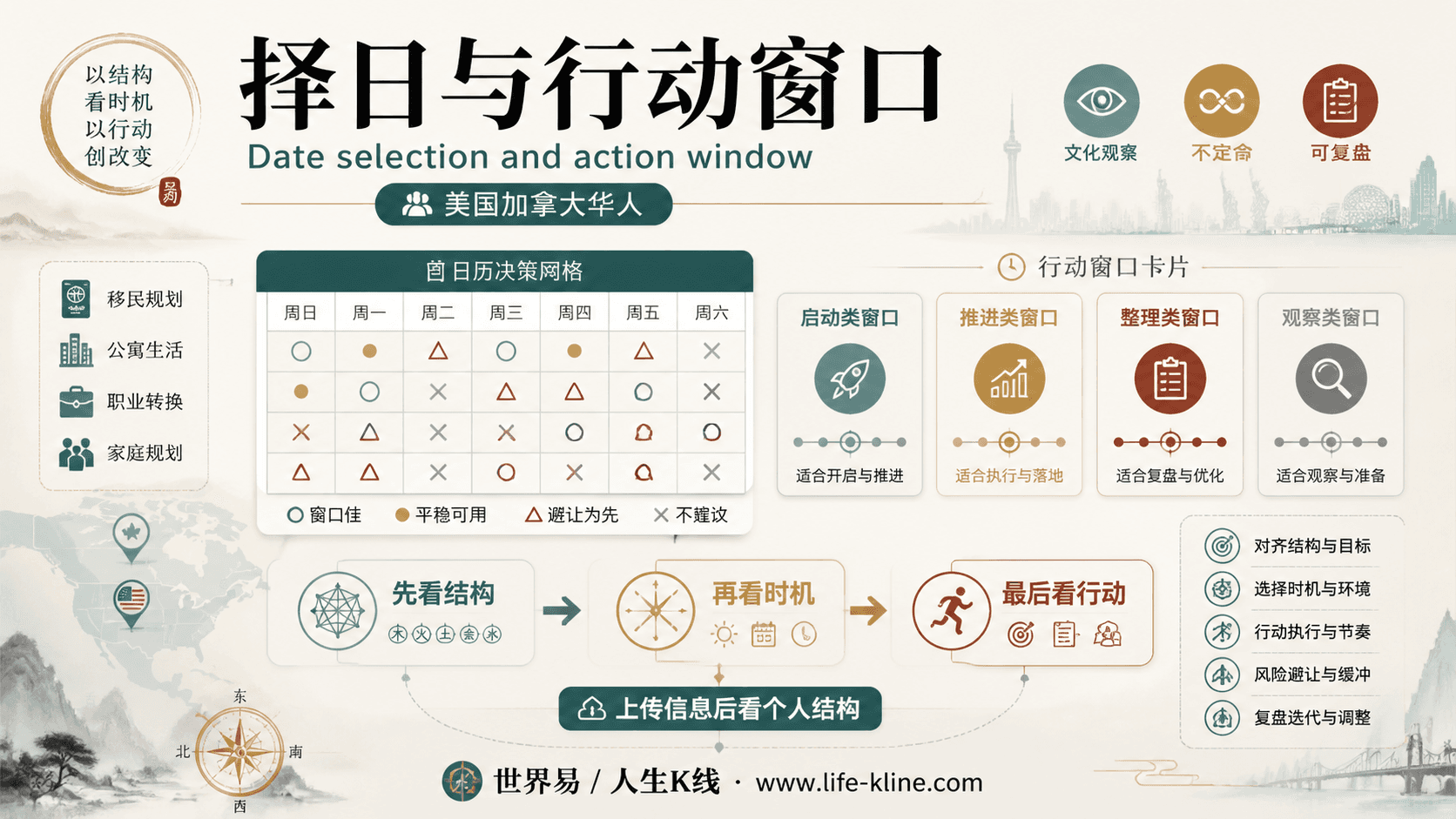
择日与行动窗口|美国加拿大华人
这张图把《Metaphysics and Legal Decision Guidance for Identifying Danger Signals in Labor Disputes》里的命理概念转成关系、边界和应用场景,适合先看图建立结构,再回到知识文章正文理解细节。
择日与行动窗口不应被写成固定结论。更适合美国加拿大华人的读法,是把传统术语翻译成结构、时机、环境、行动和复盘。
查看图片解读