Japanese Business Management Visa Immigration: BaZi Decision Analysis on Going Alone or Moving with Family
把这篇文章落到自己身上验证:先看结构,再进入个人分析,不做泛泛阅读。
Why This Decision Is Especially Difficult for This Destination
Cross-border migration to Japan, especially involving Business Management Visas, Highly Skilled Professional Visas, and study-to-work transitions, faces multiple practical challenges. The high language barrier results in slow initial social integration, significantly affecting family members' adaptability. Additionally, Japan’s long-term visa renewal and naturalization processes require migrants to have patience and stable life planning. Meanwhile, frequent earthquakes and an aging population increase uncertainties in daily life and work.
In this context, deciding whether to go alone first to explore or to move with the whole family requires thorough consideration of family structure, financial capacity, and personal psychological resilience. Migrants often exhibit cognitive biases of excessive optimism or overcaution, overlooking the complexities of long-term visas and social integration. BaZi structures such as Bi Jian (Peer Stars), Cai Xing (Wealth Stars), and Guan Sha (Officer and Killing Stars) reflect an individual’s stress tolerance, wealth acquisition potential, and social network, providing important rhythmic assistance for decision-making.
Specifically for Business Management and Highly Skilled Professional Visas, these visa types often come with high social responsibilities and work pressure. The strength of the Guan Sha (Officer and Killing Stars) structure in BaZi can indicate identity pressure and external environmental challenges. Study-to-work transitions face dual challenges of language and cultural adaptation; the balance of Cai Xing (Wealth Stars) and Bi Jian (Peer Stars) is particularly critical here, influencing economic independence and the expansion of interpersonal resources.
Therefore, combining Japan’s socio-cultural structure and BaZi rhythms, decision-makers need multidimensional analysis to evaluate how going alone first or moving with family affects family stability, career development, and mental health, avoiding misjudgments based on a single dimension.
Three Core Dimensions of BaZi Judgment
First, the Day Master and Yi Ma (Traveling Horse) combination reflects an individual’s adaptability and mobility in a foreign land. When the Day Master is relatively strong and the Yong Shen (favorable elements) are Wood and Water, and the presence of Yi Ma symbolizes migration motivation, it indicates the individual is more suitable to go alone first to flexibly respond to changes in the foreign environment. Conversely, if the Day Master is weak or Yi Ma is absent, and the individual relies on Yin Xing (Seal Stars) support, moving with the family may be more appropriate to jointly bear the pressures of living abroad.
Second, the manifestation of Cai Xing (Wealth Stars) represents the potential for wealth acquisition and resource integration in a foreign land. A strong Cai Xing moderately restrained by Bi Jian (Peer Stars) indicates a certain degree of economic independence, suitable for going alone first to lay the foundation; whereas a weak or restrained Cai Xing suggests greater economic pressure, and moving with family can create complementary resources to reduce risks.
Third, the Guan Sha (Officer and Killing Stars) structure reflects external social pressure and identity recognition. Although Zheng Guan (Proper Officer) or Yang Ren (Yang Blade) structures bring strong social responsibility and pressure, if the Da Yun (decade luck cycle) and Liu Nian (annual fortune) are favorable and the Yong Shen is supported, it benefits legal identity and career development, favoring going alone first to seek breakthroughs. Conversely, if Guan Sha is overly strong and Yong Shen is unsupported, a cautious approach of moving with family is recommended to reduce identity pressure’s impact on the family.
Additionally, the interaction between Liu Nian and Da Yun is an important reference for timing actions. A stable Da Yun combined with adaptable Liu Nian suggests flexibility in migration strategy, observing results before making further decisions.
Three Real BaZi Case Studies
Case 1: This female’s Day Master is Ji Earth (己, Ji), relatively strong, with a Zheng Guan (Proper Officer) structure. The Yong Shen are Wood and Water, and the Ji Shen (unfavorable element) is Fire. She is currently in the 6th year of Wu Wu (戊午, Wu Wu) Da Yun, with the Liu Nian being Bing Wu (丙午, Bing Wu). The strong Day Master and Zheng Guan structure indicate she faces certain challenges in social responsibility and identity pressure, but the Yong Shen of Wood and Water help balance this. Both Da Yun and Liu Nian are stable, symbolizing suitability for steady maintenance. Considering Japan’s high language barrier and slow social integration for the Business Management Visa, this BaZi suggests going alone first, leveraging the Day Master’s strong adaptability and Yi Ma potential to establish a foundation, then considering family migration later to reduce overall family adaptation pressure.
Case 2: This female’s Day Master is Xin Metal (辛, Xin), relatively strong, with a Yang Ren (Yang Blade) structure. The Yong Shen are Fire and Wood, and the Ji Shen is Earth. She is currently in the 9th year of Ren Shen (壬申, Ren Shen) Da Yun, with the Liu Nian being Bing Wu (丙午, Bing Wu). The Yang Ren structure represents a strong personality and stress resilience. The strong Cai Xing (Fire and Wood) indicates economic independence and good resource expansion ability. Japan’s society places significant identity pressure on Highly Skilled Professional Visa applicants; the Guan Sha representing social responsibility is evident. This BaZi shows suitability for going alone first, fully utilizing personal advantages to cope with external pressure. The Yong Shen Fire and Wood help regulate emotions and energy, reducing pressure’s impact on the family. Subsequent decisions about moving the family can be made based on adaptation.
Case 3: This female’s Day Master is Ding Fire (丁, Ding), relatively strong, with a Shang Guan (Hurting Officer) structure. The Yong Shen is Fire, and the Ji Shen is Wood. She is currently in the 4th year of Gui You (癸酉, Gui You) Da Yun, with the Liu Nian being Bing Wu (丙午, Bing Wu). The Shang Guan structure indicates sharp thinking and strong innovation ability, but the presence of Ji Shen Wood suggests environmental uncertainties. The relatively strong Ding Fire Day Master supported by Yong Shen Fire shows strong self-drive, but the BaZi lacks evident Cai Xing, indicating relatively weak economic support. Considering the high education and language barriers for study-to-work visas and slow social integration in Japan, this BaZi recommends moving with family. Family support can compensate for economic and adaptation shortcomings, alleviating pressure. Meanwhile, the stable Da Yun helps maintain status quo, benefiting overall family stability.
These three cases share the common characteristic of stable Da Yun and Liu Nian, combined with different Day Masters and structures, illustrating BaZi’s differentiated influence on migration strategies.
Common Misjudgments and Blind Spots for This Destination
Many cross-border migrants underestimate the substantial obstacle posed by Japan’s language barrier, overly optimistic that obtaining a visa will quickly lead to local social integration. This results in difficulties for family members, especially spouses and children, increasing psychological and financial pressure. BaZi’s Bi Jian (Peer Stars) and Cai Xing (Wealth Stars) strength indicate economic and interpersonal support levels; ignoring these signals easily causes family migration plans to become disjointed.
Another blind spot is overreliance on visa status for social standing, neglecting the identity pressure and social responsibility reflected by the Guan Sha (Officer and Killing Stars) structure. Particularly in Business Management and Highly Skilled Professional Visa applications, excessive identity pressure without effective Yong Shen support may trigger psychological tension and family conflicts, negatively affecting migration quality.
Additionally, many underestimate the impact of Japan’s aging society and earthquake risks on family life, failing to fully consider family members’ safety and long-term stability. The interaction of Liu Nian and Da Yun in BaZi reminds one to pay attention to rhythmic changes; blind actions risk unfavorable annual influences, increasing migration risks.
Finally, cross-border migration involves legal, tax, visa, and foreign exchange compliance. BaZi serves only as a rhythmic reference; ignoring professional advice can lead to decision errors.
Practical Judgment Sequence
Step one: Combine the Day Master’s strength and the configuration of Yong Shen and Ji Shen to assess personal adaptability to a foreign environment. If the Day Master is relatively strong, Yong Shen is well supported, and migration motivators like Yi Ma are present, prioritize going alone first to flexibly test the market and living environment, reducing overall family risk.
Step two: Analyze economic independence and resource integration ability by combining Cai Xing (Wealth Stars) and Bi Jian (Peer Stars) structures. Those with strong Cai Xing and moderate Bi Jian have greater economic autonomy, suitable for establishing a foundation alone; otherwise, those with average economic conditions are advised to move with family for mutual support.
Step three: Focus on identity pressure reflected by Guan Sha (Officer and Killing Stars) structures. Combine this with Da Yun and Liu Nian rhythms to judge whether the current timing is suitable for initiating migration. When Guan Sha is strong and Yong Shen support is insufficient, proceed cautiously, prioritizing stable family migration.
Finally, always coordinate with professional immigration, legal, tax, and financial advisors to ensure cross-border migration complies with laws and financial regulations. BaZi serves only as an auxiliary tool to avoid isolated decisions that cause risks.
FAQ
Question 1: How do Bi Jian (Peer Stars) and Cai Xing (Wealth Stars) specifically influence the decision between going alone or moving with family? Answer: Bi Jian represents support from peers and stress resilience, while Cai Xing represents economic resources and wealth acquisition ability. When Bi Jian is strong and Cai Xing is moderate, it indicates personal resilience and economic independence, favoring going alone first. If Cai Xing is weak or restrained, moving with family is recommended to form economic mutual assistance.
Question 2: Does a strong Guan Sha (Officer and Killing Stars) structure mean going alone is unsuitable? Answer: Guan Sha represents identity pressure and social responsibility. When Guan Sha is strong and Yong Shen support is insufficient, pressure may affect personal adaptability, suggesting cautious family migration. However, if Yong Shen is strong and Da Yun and Liu Nian are stable, going alone can effectively cope with challenges.
Question 3: Can BaZi replace professional immigration and legal-tax consultation? Answer: BaZi serves only as a rhythmic auxiliary reference and cannot replace professional legal, tax, visa, and financial advice. Cross-border migration involves complex compliance issues requiring professional consultants; BaZi judgment is only a decision-support tool.
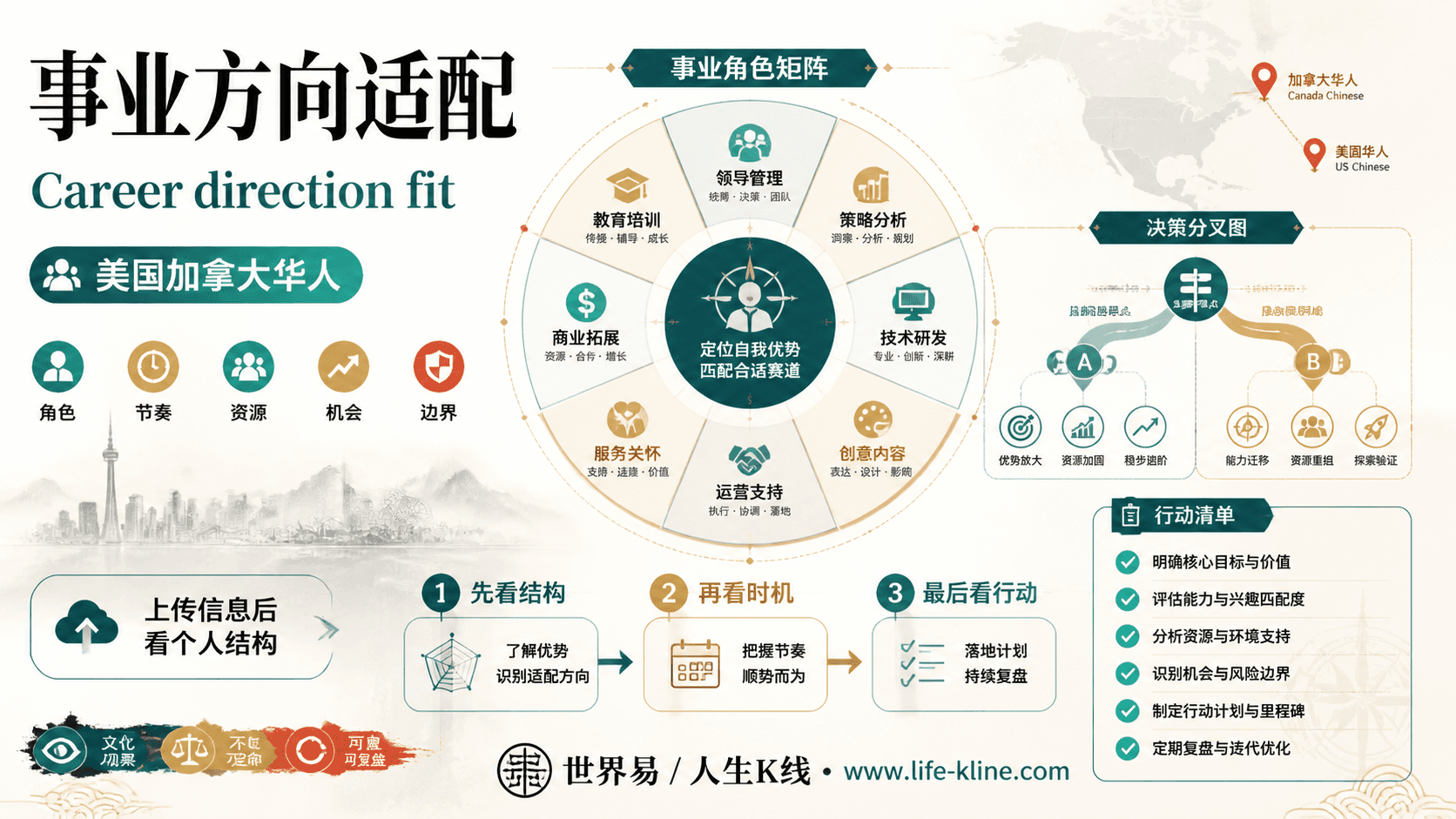
事业方向适配|美国加拿大华人
这张图把《Japanese Business Management Visa Immigration: BaZi Decision Analysis on Going Alone or Moving with Family》里的命理概念转成关系、边界和应用场景,适合先看图建立结构,再回到知识文章正文理解细节。
事业方向适配不应被写成固定结论。更适合美国加拿大华人的读法,是把传统术语翻译成结构、时机、环境、行动和复盘。
查看图片解读