Insurance and Annuity Entry and Wait-and-See Judgments: A Practical Guide Based on Metaphysics and Market Structure
把这篇文章落到自己身上验证:先看结构,再进入个人分析,不做泛泛阅读。
Why This Decision Is Especially Difficult in This Category
Investment decisions in the insurance and annuity category are complex mainly because of diverse product structures involving critical illness, medical, accident coverage, and annuity savings functions. The fee rates are often implicit, and surrender penalties are strict. Market liquidity is relatively low; compared to stocks and funds, the liquidity difference leads to longer capital lock-in periods, making risk adjustments difficult and increasing the difficulty of timing entry.
Moreover, the regulatory environment for insurance products is relatively strict. Fee rates and coverage content are often influenced by policies. Market price fluctuations are limited, but policy risks cannot be ignored. Investor psychological biases are obvious, such as over-reliance on protection functions while neglecting investment attributes, or suffering losses due to surrender traps. These psychological pitfalls correspond interestingly with the relationships between Bi Jian (Peer) and Cai Xing (Wealth Stars) in metaphysics, easily amplifying risk perception or blind optimism.
In metaphysical structures, the relationship between the Day Master and Yong Shen (favorable element), especially the strength combinations of Cai Xing (Wealth Stars) and Bi Jian (Peer), reflects an individual's ability to absorb and preserve wealth. Combined with the current Da Yun (decade luck) and Liu Nian (annual fortune), it can assist in judging risk tolerance and action rhythm, determining when it is suitable to build positions in insurance to protect wealth and when to wait to avoid capital lock-in or surrender losses.
Therefore, entry or wait decisions in insurance and annuity must simultaneously consider market structure liquidity, regulatory environment, and product characteristics, combined with metaphysical wealth rhythm, to find a relatively stable path in this complex game.
Three Core Dimensions of Metaphysical Judgment
First is the strength and pattern of the Day Master, which represents the individual's core energy. A strong Day Master indicates strong autonomy; those with slightly excessive strength are more suited to active entry, while those weaker should focus on preservation or waiting. Patterns such as Zhuan Wang Ge (Exclusive Strength Pattern), Cong Er Ge (Following Pattern), and Jie Cai Ge (Rob Wealth Pattern) determine individual wealth motivation and risk tolerance modes. Zhuan Wang Ge tends toward proactive advancement, Cong Er Ge is cautious, and Jie Cai Ge features wealth competition or risk diversification.
Second is the relationship between Yong Shen (favorable element) and Ji Shen (unfavorable element), especially the combination of Cai Xing (Wealth Stars, representing wealth) and Bi Jian (Peer, representing competition and peer support). If Yong Shen is Metal or Water, and Cai Xing is strong, wealth luck is good, suitable for increasing insurance coverage to lock in wealth. If Bi Jian is strong, attention should be paid to wealth sharing and competition risks, possibly favoring diversified allocation or waiting for better timing.
Finally, the interaction of Da Yun (decade luck) and Liu Nian (annual fortune) is crucial, especially the stability of Da Yun directly affects capital security feelings. Stable Da Yun favors preservation; if weak, caution is advised. Liu Nian plays a role in flexible adaptation. In insurance and annuity decisions, the combined effect of Da Yun and Liu Nian determines capital flow timing, helping judge whether it is suitable to heavily invest or temporarily avoid risks, preventing capital lock-in due to market or policy changes.
Overall, metaphysical judgment requires combining Day Master strength, Cai Xing Yong Shen, and Da Yun/Liu Nian rhythms to find entry or wait signals suitable for individual wealth status in the complex insurance and annuity market.
Three Real BaZi Chart Cases
Case 1: This BaZi chart has a Jia (甲, Wood) Day Master that is slightly strong, with a Zhuan Wang Ge (Exclusive Strength Pattern). The Yong Shen is Metal, and Ji Shen is Fire. Currently in the 4th year of Bing Shen (丙申) Da Yun, with Bing Wu (丙午) Liu Nian. The Da Yun is stable, suitable for preservation. The slightly strong Day Master indicates strong initiative, and the Zhuan Wang Ge emphasizes individual wealth accumulation motivation. Yong Shen Metal represents the need for monetary protection. Although the Bing Shen Da Yun and Bing Wu Liu Nian bring some Fire interference, overall it is stable, suitable for steadily increasing high-coverage insurance such as critical illness or medical insurance. Yong Shen Metal can be seen as support for capital security. The suggested judgment sequence is to first confirm product fee transparency and absence of surrender traps, then gradually increase positions after the main family insurance coverage is complete, avoiding overly aggressive moves that cause financial pressure.
Case 2: This BaZi chart has a Geng (庚, Metal) Day Master that is balanced, with a Cong Er Ge (Following Pattern). Yong Shen are Water and Wood, Ji Shen is Earth. Currently in the 6th year of Wu Shen (戊申) Da Yun, with Bing Wu (丙午) Liu Nian. The Da Yun is weak, requiring caution. The balanced Geng Metal Day Master indicates moderate wealth fortune, but the Cong Er Ge shows dependence on external environment support. Yong Shen Water and Wood represent liquidity and growth, while Ji Shen Earth indicates obstruction to capital flow. The weak Da Yun and fire-strong Liu Nian signal clear risks. In the insurance market, a wait-and-see approach is advised to avoid locking in high premiums that strain cash flow, especially for mid- to long-term annuity products with high surrender risks. It is recommended to focus on protection and light asset allocation, waiting for Da Yun improvement or Liu Nian stability before considering building positions.
Case 3: This BaZi chart has a Ren (壬, Water) Day Master that is slightly strong, with a Jie Cai Ge (Rob Wealth Pattern). Yong Shen is Metal, and Ji Shen is also Metal. The Da Yun is Ding Wei (丁未) in its 3rd year, with Bing Wu (丙午) Liu Nian. Overall stable but requires flexible adaptation. The slightly strong Ren Water Day Master and Jie Cai Ge show intense wealth competition. Metal as Yong Shen but also Ji Shen indicates internal and external contradictions in capital flow, with risks and opportunities coexisting. In the insurance market, this structure tends to oscillate between protection and investment returns, suitable for diversified allocation focusing on flexible products, such as annuities with adjustable payment periods or additional accident insurance. The judgment sequence is to first assess liquidity needs and family risk tolerance, ensuring smooth capital turnover, then gradually enter, avoiding financial pressure caused by capital lock-in.
These three cases illustrate how different combinations of Day Master strength, Yong Shen and Ji Shen, and Da Yun/Liu Nian influence insurance and annuity investment decisions, providing practical entry or wait suggestions combined with market structure.
Common Misjudgments and Blind Spots in This Category
Common misjudgments in insurance and annuity investments include ignoring surrender costs and liquidity risks. Many investors focus excessively on protection functions, neglecting fee structures and surrender penalties, resulting in long-term capital lock-in that affects overall wealth allocation flexibility. In metaphysics, those with strong Bi Jian (Peer) who fail to allocate funds reasonably are prone to such pitfalls.
Another blind spot is over-reliance on short-term Liu Nian (annual fortune) auspiciousness or inauspiciousness, neglecting the long-term trend of Da Yun (decade luck). Although Liu Nian reflects risks and opportunities of the year, if Da Yun is weak, blind entry may increase capital pressure. Especially in insurance, which has long lock-in periods, Da Yun stability must be considered when deciding to heavily invest.
Additionally, decisions on main family insurance are often emotionally driven, ignoring the balance of Yin Xing (印星, Resource Stars) and Cai Xing (Wealth Stars) in metaphysics. Excessive Yin Xing may lead to over-reliance on protection, while insufficient Cai Xing results in inadequate wealth accumulation, causing the awkward situation of too much protection but insufficient investment. Rational analysis of metaphysical structure helps avoid such blind spots.
Finally, investors often overlook the impact of regulatory policies and market fee changes. Metaphysics serves as a rhythm-assisting tool and should not replace in-depth understanding of market policies. Combining both forms a scientific and stable decision-making framework.
Practical Judgment Sequence
Step one: Assess the strength of the Day Master and the status of Yong Shen Cai Xing in one’s metaphysical chart to confirm personal risk tolerance. Those with a slightly strong Day Master and strong Yong Shen Cai Xing may consider gradually increasing positions in insurance and annuity products to lock in wealth. Otherwise, focus on protection and wait for more stable capital flow.
Step two: Combine current Da Yun and Liu Nian. Stable Da Yun suits steady layout; if weak or with obvious clashes, act cautiously to avoid long-term capital lock-in or surrender losses. Liu Nian plays a role in flexible adaptation; if Liu Nian is favorable, accelerate building positions; otherwise, delay decisions.
Step three: Deeply understand market structure, prioritizing products with transparent fees and reasonable surrender penalties. Reasonably allocate critical illness, medical, annuity, and accident insurance to ensure balance between protection and liquidity. Metaphysical judgment is only an auxiliary reference and must be combined with financial planning and market regulatory dynamics to avoid decision errors caused by sole reliance on metaphysics.
FAQ
Question 1: How do Yong Shen and Ji Shen in metaphysics affect insurance entry timing? Answer: Yong Shen represents supporting forces of capital and wealth. A strong Yong Shen indicates smooth capital inflow, suitable for steady entry. Ji Shen represents obstructive factors; if Ji Shen is too strong, caution is needed to avoid capital lock-in risks. Judging entry or waiting is more reasonable when combined with Da Yun and Liu Nian changes.
Question 2: How can surrender risks of insurance products be assisted by metaphysical judgment? Answer: Those with strong Bi Jian tend to have capital competition and diversification needs. If Da Yun is weak and Ji Shen is prominent, it means liquidity is limited and surrender risk is higher. Priority should be given to products with strong liquidity and low surrender costs to avoid capital difficulties.
Question 3: Can metaphysics replace professional financial advice for insurance investment decisions? Answer: Metaphysics is only an auxiliary tool to help grasp personal wealth rhythms and risk tolerance. It cannot replace professional financial advice. Investment decisions should integrate market structure, product characteristics, and personal financial status for comprehensive judgment to ensure scientific and stable outcomes.
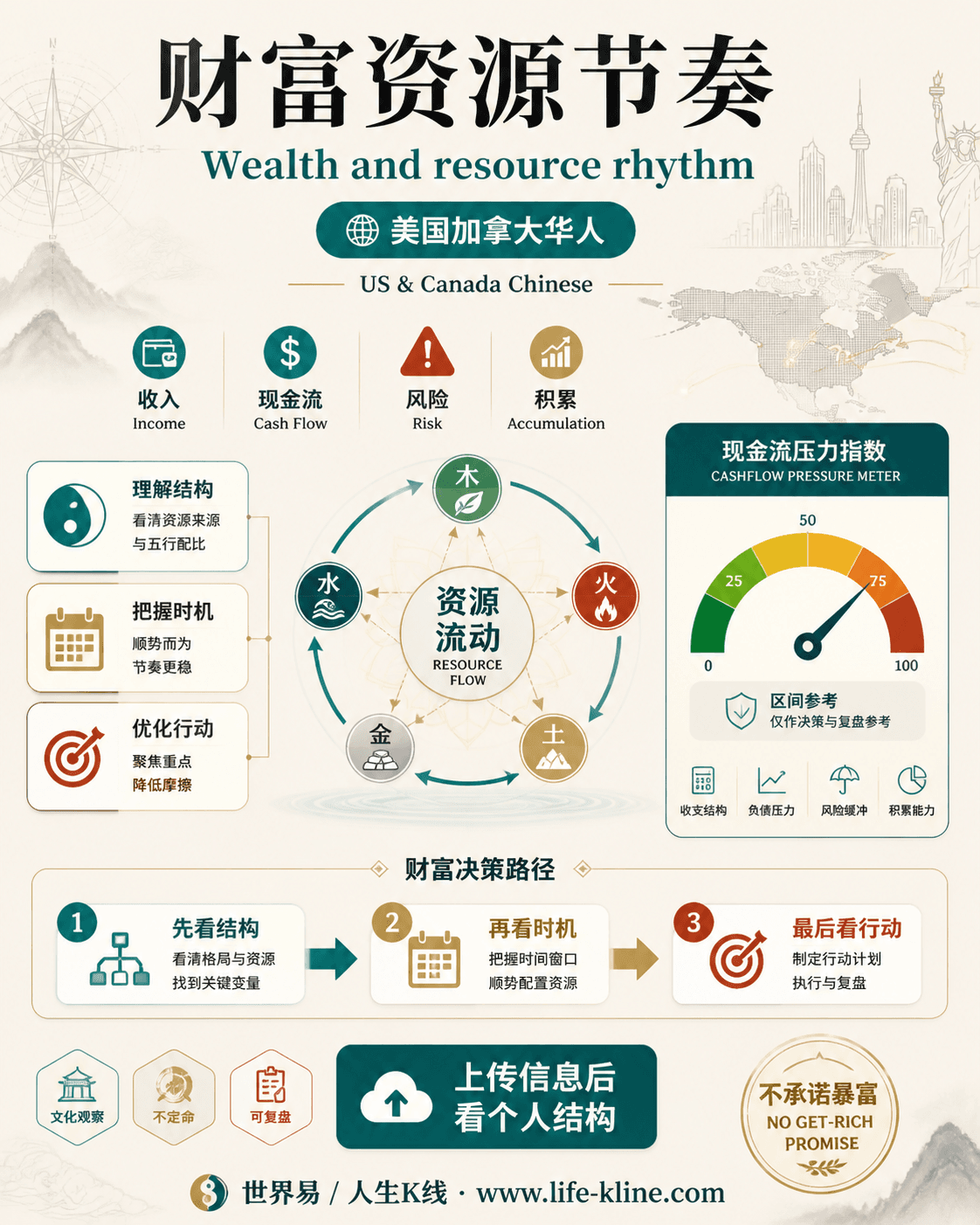
财富资源节奏|美国加拿大华人
这张图把《Insurance and Annuity Entry and Wait-and-See Judgments: A Practical Guide Based on Metaphysics and Market Structure》里的命理概念转成关系、边界和应用场景,适合先看图建立结构,再回到知识文章正文理解细节。
财富资源节奏不应被写成固定结论。更适合美国加拿大华人的读法,是把传统术语翻译成结构、时机、环境、行动和复盘。
查看图片解读