Metaphysical Reference Analysis on Insurance and Annuity Allocation Ratios and Family Positioning
把这篇文章落到自己身上验证:先看结构,再进入个人分析,不做泛泛阅读。
Why This Decision Is Especially Difficult in This Category
Insurance and annuities, as important components of family wealth allocation, pose decision-making difficulties due to the complexity of product types and poor liquidity, making flexible adjustment of asset allocation ratios challenging. Critical illness insurance, medical insurance, accident insurance, and annuity products each have different protection focuses and rate structures, with surrender traps and long-term liabilities increasing allocation difficulty.
Market regulation is becoming stricter, with frequent rate adjustments and product design changes. Families often face information asymmetry and psychological biases when allocating insurance positions, such as over-reliance on a certain insurance type or neglecting overall coordination of protection. At this time, the combination of financial stars (Cai Xing), Bi Jian, and Yin stars in metaphysics provides a rhythmic auxiliary perspective to help investors understand when to increase or cautiously hold positions.
The metaphysical perspective emphasizes the influence of Da Yun (decade luck cycles) and Liu Nian (annual fortune) on financial stars and Yong Shen (favorable elements), reflecting the rhythm of family wealth flow and risk tolerance. In the insurance category, characterized by weak liquidity and strong protection needs, the energy balance and clash/harmony states revealed by metaphysical structures are especially important for grasping allocation ratios.
Therefore, in insurance and annuity allocation, combining market structure with metaphysical judgment—especially focusing on the interaction between financial stars and Bi Jian, as well as the enhancement or weakening of Yong Shen by Da Yun and Liu Nian—can help investors reasonably allocate insurance positions in overall family wealth planning, avoiding blind following or excessive conservatism.
Three Core Dimensions of Metaphysical Judgment
First, the relationship between the Day Master (Ri Zhu) and financial stars (Cai Xing) is central to metaphysical judgment of insurance allocation. Financial stars represent wealth inflow and expenditure. Insurance products are essentially wealth risk management tools. A strong financial star usually indicates the family has strong wealth accumulation and risk tolerance, suitable for a higher proportion of insurance and annuity positions; conversely, caution is advised.
Second, the role of Bi Jian (peer stars) is particularly crucial. Bi Jian represents similar energies and shared resources. The Jie Cai pattern often manifests as resource competition and shared burdens, with economic responsibilities and risk-bearing concentrated among family members. In insurance allocation, those with strong Bi Jian need to avoid tight cash flow; allocation ratios should not be too high, leaving liquidity to handle emergencies.
Finally, Yin stars, as the nurturing force supporting the Day Master, provide important indications of family support and protection functions. A strong Yin star shows the family has strong external support or endogenous resources, suitable for maintaining stable insurance positions, especially emphasizing steady returns from annuity products. Da Yun and Liu Nian’s clash and harmony with Yong Shen (such as Fire, Wood, Water, Earth) directly affect the overall risk tolerance rhythm of the chart, reminding investors to adjust insurance allocations at different time nodes.
In summary, the core metaphysical dimensions revolve around the strength of the Day Master, the balance between financial stars and Bi Jian, and the support of Yin stars. Combined with the dynamics of Da Yun and Liu Nian, they guide the judgment of insurance and annuity allocation ratios, helping families reasonably plan assets and balance protection with liquidity.
Three Real BaZi Chart Cases
Case 1: This gentleman’s Day Master is Geng (庚, Metal), relatively strong and belonging to the Jie Cai pattern. His Yong Shen are Fire and Wood, with Earth as Ji Shen (unfavorable element). Currently in the 7th year of the Wu Shen (戊申) Da Yun, the luck is relatively weak; the Liu Nian is Bing Wu (丙午), requiring caution. The Geng Metal Day Master is relatively strong; the financial star (Wood) is the Yong Shen, but the current Wu Earth Da Yun and Xu Earth (戌) of the hour pillar form Earth suppression. Although Earth is Ji Shen, the Wu Earth Da Yun brings pressure, restraining the financial star. In the insurance market, demand for critical illness and medical insurance is relatively high. Due to the Jie Cai pattern, the family has strong responsibility, so liquidity must be preserved to avoid over-allocation. It is recommended that insurance positions maintain a medium-to-low proportion, focusing on medical and accident insurance protection, with steady annuity allocation to prevent emergencies. The investment sequence is to first ensure liquidity protection, then adjust annuity ratios according to the strength of Yong Shen Fire and Wood, avoiding excessive Earth energy that causes cash flow tightness.
Case 2: This gentleman’s Day Master is Gui (癸, Water), relatively strong Jie Cai pattern. Yong Shen are Earth and Fire, with Metal as Ji Shen. Currently in the 8th year of the Geng Shen (庚申) Da Yun, luck is relatively weak and considered inauspicious; the Liu Nian is Bing Wu (丙午), requiring caution. The Gui Water Day Master is relatively strong; the financial star is Earth, but the Earth Yong Shen is weakened by the Da Yun’s Shen Metal, with Ji Shen Metal strong and suppressing the financial star. This chart indicates family wealth liquidity pressure and higher risk. Insurance and annuity allocation should be conservative, avoiding high proportions of annuities that lock funds. Priority should be given to critical illness and accident insurance protection. Allocation ratios are suggested to remain low, reserving sufficient emergency funds to prevent changes caused by inauspicious Da Yun influences. Financial advice is to first secure basic family risks, then observe whether the Yong Shen Earth and Fire are strong before gradually adjusting insurance positions, avoiding blind increases.
Case 3: This gentleman’s Day Master is Jia (甲, Wood), relatively strong and specialized pattern. Yong Shen is Water, Ji Shen is Earth. Currently in the 7th year of the Jia Wu (甲午) Da Yun, luck is stable; the Liu Nian is Bing Wu (丙午), requiring flexible response. The Jia Wood Day Master is specialized and strong; the Yin star Water is the Yong Shen, indicating good family support and relatively stable wealth luck. In insurance and annuity allocation, the annuity position can be appropriately increased to achieve steady wealth accumulation and inheritance, while ensuring comprehensive protection with critical illness and medical insurance. Ji Shen Earth should not be excessive to avoid funds being locked long-term, causing liquidity insufficiency. It is recommended to allocate a medium-to-high proportion, focusing on annuity products, reasonably increasing positions during stable Da Yun periods, while maintaining appropriate liquidity to respond to market changes. The financial sequence is to first ensure comprehensive protection, then increase annuities, monitoring Liu Nian for risk points and adjusting flexibly.
Common Misjudgments and Blind Spots in This Category
A major misjudgment in insurance and annuity allocation is ignoring product liquidity issues. Many families, due to strong financial stars, tend to heavily invest in annuity products, neglecting the long lock-in periods and high surrender fees of annuities, resulting in restricted fund liquidity and difficulty in quickly resolving risks. When Ji Shen is restrained in metaphysics, extra caution should be taken regarding long-term lock-in risks.
Another blind spot is over-reliance on a single insurance type, especially in Jie Cai pattern charts where family responsibilities are heavy. If insurance allocation is singular, risks concentrate and increase overall family financial pressure. The power of Bi Jian in metaphysics suggests diversified and dispersed allocation to avoid single-point risks.
Furthermore, the clash and harmony relationships of Da Yun and Liu Nian are often overlooked. Combining actual market environment changes with metaphysical rhythms can more accurately predict insurance allocation timing. Lack of attention to changes in Yong Shen during Liu Nian easily leads to blind increases during low luck periods, increasing financial risks.
Finally, ignoring the role of Yin stars in protection leads to insurance allocations lacking stability and continuity. A strong Yin star represents strong family support, suitable for stable annuity allocation. A weak Yin star suggests prioritizing basic protection and avoiding excessive pursuit of returns that expose risks.
Practical Judgment Sequence
Step one: Clarify the strength of the Day Master and the status of financial stars and Yong Shen, assessing the family’s current wealth tolerance and risk preference. If the Day Master is relatively strong and the financial star Yong Shen is effective, insurance allocation can be moderately increased; otherwise, a conservative allocation should be maintained to ensure liquidity.
Step two: Combine the Bi Jian pattern to judge family resource sharing and risk co-bearing. Those with strong Bi Jian should avoid overly concentrated insurance allocation, leaving sufficient liquid assets for emergencies, and appropriately diversify insurance types and product durations to reduce cash flow risks.
Step three: Pay attention to the clash and harmony effects of Da Yun and Liu Nian on Yong Shen to determine timing and adjustment rhythm. During weak luck periods, insurance positions should be reduced, focusing on basic protection; during stable or favorable luck periods, annuity allocation can be gradually increased to pursue steady wealth growth.
Finally, combine market product characteristics, prioritizing necessary insurances such as medical and critical illness insurance to ensure family risk coverage. Then adjust annuity and accident insurance ratios according to metaphysical rhythms, avoiding blind increases or excessive withdrawals to maintain family asset stability and flexibility.
FAQ
Question 1: Does a strong financial star in metaphysics mean a large proportion of insurance should be allocated? Answer: A strong financial star indicates the family has strong wealth accumulation ability, but insurance allocation must consider liquidity and Da Yun/Liu Nian conditions, especially the status of Ji Shen and Yong Shen, to avoid excessive fund lock-in that affects overall financial security.
Question 2: How should Jie Cai pattern families balance insurance allocation and liquidity? Answer: Jie Cai patterns usually have high resource sharing pressure. Insurance allocation should avoid overly high proportions, ensuring sufficient liquid assets for emergencies. It is recommended to diversify insurance types and durations to reduce risk concentration.
Question 3: How to adjust insurance allocation during unfavorable Da Yun and Liu Nian? Answer: When Da Yun and Liu Nian are weak or inauspicious, insurance positions should be reduced, focusing on basic insurance types, minimizing long-term locked annuity products, and maintaining fund flexibility. Increase allocations gradually when luck improves.
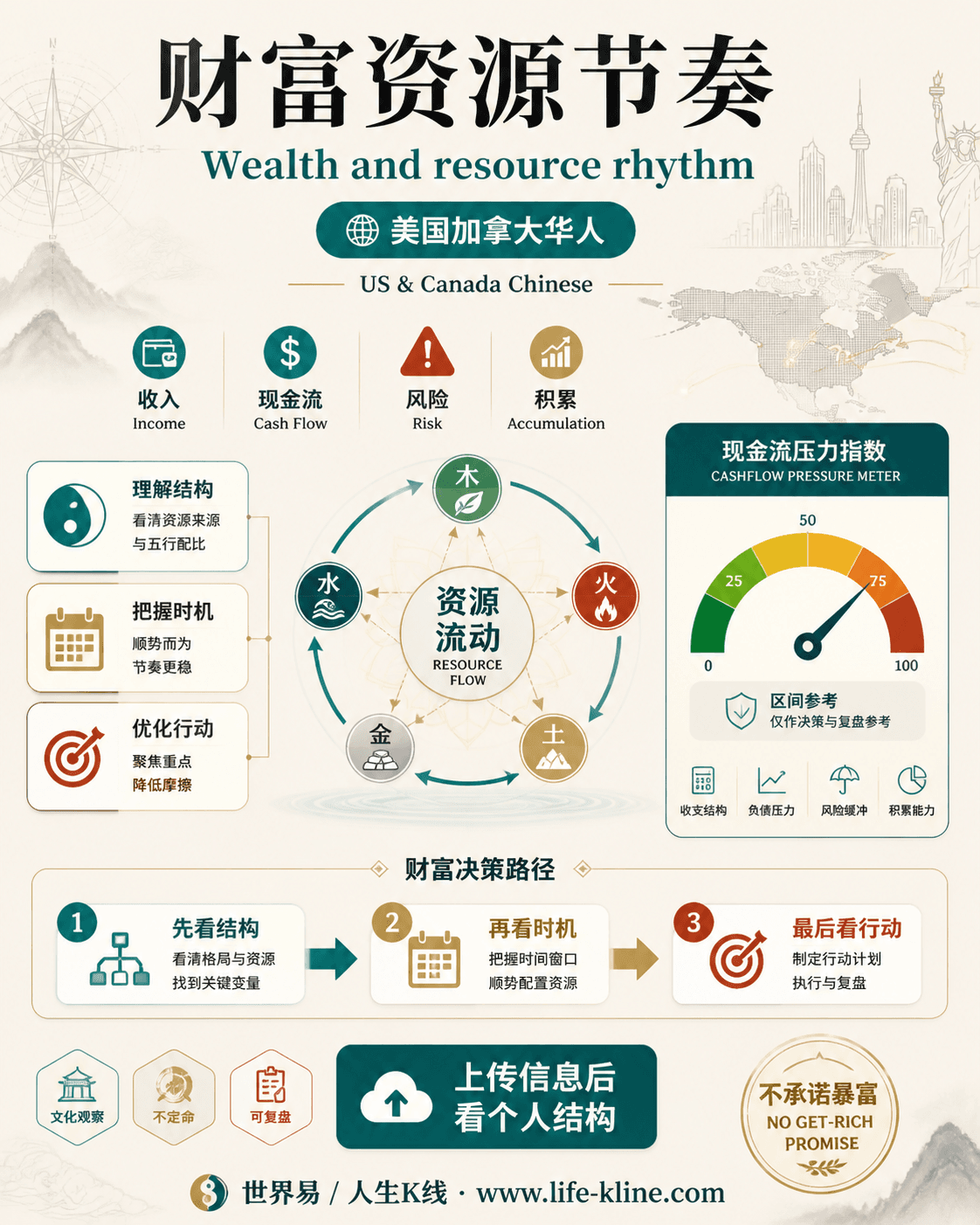
财富资源节奏|美国加拿大华人
这张图把《Metaphysical Reference Analysis on Insurance and Annuity Allocation Ratios and Family Positioning》里的命理概念转成关系、边界和应用场景,适合先看图建立结构,再回到知识文章正文理解细节。
财富资源节奏不应被写成固定结论。更适合美国加拿大华人的读法,是把传统术语翻译成结构、时机、环境、行动和复盘。
查看图片解读