Metaphysical Analysis of Family Inheritance Risk Tolerance and Financial Decision Guidance
把这篇文章落到自己身上验证:先看结构,再进入个人分析,不做泛泛阅读。
Why This Decision Is Especially Difficult in This Wealth Scenario
Family inheritance and gifting involve numerous practical constraints, including fairness in parental asset distribution, conflicts of interest among siblings, power balance in business succession, and tax compliance planning. Each factor deeply affects family members’ emotions and financial interests, placing enormous psychological pressure on decision-makers, making objective and rational choices challenging.
Moreover, the current high housing prices and inflation environment in China cause significant asset value fluctuations. The actual risk tolerance of family wealth not only relates to wealth preservation and appreciation but also directly impacts the long-term stability of family relationships. External factors such as loans among relatives and stock market volatility further increase decision uncertainty.
From a metaphysical perspective, the combinations of Wealth Stars (Cai Xing), Bi Jian (Peer Stars), and Yin Stars (Resource Stars) not only reflect wealth accumulation ability but also imply risk preference and stress response patterns. The relationships between Yong Shen (favorable elements) and Ji Shen (unfavorable elements), especially their interactions during Da Yun (decade luck cycles) and Liu Nian (annual fortune), reveal the true risk appetite of the individual beyond surface expressions.
Therefore, integrating metaphysical structures with contemporary financial realities to understand the deeper manifestations of risk tolerance is key to making sound decisions in family inheritance and gifting. Without this comprehensive perspective, emotional judgments and resource misallocation are prone, ultimately affecting the quality of wealth succession.
Three Core Dimensions of Metaphysical Judgment
First, the relationship between the Day Master (Ri Zhu) and the Wealth Stars forms the foundation of wealth risk tolerance. The strength or weakness of the Day Master determines the individual’s energy and stress resistance, while Wealth Stars represent wealth acquisition and external resources. A weak Day Master combined with strong Wealth Stars may superficially indicate attractive wealth but limited risk-bearing capacity, easily causing imbalance in wealth competition.
Second, the presence of Bi Jian (Peer Stars) reflects relationships and cooperation status with relatives and siblings. Strong Bi Jian usually indicates resource sharing and mutual support but can also bring competition and conflict, affecting cooperation stability during inheritance and indirectly influencing risk tolerance.
Third, Yin Stars (Resource Stars) represent support and protective forces. A strong Yin Star implies good spiritual and practical backing that can buffer external risks. The interplay of Yong Shen and Ji Shen related to Yin Stars determines whether strategies can be effectively adjusted during Da Yun and Liu Nian changes to adapt to sudden events in family wealth inheritance.
Additionally, the interaction between Da Yun and Liu Nian embodies dynamic risk. During stable Da Yun periods, risk tolerance tends to be steady, suitable for preservation and prudent planning; when Liu Nian brings clashes or combinations, flexible responses are required. Changes in Wealth Stars and Bi Jian especially reflect the individual’s real risk adjustment ability.
Three Real BaZi Chart Cases
Case 1: This male aged 25-30 has a relatively weak Day Master Yi Wood (乙, Yi), with a Zheng Yin (Proper Resource) pattern. His Yong Shen is Water, and Ji Shen are Fire and Earth. Currently in the Geng Yin (庚寅, Geng Yin) Da Yun, with Liu Nian Bing Wu (丙午, Bing Wu). His Wealth Stars show a cautious stance, Bi Jian is not strong, and Yin Stars dominate his chart, indicating reliance on support and protection in family inheritance. The weak Day Master and Wealth Stars suggest low risk tolerance, easily pressured in sibling asset competitions. It is recommended to focus on assessing external environment changes in inheritance risk decisions, avoid blind risks, and prioritize steady preservation with professional tax and legal support.
Case 2: This male aged 35-40 has a relatively strong Day Master Wu Earth (戊, Wu), with a Yang Ren (羊刃, Yang Blade) pattern. Yong Shen is Earth, Ji Shen is Fire. Currently in the Gui Si (癸巳, Gui Si) Da Yun, with Liu Nian Bing Wu (丙午, Bing Wu). The Yang Ren pattern emphasizes self-direction and strong initiative. Wealth Stars show strong wealth control desire, and Bi Jian may bring obvious sibling competition. His risk tolerance is relatively high, tending to actively pursue family wealth and showing a more aggressive attitude during business succession. Financial decisions should monitor his strong risk preference to avoid emotional impulsiveness causing family conflicts and tax risks. Guidance through stable cooperation mechanisms and risk diversification strategies is advised.
Case 3: This male aged 40-45 has a relatively strong Day Master Geng Metal (庚, Geng), with a Zheng Yin (Proper Resource) pattern. Yong Shen are Fire and Wood, Ji Shen is Earth. Currently in the Gui You (癸酉, Gui You) Da Yun, with Liu Nian Bing Wu (丙午, Bing Wu). The Zheng Yin pattern with Fire and Wood as Yong Shen indicates a strong support system and adjustment ability. Wealth Stars are stable, Yin Stars are strong, showing good utilization of family resources and external assistance during wealth accumulation and inheritance. Risk tolerance is moderate to high, able to remain rational amid complex tax and asset allocation. It is recommended to emphasize long-term planning and diversified asset allocation in family wealth succession, leveraging metaphysical advantages to balance internal family relations and optimize risk management.
These three cases, starting from different metaphysical structures and combined with real inheritance challenges, illustrate the multidimensional manifestations of risk tolerance. Metaphysics not only reveals individuals’ latent attitudes toward wealth risk but also provides dynamic risk identification paths for specific decisions.
Common Misjudgments and Blind Spots in This Scenario
A common misjudgment in family inheritance decisions is overreliance on verbally expressed risk preferences while neglecting true risk signals in metaphysical structures. Especially when the combination of Wealth Stars and Bi Jian is not fully interpreted, risk tolerance may be overestimated or underestimated, causing unreasonable expectations in asset distribution.
Another blind spot is ignoring the protective and supportive role of Yin Stars. Many inheritors lack effective external support and buffering mechanisms when facing complex family struggles, resulting in frequent emotional decisions that exacerbate family conflicts and wealth loss.
Furthermore, disregarding the dynamic changes of Da Yun and Liu Nian and assuming risk tolerance is fixed leads to shortsightedness and stubbornness. Family wealth inheritance and gifting is a long-term, dynamically adjusting process that must incorporate metaphysical temporal-spatial changes to flexibly respond to internal and external risks.
Finally, tax arrangements and legal compliance are often viewed as technical details separate from metaphysical risk tolerance, causing hidden costs and potential risks in the wealth succession process to be underestimated, thus affecting overall inheritance outcomes.
Operational Judgment Sequence
First, clarify the strength of the Day Master and pattern positioning, combined with Yong Shen and Ji Shen, to preliminarily assess the individual’s foundational energy for risk tolerance. For family inheritance, focus on analyzing the current status of Wealth Stars and Bi Jian and their performance in the current Da Yun and Liu Nian to judge wealth control ability and cooperation or competition with relatives.
Second, evaluate the support role of Yin Stars to determine whether the person has sufficient resource protection and external support, especially their adaptability facing family disputes and tax adjustments. The interaction of Da Yun and Liu Nian provides dynamic risk signals; combined with specific annual influences, decide whether it is suitable to act proactively or conservatively wait.
Finally, integrate the real financial environment, such as housing price fluctuations, tax policies, and family structure, to formulate specific risk tolerance strategies. Those with low risk tolerance should adopt steady preservation, emphasizing professional planning and legal safeguards; those with higher risk tolerance must control impulses, reasonably diversify risks, and avoid major losses caused by emotions. The entire process should be dynamically adjusted with regular reviews of metaphysical and real-world alignment to ensure scientific and sustainable decision-making.
FAQ
Question 1: Does a strong Wealth Star in the BaZi chart mean higher inheritance risk tolerance? Answer: A strong Wealth Star indicates strong wealth capability, but if the Day Master is weak or Bi Jian is overly strong, risk tolerance may be insufficient or family internal conflicts may intensify. Therefore, strong Wealth Stars do not necessarily equate to high risk tolerance; the overall pattern must be considered.
Question 2: How does Bi Jian affect family inheritance risk tolerance? Answer: Bi Jian represents sharing and competition among relatives and friends. When strong, it offers cooperation potential but may also trigger family conflicts, affecting the stability of risk tolerance. Correct interpretation of Bi Jian helps anticipate cooperation and conflicts during inheritance, guiding risk management strategies.
Question 3: How to use Da Yun and Liu Nian to judge timing for risk tolerance? Answer: Da Yun and Liu Nian reflect dynamic changes in metaphysical energies. Stable Da Yun periods suit preservation and steady planning, while Liu Nian with clashes or combinations indicates risk adjustment phases. Combining the chart’s Yong Shen and Ji Shen helps decide whether to act proactively or wait conservatively, optimizing inheritance risk tolerance strategies.
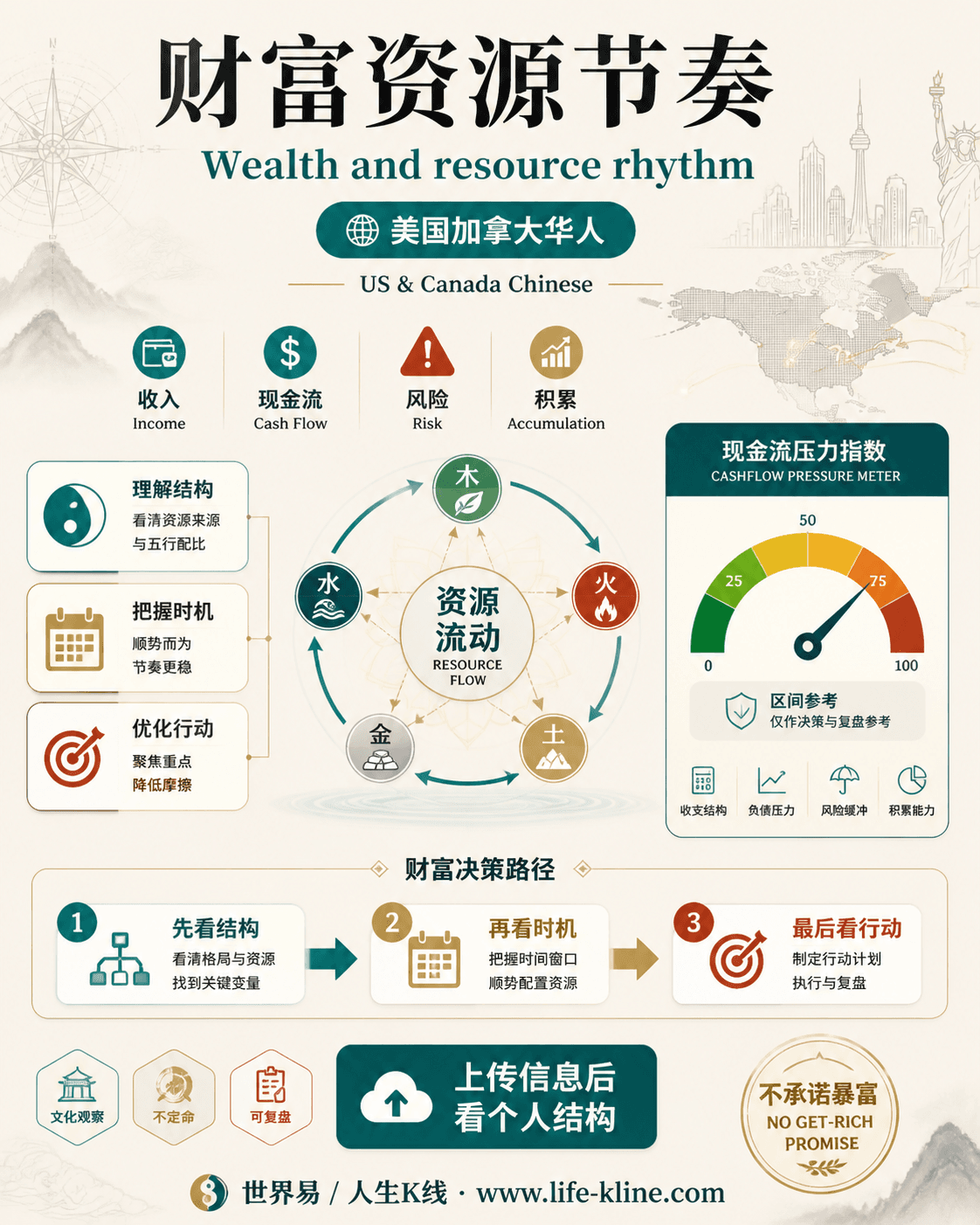
财富资源节奏|美国加拿大华人
这张图把《Metaphysical Analysis of Family Inheritance Risk Tolerance and Financial Decision Guidance》里的命理概念转成关系、边界和应用场景,适合先看图建立结构,再回到知识文章正文理解细节。
财富资源节奏不应被写成固定结论。更适合美国加拿大华人的读法,是把传统术语翻译成结构、时机、环境、行动和复盘。
查看图片解读