Post-Loss Review and Restart in Family Inheritance: A Metaphysical Analysis
把这篇文章落到自己身上验证:先看结构,再进入个人分析,不做泛泛阅读。
Why This Decision Is Especially Difficult in This Wealth Scenario
Family inheritance and gifting involve the distribution of parental assets, sibling interest conflicts, business succession challenges, and complicated tax arrangements, resulting in high real-world uncertainty. Especially after losses occur, how to review past decisions and restart wealth management plans becomes a core difficulty. Inflation pressures asset preservation, housing prices and stock market volatility tighten cash flow, family savings are generally insufficient, and complex lending relationships among relatives further complicate emotional and financial entanglements.
Psychologically, losses often lead to avoidance of reality or excessive optimism biases, causing blind remediation or premature loss recognition. The metaphysical structure subconsciously influences an individual's risk tolerance and decision tendencies. For example, a strong Cai Xing (Wealth Star) but weak Day Master (Ri Zhu) may manifest as an excessive pursuit of wealth recovery while neglecting risk control; a chart with strong Bi Jian (Peer) stars tends to experience resource dispersion and internal friction in family wealth disputes.
Moreover, the interaction between Da Yun (decade luck cycles) and Liu Nian (annual fortune) can amplify or suppress the difficulty of post-loss review. Auspicious Da Yun support steady actions and resource integration, while adverse Da Yun require greater caution to avoid blind investments. Overall, this decision is not merely a financial adjustment but a comprehensive reflection of family relationships and personal metaphysical conditions, making it particularly complex.
Therefore, viewing through a metaphysical lens combined with contemporary financial realities, precisely grasping when to recognize losses and exit or when to actively remediate becomes key to improving decision quality.
Three Core Dimensions of Metaphysical Judgment
The relationship between the Day Master (Ri Zhu) and Cai Xing (Wealth Star) forms the foundation of wealth decisions. The strength of the Day Master determines individual risk tolerance; a relatively strong Day Master means abundant energy and self-recovery capability, while a weak Day Master relies on support from Cai Xing or Yin Xing (Resource Stars). Cai Xing represents wealth resources; when strong, it indicates strong accumulation and acquisition ability, but if in conflict with Ji Shen (unfavorable elements), it may lead to wealth loss.
Bi Jian (Peer) stars symbolize peer resources and competition. In family inheritance scenarios, strong Bi Jian indicates intense sibling rivalry, resource dispersion, and increased difficulty in cooperation. Yin Xing represents supportive forces that can ease conflicts and enhance stability. The reasonable configuration of Yong Shen (favorable elements) is key to balancing these three factors, determining the path for post-loss review and restart.
The interaction between Da Yun and Liu Nian reflects the temporal influence on wealth fortune. Favorable luck phases are suitable for resource integration and recovery planning, while adverse phases advise caution and possible loss limitation. Aligning with Liu Nian can effectively assist Da Yun in strengthening action; if Liu Nian conflicts with Da Yun, risks must be carefully assessed to avoid blind operations.
Integrating these three dimensions requires examining the intrinsic strength of the Day Master and Yong Shen configuration within the chart, alongside external Da Yun and Liu Nian conditions, to scientifically judge when to recognize losses or when to remediate.
Three Real BaZi Chart Cases
Case 1: Female, 40-45 years old, Day Master Bing (丙, Fire) relatively strong, Qi Sha (Seven Killings) pattern, Yong Shen are Water and Metal, Ji Shen is Wood. Current Da Yun is Wu Zi (戊子, auspicious luck with career and wealth progress), Liu Nian is Bing Wu (丙午). This chart shows a Day Master with strong Fire; Cai Xing Water and Metal as Yong Shen indicate smooth wealth acquisition channels and strong risk resistance. The Qi Sha pattern reflects strong decisiveness and action capability, suitable for proactive measures. Both Da Yun and Liu Nian are favorable, aiding family wealth integration and effective loss review and restart. In family inheritance contexts, she can rationally face sibling disputes and use Yong Shen Water and Metal to resolve conflicts. The recommended judgment sequence is to first confirm if Da Yun and Liu Nian support remediation; if favorable over consecutive years, actively adjust asset allocation; otherwise, cautiously evaluate the timing to recognize losses.
Case 2: Male, 45-50 years old, Day Master Ren (壬, Water) relatively weak, Qi Sha pattern, Yong Shen Metal, Ji Shen Wood and Fire. Current Da Yun is Gui Si (癸巳, stable luck suitable for preservation), Liu Nian is Bing Wu (丙午). A weak Day Master indicates limited risk tolerance, relying on Yong Shen Metal for wealth support. The Qi Sha pattern brings external pressure and competition; the presence of Ji Shen Wood and Fire increases decision-making resistance and potential friction. The Da Yun is stable but not significantly favorable; Liu Nian Bing Wu brings some volatility, implying cautiousness during loss review to avoid blind remediation causing greater loss. Considering family inheritance realities, he may face sibling financial disputes and heavy tax burdens. It is advised to first assess the safety margin of existing assets, confirm if preservation is reasonable, and if necessary, choose to recognize losses and exit to avoid risk expansion.
Case 3: Female, 30-35 years old, Day Master Ren (壬, Water) relatively strong, Yang Ren (Yang Blade) pattern, Yong Shen Earth and Fire, Ji Shen Metal. Current Da Yun is Yi Chou (乙丑, auspicious luck with career and wealth progress), Liu Nian is Bing Wu (丙午). A relatively strong Ren Day Master shows strong self-repair and resource integration ability; the Yang Ren pattern represents resilience and breakthrough in adversity. Yong Shen Earth and Fire help stabilize the foundation and stimulate potential. The current Da Yun is auspicious and Liu Nian is favorable, conducive to proactive remediation and wealth restructuring. In family inheritance scenarios, she is suited to leverage her advantages to integrate family resources, optimize asset structure, and actively address post-loss challenges. The judgment sequence should prioritize checking if Yong Shen is conflicted by Liu Nian or Da Yun; if supported well, formulate a relatively aggressive remediation plan; if conflicted, set risk stop-loss points to prevent loss expansion.
Common Misjudgments and Blind Spots in This Scenario
A common misjudgment during loss review is over-reliance on emotional factors while neglecting the alignment of metaphysics and financial realities. Family members often emotionally handle asset distribution, leading to blind over-investment in remediation and ignoring the Day Master’s strength and Yong Shen status on risk tolerance, easily resulting in cash flow breaks or family relationship breakdowns.
Another blind spot is insufficient consideration of the interaction between Da Yun and Liu Nian. Some decision-makers focus only on the current Liu Nian’s auspiciousness but overlook the overall Da Yun trend, resulting in blind optimism during adverse luck or missed opportunities during favorable luck, misjudging the best timing for loss recognition or restart.
Additionally, charts with strong Bi Jian stars tend to experience resource internal friction and intense competition in family wealth handling. Failure to identify this structure can trigger unnecessary family disputes and resource dispersion, reducing overall wealth recovery efficiency.
Finally, the impact of Ji Shen is often ignored, especially regarding tax arrangements and legal compliance. If the obstacles represented by Ji Shen are not properly resolved, they will increase the difficulty of review and restart, raising the risk of decision errors.
Practical Judgment Sequence
Step one: Assess the strength of the Day Master and the status of Yong Shen to determine personal risk tolerance and the foundational conditions for wealth recovery. A strong Day Master with good Yong Shen support suits active remediation; a weak Day Master or conflicted Yong Shen requires cautious consideration of loss recognition and exit to avoid expanding losses.
Step two: Analyze the current interaction between Da Yun and Liu Nian to judge whether the external environment favors wealth integration and recovery. Favorable Da Yun with aligned Liu Nian indicates a good opportunity to start review and restart; adverse luck or conflicting Liu Nian suggests maintaining a conservative stance and waiting for a better timing.
Step three: Combine the Bi Jian and Yin Xing (Resource Stars) configuration to evaluate internal family resource cooperation and conflict. Excessive Bi Jian requires vigilance against internal friction and appropriately introducing Yin Xing to balance; strong Yin Xing benefits family relationship stability and wealth security, facilitating steady progress after review.
In summary, decision-making should first confirm the alignment of internal metaphysical and external environmental factors, prioritize risk boundaries, then formulate loss recognition or remediation plans based on actual financial conditions, avoiding blind emotional actions.
FAQ
Question 1: In family inheritance, how to judge whether to recognize loss and exit after a loss? Answer: First assess the strength of your Day Master and whether Yong Shen is conflicted, combined with the auspiciousness of current Da Yun and Liu Nian. If overall unfavorable and resource support insufficient, recognizing loss and exiting can better avoid risk expansion.
Question 2: What impact does strong Bi Jian in metaphysics have on family inheritance review? Answer: Strong Bi Jian often means intense competition among family members and easy resource dispersion. During review, attention should be paid to coordinating cooperation to avoid internal friction causing further wealth loss.
Question 3: When Liu Nian conflicts with Da Yun, how should the review strategy be adjusted? Answer: Maintain caution, avoid major investments or asset restructuring, prioritize steady preservation, and wait for favorable Da Yun or aligned Liu Nian before taking active actions.
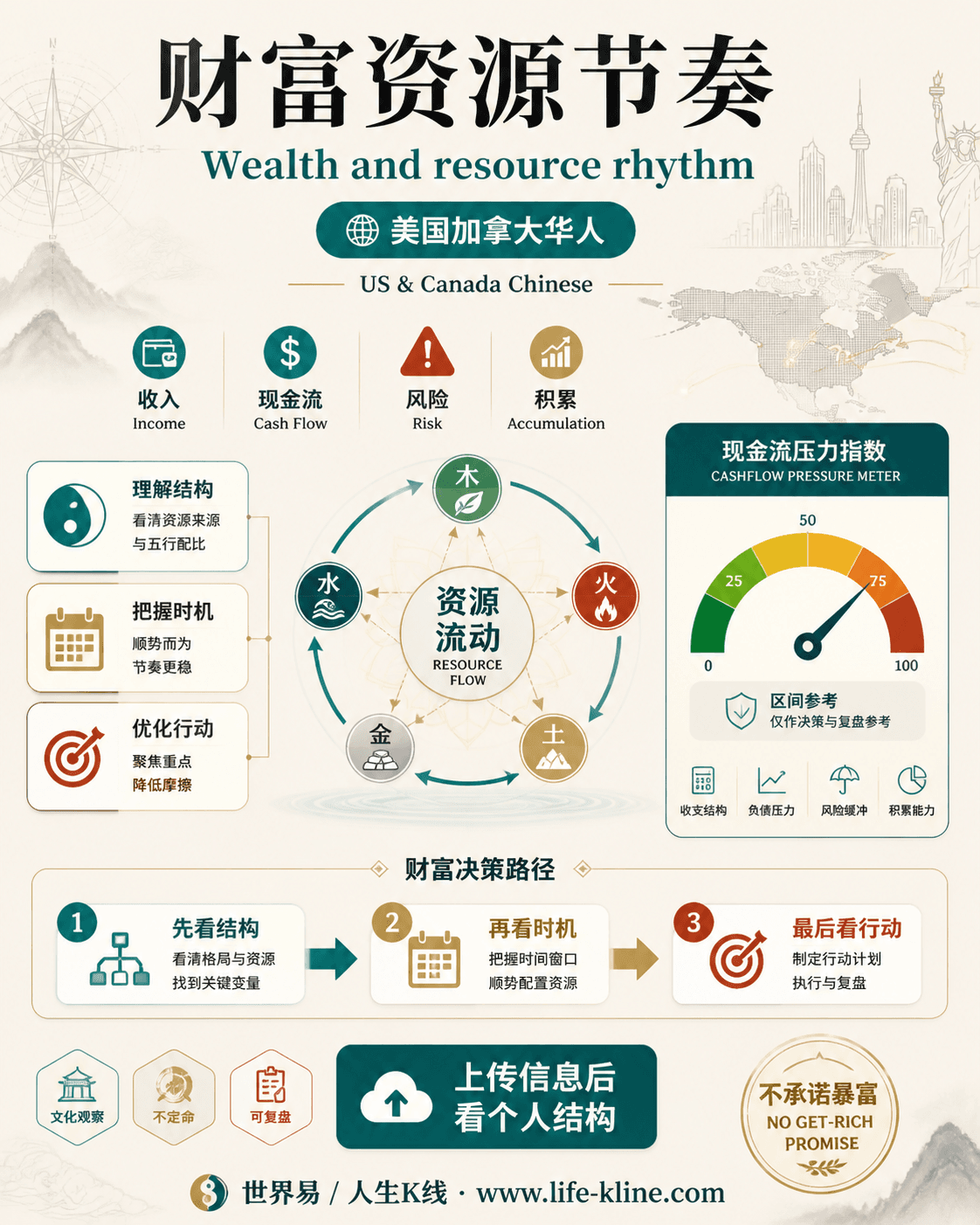
财富资源节奏|美国加拿大华人
这张图把《Post-Loss Review and Restart in Family Inheritance: A Metaphysical Analysis》里的命理概念转成关系、边界和应用场景,适合先看图建立结构,再回到知识文章正文理解细节。
财富资源节奏不应被写成固定结论。更适合美国加拿大华人的读法,是把传统术语翻译成结构、时机、环境、行动和复盘。
查看图片解读