An Auxiliary BaZi Analysis and Practical Guide for Judging Cooperative Partners in Family Inheritance
把这篇文章落到自己身上验证:先看结构,再进入个人分析,不做泛泛阅读。
Why This Decision Is Especially Difficult in This Wealth Scenario
Family inheritance and gifting involve large asset distribution and complex interpersonal relationships. Parental asset allocation often affects the balance of interests among siblings, business succession includes the transfer of power and responsibility, and tax planning adds complexity to compliance and risk management. In this environment, finding a trustworthy cooperative partner becomes a core challenge in financial decision-making.
In reality, the intertwining of familial affection and interests makes judging the credibility of cooperative partners full of uncertainty. Implicit competition among family members is inevitable, and it is difficult to comprehensively assess the borrower's or investor's integrity and capability. Psychologically, decision-makers often carry emotional biases, overlooking potential risk signals from the other party.
From a BaZi perspective, the strength of the Day Master, the relationship between Wealth Stars and Bi Jian/Jie Cai (Peer/Rob Wealth stars) reflect the mutual assistance and competition dynamics in cooperation. Yong Shen (favorable elements) and Ji Shen (unfavorable elements) indicate favorable or adverse conditions in financial decisions. Da Yun (decade luck) and Liu Nian (annual fortune) reveal the current environment’s support or pressure. The combination of these three forms a multidimensional framework for judging cooperation credibility.
Therefore, the difficulty of this decision lies in integrating real financial constraints, interpersonal psychological dynamics, and BaZi structures to scientifically evaluate the risks and potentials of cooperative partners, avoiding missed opportunities due to blind trust or excessive caution.
Three Core Dimensions of BaZi Judgments
First, the relationship between the Day Master and Wealth Stars is an important dimension for judging a cooperative partner’s wealth fortune and capital flow capability. A relatively strong Day Master usually indicates strong self-drive; prosperous Wealth Stars reflect abundant financial resources, but if Wealth Stars are overly strong, it may cause capital disputes or overreliance on external support.
Second, the presence of Bi Jian/Jie Cai stars reveals competition and sharing in cooperation. Strong Bi Jian/Jie Cai represents strong peer power, which may support among relatives or partners but might also lead to resource contention. Appropriate Bi Jian/Jie Cai fosters good mutual assistance; otherwise, internal friction should be guarded against.
Finally, the interaction between Liu Nian (annual fortune) and Da Yun (decade luck) reflects the current and future fortune environment. Auspicious luck aligned with Yong Shen can amplify cooperation success, while Ji Shen in command signals increased risks. Especially when Da Yun is stable and Liu Nian is favorable, actions are relatively safe; otherwise, timing should be observed cautiously.
In summary, when judging cooperation credibility, focus on the Day Master’s strength and the balance with corresponding Wealth Stars, the impact of Bi Jian/Jie Cai’s increase or decrease on relationships, and the support or restriction from Da Yun and Liu Nian, forming a three-dimensional BaZi map to provide reference for real financial decisions.
Three Real BaZi Case Studies
Case 1: This female’s BaZi chart has a Day Master of 戊 (Wu, Earth) that is relatively strong, belonging to the Qi Sha (Seven Killings) pattern. Her Yong Shen are Wood and Water, and Ji Shen is Fire. Currently, she is in the 己酉 (Ji You) Da Yun, a stable preservation period, with the Liu Nian of 丙午 (Bing Wu) bringing adaptability. In family inheritance and gifting, her strong Day Master indicates strong self-drive; the Qi Sha pattern suggests good ability to handle complex relationships, but the Ji Shen Fire may imply internal friction or emotional conflicts. The Yong Shen Wood and Water suggest she should seek partners who can bring growth and liquidity, avoiding cooperation with those strong in Fire elements. For judging cooperative partners, focus on whether the other party can bring Wood and Water supportive energy. Since the Da Yun is stable and preservation-oriented, a prudent approach is advised, prioritizing observation of the partner’s financial steadiness before deep cooperation.
Case 2: This male’s BaZi chart has a Day Master 癸 (Gui, Water) that is relatively strong, with a Qi Sha pattern. His Yong Shen are Earth and Fire, and Ji Shen is Metal. He is in the 丙戌 (Bing Xu) Da Yun, with the current Liu Nian of 丙午 (Bing Wu), overall very auspicious and favorable to act accordingly. His Qi Sha pattern shows strong ability to face challenges; the strong Day Master Water indicates suitability for flexible adaptation. The Wealth Stars Earth and Fire as Yong Shen indicate that his cooperative partners should have stable resource support and driving force. The presence of Ji Shen Metal warns against competition or interference from strong Metal elements. In the family inheritance scenario, he is suitable to cooperate with partners who are steady and have strong execution ability, especially valuing their resource integration capacity. The judgment sequence should first confirm whether the partner’s financial structure has coordinated Earth and Fire elements, avoiding cooperation with parties strong in Metal elements, ensuring resource complementarity rather than conflict.
Case 3: This female’s BaZi chart has a Day Master 癸 (Gui, Water) that is relatively strong, with the Pian Cai (Indirect Wealth) pattern. Her Yong Shen is Metal, and Ji Shen is also Metal. She is currently in the 甲申 (Jia Shen) Da Yun, with the Liu Nian of 丙午 (Bing Wu). The Da Yun is auspicious, with progress in career and wealth. The Pian Cai pattern indicates strong wealth attraction ability; Yong Shen Metal means she needs Metal element support in cooperation to stabilize financial sources. However, the contradictory Ji Shen Metal warns to be cautious of conflicts caused by excessive Metal element in cooperation. In family inheritance cooperation, she should seek partners with balanced Metal elements who can bring wealth growth. Judgment should focus on whether the partner’s Metal element configuration is appropriate, avoiding disputes over funds or rights caused by Metal element clashes. It is recommended to start by evaluating the partner’s financial transparency and stability, confirming complementary financial structures before advancing cooperation.
Common Misjudgments and Blind Spots in This Scenario
A common misjudgment in family inheritance and gifting cooperation is overreliance on familial affection to judge the credibility of cooperative partners, neglecting professional assessment of financial and BaZi structures. Familial relationships may conceal potential financial risks and personality conflicts, leading to blind trust that ultimately affects wealth security.
Another blind spot is ignoring the warning role of Ji Shen (unfavorable elements) in BaZi. Some decision-makers focus only on the apparent strength of the Day Master and Wealth Stars without deeply analyzing the balance between Yong Shen and Ji Shen, which easily misjudges the partner’s resource complementarity and potential risks.
Furthermore, insufficient attention to the dynamic influence of Da Yun and Liu Nian leads to poor timing choices. Especially when Da Yun is unfavorable or Liu Nian causes clashes, acting rashly may cause cooperation setbacks or difficulties in capital flow.
Lastly, the financial transparency and communication mechanisms of cooperative partners are often inadequately examined. Relying solely on BaZi structure for decisions has limitations. BaZi should serve as an auxiliary tool combined with real financial due diligence to reduce cooperation risks.
Practical Judgment Sequence
Step 1: Assess the cooperative partner’s Day Master strength and BaZi pattern, confirm whether their Wealth Stars and Bi Jian/Jie Cai combinations complement your own BaZi structure, paying special attention to the balance between Yong Shen and Ji Shen to ensure resource support rather than conflict in cooperation.
Step 2: Combine the current auspiciousness or inauspiciousness of Da Yun and Liu Nian to judge the suitability of timing. When Da Yun is stable and Liu Nian is favorable, cooperation risk is lower and can be considered; if there are clashes or unfavorable signs, it is advisable to postpone or take precautionary measures.
Step 3: Conduct real-world financial transparency and integrity due diligence, combining BaZi-indicated risk points to screen for potential capital chain issues or personality obstacles, avoiding decisions based solely on BaZi.
Finally, establish cooperation communication and risk-sharing mechanisms to ensure clear mutual rights. BaZi analysis should be an auxiliary reference, integrated with financial and legal frameworks to form a comprehensive and robust cooperation judgment system.
FAQ
Question 1: How do Yong Shen and Ji Shen specifically affect the choice of cooperative partners in BaZi? Answer: Yong Shen represents favorable elements in cooperation that promote financial growth and harmonious relationships; Ji Shen indicates potential conflicts or risks. When choosing partners, seek those whose BaZi structures have Yong Shen complementary to yours and Ji Shen that do not conflict, reducing cooperation disputes and financial risks.
Question 2: Should cooperation be completely avoided when Da Yun and Liu Nian are unfavorable? Answer: Unfavorable Da Yun and Liu Nian indicate increased environmental pressure and higher risks, but do not necessarily require complete avoidance of cooperation. Strengthening risk control, carefully evaluating the partner’s finances and relationships, and adopting conservative strategies or delaying cooperation timing may be necessary.
Question 3: Can BaZi replace financial due diligence and legal review? Answer: BaZi is an auxiliary tool providing multidimensional risk references but cannot replace financial due diligence and legal review. Reasonably combining all three allows comprehensive control of risks and opportunities in family inheritance cooperation.
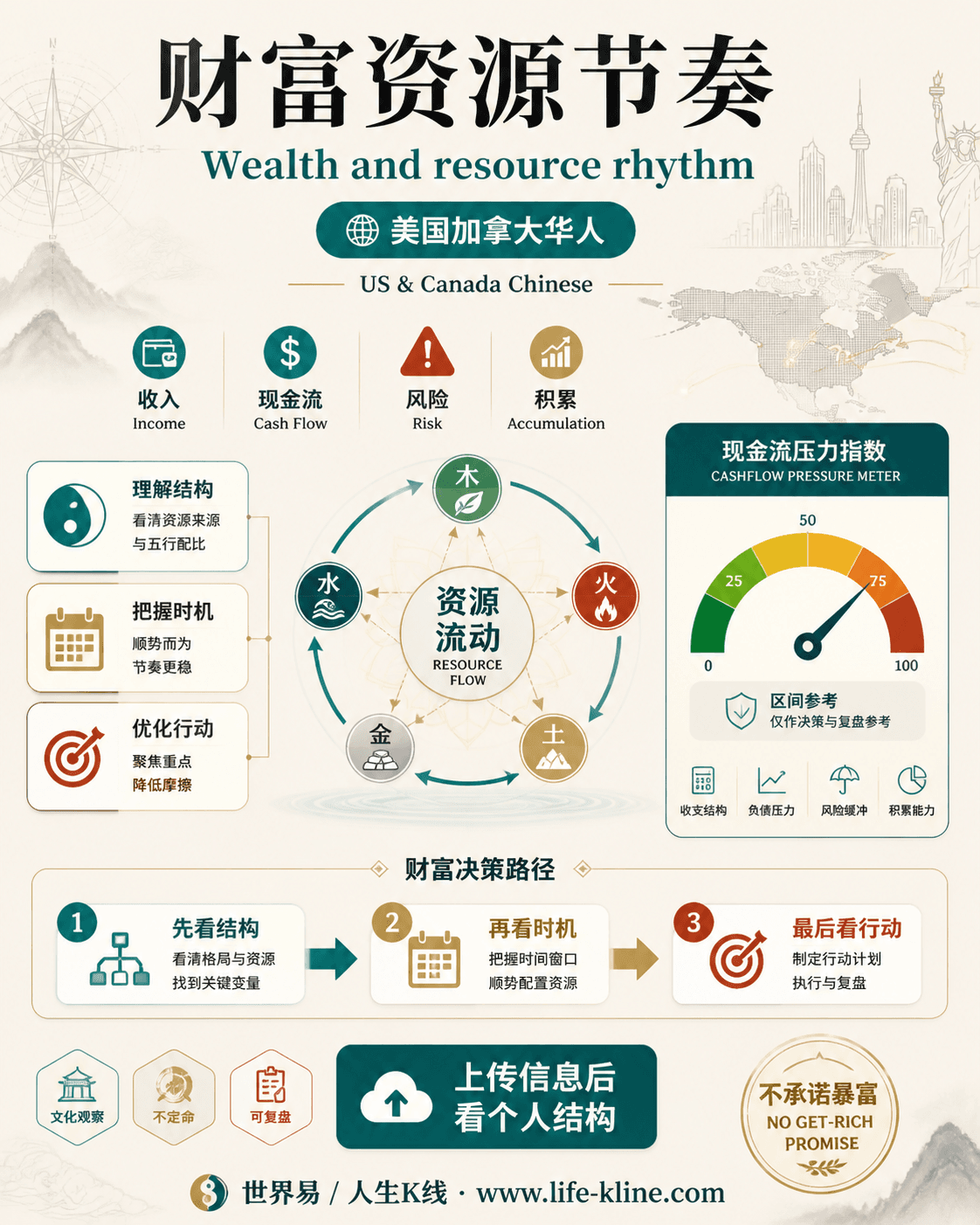
财富资源节奏|美国加拿大华人
这张图把《An Auxiliary BaZi Analysis and Practical Guide for Judging Cooperative Partners in Family Inheritance》里的命理概念转成关系、边界和应用场景,适合先看图建立结构,再回到知识文章正文理解细节。
财富资源节奏不应被写成固定结论。更适合美国加拿大华人的读法,是把传统术语翻译成结构、时机、环境、行动和复盘。
查看图片解读