Metaphysical Financial Decision Analysis for the Optimal Time Window of Family Inheritance
把这篇文章落到自己身上验证:先看结构,再进入个人分析,不做泛泛阅读。
Why This Decision Is Especially Difficult in This Wealth Scenario
The complexity of family inheritance and gifting decisions arises from multiple real-world constraints. Parental asset distribution must consider legal and tax requirements alongside emotional dynamics among family members. Business succession involves operational continuity and interest balancing. Additionally, the current environment of high housing prices, interest rates, and inflation intensifies the pressure on wealth transfer. Choosing an inappropriate timing may lead to asset value depreciation or strained family relationships.
On a psychological level, inheritance decisions are often influenced by emotional entanglements and conflicts of interest, which can cause shortsighted or extreme behaviors. Especially when there is sibling rivalry, emotional fluctuations may amplify decision risks, resulting in uneven asset division or inheritance disputes.
From a metaphysical perspective, the relationship between the Day Master and its Yong Shen (favorable elements) and Ji Shen (unfavorable elements) combinations significantly affects the auspiciousness of the inheritance timing. The clash and combination relationships between Da Yun (decade luck cycles) and Liu Nian (annual fortunes) determine the smoothness of actions. Ignoring these metaphysical signals may cause obstacles in financial arrangements, tax planning, or business succession.
Therefore, the optimal time window for family inheritance is not only a matter of legal and market considerations but must also integrate the BaZi structure. Avoiding Ji Shen dominance or unfavorable Da Yun periods when pushing forward blindly ensures the stability and appreciation of wealth succession.
Three Core Dimensions of Metaphysical Judgment
First, the relationship between the Day Master and the wealth stars is a crucial basis for judging the timing of family inheritance. The strength of the Day Master influences its ability to control wealth, while the Sheng-Ke (generating and overcoming) relationships of the wealth stars reflect the direction and stability of wealth flow. In inheritance scenarios, a strong wealth star with a moderate Day Master indicates smoother wealth succession.
Second, the Bi Jian (peer) and Jie Cai (rob wealth) stars reflect cooperation or competition among family members. When Bi Jian and Jie Cai are strong, siblings may have intense rivalry, so it is advisable to choose Da Yun and Liu Nian where these stars are weak or restrained to avoid escalating conflicts.
Third, the clash and combination situations between Da Yun and Liu Nian affect the overall environmental favorability. When Da Yun is stable and the Yong Shen is empowered, it is a favorable time to advance family asset distribution and business succession. Conversely, if Da Yun carries Ji Shen and Liu Nian clashes with Da Yun, caution and waiting are advised.
By integrating these three dimensions with the current financial market environment and tax policies, one can more scientifically select the optimal time window for inheritance, reducing risks and increasing success rates.
Three Real BaZi Chart Cases
Case 1: This female’s BaZi chart has a Day Master of Geng Metal (庚, Gēng), moderately strong with a Cong Er pattern. The Yong Shen are Water and Wood, and the Ji Shen is Earth. She is currently in the Wu Xu Da Yun (戊戌, Wù Xū) — an unfavorable luck cycle requiring caution against major upheavals. The Liu Nian is Bing Wu (丙午, Bǐng Wǔ), both Da Yun and Liu Nian are relatively weak, signaling a cautious overall fortune. In the family inheritance context, she faces pressure from parental asset distribution and sibling rivalry. The Earth-heavy Ji Shen Wu Xu Da Yun tends to provoke family tension and financial volatility. The optimal time window should avoid the early phase of the Da Yun and periods of Liu Nian clash. Waiting until the Da Yun enters a more stable phase with the Yong Shen Water and Wood empowered will facilitate successful inheritance arrangements. The recommended judgment sequence is to first check the activity level of the Ji Shen Earth in the Da Yun, then consider the clash and combination of Liu Nian, and finally confirm the timing when the Yong Shen is strong before proceeding.
Case 2: This male’s Day Master is Xin Metal (辛, Xīn), relatively weak, with a Pian Cai (偏财) pattern. The Yong Shen is Water, and the Ji Shen is Wood. He is currently in the Wu Shen Da Yun (戊申, Wù Shēn), which is stable, and the Liu Nian is Bing Wu (丙午, Bǐng Wǔ), showing some adaptability characteristics. In family inheritance, he is suited for preserving wealth, avoiding fierce competition and risky investments. Since the Yong Shen Water is restrained by the Ji Shen Wood, inheritance timing should avoid Wood-strong Liu Nian and Da Yun periods to prevent wealth loss or inheritance disputes. The best time window is when the Da Yun is stable and Liu Nian lacks strong Ji Shen influence, especially when Water is supported or there is a balance between Water and Wood in the Liu Nian. It is advised to first assess the strength of Ji Shen Wood in the current Da Yun and Liu Nian, then evaluate the support for Yong Shen Water to ensure stable financial arrangements before execution.
Case 3: This male’s Day Master is Geng Metal (庚, Gēng), relatively weak, with a Shang Guan (伤官) pattern. The Yong Shen is Wood, and the Ji Shen is Water. He is currently in the Bing Shen Da Yun (丙申, Bǐng Shēn), and the Liu Nian is Bing Wu (丙午, Bǐng Wǔ), both indicating stable fortunes. In family inheritance, he faces business succession and asset distribution challenges. The Shang Guan pattern implies active thinking but emotional volatility; the presence of Ji Shen Water may bring liquidity risks. The optimal time window is when Wood is strong in Da Yun and Liu Nian and Ji Shen Water is restrained or neutralized, facilitating smooth inheritance decisions. It is recommended to first examine the manifestation of Ji Shen Water in Da Yun and Liu Nian, confirm the empowerment of Yong Shen Wood, and then, combined with the real-world business and tax environment, choose the right moment to advance the inheritance plan.
Common Misjudgments and Blind Spots in This Scenario
Many people overly rely on legal and market factors in family inheritance decisions, neglecting the profound impact of Da Yun and Liu Nian on wealth flow. This often leads to blindly pushing forward when Ji Shen is dominant, resulting in financial disputes and inheritance failures, which exacerbate family conflicts.
Another blind spot is ignoring the role of Bi Jian and Jie Cai stars, especially in families with many siblings. Strong Bi Jian and Jie Cai stars often indicate intense internal competition. Failure to identify their strength can prevent reasonable arrangement of inheritance proportions and timing, escalating disputes.
Additionally, many decision-makers fail to distinguish the actual manifestation of Yong Shen and Ji Shen, mistakenly treating Ji Shen as an absolute taboo and overlooking its potential neutralization or transformation in specific Da Yun and Liu Nian, thereby missing opportunities for financial optimization.
Therefore, a deep understanding of the BaZi structure combined with real financial environments, avoiding simplistic mechanical inheritance arrangements, is key to improving decision quality.
Practical Judgment Sequence
Step one: Analyze in detail the strength of the Day Master and the Yong Shen and Ji Shen in the chart to assess the individual’s ability to control wealth and potential risks. Focus on the Sheng-Ke (generating and overcoming) relationships of the wealth stars to determine wealth flow and stability.
Step two: Combine the current Da Yun and Liu Nian, focusing on whether Ji Shen is dominant and if there are clashes or combinations between Da Yun and Liu Nian. Evaluate the overall auspiciousness. When Ji Shen is dominant and clashes are intense, avoid advancing inheritance decisions.
Step three: Integrate the specific financial realities of family inheritance, such as tax policies, asset types, and family relationships, to judge whether the current environment is suitable for executing decisions. If both metaphysical and real-world factors indicate high risk, it is advisable to wait for Da Yun and Liu Nian to stabilize or for Yong Shen to be empowered before acting.
FAQ
Question 1: Why is it important to focus on Yong Shen and Ji Shen in family inheritance? Answer: Yong Shen represents favorable elements in the chart that benefit wealth and smooth succession, while Ji Shen may bring obstacles and risks. Grasping the timing when Yong Shen is strong and Ji Shen is restrained helps reduce decision risks and improve inheritance success rates.
Question 2: How significant are Da Yun and Liu Nian in inheritance decisions? Answer: Da Yun represents the trend of luck over a longer period, while Liu Nian reflects the specific conditions of the current year. Their interaction determines whether it is suitable to carry out major financial decisions such as inheritance and gifting, affecting success or failure.
Question 3: If the current Da Yun and Liu Nian are unfavorable, should inheritance decisions be completely postponed? Answer: Not necessarily completely postponed but should be approached cautiously, avoiding major asset adjustments or high-risk arrangements. A conservative preservation strategy is recommended, waiting for Da Yun and Liu Nian to improve or for assistance from empowered Yong Shen before making significant moves.
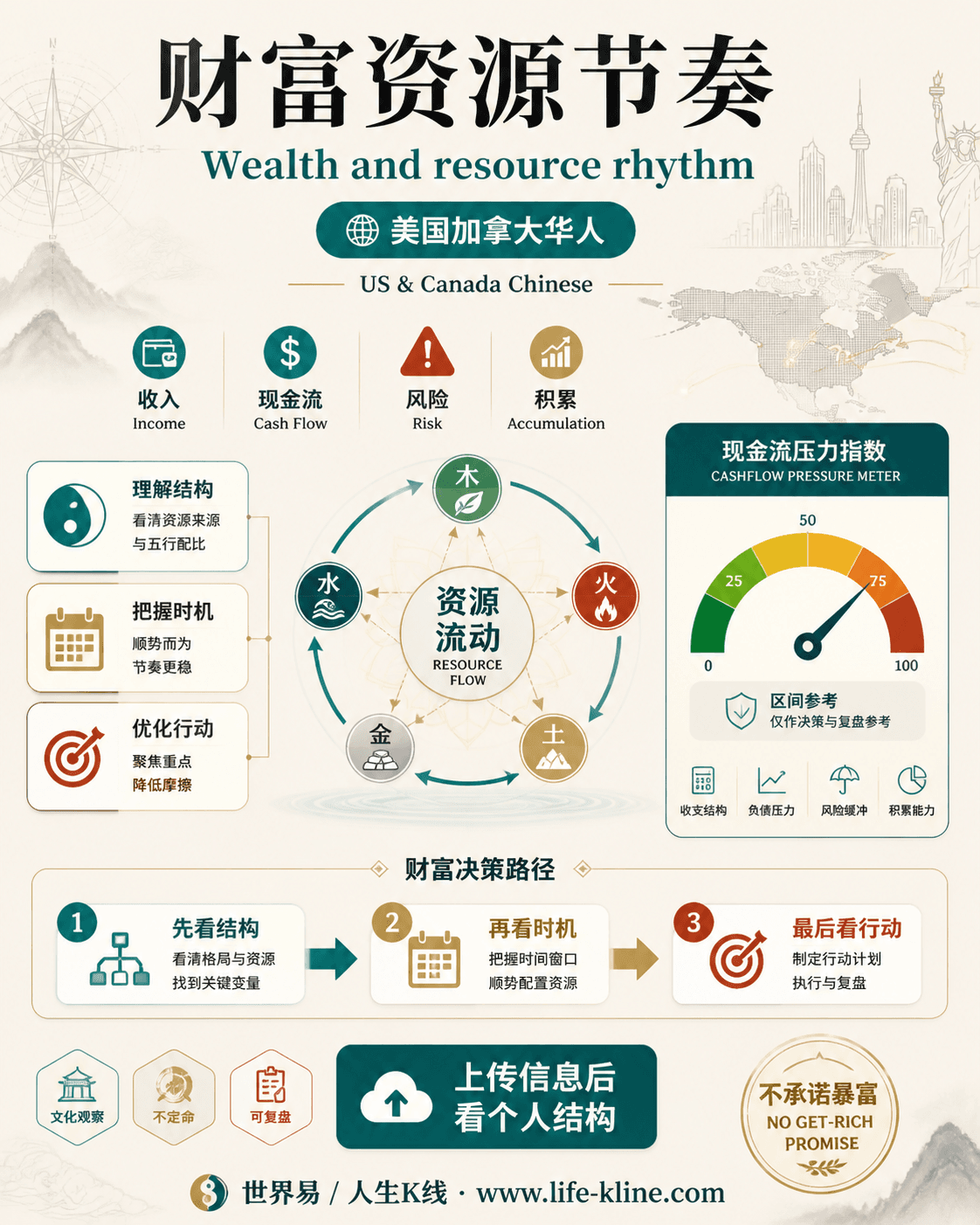
财富资源节奏|美国加拿大华人
这张图把《Metaphysical Financial Decision Analysis for the Optimal Time Window of Family Inheritance》里的命理概念转成关系、边界和应用场景,适合先看图建立结构,再回到知识文章正文理解细节。
财富资源节奏不应被写成固定结论。更适合美国加拿大华人的读法,是把传统术语翻译成结构、时机、环境、行动和复盘。
查看图片解读